How this Fast DietLifestyle works: Eat these meals tomorrow, for a calorie total of less than 600. On another day this week, eat the meals from a different post, another day of eating 600 calories or less. Eat sensibly the other days of the week. That’s it. Simple way to lose weight and be healthier.
You know how I like to talk about traveling/vacationing and still following the Fasting Lifestyle? Well, I’m going to do it again. We went to Brittany, France last May: partly because it is a wonderful place to visit and partly because some of my mother’s ancestors are from there. I had visited 50 years ago [literally: in 1969] on a student tour and had wanted to return. So we did. We rented a self-catering cottage in the region whence came my ancestors and we had a wonderful time. We hiked, we bird-watched, we drove to lovely and interesting places, we purchased food in local farmer’s markets, and we visited local restaurants. We also ate galettes and crepes and washed them down with cidre, naturallement. Our cottage was in the tiny hamlet of Kergeral near the sea. It was delightful.
It is not difficult to stay on a Fast Diet while traveling. You need to be mindful and to make the right choices. Deprivation is not necessary, as you can see from sample meals below. Upon return, my weight was still below my Target. Hooray!
The last breakfast at our cottage, we had some food left over — eat it or toss it? This ‘breakfast bread pudding’ contained bread cubes, egg, cooked fish, cooked vegetables, and a topping of cheese. Delicious and under 300 calories!We drove to Carnac to see the Standing Stones and to eat oysters. Here are the oysters, as served at Huitres de Cochennec, enjoyed at one of their outdoor tables at water’s edge. Fabulous combination of location and food consumed. Oysters are a wonderful dinner choice for the Faster.
People who are new to Fasting often pose the questions: “Can I really eat ‘anything I want’ on a Slow Day?” and “What should I eat on Slow Days?” To answer those questions, I have decided to add some blog posts to show some of the foods we eat on what the world calls NFDs [non-fast days] but which, in our house, we call ‘Slow Days.’ This feature will appear sporadically.
While browsing the Web, I saw a reference to a Turkish dish made with lamb, spices and feta cheese. The concoction was called Gozleme [approximately pronounced as: guzz-leh’-mah] and I wanted to try it. The blog ‘wife ofaturkishlife‘ had just the thing.
1-1/4 c flour ½ tsp salt ¼ c water ¼ c plain yogurt
Mix flour + salt in large bowl. Combine yogurt/water and stir in until well-combined. Add a bit more water if too dry. On a floured surface, knead for ~3 mins, until smooth and elastic. Cover and let sit.
½ tsp Olive Oil 1 cup onion 1 clove garlic 4 oz ground lamb
Saute onion over medium heat 3-4 minutes until onion is soft. Add garlic and cook 1 minute more.Add lamb and cook while breaking up into chunks for ~5 minutes.
½ tsp coriander, ground 1 tsp tomato paste/puree ¼ tsp pepper + ¼ tsp salt ½ tsp paprika 1 tsp cumin, ground 3 oz spinach, fresh or frozen
Add tomato puree and spices. Add spinach. Cook and stir for a few minutes. Set aside to cool for a bit. Divide equally into 4 bowls.
¼ cup fresh mint 1 scallion ¼ cup parsley ¼ cup feta ½ medium-sized tomato
Divide these ingredients among 4 bowls so that each bowl has equal amounts. Divide the dough into 4 parts. Roll dough into 10-9” squares and spread ¼ cup of lamb mixture over each. Top with fresh ingredients. Fold over dough to form a triangle or rectangle. Moisten and crimp edges to seal.
Lemon wedges olives
Spray a large skillet/griddle with cooking spray. Cook Gozleme 3-4 minutes/side until golden brown and crisp. Cut each in half diagonally and serve with lemon wedges and olives.
This is half of the recipe on line and it made enough for Dear Husband and me to eat it twice. [He eats 1-1/2 pieces and I eat one half, which is filling.] This is a recipe that calls for a mis en place, just to keep you organized.
Here is a full serving — one Gozleme cut in half.The calories in this portion actually qualify it as a Fast Day meal! It suffices for me any day.
This is delicious and really quite simple to prepare. You don’t need to be experienced with bread-making, since the dough is not yeast-based. I will definitely make this again!
Dear Readers: What do you think of this ‘table-style’ format for ingredients and directions? To me, it is very clear and easy to follow, but I’d like to know your opinions.
How this Fast DietLifestyle works: Eat these meals tomorrow, for a calorie total of less than 600. On another day this week, eat the meals from a different post, another day of eating 600 calories or less. Eat sensibly the other days of the week. That’s it. Simple way to lose weight and be healthier.
On October 14, 1961, the musical “How to Succeed in Business Without Really Trying” had its debut. The show was a cynical look at the business world, where whom you know and naked ambition could carry you far. Some of its popular tunes included “I Believe In You” and “The Company Way“. The original role of the striving J. Pierrepont Finch was created by Robert Morse, then played in 2011 by Daniel Radcliffe. With music by Frank Loesser and a book by Abe Burrows, it was a sure-fire hit. The show was based on a satirical ‘how-to’ book written in the 1952 by Shepherd Mead who really did work his way up from the mail room to the vice-presidency of his company.
Today, I want to discuss how to succeed at Fasting or ‘the Fasting Lifestyle’ as we like to think of it. Why do we Fast? There are many benefits of intermittent [not everyday] fasting: lower blood pressure, lower cholesterol, lower blood sugar, and lower weight. Furthermore, there is a reduction of HGH [human growth hormone]. This means that your body has a chance to rest and repair — rather like a good night’s sleep but more significant. The decrease of calories for many hours [600 calories in 36 hours, which includes one Fast Day + sleep hours before and after] gives the body a real break from its usual revved-up pace. Do this twice a week, because two Fasts are better than one.
How do you begin the Fasting Lifestyle? Start by choosing your days. You might do ONE day per week and see how you like it — say, Monday. Look at some of the previous posts and decide what you will eat that day. Write on the calendar that you will Fast that day and what you will eat — that makes it more of a commitment. Go shopping for the items necessary to prepare the breakfast and the dinner. If you keep it similar to what you usually eat, it might be a better transition.
Eggs scrambled with ham and served with applesauce will keep you going for hours.
Then do it. Weigh yourself before breakfast and write it down. Eat breakfast as late as you can and eat the second meal of the day about eight hours later. If you eat within an eight-hour window, you will maximize your weight loss. Weigh yourself the next morning to see how well it worked.
How do you STAY on the plan? I think that a key is to plan your meals ahead. Hide any foods that are of low nutritional value, so they won’t tempt you. Stick to eating protein-rich foods that will keep you full, such as eggs, lean meat, and fish high in Omega-3. Fill your plate with fruits and vegetables so your mind thinks you are eating a lot.
Tuna with Grilled Vegetables is a wonderful dinner.
Keep busy on Fast Days, so boredom doesn’t convince you that you are hungry. Keep your goals in mind. It is really rather easy to say ‘NO’ to empty calories on a Fast Day: one because you have your goals firmly in mind and because you could always eat it tomorrow. This is only two days a week, my Friends. You can do it. I believe in you.
People who are new to the Fasting Lifestyle often pose the questions: “Can I really eat ‘anything I want’ on a Slow Day?” and “What should I eat on Slow Days?” To answer those questions, I have decided to add some blog posts to show some of the foods we eat on what the world calls NFDs [non-fast days] but which, in our house, we call ‘Slow Days.’ This feature will appear sporadically.
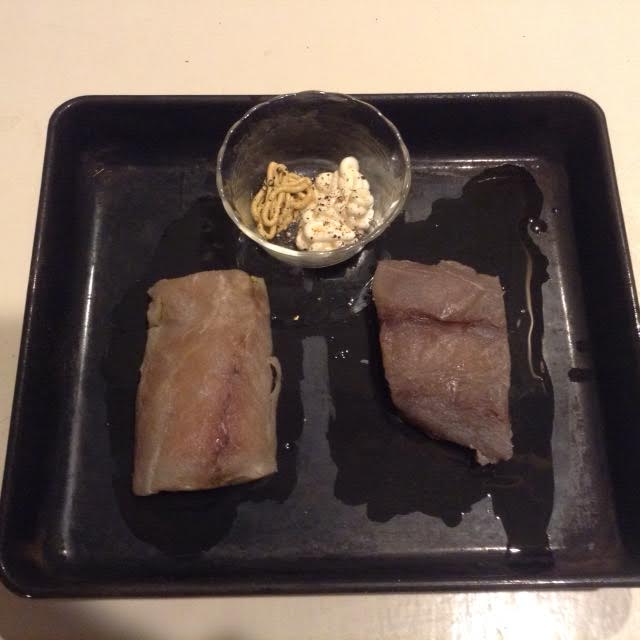
Dear Husband grew up fishing for and eating Bluefish. It is a migratory fish off the East Coast of North America and they run in large, hungry schools. This is not to be confused with “Boston Bluefish” which is Pollock named after its betters. The genuine article is a dense, dark-fleshed fish with a fine taste. I enjoyed it once at Legal Seafoods in Boston, where it was baked with a very nice sauce. Rarely do we see it in markets, but when we do, we snap it up. When I tried to emulate the restaurant sauce, I do believe that I succeeded very well.
The topping mixture consists of mayonnaise and Dijon mustard with salt, pepper, and maybe a little lemon juice. Combine the topping and spread it evenly over 3-4 oz fillets of fish per person. Bake at 400F. for 12-15 minutes. Ordinarily I would cook fish for 10 minutes per inch of thickness of the fish. But Bluefish is denser, so it takes longer to cook.
People who are new to Fasting often pose the questions: “Can I really eat ‘anything I want’ on a Slow Day?” and “What should I eat on Slow Days?” To answer those questions, I have decided to add some blog posts to show some of the foods we eat on what the world calls NFDs [non-fast days] but which, in our house, we call ‘Slow Days.’ This feature will appear sporadically.
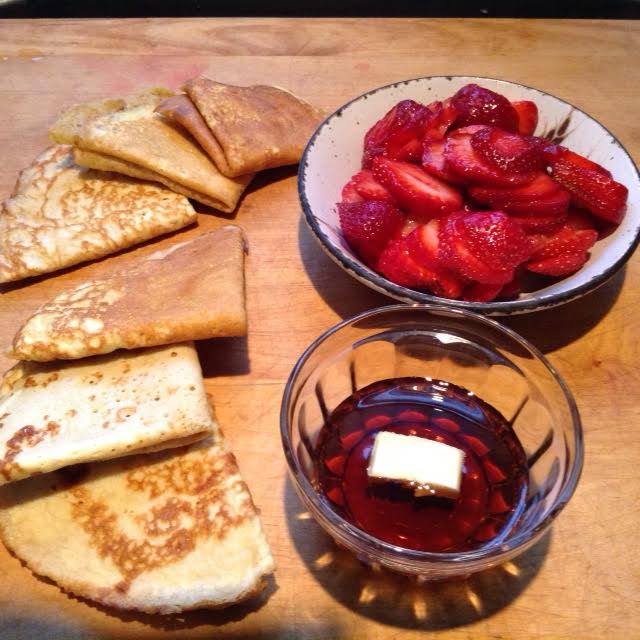
Sunday Breakfast is enshrined in our house as a special meal: a day for something out of the ordinary. Pancakes and waffles were popular in Dear Husband’s family, while yeast-raised cinnamon buns were my family’s favorite. Recently, a large supply of luscious strawberries gave rise to inspiration: crepes in a strawberry-maple syrup. The crepes were already prepared and in the freezer, which made it SO much easier. [You know how I always urge you to make things in bulk and freeze them for later? This is why! And crepes don’t take up a lot of room, even in a small freezer.]
In the foreground, you see 1/3 cup maple syrup with a teaspoon of butter.
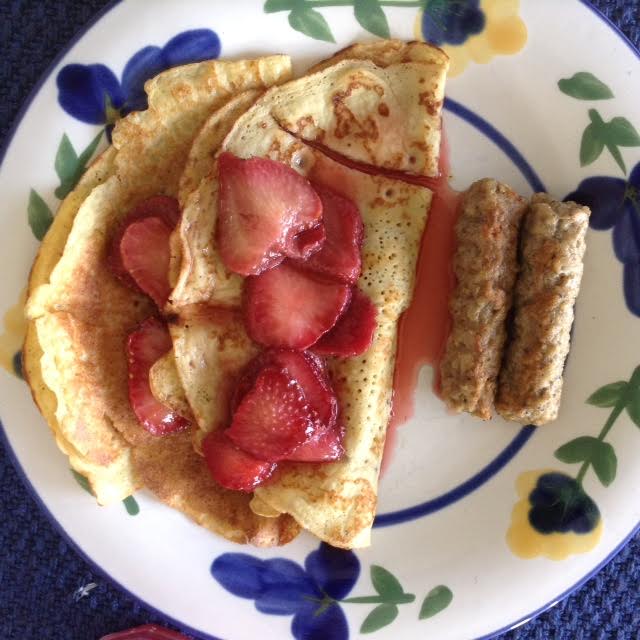
Six crepes [not the savory ones made with buckwheat flour, but the sweet ones that were made for the Strawberry Moon blog on 16-June-2019] were taken from the freezer and thawed in their plastic storage bag overnight. They were warmed on a griddle. The maple syrup was warmed with a little butter and the strawberries were put in briefly, so they didn’t cook down to mush. The syrup took on a wonderful color and flavor from the berries! Chicken sausages were cooked and plated. The crepes were put on the plate open, generously laced with syrup and berries, folded in half and doused with fruit and syrup again.
People who are new to Fasting often pose the questions: “Can I really eat ‘anything I want’ on a Slow Day?” and “What should I eat on Slow Days?” To answer those questions, I have decided to add some blog posts to show some of the foods we eat on what the world calls NFDs [non-fast days] but which, in our house, we call ‘Slow Days.’ This feature will appear sporadically.
Breakfasts at our house are a treat. True, cereal [hot or cold] is on the menu twice a week, but the other days see a succession of delightful baked goods or savory egg dishes. I like to bake and Dear Husband likes to get up early to prepare breakfast — our’s is a marriage made in heaven. Often, the night before, I will prepare something to be baked and then leave it on the counter to be finished and presented the next morning. This works for most yeasted recipes and definitely for ‘quick breads’ which are raised with ‘double acting’ baking powder. One such recipe is Lavender Scones.
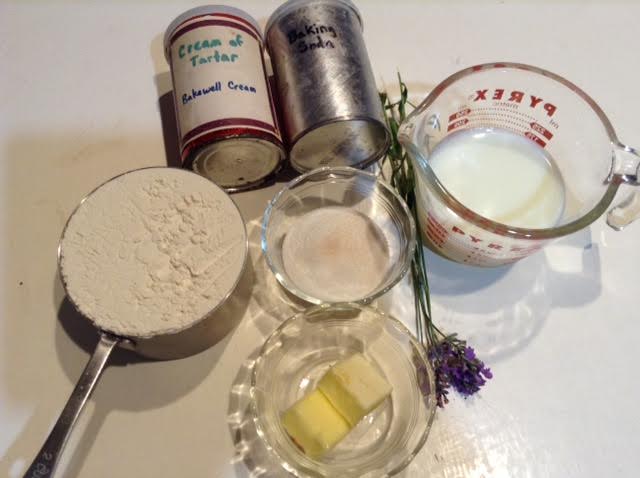
You’ll have to find your own recipe for scones — I’m sworn to secrecy about mine. The key is adding fresh lavender buds: 1-2 tsp of buds which have been picked off the stems.
That’s buttermilk, by the way, not plain milk. It makes the leavening act differently.
Since there are only 2 of us, all I need to bake are 4-5 scones for a breakfast. This requires 1 cup of the dry ingredients, even though the whole batch has been prepared. The remaining dry ingredients are stored in a jar for another day.
I’ll use 1 cup of the scone mix to serve 2 people with 2 scones each. The storage jar is labeled ‘buttermilk’ to remind me to use that. If you don’t have lavender, you could add dried black currants or zante currants or other dried fruit to the mixture.
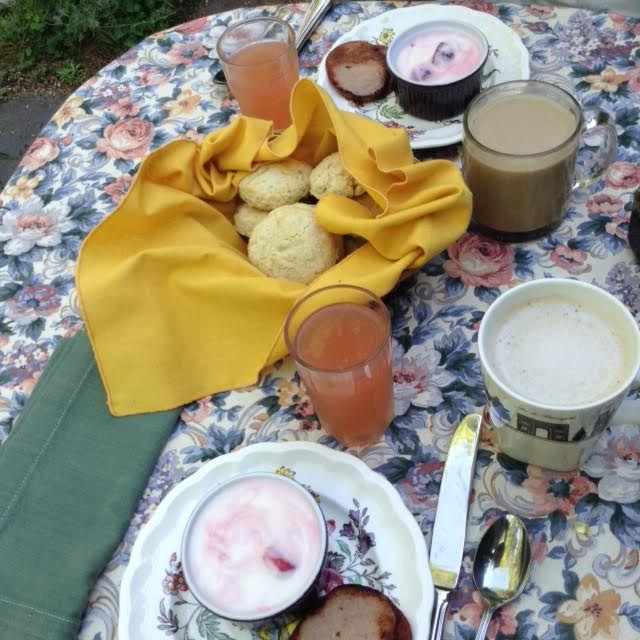
Here the table is set with the full meal: fruit yogurt [we add our own fruit to low-fat yogurt], Canadian bacon [back bacon to many of you], cafe au lait, rhubarb juice, and of course the Lavender Scones. A delightful Summer meal.
People who are new to Fasting often pose the questions: “Can I really eat ‘anything I want’ on a Slow Day?” and “What should I eat on Slow Days?” To answer those questions, I have decided to add some blog posts to show some of the foods we eat on what the world calls NFDs [non-fast days] but which, in our house, we call ‘Slow Days.’ This feature will appear sporadically.
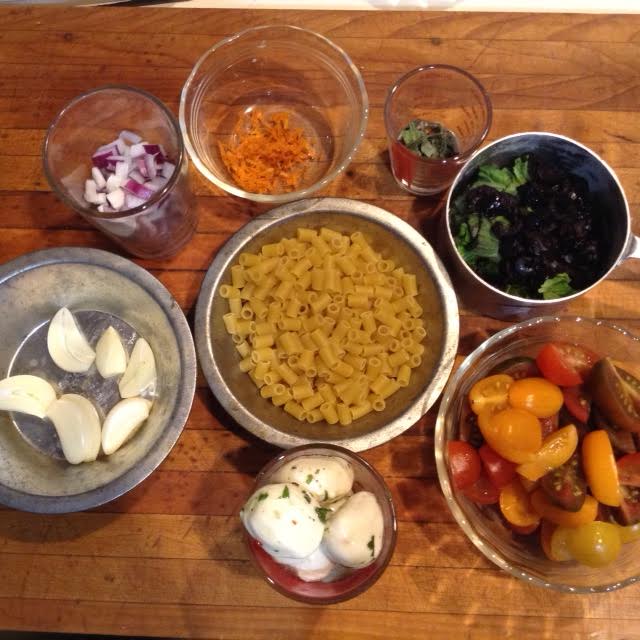
This recipe is from Lynne Rosetto Kasper’s book The Italian Country Table. She describes visiting the market in Siracusa, Sicily: the people she chats with and the ingredients that inspired this recipe. From them she makes a wondrous pasta dish. The following ingredients make enough for TWO [2] servings.
You will really need a mise en place for this preparation, so set it up now.
Sv 2
3 cloves Garlic, halved 2 tsp olive oil
Sauté until pale gold and take from pan.
¼ cup red onion, chopped
Saute over medium-high heat until transparant.
zest of orange and/or lemon
Add zest, cook 30 secs
1/4 c fresh oregano leaves/ 1 tsp. dried
Add oregano and cook 30 secs. Take off heat.
3 oz ditalini pasta
Cook pasta 5-6 mins until it is al dente. Reserve ½ cup of pasta water.
½ c. pasta water cooked garlic
Add pasta water and garlic to sauce pan and cook 30 secs.
Cooked pasta ½ cup basil 8 oil-cured olives
Roughly shred the basil. Roughly chop olives. Add these, tossing everything to coat it with flavors.
1 cup quartered cherry or Roma tomatoes
Put tomatoes in pan and adjust seasoning.
3 oz mozzarella balls basil leaves optional: clementine or orange sections
Plate with the cheese balls on top. Strew with basil leaves and citrus sections.
I added spinach leaves and clementine sections for even more color and bright flavor.
How this Fast Diet Lifestyle works: Eat these meals tomorrow, for a calorie total of less than 600. On another day this week, eat the meals from a different post, another day of eating 600 calories or less. Eat sensibly the other days of the week. That’s it. Simple way to lose weight and be healthier. Welcome to Organic Tree who is now Following.
We all like to go on vacation: to visit new places and have new experiences. It has been said that “Travel is broadening.” But that can be a problem — you go on a great trip and come back with several extra pounds. Often the reason given is that “when you stay in a hotel, you have to eat off the menu and therefore you can’t possibly continue to Fast.” I’m here to argue against that. Two years ago, I went on a hiking trip with our cousin and her son. The Hadrian’s Wall Path is 84 miles long. We started on the East end [Wallsend, Northumberland] and walked to the West end [Bowness-on-Solway, Cumbria]. And all along the way we stayed in a variety of places: from hotels to inns to holiday parks. The Wall and the Wall Path were truly amazing: a wonderful walk through beautiful countryside and pretty villages. We hiked 8 days, ranging from 5 to 19 miles per day. Can you Fast while on vacation? Yes. Can you Fast and still go hiking? Yes. It was great. The trip covered two Fast Days and here are some of my breakfast choices for the week:
A two-egg omelette ordered off the menu with a side of mushrooms and a cup of coffee was just what I needed at the Benkinsopp Castle Inn in Brampton.
In East Wallhouses, at the Robin Hood Inn, scrambled eggs on toast became the perfect start to a day on the Path. This is similar to a meal we would have at home a Fast Day. [The extra pieces of toast were not eaten.]
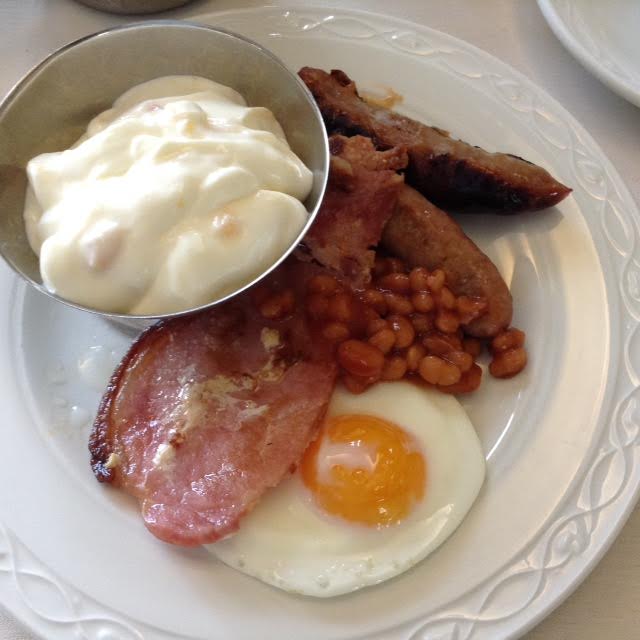
Of course at some point in England one will be served the Full English Breakfast, as we were at the Gilsland Spa Hotel in Brampton. This can be a temptation for a real pig-out, but I opted for lots of protein and some fruit yogurt.
People who are new to Fasting often pose the questions: “Can I really eat ‘anything I want’ on a Slow Day?” and “What should I eat on Slow Days?” To answer those questions, I have decided to add some blog posts to show some of the foods we eat on what the world calls NFDs [non-fast days] but which, in our house, we call ‘Slow Days.’ This feature will appear sporadically.
Our FirstBorn and his wife love to travel. On a trip to Firenze, Italy, in addition to the art and history, they discovered a panini shop and this sandwich. They prepared it for us when we visited them and gifted us with the ingredients at Christmas. How splendid to have generous, creative offspring! The bread is a ‘no knead’ Focaccia, recipe perfected by FirstBorn, which is really easy to bake — although it needs an 8-12 hour rising time, which takes some planning ahead. Surely you could buy some bread locally. My batch produced 4 round loaves, 8″ in diameter, each weighing 6-7 oz.
The ingredients to serving two are simple: 1 loaf focaccia bread, 2 Tbsp creamy white cheese [Stracchino or crème fraiche or whipped cream cheese or Philadelphia brand 1/3 fat Cream Cheese [‘Neufchatel’], 2 Tbsp truffle cream [combination of mushrooms, oil, truffles], 1 oz uncured capicola ham, and 1.5 cups arugula or ‘spring mix’ greens. To assemble, cut the loaf around the equator into two equal rounds. Spread the soft cheese on the bottom round, then spread on the truffle cream. Arrange the ham evenly on top, then heap on the greens. Sprinkle with a good finishing salt and top with the other piece of the loaf. This serves two very nicely, or three if you had more sides than the cherry tomatoes.
People who are new to Fasting often pose the questions: “Can I really eat ‘anything I want’ on a Slow Day?” and “What should I eat on Slow Days?” To answer those questions, I have decided to add some blog posts to show some of the foods we eat on what the world calls NFDs [non-fast days] but which, in our house, we call ‘Slow Days.’ This feature will appear sporadically.
Every Saturday night, we eat pizza for dinner. These are home-made, personal-size [8″ diameter] pizzas. The toppings can be simple or extravagant; elegantly crafted or clear-out-the-‘fridge. But on the night before Easter Sunday, somehow the idea of kicking back with a fun and fabulous pizza seems a little out of line. Some research turned up a pizza made with a cheese from Apulia [aka Puglia]. Far from the glittering lights of the big cities and the tourist haunts, Apulia has had its share of hard times. This pizza is austere and yet delicious.
The ingredients are few: one 8″ pizza crust per person, olive oil to brush on the crust, Italian herb blend to scatter on the oil, 1/2 cup of grated scamorza [smoked mozzarella] for each pie, and 1/4 cup grated Parmesan cheese for each pie. Here is a new twist for sharing bread and wine with loved ones or friends. Optional:11 halved cherry/grape tomatoes per pie. Served with a salad and a glass of wine, it is suitable to the day. In another context, it would make a great appetizer.






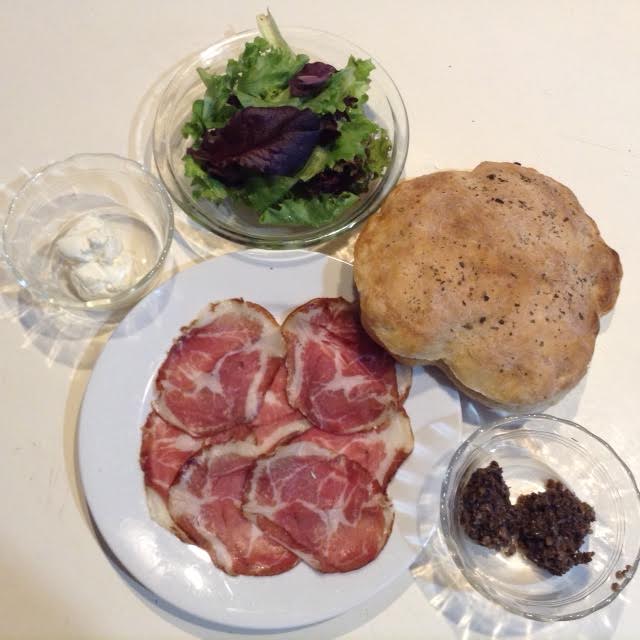 To assemble, cut the loaf around the equator into two equal rounds. Spread the soft cheese on the bottom round, then spread on the truffle cream. Arrange the ham evenly on top, then heap on the greens. Sprinkle with a good finishing salt and top with the other piece of the loaf.
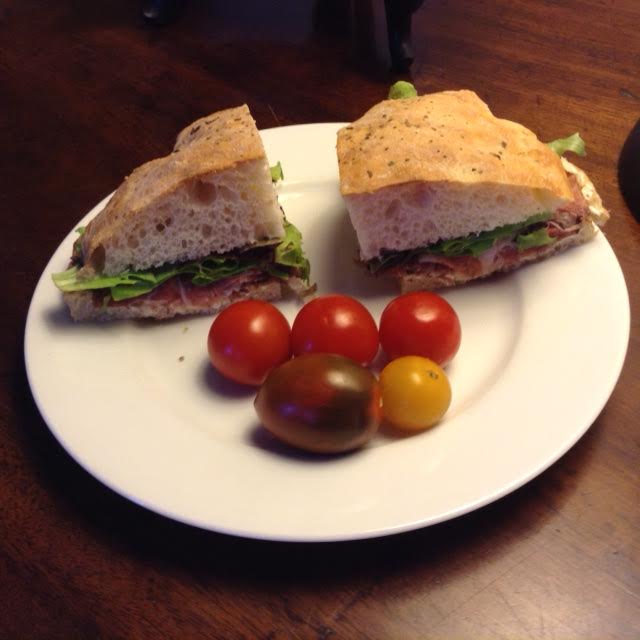 This serves two very nicely, or three if you had more sides than the cherry tomatoes.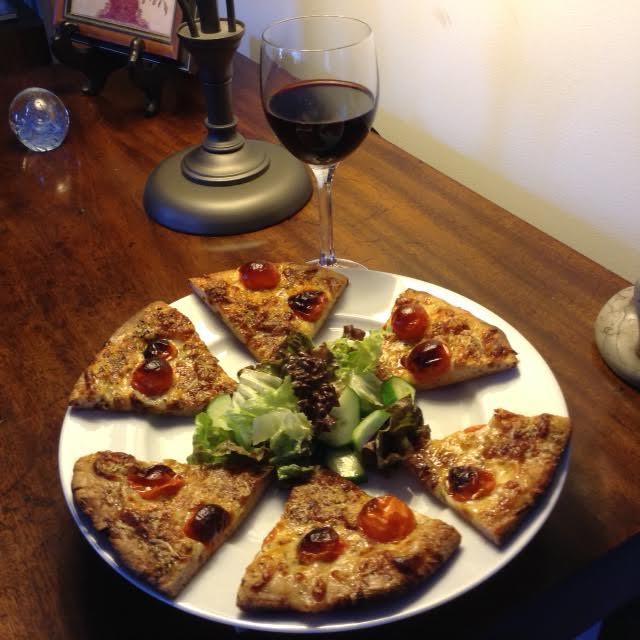
 Eating well, with creative recipes, to follow the Fasting Lifestyle according to Michael Mosley's "Fast Diet."