Slow Days: Lammas Bread

People who are new to Fasting often pose the questions: “Can I really eat ‘anything I want’ on a Slow Day?” and “What should I eat on Slow Days?” To answer those questions, I have decided to add some blog posts to show some of the foods we eat on what the world calls NFDs [non-fast days] but which, in our house, we call ‘Slow Days.’ This feature will appear sporadically. 

Now for the answers. Can you really eat ANYTHING you want on a Slow Day? Not really. If you eat too many calories every Slow Day, you will not lose weight. There are many questions asked on the FastDiet Forum which attest to that. Once in a while you can splurge, as long as it isn’t everyday. For what to eat on Slow Days, Dr. Mosley recommends a Mediterranean Diet. As for how we eat, an example follows.

One of the most popular topics on which I have blogged is that of Lammas. Maybe it is a love of all things Celtic. Maybe it is a yearning for simpler times. Maybe it is a renewal of interest in growing and producing one’s own food. The festival was called Lughnasagh in Ireland; Lunastain, in Scotland; and became Lammas [Loaf Mass] after the missionaries Christianized it. As a harvest festival, it was observed on the mid-Summer cross-quarter day around August 2 — usually August 1, 2,3. At that time the cereal crops* [wheat, rye, barley, oats] were being harvested. Flour was quickly ground from the grain, baked into loaves to be savored by the entire farm family while giving thanks for a successful harvest and offering prayers for future crops. Bread, therefore, is the recipe of the day. *Note: in the UK, cereal crops are all called ‘corn.’ This is confusing to Americans, to whom ‘corn’ is Zea mays for eating on the cob or for popping. When you follow the links, keep that in mind.

I’ve got two recipes for you: pick the one that suits your baking style and what is in the pantry. 1] Here is a non-yeasted recipe, making something like a biscuit. This is probably the “real” bread for Lammas, since it is prepared quickly. Buttermilk Bread Charm for Lammas

3 mugs strong white flour +++ 1/2 tsp salt ++++ 1 tsp bicarbonate of sodaPlace the flour in a large bowl. Make a well in the centre. Sieve in the blended salt and soda
500 ml Buttermilk Pour in the buttermilk. Mix well with a wooden spoon or your hand until the dough feels springy.
Sprouted seeds – these represent regenerationMix in the sprouted seeds. If it feels too sloppy, just add a little more flour.
Turn it onto a board and cover with a fine dusting of flour. Pat it with your hands until you have a round shape. Take a sharp knife and score lightly into eight sections, one for each festival. Take time to focus on the bread you have created. Turn the loaf three times saying “From the fields and through the stones, into fire, Lammas Bread, as the Wheel turns may all be fed. Goddess Bless.”
Place on a greased baking tray and pop it into a moderate oven for 20-25 minutes. Keep an eye on it. When the bread is ready, it will change colour and will sound hollow when you tap the bottom.
Cool completely on a wire rack. When it is cool, tie it with Lammas ribbon in your choice of colour – gold, orange, yellow

2] Sour Dough Fruited Summer Bread: The one I’ll make this year is based on a sourdough, in keeping with all of those who are attempting that during the current lock-down. This bread is easy to make. [Original recipe from Paul Hollywood] With the addition of Summer fruits and whole wheat, it seems fit for a festival.

All the ingredients, ready to mix.
64 g bread flour +++++ 64 g white whole wheat flour ++++++ 125 g active sourdough starter +++++ 3.8 g salt ++++++ 65-88 ml water ++++ 2 tsp honeyCombine dry ingredients in a large bowl. Add the honey to the water. Pour it in a little bit at a time and mix with your hands to make a soft dough. You may not need all the water. If you have extra water, add it to the next step.
½ cup chopped dried apricots ++++ ½ cup dried cherriesPut the fruits in a small bowl and cover with boiling water. Let sit for 15 minutes, then drain, reserving the water. Add to the dough.
Coat work surface w/ olive oil + knead the fruit into the dough on the oiled surface for 10-15 mins or until the dough is smooth + elastic and the fruit is well-incorporated.
Put in lightly-oiled bowl + cover w/ film. Rise in warm place 5 hr or overnight in a cool place
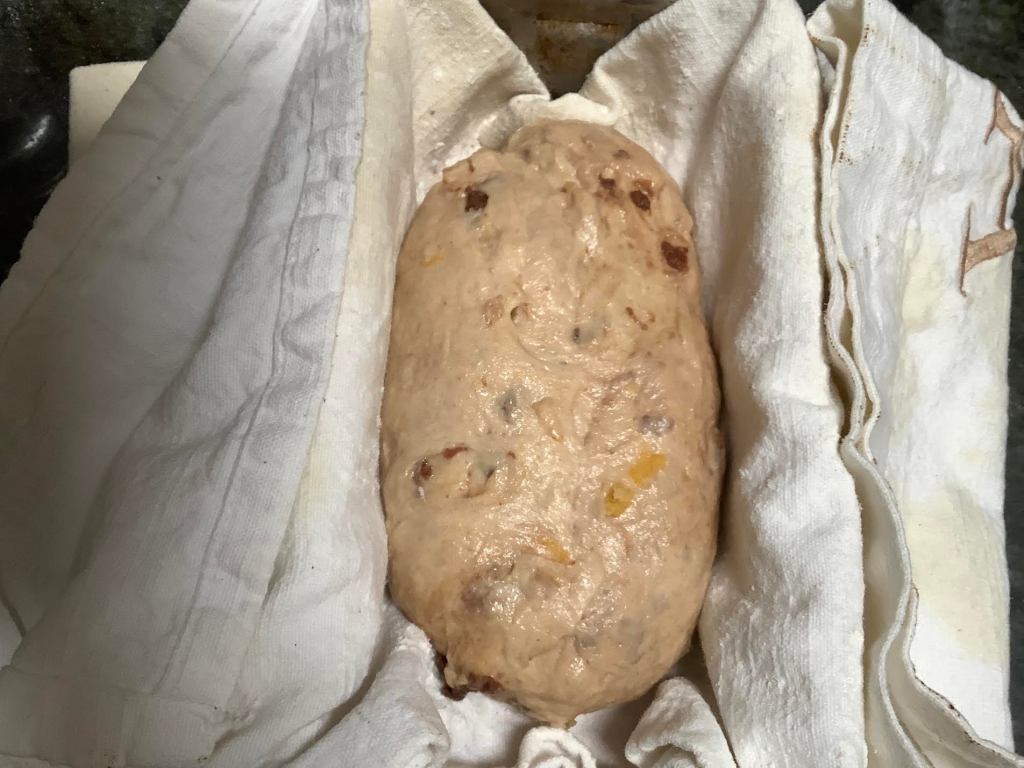
Knead dough until smooth, knocking the air out. Shape into an oval. Let rise on a well-floured towel [a couche], up-side down, in a loaf pan for 4-8 hrs or overnight in a cool place.
Bread is rising on a floured towel in a small loaf pan to help it to keep its shape.
Reserved soaking water +++ 2 tsp honeyPut in a small pan and simmer while adding the honey. Cook down until it is syrup-y, not runny.
Put a tray of water on the bottom of the oven. Preheat to 425F Gently tip the risen dough onto parchment paper on a baking tray. With a lame or sharp knife, score the top of the bread: down the center, then 3 on each side at an angle – sort of like a fern or the veins on a leaf. When you open the oven, add more water to the tray at the bottom of the oven to produce steam. Bake 30 mins at 425. Brush loaf with fruit syrup, then reduce oven to 400 F and bake 15 mins more.
The very dark syrup made the crust a rich mahogany color. Serve with comb honey.

Slow Days: Hake with Green Sauce

People who are new to Fasting often pose the questions: “Can I really eat ‘anything I want’ on a Slow Day?” and “What should I eat on Slow Days?” To answer those questions, I have decided to add some blog posts to show some of the foods we eat on what the world calls NFDs [non-fast days] but which, in our house, we call ‘Slow Days.’ This feature will appear sporadically. 

Now for the answers. Can you really eat ANYTHING you want on a Slow Day? Not really. If you eat too many calories every Slow Day, you will not lose weight. There are many questions asked on the FastDiet Forum which attest to that. Once in a while you can splurge, as long as it isn’t everyday. For what to eat on Slow Days, Dr. Mosley recommends a Mediterranean Diet. As for how we eat, an example follows.

In April, disappointed that our trip to France was canceled, we decided that if we couldn’t be in Gascony, we could eat as if we were in Gascony. After scouring our cookbooks, we chose recipes for dinner, and sometime breakfast, that would be typical of where we would have been on a particular date. Thus we “dined out” in the restaurants of our imaginations. One of the earliest meals was named Hake in Green Sauce. There is no sauce. “Green Sauce” is a centuries-old term for vegetables served on or with the protein of the meal. In Spanish, the term is ‘salsa verde,’ which we today think of as a mild-hot condiment in a jar. The recipe, called “Merluza, Salsa Verde,” is found in Anne Willan’s French Regional Cooking.

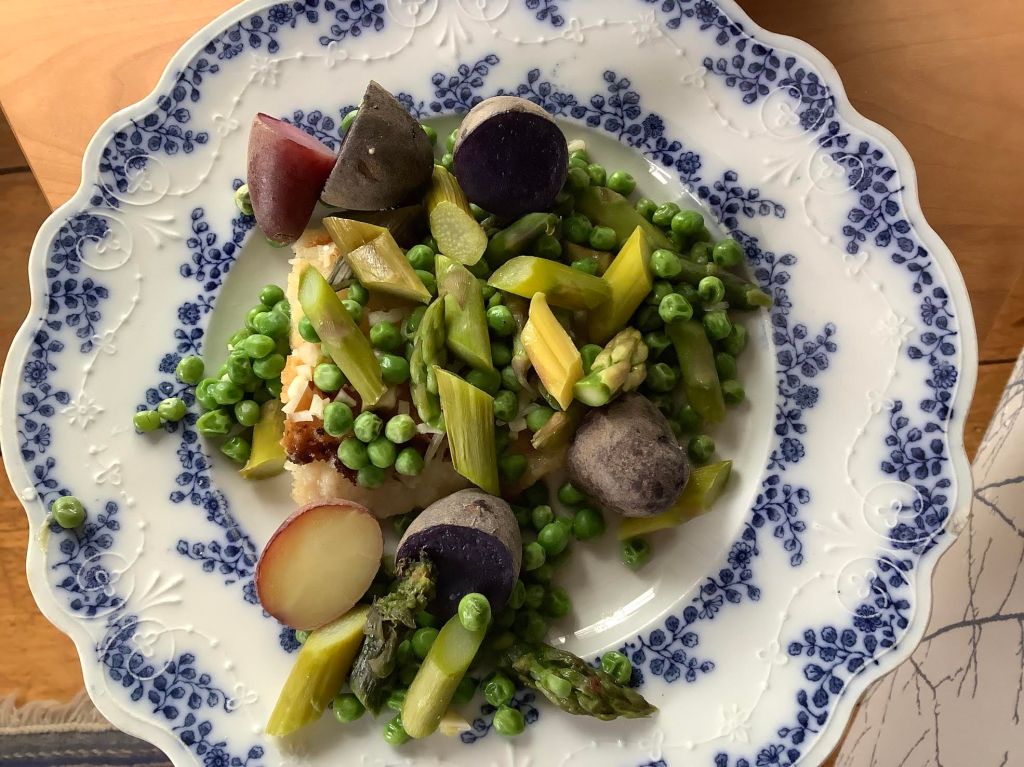
The ingredients you see pictured are enough for two people.

Hake, new potatoes [our’s were multi-colored], garlic, oil, crushed red pepper, peas and asparagus comprise the ingredients. The potatoes are simmered in boiling water for 15 minutes, then drained. The peas are cooked until just tender, then shocked in cold water and drained. Same for the asparagus. The hake is seasoned, then dredged lightly in flour. Brown the hake in an oil-coated pan until lightly brown on both sides, but not cooked through. Arrange the dish in an oven-safe dish [I used the tart pan you see in the above photo] and sprinkle with the hot pepper flakes and chopped garlic. Put the potatoes around the edges of the fish, then put the vegetables on top. Sprinkle with parsley, salt, and pepper. Pour 1/4 cup water into the dish, cover it, and bake at 375F/190C for 15-20 minutes, when the fish will be tender.

This is really good — I ate the whole thing!

Slow Days: Sourdough Pancakes

People who are new to Fasting often pose the questions: “Can I really eat ‘anything I want’ on a Slow Day?” and “What should I eat on Slow Days?” To answer those questions, I have decided to add some blog posts to show some of the foods we eat on what the world calls NFDs [non-fast days] but which, in our house, we call ‘Slow Days.’ This feature will appear sporadically. 

Now for the answers. Can you really eat ANYTHING you want on a Slow Day? Not really. If you eat too many calories every Slow Day, you will not lose weight. There are many questions asked on the FastDiet Forum which attest to that. Once in a while your can splurge, as long as it isn’t everyday. For what to eat on Slow Days, Dr. Mosley recommends a Mediterranean Diet. As for how we eat, an example follows.

It is almost a joke now that during the Pandemic Lock-Down, people vowed that they would use the time to perfect the art of baking: specifically sourdough bread. It seemed to be the culinary equivalent of reading War and Peace — something to get around to when you had time. Early on, bread flour and yeast were GONE from supermarket shelves. New England’s flour-of-choice, King Arthur brand from Vermont, was not even available on-line. For those who have sourdough starter [don’t be a wimp — start your own starter!], be aware that there are many things to do with it, besides making bread. Recently, we made Sourdough Pancakes [click link for recipe] for Sunday Breakfast. A real treat and easy to do.

HINT: For two people, I cut the recipe in half. The night before, I combine the flours with the sugar, oil, buttermilk [substitute = soured milk], salt, and starter. This is left on the counter overnight to ripen.

The next morning, the batter is stirred. An egg and the baking soda are added in. The mixture needs to sit a few minutes while you heat the griddle, set the table, and make the coffee. By now the batter is foaming in the bowl.

This recipe resulted in 14 pancakes: enough for today’s breakfast, another meal later, and 2 for a snack with peanut butter and jelly.

Lightly butter the griddle and use a 1/4 cup measure to pour 3-4 Tablespoons of batter on the hot surface. Continue until there is no more space on the pan. When the top of each pancake starts to develop ‘eyes’ [little holes], it is time to flip them to the other side.

Served with maple syrup [our own, I’m happy to say] and sausages — what a treat! The breakfast is completed by the berry-yogurt smoothie and mocha cafe au lait which we enjoy every morning. Great start to a great day. A lot easier than making bread.

Slow Days: Bruschetta

People who are new to Fasting often pose the questions: “Can I really eat ‘anything I want’ on a Slow Day?” and “What should I eat on Slow Days?” To answer those questions, I have decided to add some blog posts to show some of the foods we eat on what the world calls NFDs [non-fast days] but which, in our house, we call ‘Slow Days.’ This feature will appear sporadically. 

Now for the answers. Can you really eat ANYTHING you want on a Slow Day? Not really. If you eat too many calories every Slow Day, you will not lose weight. There are many questions asked on the FastDiet Forum which attest to that. Once in a while your can splurge, as long as it isn’t everyday. For what to eat on Slow Days, Dr. Mosley recommends a Mediterranean Diet. As for how we eat, an example follows.

“Bruschetta” … what does that word mean to you? And how do you pronounce it? The cookbook Diary of a Tuscan Chef gave us a recipe for this concoction, which we ate happily for years — a tomato relish on bread. And we called it ‘bruce-SHET-ta.’ Had we turned the cookbook page, we would have had the real story. When olives are being pressed into oil, [a late-Fall, cool-weather activity] one of the workers will toast bread over a fire, rub it with garlic, and drizzle the new oil over it so everyone can have a snack and a taste of the crop. THAT is bruschetta!

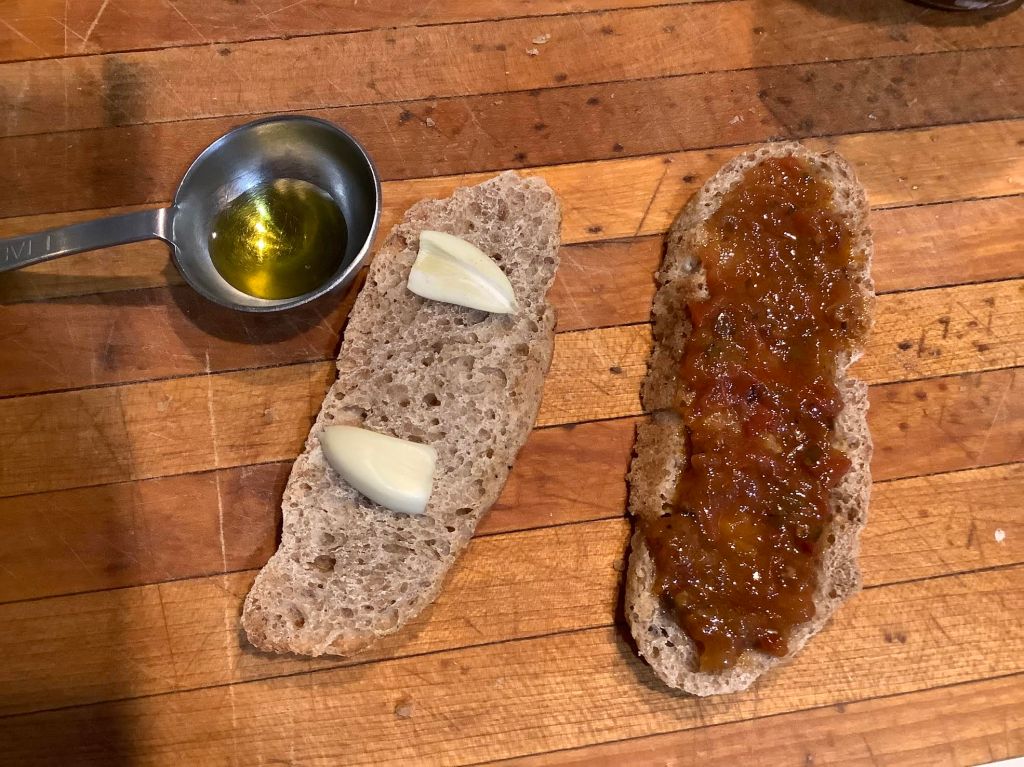
Bread, garlic, and olive oil = bruschetta

Of course, as the idea of ‘putting some food on toast’ moved around the world, something was lost in translation, including the pronunciation. When on tour in Italy, I asked the guide, a Roman, how to pronounce this culinary creation. Chuckling, he said that Americans always ask that and for the longest time he had no idea what they meant by ‘bruce-shet-ta.’ The correct way to say it? ‘bruce-KAY-ta’ The aforementioned Tuscan Chef, Cesare Casella, writes: “Americans seem to think bruschetta is chopped tomatoes, garlic, basil, and olive oil on toast. I don’t know why. For us that is crostini con pomodoro.” He concludes that there seems to be an “American craving for cubed tomatoes.”

On the right you see Cesare Casella’s ‘tomato relish’ on the bread.

When Older Son began baking, he sent us a recipe for his ‘no-knead focaccia’, which is great but makes more bread than Dear Husband and I can eat in a week. So Older Son prompted us to eat it as Bruschetta. I protested that there would be very little protein in that: just bread and tomato relish. Being wise, our son suggested additional toppings: herbed ricotta cheese, slices of chicken or turkey breast. Anchovies would be good. The recipe for the bread is below.

So that is the evolution of a meal that is perfect in Summer or any warm evening. Perhaps we should call it ‘Crostini’ but we don’t. We’re Americans, you see.

No-Knead Focaccia

one 10” loaf, four 6” loavesTwo 6” loaves or 6 bunsDutch oven or cast iron skillets
500 g bread flour or half bread flour, half white whole-wheat
375 g water
10 g salt
6 g yeast
250 g bread flour or half bread flour, half white whole-wheat
187 g water
5 g salt
3 g yeast
Combine ingredients until they form a shaggy ball.
Cover bowl and let rest 8-12 hours. Rising overnight works very well.
Olive oilOlive oilLeave dough whole or divide into smaller portions. Oil pans and add dough.
Let rise 1-2 hours.
Olive oil garlic, chopped
olives, chopped
herbs
Olive oil
garlic, chopped
olives, chopped
herbs
Brush dough with oil, then sprinkle with optional topping of your choice.
Bake at 450F 30-40 minutes, until golden brown. If baking smaller portions, shorten baking time.
1 of 8 servings = 64 calories

Slow Days: Lobster Rolls

People who are new to Fasting often pose the questions: “Can I really eat ‘anything I want’ on a Slow Day?” and “What should I eat on Slow Days?” To answer those questions, I have decided to add some blog posts to show some of the foods we eat on what the world calls NFDs [non-fast days] but which, in our house, we call ‘Slow Days.’ This feature will appear sporadically. 

Now for the answers. Can you really eat ANYTHING you want on a Slow Day? Not really. If you eat too many calories every Slow Day, you will not lose weight. There are many questions asked on the FastDiet Forum which attest to that. Once in a while you can splurge, as long as it isn’t everyday. For what to eat on Slow Days, Dr. Mosley recommends a Mediterranean Diet. As for how we eat, an example follows.

If times were normal, we might be at our vacation cottage right about now. Not to stay for a long time, but to see the place in late Spring, before the tourists descend. We used to go there during my school’s April Break: to open the cottage, move up some furniture, visit with local friends, and see what the Winter storms did to the beach. If we stayed into early May, then the ocean would be dotted with colorful buoys and small fishing boats — in other words: Lobster Season. Prince Edward Island has two very limited seasons, one for each of two different parts of the island. In full Summer, when we usually arrive, lobsters are still available. When Summer guests appear at out cottage, we treat them to a lobster feast. Afterward, the cephalo-thoraces [the front-middle part that everyone else throws away] are picked clean of the meat located in the ‘shoulder joints’: enough to make lobster rolls!! [Four thoraces produce enough meat for this meal of three rolls.]

1-1/2 cups of lobster meat, chopped celery and red onion, chiffonade of lettuce or spinach, mayonnaise, and celery seed make the filling. The rolls are ‘New England’ style hot-dog buns. That means they are sliced across the top, not along the side. Being New Englanders, we prefer those.

The buns are lightly toasted with butter on a griddle and served with fresh tomatoes or a light salad. If you want to know about the wine — we always serve ‘The Hermit Crab’ or a Viognier with lobster rolls — go to Dear Husband’s blog peterspicksblog.com.

Slow Days: Blueberry Muffins

People who are new to Fasting often pose the questions: “Can I really eat ‘anything I want’ on a Slow Day?” and “What should I eat on Slow Days?” To answer those questions, I have decided to add some blog posts to show some of the foods we eat on what the world calls NFDs [non-fast days] but which, in our house, we call ‘Slow Days.’ This feature will appear sporadically. 

Now for the answers.  Can you really eat ANYTHING you want on a Slow Day? Not really. If you eat too many calories every Slow Day, you will not lose weight. There are many questions asked on the FastDiet Forum which attest to that. Once in a while you can splurge, as long as it isn’t everyday. For what to eat on Slow Days, Dr. Mosley recommends a Mediterranean Diet. As for how we eat, an example follows.

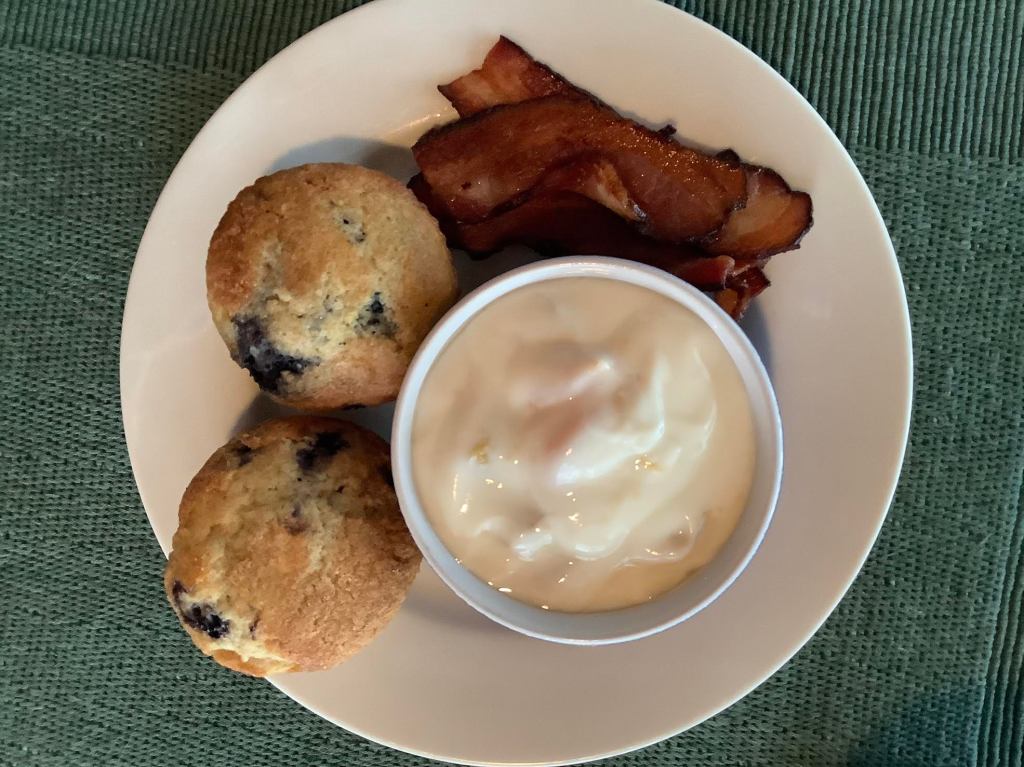
People get lyrical about muffins. On the other hand, James Beard had a dim view of them, saying “Muffins have been inordinately popular for years. I, for one, have never been able to understand why.” For a long time, I didn’t care for most blueberry muffins I ever had — they were either too much like biscuits or they were gigantic and super-sweet. Finally I found a recipe from Maine for a coffeecake with blueberries in it. Inspiration!! It struck me that this recipe would be perfect when baked as muffins. Many fine breakfasts have resulted from that recipe, and here it is:

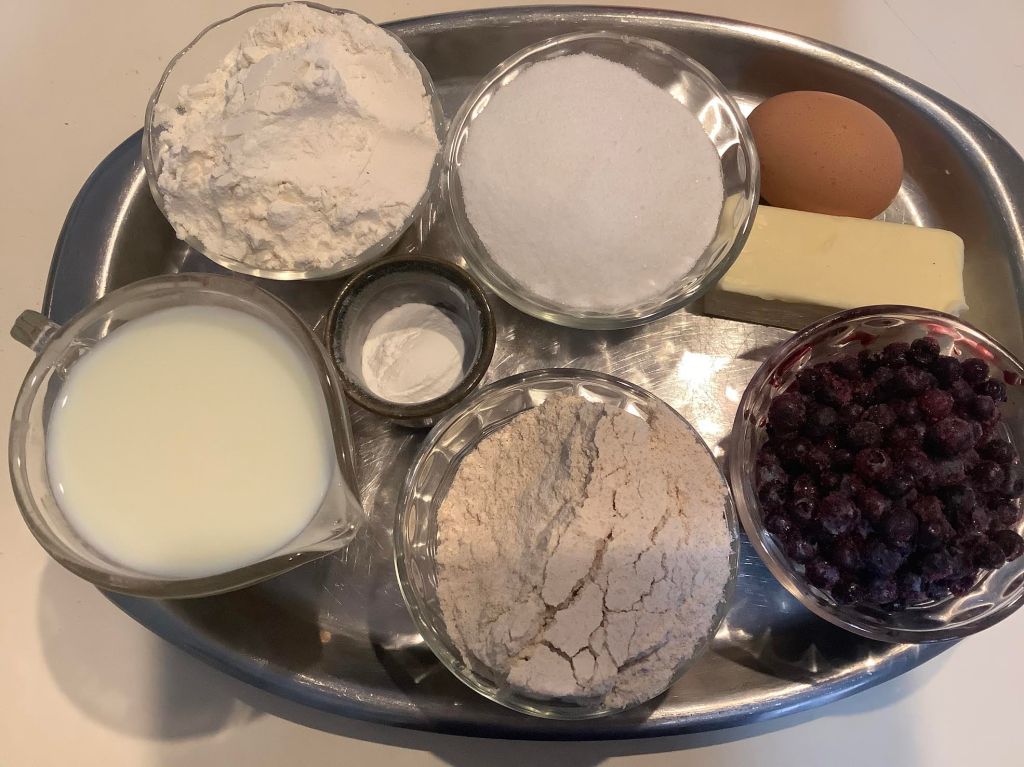
++1 cup unbleached flour++++ 1 cup white whole wheat flour++++ 3/4 cup sugar++++ 3 teaspoons baking powder++++ 1 teaspoon salt++++ 1/3 cup butter [fairly soft so it will mix]++++ 1 cup milk**++++ 1 egg++++ 1/4 teaspoon almond extract++++ 1 cup blueberries [fresh or frozen — frozen are better since they don’t mush up when stirred in which turns the batter a nasty grayish-blue]++ **You could use buttermilk or plain yogurt instead of milk, and then you would need to add 1 teaspoon of baking soda to the above ingredients.

Combine and mix all the ingredients except the blueberries. Lastly, gently stir in the berries. Put into muffin papers or greased muffin tins. NB: Do all this the night before and leave the pan on the counter, covered, ready to bake in the morning. Works perfectly. Bake at 350F for 15 minutes or so. How many muffins you’ll get depends on the size of the tins. When I use silicon cupcake forms [see right] and I get 13-15 muffins.

What isn’t eaten for breakfast is put into zipper-locking bags, as these freeze and reheat very nicely. Have a happy breakfast!

Slow Days: Breadcrumb Pasta

People who are new to Fasting often pose the questions: “Can I really eat ‘anything I want’ on a Slow Day?” and “What should I eat on Slow Days?” To answer those questions, I have decided to add some blog posts to show some of the foods we eat on what the world calls NFDs [non-fast days] but which, in our house, we call ‘Slow Days.’ This feature will appear sporadically. 

Now for the answers. Can you really eat ANYTHING you want on a Slow Day? Not really. If you eat too many calories every Slow Day, you will not lose weight. There are many questions asked on the FastDiet Forum which attest to that. Once in a while your can splurge, as long as it isn’t everyday. For what to eat on Slow Days, Dr. Mosley recommends a Mediterranean Diet. As for how we eat, an example follows.

For years we searched for the right foods to eat during Lent. We wanted foods that were connected to the meaning of the season; foods that were good to eat yet not so fancy that we seemed to be ‘living it up’; foods that had a nod to the traditional austerity typical of the 6-week period of religious contemplation. One of the thorny decisions concerned Ash Wednesday, the beginning of Lent, which is a solemn day after the giddiness of Carnival before it. At last we decided: a breadcrumb pasta from the Puglia Region of Italy. The idea of dressing your noodles with a sauce of breadcrumbs struck just the right note of culinary penance. No meat, no butter: this is the perfect choice to begin Lent.

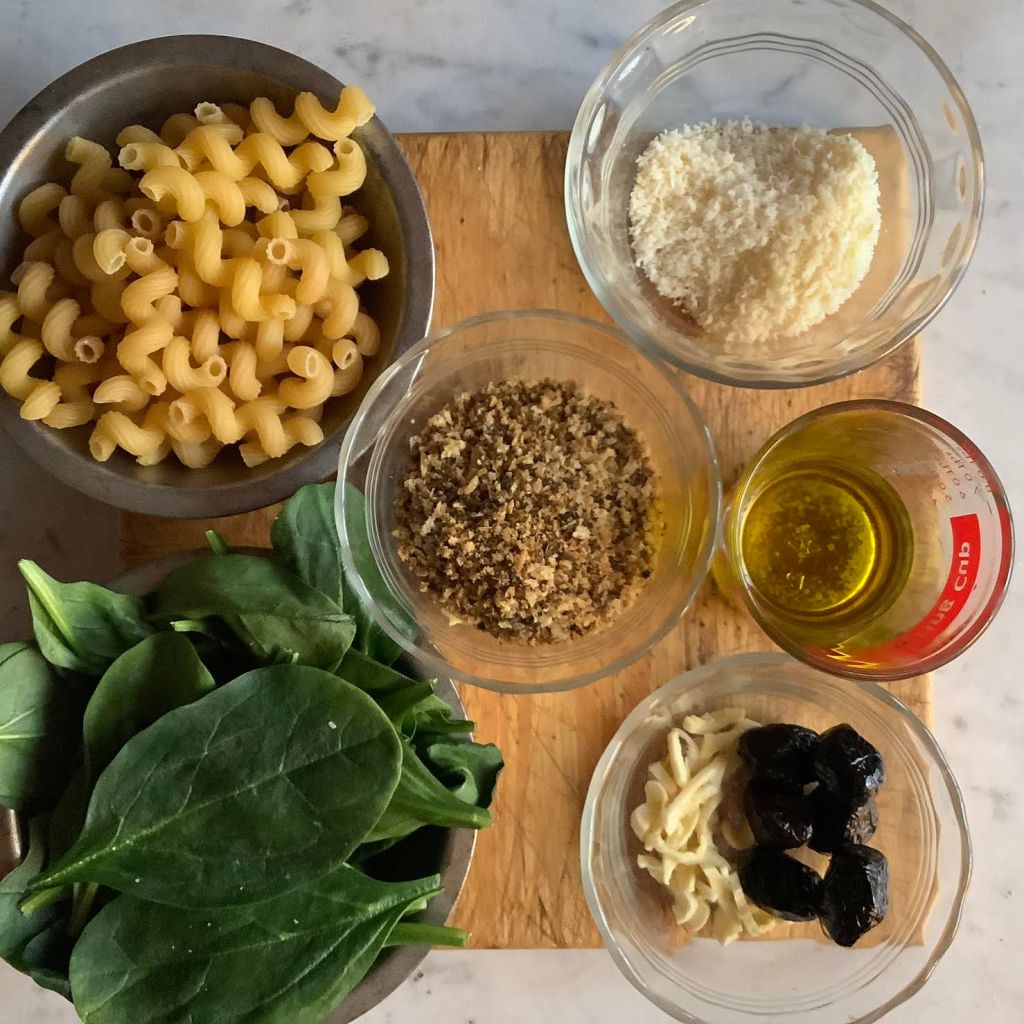
The ingredients are very simple: 3 oz pasta, 1/3 cup crumbs from day-old bread [we use whole grain for flavor and fiber], 2 Tbsp olive oil, 1 Tbsp sliced garlic, oregano, salt, 6 olives, 1 oz spinach leaves, grated pecorino cheese.

These ingredients are enough for two servings.

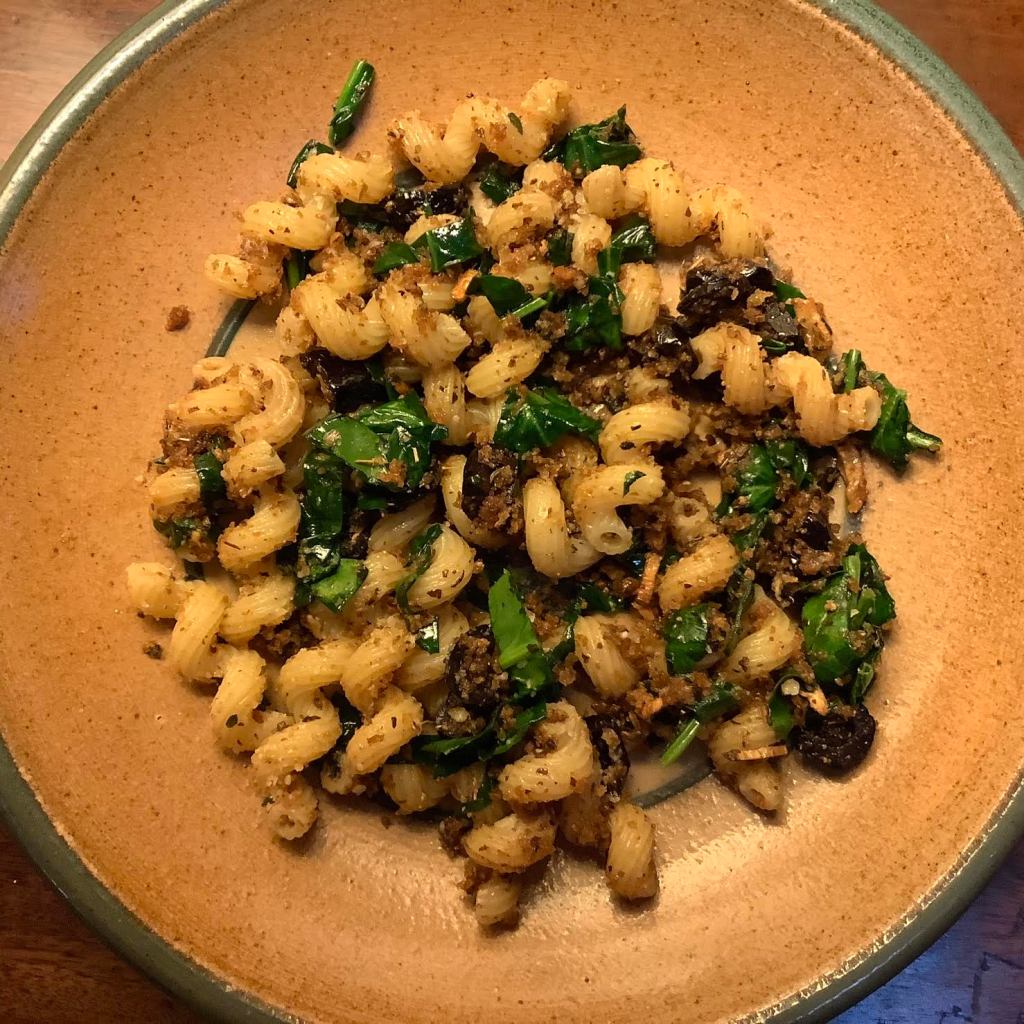
You will need a mise-en-place, this cools so quickly! Once you have prepared your mise-en-place, start cooking the pasta. Cook the pasta for about 4 minutes, then turn off the heat with the pasta still in the water. Stack the spinach leaves and cut them cross-wise [chiffonade]. Pit the olives and cut each into four pieces. Heat a cast iron skillet at medium heat and pour in the oil. When the oil is hot, add the garlic and briefly cook it until pale yet fragrant. Add the crumbs and stir into the oil. Add the oregano and take off the heat. Stir. Turn down the heat, then put the pan back on it. Cook, stirring until the crumbs are crispy. Take off heat again and stir in the olives. By now the pasta is ready. Using a slotted spoon, remove it from the water and put it in the pan with the crumbs. The trick is to incorporate a little of the noodle-water into the dish. Stir to mix. Add two pinches of salt and the sliced spinach. Toss it all together, then add the grated cheese. Plate. This took such a short amount of time that I barely called out a pre-dinner alert, than it was time to plate up.

Such an unusual combination of flavors and textures!

This is not a meal for a low-carb menu. But then, this is a Slow Day, so we don’t need to count calories. We eat this one time each year and we enjoy it.

Slow Day: Grilled Vegetable Pasta

People who are new to Fasting often pose the questions: “Can I really eat ‘anything I want’ on a Slow Day?” and “What should I eat on Slow Days?” To answer those questions, I have decided to add some blog posts to show some of the foods we eat on what the world calls NFDs [non-fast days] but which, in our house, we call ‘Slow Days.’ This feature will appear sporadically. 

Now for the answers. Can you really eat ANYTHING you want on a Slow Day? Not really. If you eat too many calories every Slow Day, you will not lose weight. There are many questions asked on the FastDiet Forum which attest to that. Once in a while your can splurge, as long as it isn’t everyday. For what to eat on Slow Days, Dr. Mosley recommends a Mediterranean Diet. As for how we eat, an example follows.

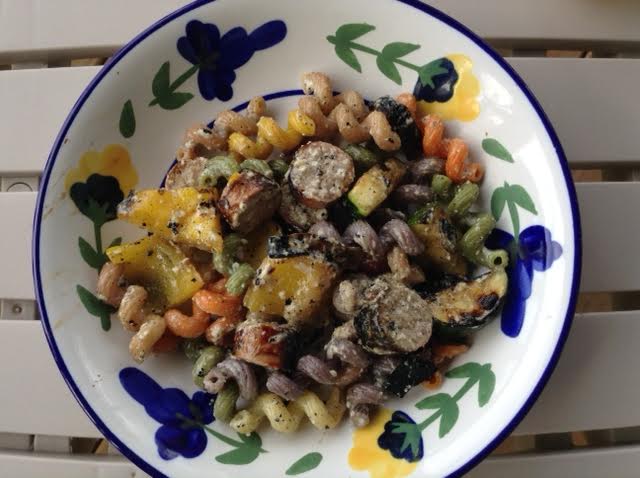
Sometimes, there is a crowd to feed and that’s when we turn to one of our stand-by meals: Grilled Vegetable Pasta with Sausage. The vegetables include: zucchini/summer squash, yellow or orange sweet peppers, red onion, and or other colorful fresh items of the same texture. Choose any pasta you wish — 2 ounces by weight per person. Bratwurst or Italian sausage will do just fine. Make 1-1/2 cups of your favorite white sauce and add 1/2 cup of grated Parmesan cheese.

The colors of the vegetables are echoed in the colorful pasta.

The sausages are grilled, then sliced. The vegetables are sliced or cut into chunks, as you prefer. In a grill basket, toss and shake the vegetables over hot coals until softer and starting to blacken, then empty into a large bowl. While one person is doing the grilling, the other preparing the cheese sauce. SLOWLY, over low heat. [Sometimes (often), my sauce ‘breaks’ and becomes clotted. The solution is to whisk flour into the milk to bind the sauce back together.] Cook the pasta and combine everything in the bowl with the vegetables. Easy to prepare and always a hit.

Often, seconds helpings are the norm.

Slow Days: Tree-Decorating Dinner

People who are new to Fasting often pose the questions: “Can I really eat ‘anything I want’ on a Slow Day?” and “What should I eat on Slow Days?” To answer those questions, I have decided to add some blog posts to show some of the foods we eat on what the world calls NFDs [non-fast days] but which, in our house, we call ‘Slow Days.’ This feature will appear sporadically. 

Now for the answers. Can you really eat ANYTHING you want on a Slow Day? Not really. If you eat too many calories every Slow Day, you will not lose weight. There are many questions asked on the FastDiet Forum which attest to that. Once in a while your can splurge, as long as it isn’t everyday. For what to eat on Slow Days, Dr. Mosley recommends a Mediterranean Diet. As for how we eat, an example follows.

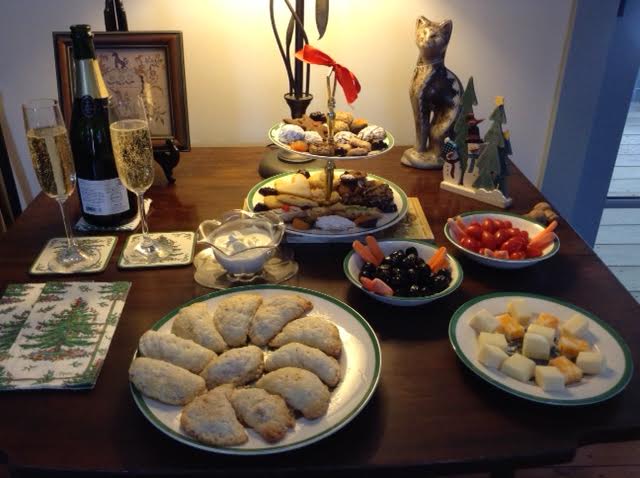
Here we are in early December with Christmas fast approaching — how can one fit everything in? Years ago we worked out a multi-tasking method for the day we trim the Christmas Tree, and it works so well that we still do it that way. We always decorate the tree on December 13. [Dear Husband grew up in a German family where the tree went up Christmas Eve and came down seven days later. He loves having the tree up longer. Me too.] Dinner consists of finger food which can be prepared ahead: salmon piroshki

, with cheeses, vegetables, and a dipping sauce [plain, fat-free yogurt + dill weed]. For dessert, the full array of our families’ cookies. And to add to the celebration, a glass of sparkling wine. The meal is for ‘grazing’ — nibble, hang an ornament, nibble, sip.

The salmon piroski are filled with cooked salmon mixed with enough Dijon mustard to make a moist pate. One tablespoon of the mixture is placed inside rounds of pie crust which are folded over and crimped, turn-over/empanada style. [Yes, I know this is very non-traditional, but that’s how Craig Claiborne made them.] Made a day ahead, they are kept cool until being baked at 400 F for 15 minutes. Each year we enjoy this very special little feast — and still get the tree decorated!

Slow Days: “French Lunch”

People who are new to Fasting often pose the questions: “Can I really eat ‘anything I want’ on a Slow Day?” and “What should I eat on Slow Days?” To answer those questions, I have decided to add some blog posts to show some of the foods we eat on what the world calls NFDs [non-fast days] but which, in our house, we call ‘Slow Days.’ This feature will appear sporadically. 

Now for the answers. Can you really eat ANYTHING you want on a Slow Day? Not really. If you eat too many calories every Slow Day, you will not lose weight. There are many questions asked on the FastDiet Forum which attest to that. Once in a while your can splurge, as long as it isn’t everyday. For what to eat on Slow Days, Dr. Mosley recommends a Mediterranean Diet. As for how we eat, an example follows.

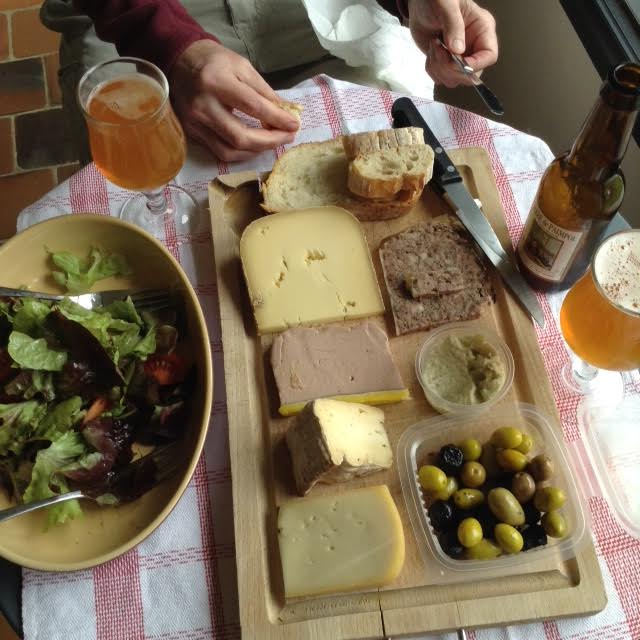
This is one of my favorite meals. Restaurants will call it a bread & cheese board or a charcuterie platter and we call it a ‘French Lunch.’ I don’t care what you call it — it is easy to prepare and it is good to eat. “Charcuterie” is the French word for the meats you don’t get from a butcher [boucher] — such as pates and sausages. Cheeses come from a ‘fromagier’ or sometimes from a ‘charcuterier.’ Then there is good bread — very important! We add fresh fruit, chutney, and/or mustard to the board. Pair that with a nice wine, settle down, and enjoy a very nice repast without having to cook/prepare anything.

Here we have two artisanal breads, some salad, a variety of cheeses, two jars of chutney, and four spreads: chorizo paste, chicken liver pate, salmon pate, and mushroom pate. [The pates store very well in the freezer if you don’t eat them all now.]
Here’s another version of the idea, with three cheeses, olives, a duck liver mousse, a country pate, and an artichoke spread — all served with a salad and lovely bread. Washed down with cidre from apples.