
How this Fast Diet Lifestyle works: Eat these meals tomorrow, for a calorie total of less than 600. On another day this week, eat the meals from a different post, another day of eating 600 calories or less. Eat sensibly the other days of the week. That’s it: a simple way to lose weight and be healthier. Join me in the Fasting Lifestyle.

George Stephenson was not supposed to become an engineer. He was not supposed to rise above his origins. But he did. George Stephenson was born in tiny Wylam, Northumberland, on June 9, 1781. His parents were illiterate, so George was destined to follow his father into the coal mines. Which he did — at age eight. But George was not cut out for a life of grinding drudgery. He had a good mind, and he liked to see how things worked. In his off hours, George taught himself to read and write. While in the mines, he observed the pumping and lifting machines and surely asked a lot of questions about them. His aptitude and quick intellect were noted, and over time Stephenson became a mining engineer. One of his strengths was seeing new applications for technology, and he saw a need for moving goods like coal from the mines to the shipping port of New Castle. There was a wagonway where carts riding on iron rails were pulled by oxen, hauling coal from the Wylam pit down the river to Newcastle. From the little white house where he grew up, Stephenson could see the slow parade of coal. In 1776, James Watt had perfected the steam engine, and it was used in mines to pump out water. In 1814, Stephenson built a steam-powered railroad engine — with several improvements over existing steam locomotives. In 1815, the ox-carts on the Wylam Wagonway were replaced by a railroad, as the use of trains took over the hauling of freight. George Stephenson is called the “Father of the Railroad”, and the title is well-deserved. His locomotives and the coal they carried fueled the Industrial Revolution and made Newcastle into an industrial giant of steel-making, ship-building, and coal exporting. The first passenger railroad was established in 1825 — the rest is history. All because little George Stephenson in Wylam looked out the window and thought of a better way to “Carry coals to Newcastle“.
Robin Hood Egg: 150 calories… 6 g fat… 1 g fiber… 15 g protein… 26 g carbs… 111 mg Calcium… NB: The food values given above are for the egg bake and fruit only, not the optional beverages. PB What this breakfast has to do with the legendary outlaw, I don’t know. At least no robbery is involved – you can keep your wallet and your waistline.

++ ½ multi-grain Sandwich Thin @ 60 calories ++++ one 2-oz egg ++++ 1 slice “Canadian bacon” [or 1 round = 1 oz = 20 calories slice of ham] ++++ 2 oz sliced tomato Optional: blackish coffee [53 calories] or blackish tea or mocha cafe au lait [65 calories] ++++ Optional: 5-6 oz fruit smoothie or berry-yogurt smoothie [88 calories] ++
Lightly toast the sandwich thin and plate it. Broil the tomato slice and lightly cook the Canadian bacon while you fry the egg in a pan lightly-spritzed with non-cook spray. Assemble the layers in your order of preference and pour the optional beverages. Tuck [not Friar Tuck] in with knife and fork.
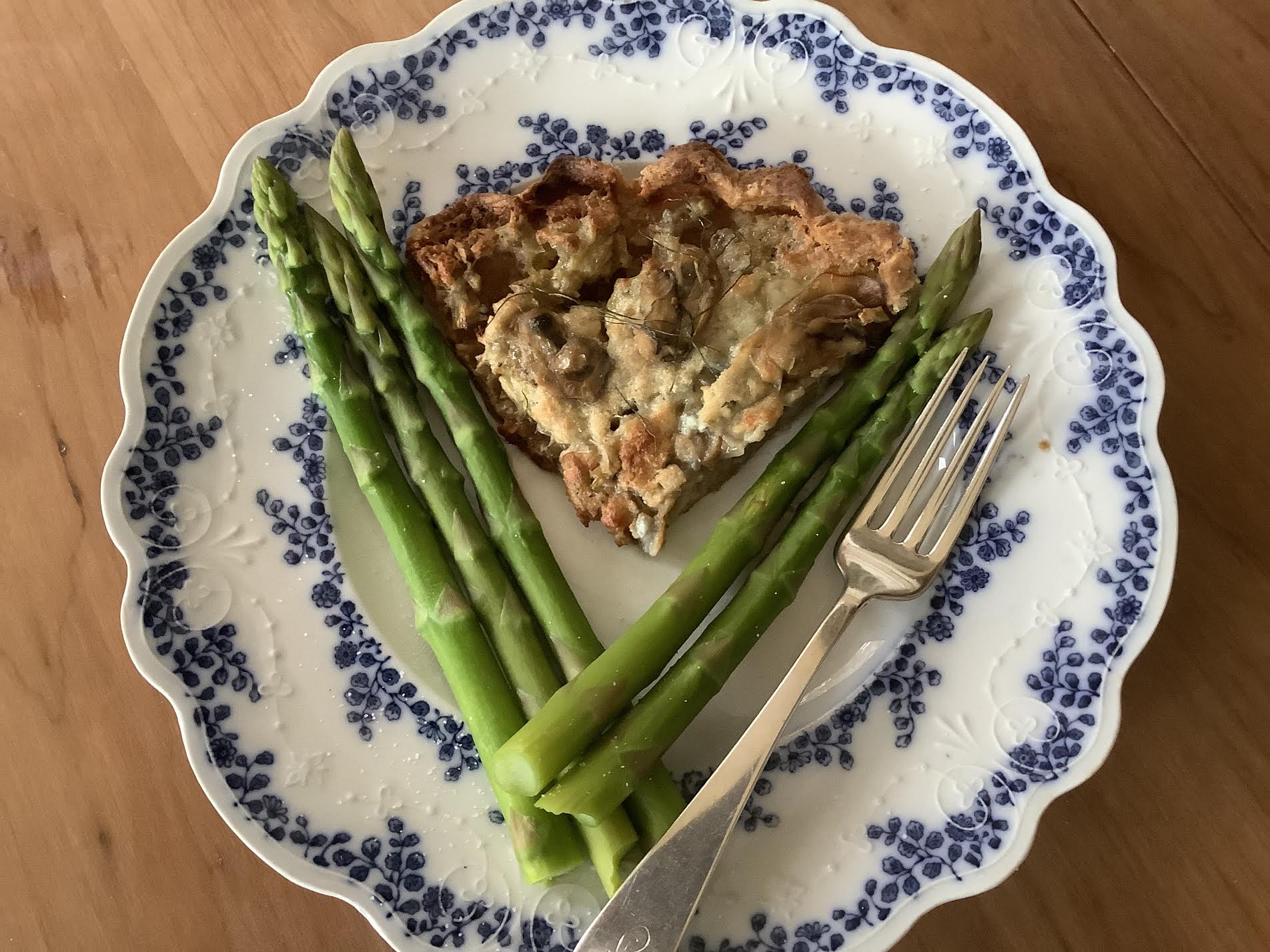
Bleu Cheese & Oyster Pie: pie filling only, 1 of 6 servings = 116 calories… 8 g fat… 1 g fiber… 5.6 g protein… 5 g carbs… 88 mg Calcium… With pie crust, 1 of 6 servings: add 193 calories [the entire pie crust for an 8” pie plate = 1160 or fewer calories] PB GF NB: if you want a GF meal, do not use any pie crust – especially not a purchased GF crust which is very high in calories. The pie makes a fabulous, indulgent meal but it is low in protein and fiber. For a very special treat, it is wonderful. The left-hand column gives the recipe is for an 8”, full-sized pie plate, which serves 6. The center column gives amounts to prepare a 6” pie plate to serve 4. HINT: leftover pieces freeze well.
| 8” pie pan with pie crust | 6” pie pan +pie crust | Roll out dough, fit into pie pan. Crimp edge. Blind bake 15 mins. Remove foil and weights + bake until golden, ~ 5 mins. SEE ABOVE NOTE ABOUT PIE CRUST |
| ++++1 Tbsp butter++++ ½ c leeks++ ½ c fennel bulb++++½ c tart apple++ ½ tsp ground black pepper+++ pinch salt | ++2 tsp butter ++++¼ c leeks+++++++ ¼ c fennel bulb++++¼ c apple++++++ ¼ tsp pepper+++++pinch salt | Finely chop leeks and fennel. Dice apple. Melt butter in a skillet, add leeks, fennel and apple, and sauté on low until tender and translucent. Season with a pinch of salt and pepper and remove from heat. Heat oven to 400F. |
| 12 oysters – we like East Coast oysters which are brinier | 6-8 oysters | Put oysters flat in a saucepan w/ just enough water to cover. Heat pan on med-high until water reaches 131F/55C, on a food-safe thermometer. Shut off heat and let sit on burner 5 mins. Take oysters from water, cool in a bowl. Open shells, remove oysters, catching juices in bowl. |
| ++4 oz blue cheese +++++++3 Tbsp reserved oyster juice ++++++++++++ 1 egg white | ++2 oz blue cheese ++++1.5 T oyster juice +++++ ½ egg white | In a separate bowl, mash cheese, adding reserved oyster juice. Beat egg white until softly peaked and fold into cheese. |
| Spread leek mixture in pie shell. Spread cheese mixture on top. Bake 20 mins. | ||
| oysters | oysters | Take pie from oven, arrange oysters on top. Bake 2 mins. |
| fennel fronds +++++4-5 asparagus stalks/person | fennel fronds+++ 4-5 asparagus stalks per person | Take from oven, strew with fronds. Let pie set about 10 mins, cut in portions and serve with steamed asparagus. |
 Eating well, with creative recipes, to follow the Fasting Lifestyle according to Michael Mosley's "Fast Diet."