How To Start

How this Fast Diet Lifestyle works: Eat these meals tomorrow, for a calorie total of less than 600. On another day this week, eat the meals from a different post, another day of eating 600 calories or less. Eat sensibly the other days of the week. That’s it. Simple way to lose weight and be healthier.  Welcome to Adeoye Emmanuel who is now Following.

How does one begin the Fasting Lifestyle? It isn’t difficult. You won’t have to count calories or calculate nutrients — if you use my recipes, I have done it for you. 1st: designate the day or days that you plan as Fast Days. Write it on the calendar. Have your phone or tablet remind you, just as you would any appointment. We like Monday and Thursday. 2nd: Look in this blog’s archives for breakfast menus and choose four for Mondays and four for Thursdays. Write them on the calendar. Now you know what to eat for 8 breakfasts in the month. We like a baked egg dish on Monday, and an omelette/scramble on Thursday. But there are eggless breakfasts too. 3rd: Do the same for dinners for Mondays and Thursdays, and write them on the calendar. We like seafood/meatless dinners on Monday and meals with meat on Thursday. There are vegetarian meals on this blog too. 4th: Go shopping for the ingredients, at least for the first week. While shopping, resist the temptation to put snack foods or highly processed foods into the basket — even on the Slow Days, you should cut down on those empty calories. 5th: If, like me, you are not a morning person, prep part of the breakfast the night before. If you rush home just before dinner time, choose a Fast meal that could be thawed out when you get home. Soup is often a good choice for Fasting. These behavior changes will help to prevent you from getting processed breakfasts on the run or take-out for dinner. You will save money too. 6th: Can you delay breakfast — even by an hour? Can you move up dinner/supper? If you usually breakfast at 7 am and dine at 8 pm, that’s a long stretch for a beginning Faster. See what you can do about that.

Try these meals tomorrow. They are fairly easy to prepare and they have a lot of flavor. Good flavor, good fiber, and eye appeal will help you to appreciate a meal more. Drink lots of water or tea, and get into Fasting.

Creole Bake: 137 calories 6.5 g fat 2 g fiber 8.4 g protein 11.6 g carbs [10 g Complex] 67 mg Calcium   NB: The food values given above are for the egg bake and fruit only, not the optional beveragesPB GF  Creole flavors add zip to the morning eggs.
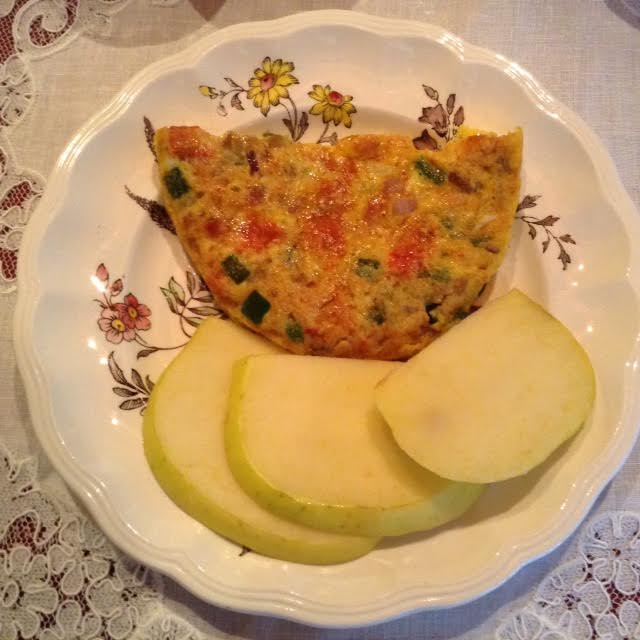
1 two-oz egg 1 Tbsp tomato dice or puree 1.5 tsp onion, minced 1 Tbsp bell pepper, minced 1 Tbsp bacon, chopped and measured raw 1.5 tsp Cheddar cheese, finely grated Pinch file powder 1.5 tsp creole seasoning  2 oz pear or apple   Optional: blackish coffee [53 calories] or blackish tea or mocha cafe au lait [65 calories] or lemon in hot water  Optional: 5-6 oz fruit smoothie or berry-yogurt smoothie  [88 calories]

Put the tomato, onion, bell pepper, and bacon in a small pan and cook until the bacon is mostly cooked. Drain the bacon fat from the vegetables. HINT: You could do this the night before. Spritz an oven-safe pan with non-stick spray and set the oven to 350 F. Whisk the egg and then stir in the cheese, vegetables, and seasonings. Pour into the prepared pan and bake for 12-15 minutes. Prepare your beverages of choice and slice the fruit.

Tuna Salad Sandwich, country-style:  Per Serving: 281 calories 9 g fat 4 g fiber 20 g protein 31 g carbs 91 mg Calcium   PB GF – if using a GF bun  Mayonnaise is a problem for me – I’d rather spend my calories on something else. So I came up with a different way to moisten my tuna salad, improving the protein and Calcium along the way. Try it. HINT: These amounts make enough for three [3] sandwiches. Dinner for three or dinner + two lunches.
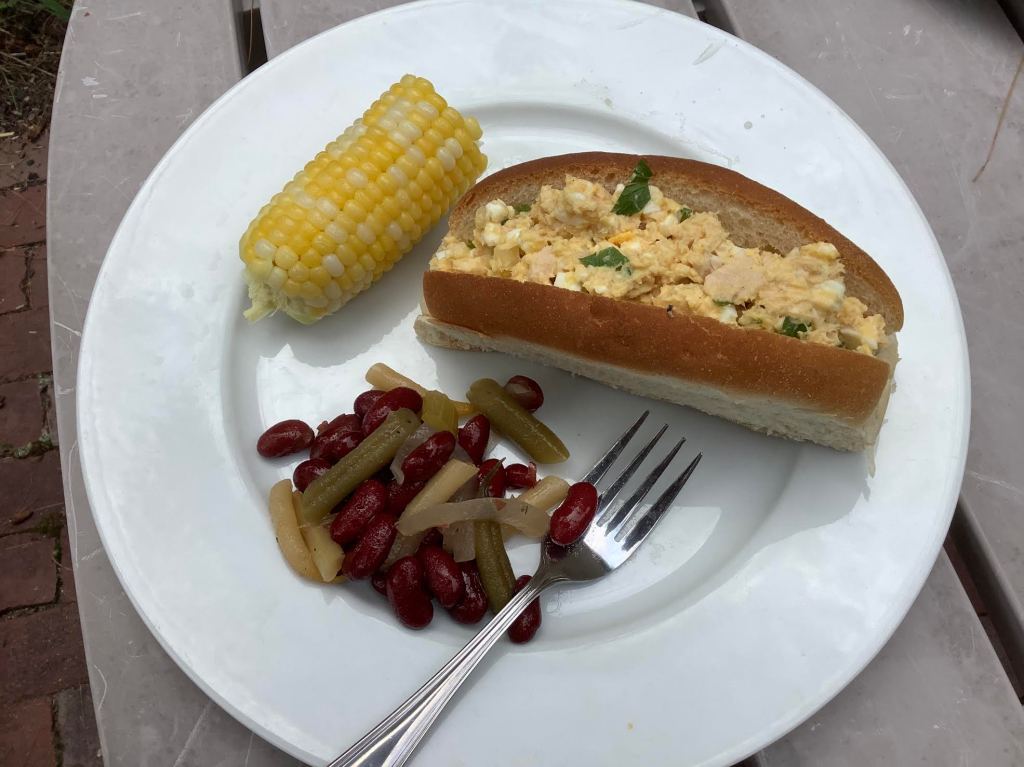
One 5-oz can of white tuna in water [4.5 oz drained/ 115 g/ ¾ cup] 1 hard-boiled egg 4 Tbsp 2% milk-fat cottage cheese 2 Tbsp minced celery 2 Tbsp minced onion salt and pepper 3 hot dog buns   per serving:  ¼ cup 4-bean salad + ½ ear corn on the cob

Drain the tuna and turn it into a bowl. Break up the tuna with a fork. Chop the egg and add it to the tuna along with the cottage cheese, celery, onion, salt and pepper. Stir to incorporate. Boil the corn for 8 minutes. Divide the tuna salad among the hot dog buns and plate with the vegetables.

Slow Day: Dutch Babies

People who are new to Fasting often pose the questions: “Can I really eat ‘anything I want’ on a Slow Day?” and “What should I eat on Slow Days?” To answer those questions, I have decided to add some blog posts to show some of the foods we eat on what the world calls NFDs [non-fast days] but which, in our house, we call ‘Slow Days.’ This feature will appear sporadically. 

Now for the answers. Can you really eat ANYTHING you want on a Slow Day? Not really. If you eat too many calories every Slow Day, you will not lose weight. There are many questions asked on the FastDiet Forum which attest to that. Once in a while you can splurge, as long as it isn’t everyday. For what to eat on Slow Days, Dr. Mosley recommends a Mediterranean Diet. As for how we eat, an example follows.

Some people call these “German Pancakes” while others call them “Dutch Babies.” Since ‘Dutch’/Deutsch often refers to ‘Germans,’ we can guess that this might be related to the German Pflannkuchen, but the recipe for this breakfast dish seems to have been invented in American West-Coast kitchens in the early 1900s. Several restaurants claim to have been the first to serve it, and it appears without attribution in many cookbooks. We enjoy this on Sundays. And I do mean ENJOY. Our recipe and method are from Marion Cunningham’s The Breakfast Book.

The mise en place above shows how easy this recipe is: 3 eggs, 1/2 cup flour, 1/2 tsp salt, 1/2 cup milk, 2 Tbsp butter. These were set out on the counter the night before so the eggs and butter could be at room temperature. Heat the oven to 450 and generously butter a 10 or 12″ cast iron skillet or, as we use, two 8″ skillets. Use an egg beater to break up the eggs in a bowl, then add the milk. Add the flour and salt, again deploy the egg beaters. Then mix in the melted butter to make a smooth batter. Pour into the pan/pans and pop into the oven. Bake for 15 minutes for the small pans. For the larger pan, after 15 minutes at 450F, turn heat down to 350F and continue to bake for 10 minutes more.

Great big popover bowls! One for each of us.

Magically, the batter rises up the sides to form a serving bowl of huge proportions! Serve with any fresh fruit in season, or with thawed and drained unsweetened frozen fruit. Maple syrup, lingonberry syrup, or cloudberry syrup are our faves.

Why to Start

How this Fast Diet Lifestyle works: Eat these meals tomorrow, for a calorie total of less than 600. On another day this week, eat the meals from a different post, another day of eating 600 calories or less. Eat sensibly the other days of the week. That’s it. Simple way to lose weight and be healthier.

Tomorrow is the 1st of the month which is a good day to start a good habit. Have your heard the news from health departments around the world? Recently, they have reported that being overweight is a contributing factor to deaths from COVID-19. Being obese doesn’t cause COVID, but it makes one more likely to be very ill or die from the disease. This is NOT fat-shaming. This is telling an unhappy truth. The National Institute of Health says so, as does the New England Journal of Medicine. The Lancet in the UK and the chief epidemiologist in France concur. If ever you needed a reason to lose weight, fear of COVID-19 could be it. You don’t need some bread-and-water crash died — you need a new style of eating. The Fast Diet is a lifestyle in which you change your diet two days a week. Surely you can do that, especially when your health is at risk. Yes, you can.

Try out these two simple meals: meat and bread for breakfast; bacon and eggs for dinner. Start the Fasting Lifestyle tomorrow. Need another reason? If all the days seem the same to you now, then you’ll find that the Fast Days punctuate the week and give you two days that are different from the others.

Czech Breakfast: 233 calories 5 g fat 3.8 g fiber 11.7 g protein 37 g carbs [18 g complex] 65.6 mg Calcium  NB: The food values are for the meal and fruit only and do not include the optional coffee. I’m told that the majority of citizens of the Czech Republic eat this for breakfast daily. Join them.

1 to 1.6 g sourdough rye bread 1 oz sliced ham, 3% fat ½ oz Hermelin cheese, or substitute Camembert 2 yellow plums, or other color of your choice   Optional: blackish coffee [53 calories] or blackish tea or mocha cafe au lait [65 calories]  NO Smoothie today unless you forgo the coffee.

Whether you pile everything on the bread and eat it that way, or sample each item separatly, this is a hearty way to start the day. For those of you who start your day with lunch, this is for you.

Asparagus Omelette:  270 calories 14.7 g fat 3.3 g fiber 18 g protein 10 g carbs 178 mg Calcium  PB GF  Susan Herrmann Loomis comes up with another super dinner omelette. HINT: This recipe serves two [2], but you could cut it if you wish, or double it to serve four [4]. 

4 two-oz eggs  ½ oz [3 Tbsp] Parmesan-Reggiano cheese Whisk the eggs, just to blend in the yolks. Grate the cheese and stir it in.
4 oz asparagus, tough stalk-ends snapped offCook until tender, about 7 minutes. Cut off the bud ends and slice the stalks thinly.
2 slices uncured bacon [30 cal per slice] cut into ½” pieces   Cook in a non-stick pan until ‘lightly golden’, 2-3 minutes.Drain off all but ½ Tbsp fat.
1 scallion [1 oz], thinly sliced
bud ends of asparagus
Saute in fat until transluscent and add the asparagus. Cook until hot. Add eggs without disturbing the other ingredients. Cook until the top is done to your liking. Fold and plate, garnished with bud tips.
1 cup Baby greens, sliced beets, 1/2 oz tomatoesToss with 1 tsp good vinaigrette.

Ingredients for next week: Breakfast, single portion for Monday ……… single portion for Thursday:

1 two-oz egg + bacon1.5 two-oz eggs 
tomato + onion + Cheddaruncured capicola ham
green sweet pepper oregano
creole seasoning + apple/pearapple
Optional smoothieoptional smoothie
optional hot beverageoptional hot beverage

Dinner, single portion for Monday: …….. single portion for Thursday:

water-canned tuna + celerybeef or chicken stock + egg
2% fat cottage cheese + oniongarlic + Swiss cheese
hot dog bun + corn on the cobpotatoes + parsnips + butter
4-bean saladrye bread +marjoram
Sparkling waterSparkling water

Slow Day: Eastern Mediterranean Sampler

People who are new to Fasting often pose the questions: “Can I really eat ‘anything I want’ on a Slow Day?” and “What should I eat on Slow Days?” To answer those questions, I have decided to add some blog posts to show some of the foods we eat on what the world calls NFDs [non-fast days] but which, in our house, we call ‘Slow Days.’ This feature will appear sporadically. 

Now for the answers. Can you really eat ANYTHING you want on a Slow Day? Not really. If you eat too many calories every Slow Day, you will not lose weight. There are many questions asked on the FastDiet Forum which attest to that. Once in a while you can splurge, as long as it isn’t everyday. For what to eat on Slow Days, Dr. Mosley recommends a Mediterranean Diet. As for how we eat, an example follows.

The meal at Troy

When we visit Wolfville, Nova Scotia, Canada, we enjoy dining at Troy. We usually order the Sampler Platter, along with local beer and cidre. Since dining there is not an option during these Covid Times, I decided to try my hand at preparing such a meal. Happily, the elements were at hand — in the freezer or in the ‘fridge or made from fresh ingredients.

From the left, going clockwise around the platter: Lamb Gozleme; turkey breast; beet hummus**; oil-cured olives; tomatoes; feta + green olives; red pepper spread; dried figs. The flat bread in the middle is the same as in the Gozleme, but un-stuffed and griddle fried. A delightful meal for two, served with memories of visits to the orchards and vineyards of the Annapolis Valley in Nova Scotia.

**HUMMUS: 1 Tbsp = 27 calories… 1.3 g fat… 0.6 g fiber… 0.7 g protein… 3 g carbs… 0.7 mg Calcium…   PB GF —makes 2 cups— Recipe from Moosewood Cookbook by Mollie Katzen . ++++ 1 can chickpeas, drained + rinsed ++++ 4 cloves garlic ++++ 1½ tsp salt++++ 4 tsp lemon juice ++++ 5 T tahini pepper +++ cayenne ++++ ¼ c chopped scallions Put everything in the food processor and whiz until smooth. Taste for seasonings. Freezes well. Variation: Add a few slices of cooked beet to obtain an amazing pink color.

Slow Days: Summer Desserts

People who are new to Fasting often pose the questions: “Can I really eat ‘anything I want’ on a Slow Day?” and “What should I eat on Slow Days?” To answer those questions, I have decided to add some blog posts to show some of the foods we eat on what the world calls NFDs [non-fast days] but which, in our house, we call ‘Slow Days.’ This feature will appear sporadically. 

Now for the answers. Can you really eat ANYTHING you want on a Slow Day?  Not really. If you eat too many calories every Slow Day, you will not lose weight. There are many questions asked on the FastDiet Forum which attest to that. Once in a while you can splurge, as long as it isn’t everyday. For what to eat on Slow Days, Dr. Mosley recommends a Mediterranean Diet. As to how we eat, some examples follow.

In the Summer, we want our desserts to be light and cooling. Hot pie is out, ice cream is in. I remember when fruited Jello was acceptable. And then chiffon pie was in vogue. Ugh. Both highly processed. A waste of calories, in my opinion. Fruit is always the answer: fresh, real, delicious, versatile, good for you. I don’t usually give nutritional information on a Slow Day Post, because with the Fast Diet you need ‘diet’ only 2 days each week. But these desserts are SO good that the calorie counts prove that one can eat well without going hog wild on calories. Hope you like these!

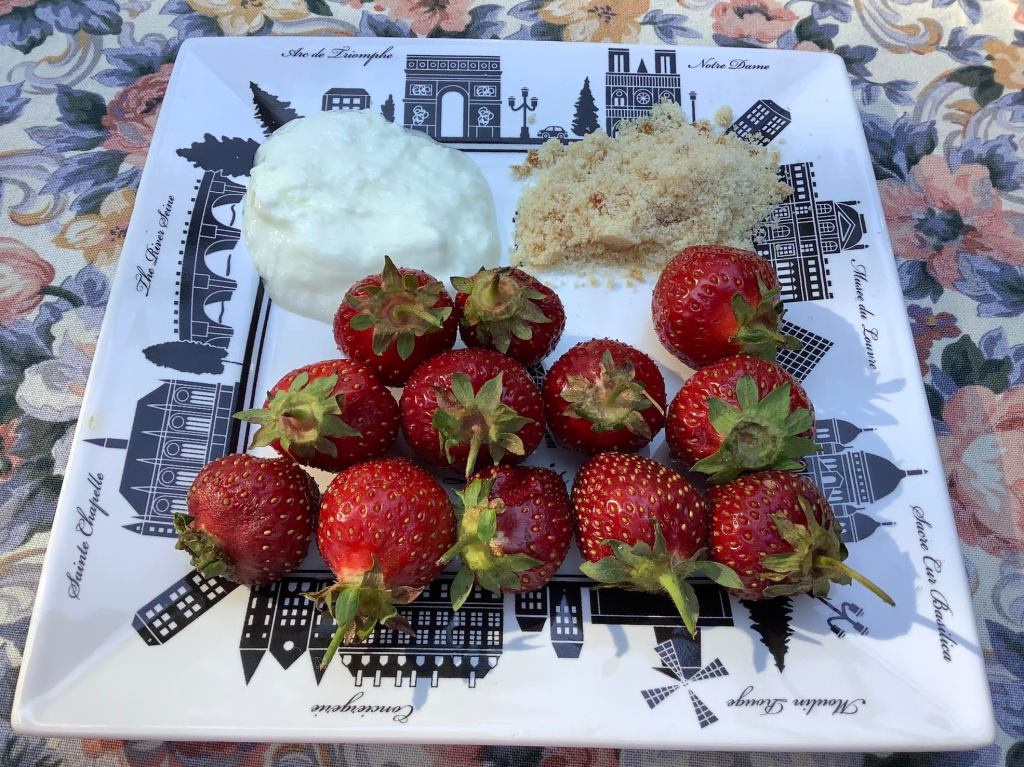
‘Blue Strawberries’: In Portsmouth, NH, in the 1970s/80s, James Haller and friends ran the Blue Strawbery Restaurant. They served a prix-fixe menu with only one dessert: their signature strawberries. Awfully simple to prepare and a delight to eat.

This plate will serve two diners.

++ 5 oz medium-sized strawberries ++++ 2 Tbsp low fat vanilla yogurt ++++ 2 Tbsp brown sugar ++

On individual serving plate, place the strawberries, spoon out the yogurt in a separate spot, and place the sugar in its own space. Grasp a strawberry by the stem, dip into the yogurt, dip into the sugar. Eat. Repeat.

Chocolate-Dipped Strawberries: each: 34 calories… 2 g fat… 1 g fiber… 0.5 g protein… 3.6 g carbs… 13 mg Calcium… PB GF These are so easy to make that I can’t imagine buying a kit at the supermarket. Is this ‘gilding the lily’? Yes! And they are SO good. 

++ 6 fresh strawberries [½-3/4 oz each] with leaves and stems attached ++++ 3 oz dark [60-70%] or bitter-sweet chocolate [chocolate chips/bar chocolate/melting wafers] — you will end up using less than 1 oz and will have some left over ++

Put the chocolate in a wide-mouthed glass bowl and place it in a small pan. Add water to the pan to about half-way up the vessel with the chololate. Gently heat the water so that the chocolate melts. Do not let the heating water bubble, lest water drops end up in the chocolate. Stir the chocolate to make sure it is all melted. Put the berries on a piece of waxed paper [or a silicon mat] on a small tray that will fit in the ‘fridge. The berries must be perfectly dry – no water drops, lest the chocolate ‘seize up.’ Pick up a berry by the leaves/stem and dip into the chocolate until it is coated about 2/3 of the way up. You may have to roll it a bit to coat it. As you remove it from dipping, wipe it gently against the side of the vessel, as you would wipe excess paint from a paintbrush. Lay the coated berry on the waxed paper and continue with the other berries. Put the berries in the ‘fridge to harden and cool. Cool any excess chololate and keep in the ‘fridge for any future use.

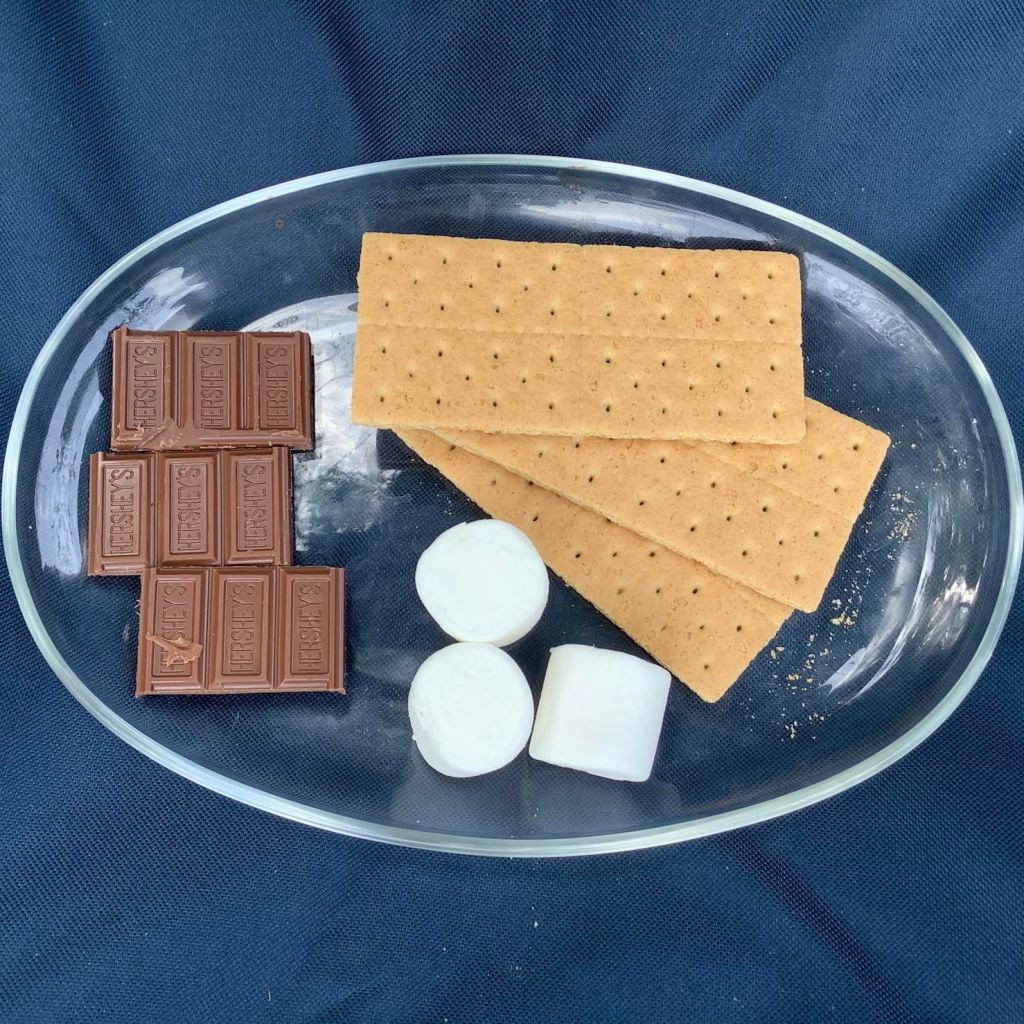
S’More: 145 calories… 4.7 g fat… 0.5 g fiber… 2 g protein… 24.5 g carbs… 22.5 mg Calcium… The Girl Scouts of America tell their members that this campfire treat was invented by them. No summer is complete without the gooey-chocolatey goodness of the s’more! The name is a contraction of “I want some more.” I must say I was surprised at the low calorie count.

These are the fixings for THREE s’mores.

++1 graham cracker, broken in half cross-wise along the perforations ++++ 1 marshmallow – regular size, neither mini nor monstrous ++++ 3 sections of one standard Hershey Milk or Special Dark Chocolate Bar ++

On one of the halves of the cracker, place the chocolate. Cook the marshmallow the way you like it. Put the marshmallow on the chocolate, top with the other piece of cracker. Push down on the top to squish the marshmallow so it oozes out the sides a little. Eat immediately.

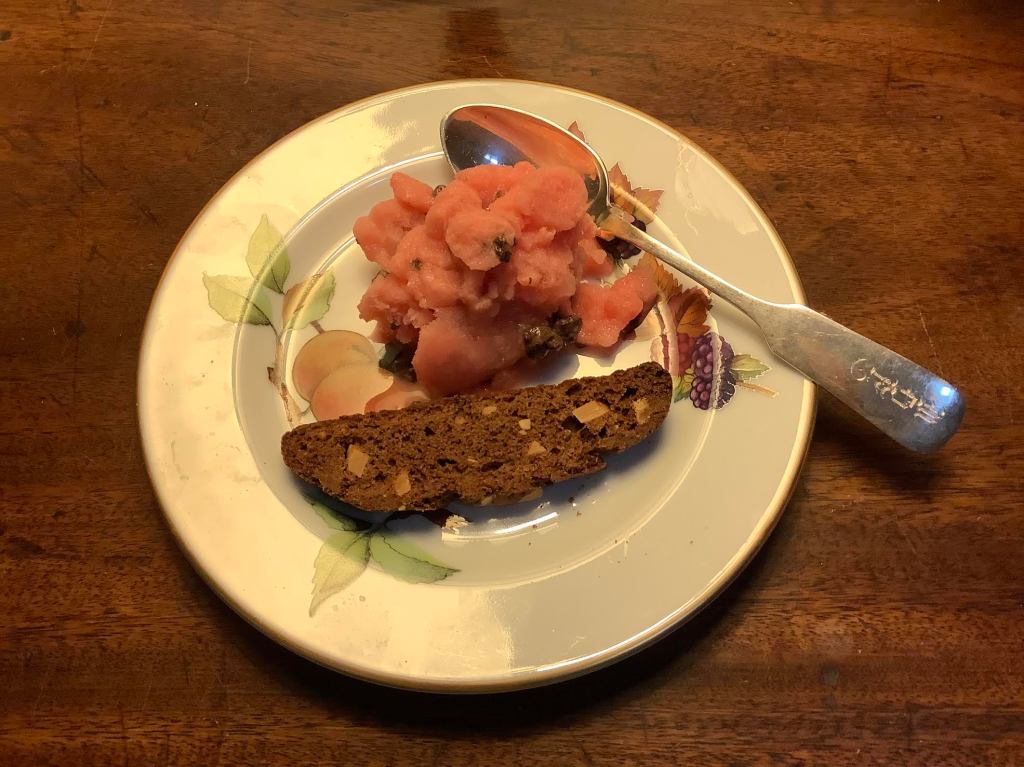
Watermelon Sherbet:  54 calories 2 g fat 1 g fiber 1 g protein 9 g carbs 42 mg Calcium   PG GF   Such a delight for a hot Summer night! Goes together very quickly at dessert time. Serve with a simple cookie, such as chocolate biscotti. HINT: One serving = 3/4 of a cup. This is really good!

3 cups watermelon1½ cup melon Freeze the watermelon cubes in a single layer on a piece parchment paper or foil for at least 3-4 hours.
1-1/2 cup frozen melon
½ cup plain yogurt OR lite canned coconut milk/ sweetened condensed milk/ Vanilla yogurt
¾ cup frozen melon ¼ cup plain yogurtWhen ready to make, add half the watermelon to the food processor and blend until smooth. Scrape down the sides and add the yogurt/ coconut milk/ condensed milk. 
1-1/2 cup frozen melon 3 Tbsp mini choc chips¾ cup frozen melon
1.5 Tbsp mini chips
Add the remaining watermelon and the mini chips. Blend until smooth and creamy.
Eat immediately or freeze for 2-3 hours for a firmer texture. If frozen longer, leave it out for 30 minutes before eating so it can soften up and become creamy.

Slow Days: Hake with Green Sauce

People who are new to Fasting often pose the questions: “Can I really eat ‘anything I want’ on a Slow Day?” and “What should I eat on Slow Days?” To answer those questions, I have decided to add some blog posts to show some of the foods we eat on what the world calls NFDs [non-fast days] but which, in our house, we call ‘Slow Days.’ This feature will appear sporadically. 

Now for the answers. Can you really eat ANYTHING you want on a Slow Day? Not really. If you eat too many calories every Slow Day, you will not lose weight. There are many questions asked on the FastDiet Forum which attest to that. Once in a while you can splurge, as long as it isn’t everyday. For what to eat on Slow Days, Dr. Mosley recommends a Mediterranean Diet. As for how we eat, an example follows.

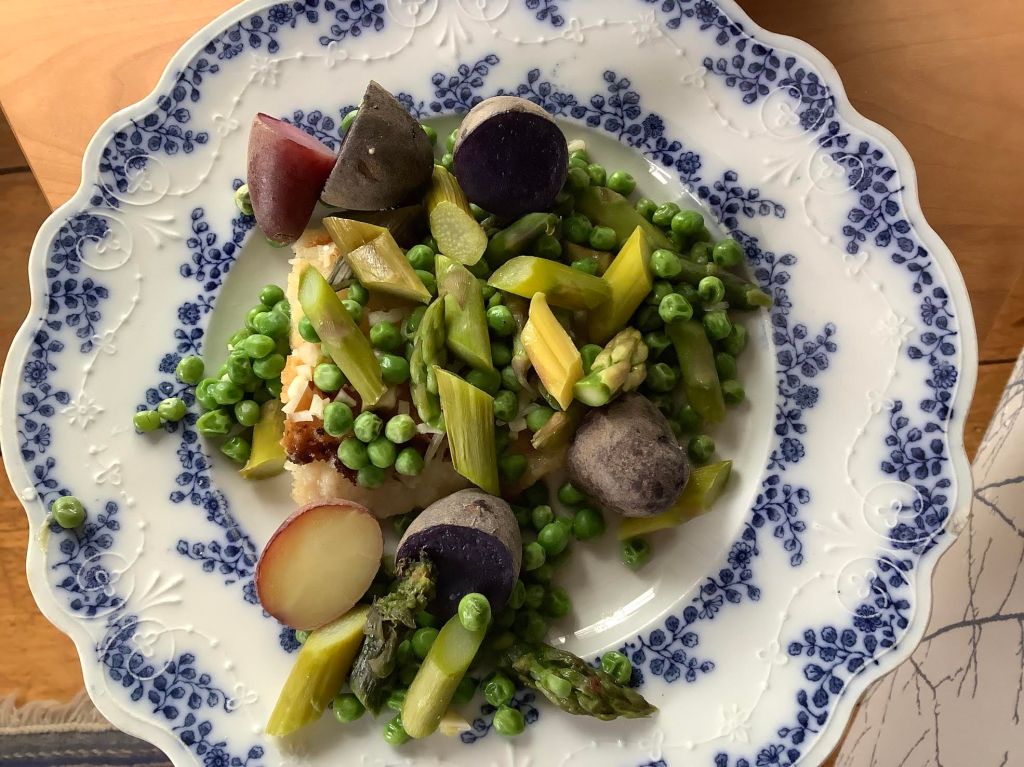
In April, disappointed that our trip to France was canceled, we decided that if we couldn’t be in Gascony, we could eat as if we were in Gascony. After scouring our cookbooks, we chose recipes for dinner, and sometime breakfast, that would be typical of where we would have been on a particular date. Thus we “dined out” in the restaurants of our imaginations. One of the earliest meals was named Hake in Green Sauce. There is no sauce. “Green Sauce” is a centuries-old term for vegetables served on or with the protein of the meal. In Spanish, the term is ‘salsa verde,’ which we today think of as a mild-hot condiment in a jar. The recipe, called “Merluza, Salsa Verde,” is found in Anne Willan’s French Regional Cooking.

The ingredients you see pictured are enough for two people.

Hake, new potatoes [our’s were multi-colored], garlic, oil, crushed red pepper, peas and asparagus comprise the ingredients. The potatoes are simmered in boiling water for 15 minutes, then drained. The peas are cooked until just tender, then shocked in cold water and drained. Same for the asparagus. The hake is seasoned, then dredged lightly in flour. Brown the hake in an oil-coated pan until lightly brown on both sides, but not cooked through. Arrange the dish in an oven-safe dish [I used the tart pan you see in the above photo] and sprinkle with the hot pepper flakes and chopped garlic. Put the potatoes around the edges of the fish, then put the vegetables on top. Sprinkle with parsley, salt, and pepper. Pour 1/4 cup water into the dish, cover it, and bake at 375F/190C for 15-20 minutes, when the fish will be tender.

This is really good — I ate the whole thing!

Slow Days: Sourdough Pancakes

People who are new to Fasting often pose the questions: “Can I really eat ‘anything I want’ on a Slow Day?” and “What should I eat on Slow Days?” To answer those questions, I have decided to add some blog posts to show some of the foods we eat on what the world calls NFDs [non-fast days] but which, in our house, we call ‘Slow Days.’ This feature will appear sporadically. 

Now for the answers. Can you really eat ANYTHING you want on a Slow Day? Not really. If you eat too many calories every Slow Day, you will not lose weight. There are many questions asked on the FastDiet Forum which attest to that. Once in a while your can splurge, as long as it isn’t everyday. For what to eat on Slow Days, Dr. Mosley recommends a Mediterranean Diet. As for how we eat, an example follows.

It is almost a joke now that during the Pandemic Lock-Down, people vowed that they would use the time to perfect the art of baking: specifically sourdough bread. It seemed to be the culinary equivalent of reading War and Peace — something to get around to when you had time. Early on, bread flour and yeast were GONE from supermarket shelves. New England’s flour-of-choice, King Arthur brand from Vermont, was not even available on-line. For those who have sourdough starter [don’t be a wimp — start your own starter!], be aware that there are many things to do with it, besides making bread. Recently, we made Sourdough Pancakes [click link for recipe] for Sunday Breakfast. A real treat and easy to do.

HINT: For two people, I cut the recipe in half. The night before, I combine the flours with the sugar, oil, buttermilk [substitute = soured milk], salt, and starter. This is left on the counter overnight to ripen.

The next morning, the batter is stirred. An egg and the baking soda are added in. The mixture needs to sit a few minutes while you heat the griddle, set the table, and make the coffee. By now the batter is foaming in the bowl.

This recipe resulted in 14 pancakes: enough for today’s breakfast, another meal later, and 2 for a snack with peanut butter and jelly.

Lightly butter the griddle and use a 1/4 cup measure to pour 3-4 Tablespoons of batter on the hot surface. Continue until there is no more space on the pan. When the top of each pancake starts to develop ‘eyes’ [little holes], it is time to flip them to the other side.

Served with maple syrup [our own, I’m happy to say] and sausages — what a treat! The breakfast is completed by the berry-yogurt smoothie and mocha cafe au lait which we enjoy every morning. Great start to a great day. A lot easier than making bread.

Slow Days: Bruschetta

People who are new to Fasting often pose the questions: “Can I really eat ‘anything I want’ on a Slow Day?” and “What should I eat on Slow Days?” To answer those questions, I have decided to add some blog posts to show some of the foods we eat on what the world calls NFDs [non-fast days] but which, in our house, we call ‘Slow Days.’ This feature will appear sporadically. 

Now for the answers. Can you really eat ANYTHING you want on a Slow Day? Not really. If you eat too many calories every Slow Day, you will not lose weight. There are many questions asked on the FastDiet Forum which attest to that. Once in a while your can splurge, as long as it isn’t everyday. For what to eat on Slow Days, Dr. Mosley recommends a Mediterranean Diet. As for how we eat, an example follows.

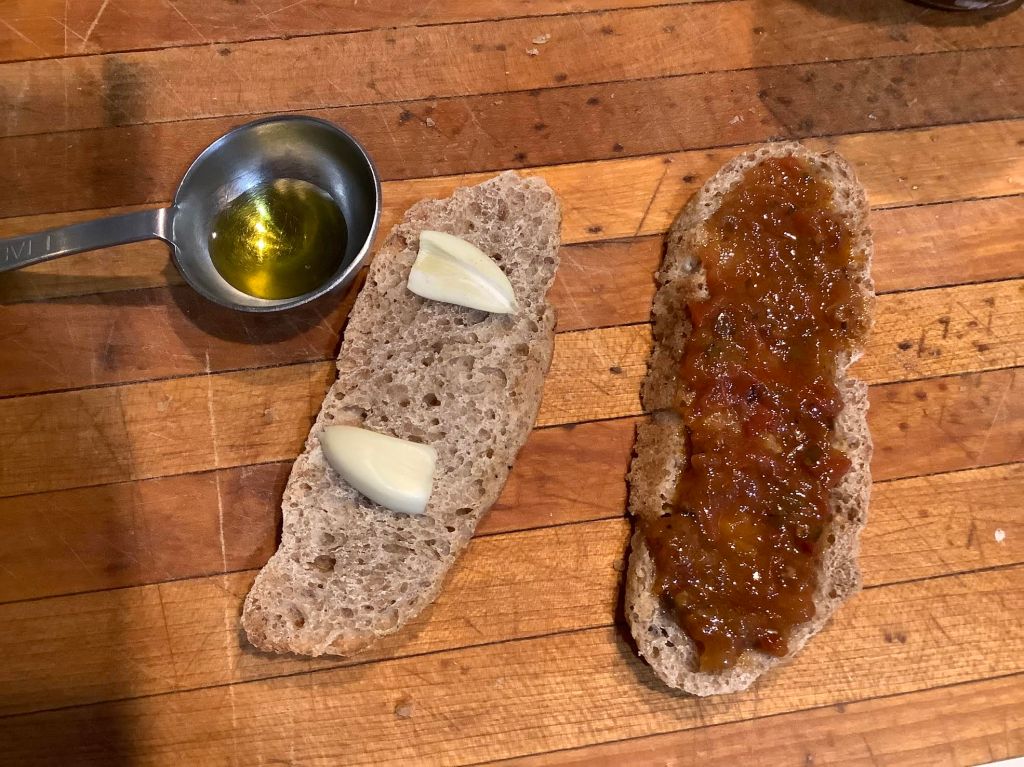
“Bruschetta” … what does that word mean to you? And how do you pronounce it? The cookbook Diary of a Tuscan Chef gave us a recipe for this concoction, which we ate happily for years — a tomato relish on bread. And we called it ‘bruce-SHET-ta.’ Had we turned the cookbook page, we would have had the real story. When olives are being pressed into oil, [a late-Fall, cool-weather activity] one of the workers will toast bread over a fire, rub it with garlic, and drizzle the new oil over it so everyone can have a snack and a taste of the crop. THAT is bruschetta!

Bread, garlic, and olive oil = bruschetta

Of course, as the idea of ‘putting some food on toast’ moved around the world, something was lost in translation, including the pronunciation. When on tour in Italy, I asked the guide, a Roman, how to pronounce this culinary creation. Chuckling, he said that Americans always ask that and for the longest time he had no idea what they meant by ‘bruce-shet-ta.’ The correct way to say it? ‘bruce-KAY-ta’ The aforementioned Tuscan Chef, Cesare Casella, writes: “Americans seem to think bruschetta is chopped tomatoes, garlic, basil, and olive oil on toast. I don’t know why. For us that is crostini con pomodoro.” He concludes that there seems to be an “American craving for cubed tomatoes.”

On the right you see Cesare Casella’s ‘tomato relish’ on the bread.

When Older Son began baking, he sent us a recipe for his ‘no-knead focaccia’, which is great but makes more bread than Dear Husband and I can eat in a week. So Older Son prompted us to eat it as Bruschetta. I protested that there would be very little protein in that: just bread and tomato relish. Being wise, our son suggested additional toppings: herbed ricotta cheese, slices of chicken or turkey breast. Anchovies would be good. The recipe for the bread is below.

So that is the evolution of a meal that is perfect in Summer or any warm evening. Perhaps we should call it ‘Crostini’ but we don’t. We’re Americans, you see.

No-Knead Focaccia

one 10” loaf, four 6” loavesTwo 6” loaves or 6 bunsDutch oven or cast iron skillets
500 g bread flour or half bread flour, half white whole-wheat
375 g water
10 g salt
6 g yeast
250 g bread flour or half bread flour, half white whole-wheat
187 g water
5 g salt
3 g yeast
Combine ingredients until they form a shaggy ball.
Cover bowl and let rest 8-12 hours. Rising overnight works very well.
Olive oilOlive oilLeave dough whole or divide into smaller portions. Oil pans and add dough.
Let rise 1-2 hours.
Olive oil garlic, chopped
olives, chopped
herbs
Olive oil
garlic, chopped
olives, chopped
herbs
Brush dough with oil, then sprinkle with optional topping of your choice.
Bake at 450F 30-40 minutes, until golden brown. If baking smaller portions, shorten baking time.
1 of 8 servings = 64 calories

Slow Days: Lobster Rolls

People who are new to Fasting often pose the questions: “Can I really eat ‘anything I want’ on a Slow Day?” and “What should I eat on Slow Days?” To answer those questions, I have decided to add some blog posts to show some of the foods we eat on what the world calls NFDs [non-fast days] but which, in our house, we call ‘Slow Days.’ This feature will appear sporadically. 

Now for the answers. Can you really eat ANYTHING you want on a Slow Day? Not really. If you eat too many calories every Slow Day, you will not lose weight. There are many questions asked on the FastDiet Forum which attest to that. Once in a while you can splurge, as long as it isn’t everyday. For what to eat on Slow Days, Dr. Mosley recommends a Mediterranean Diet. As for how we eat, an example follows.

If times were normal, we might be at our vacation cottage right about now. Not to stay for a long time, but to see the place in late Spring, before the tourists descend. We used to go there during my school’s April Break: to open the cottage, move up some furniture, visit with local friends, and see what the Winter storms did to the beach. If we stayed into early May, then the ocean would be dotted with colorful buoys and small fishing boats — in other words: Lobster Season. Prince Edward Island has two very limited seasons, one for each of two different parts of the island. In full Summer, when we usually arrive, lobsters are still available. When Summer guests appear at out cottage, we treat them to a lobster feast. Afterward, the cephalo-thoraces [the front-middle part that everyone else throws away] are picked clean of the meat located in the ‘shoulder joints’: enough to make lobster rolls!! [Four thoraces produce enough meat for this meal of three rolls.]

1-1/2 cups of lobster meat, chopped celery and red onion, chiffonade of lettuce or spinach, mayonnaise, and celery seed make the filling. The rolls are ‘New England’ style hot-dog buns. That means they are sliced across the top, not along the side. Being New Englanders, we prefer those.

The buns are lightly toasted with butter on a griddle and served with fresh tomatoes or a light salad. If you want to know about the wine — we always serve ‘The Hermit Crab’ or a Viognier with lobster rolls — go to Dear Husband’s blog peterspicksblog.com.

Slow Days: Blueberry Muffins

People who are new to Fasting often pose the questions: “Can I really eat ‘anything I want’ on a Slow Day?” and “What should I eat on Slow Days?” To answer those questions, I have decided to add some blog posts to show some of the foods we eat on what the world calls NFDs [non-fast days] but which, in our house, we call ‘Slow Days.’ This feature will appear sporadically. 

Now for the answers.  Can you really eat ANYTHING you want on a Slow Day? Not really. If you eat too many calories every Slow Day, you will not lose weight. There are many questions asked on the FastDiet Forum which attest to that. Once in a while you can splurge, as long as it isn’t everyday. For what to eat on Slow Days, Dr. Mosley recommends a Mediterranean Diet. As for how we eat, an example follows.

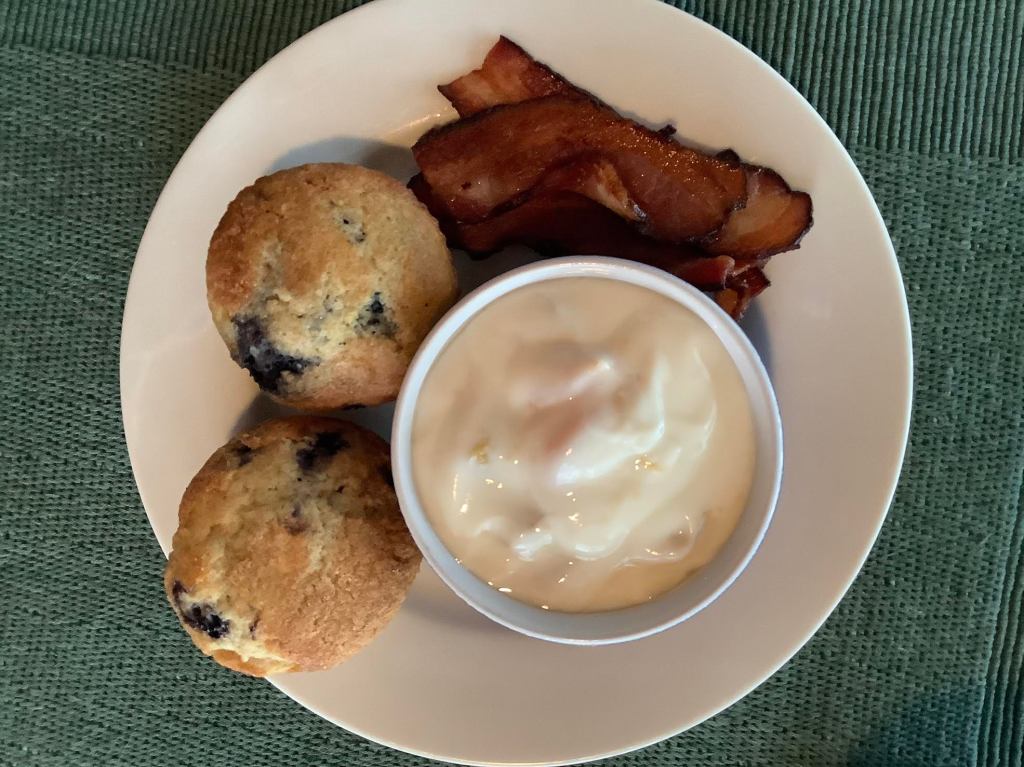
People get lyrical about muffins. On the other hand, James Beard had a dim view of them, saying “Muffins have been inordinately popular for years. I, for one, have never been able to understand why.” For a long time, I didn’t care for most blueberry muffins I ever had — they were either too much like biscuits or they were gigantic and super-sweet. Finally I found a recipe from Maine for a coffeecake with blueberries in it. Inspiration!! It struck me that this recipe would be perfect when baked as muffins. Many fine breakfasts have resulted from that recipe, and here it is:

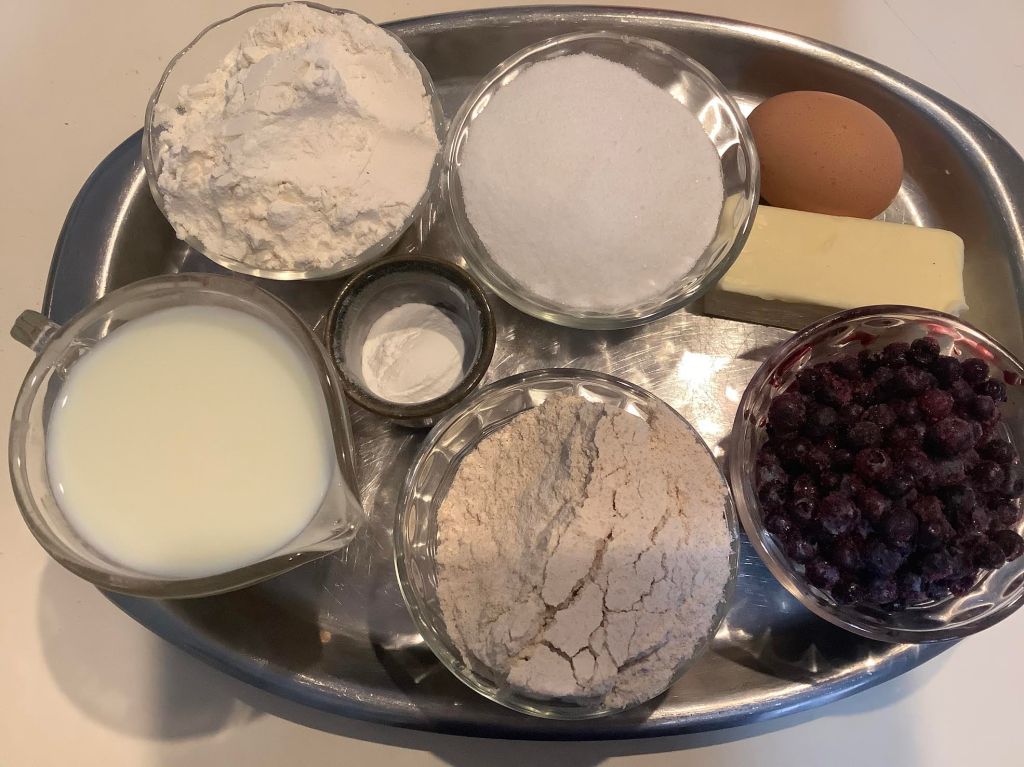
++1 cup unbleached flour++++ 1 cup white whole wheat flour++++ 3/4 cup sugar++++ 3 teaspoons baking powder++++ 1 teaspoon salt++++ 1/3 cup butter [fairly soft so it will mix]++++ 1 cup milk**++++ 1 egg++++ 1/4 teaspoon almond extract++++ 1 cup blueberries [fresh or frozen — frozen are better since they don’t mush up when stirred in which turns the batter a nasty grayish-blue]++ **You could use buttermilk or plain yogurt instead of milk, and then you would need to add 1 teaspoon of baking soda to the above ingredients.

Combine and mix all the ingredients except the blueberries. Lastly, gently stir in the berries. Put into muffin papers or greased muffin tins. NB: Do all this the night before and leave the pan on the counter, covered, ready to bake in the morning. Works perfectly. Bake at 350F for 15 minutes or so. How many muffins you’ll get depends on the size of the tins. When I use silicon cupcake forms [see right] and I get 13-15 muffins.

What isn’t eaten for breakfast is put into zipper-locking bags, as these freeze and reheat very nicely. Have a happy breakfast!