Agatha Christie

How this Fast Diet Lifestyle works: Eat these meals tomorrow, for a calorie total of less than 600. On another day this week, eat the meals from a different post, another day of eating 600 calories or less. Eat sensibly the other days of the week. That’s it: a simple way to lose weight and be healthier.

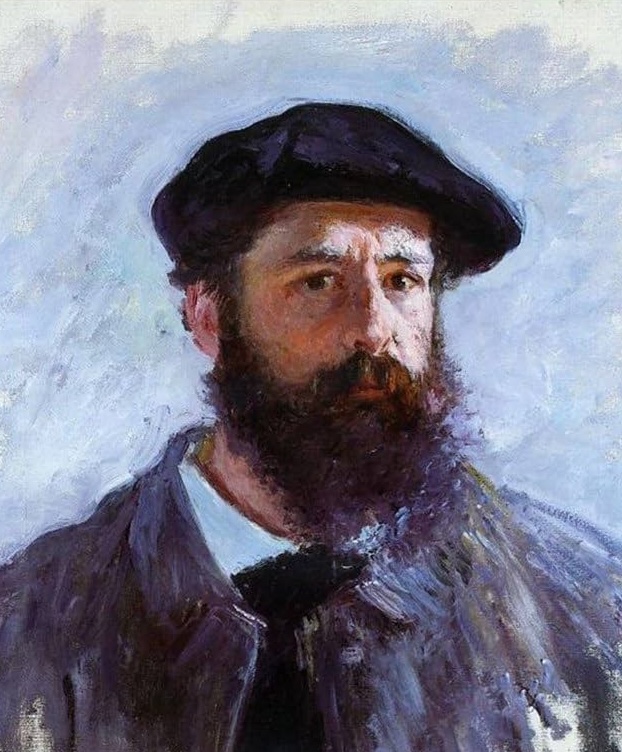
When Agatha Miller was born in Torquay, Devon, England on September 15, 1890, no one could predict the effect she would have on literature. She was raised in moderate wealth as a solitary child. Despite her mother’s idea that she not learn to read until age eight, Agatha taught herself when she was four. From then on she read voraciously — children’s books, and classics of English authors appropriate to her age. Finally, at age 12, she attended a boarding school — and left because she chafed at the routine. Agatha loved writing stories and amateur theatricals. In 1914, after a brief courtship, she married Archibald Christie, who went off to war and worked his way up through the ranks. He encouraged her writing. In 1920, Mrs. Christie published The Mysterious Affair at Styles, introducing the sleuth Hercule Poirot. He appeared in 15 books plus a play and short stories until 1937. Next, Tommy and Tuppence made their debut, as a chippy young couple around the author’s age. Miss Marple appeared in 1930, and became perhaps her most memorable character after 12 books and numerous stories through to 1976. Agatha Christie learned the apothecary’s trade and during both World Wars she worked in a hospital dispensary as her contribution to the war effort. Readers will appreciate that more than half of the murders in Christie’s books are by poison, ‘the woman’s weapon,’ showing that she learned her craft well. In December of 1926, Mrs. Christie was the subject of a famous mystery. She disappeared for 11 days, traveling around England under an assumed name. Some said it was a publicity stunt, others said it was a psychotic break caused by her mother’s death and her husband’s infidelity [her assumed surname was that of her husband’s paramour]. She never spoke of it. A brief courtship resulted in marriage to an archeologist, Max Mallowan who was several years her junior. With him she went on annual digs throughout the Levant. She wrote, he dug, she helped to catalogue and preserve the artifacts, and together they had a good life. Her accolades were many; her book sales were staggering; her play The Mousetrap set records. Her writing as ‘Mary Westmacott’ produced four more best-selling novels. My favorite is Absent in the Spring in which no murder occurs, yet the protagonist’s life is dismantled as she reflects on how she has interacted with her family. The Queen of Crime died in 1976 and her family handles her merchandizing.

When we think of a book by Dame Agatha, our inner eye sees a charming English village dominated by a church and the manor house. The murder has taken place in the manor house and of course the butler did it — or did he? Our menu today is typical of meals at the manor, before the mayhem started.

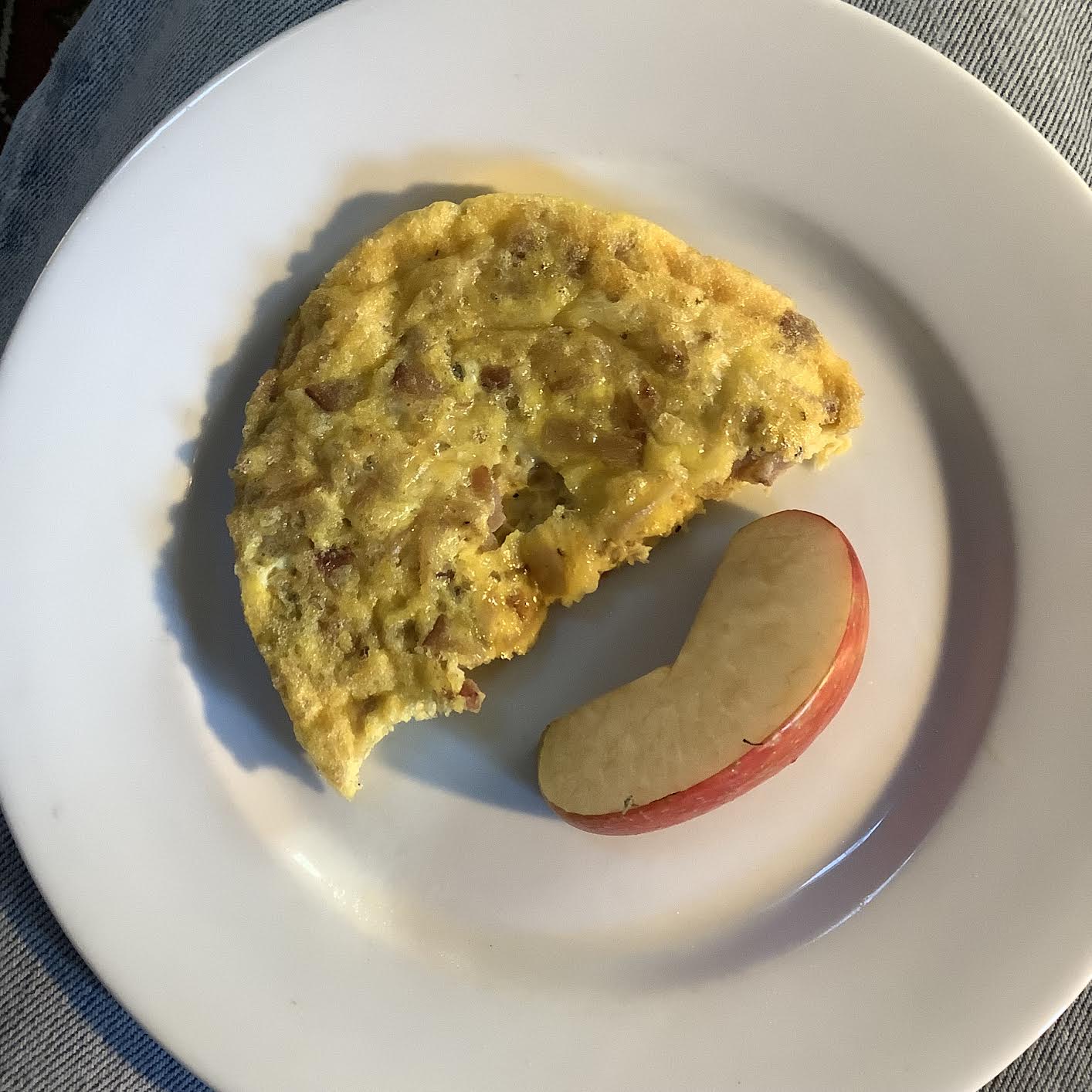
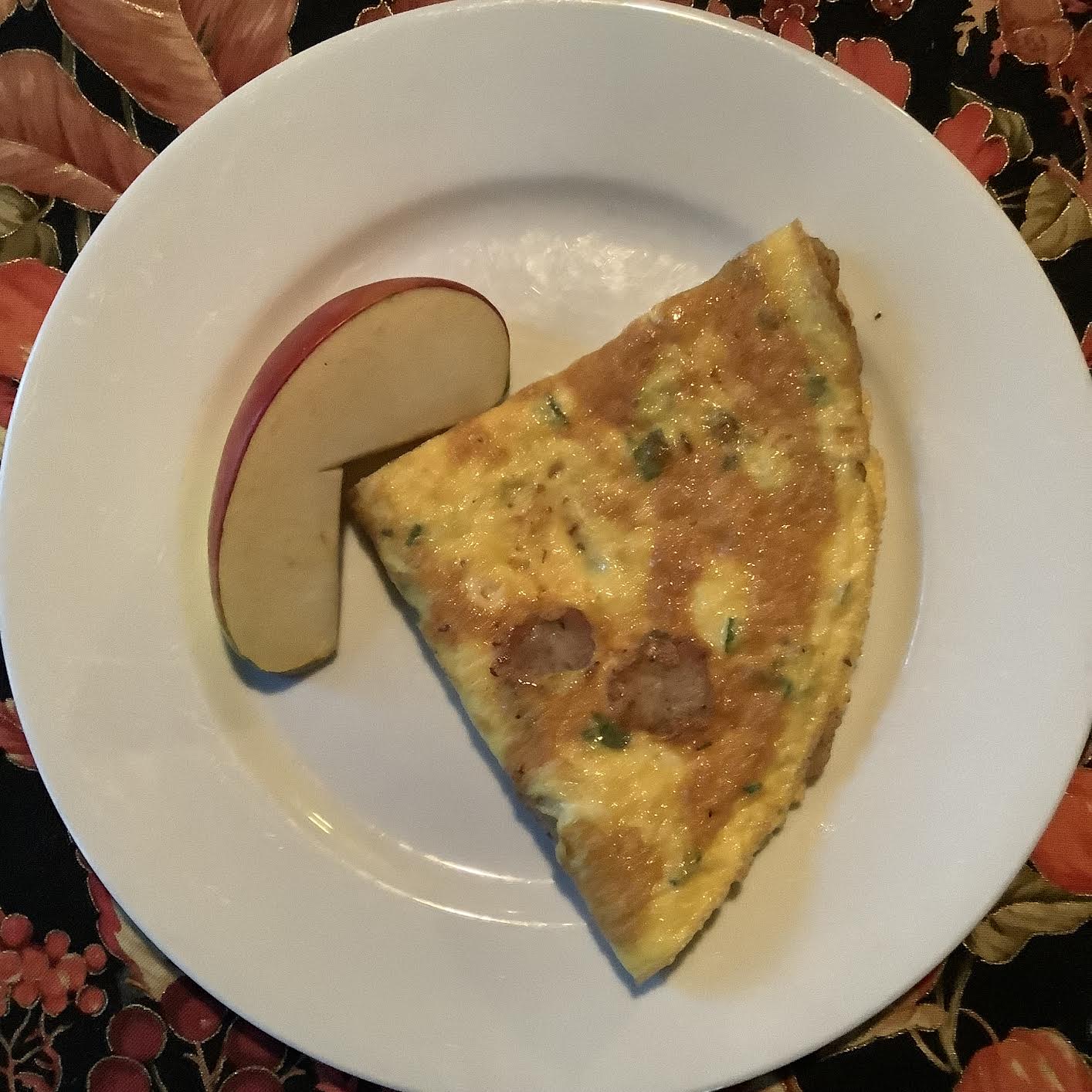
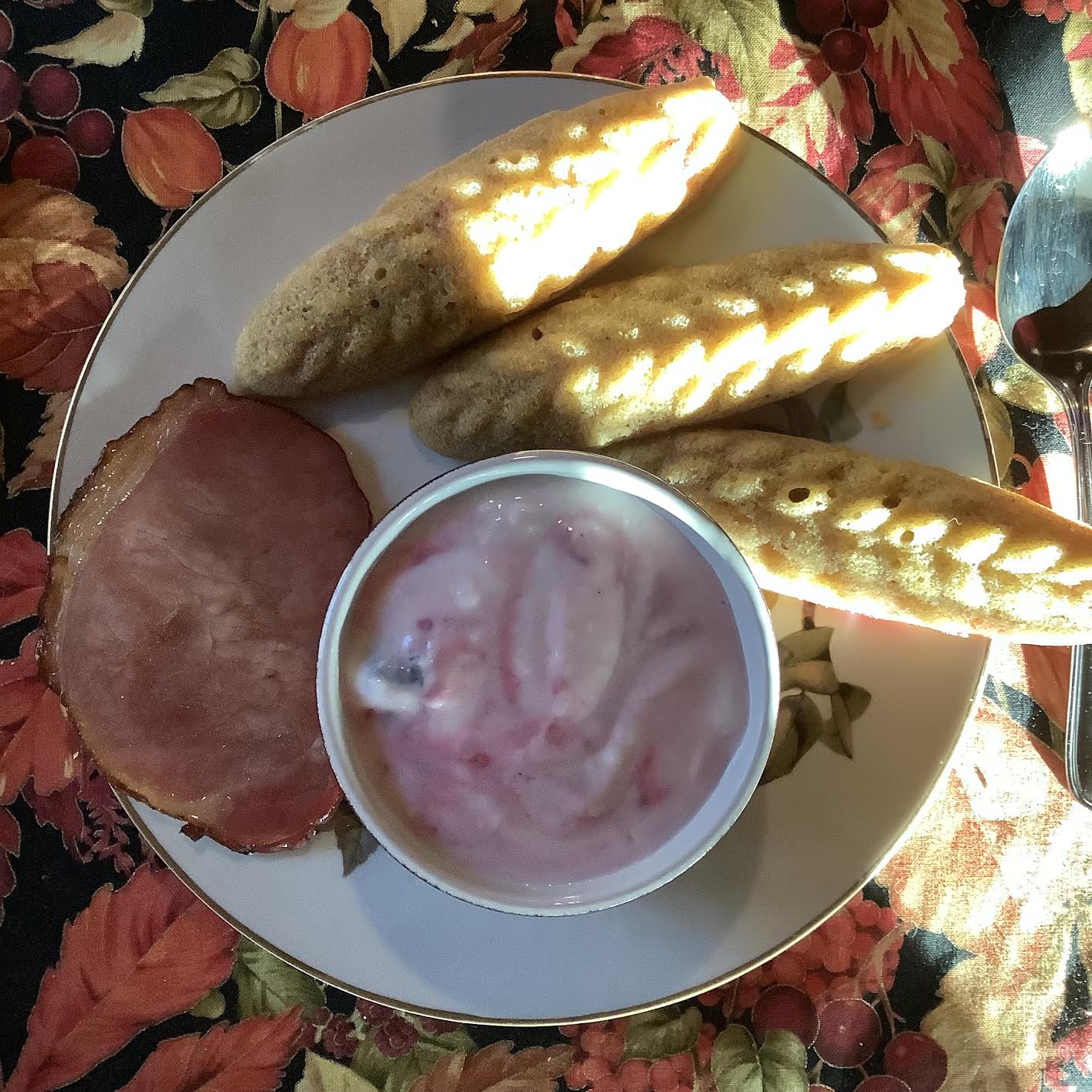
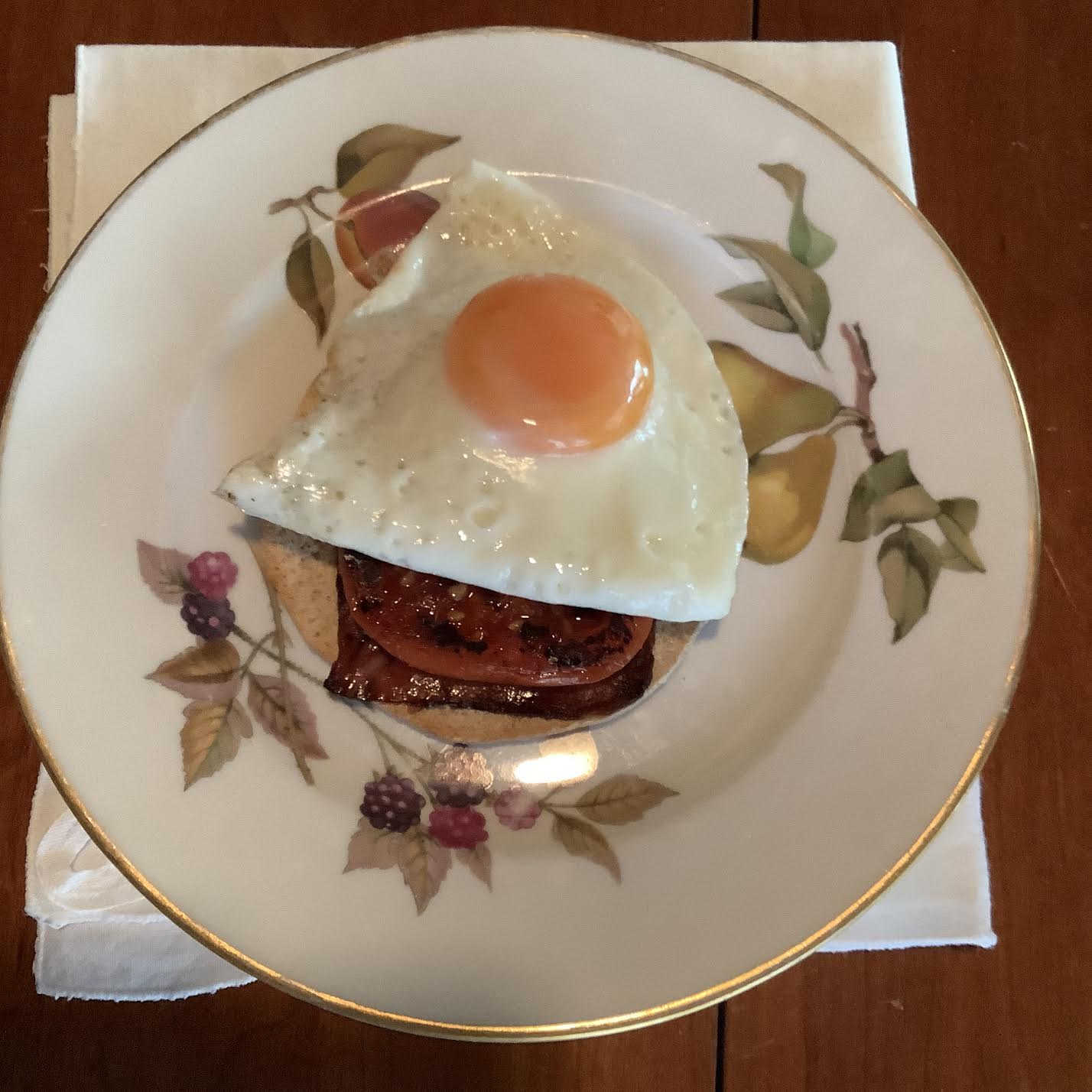
Ham & Mushroom ScrOmelette: 151 calories 8.5 g fat 2 g fiber 12 g protein 5.4 g carbs [4.5 g Complex] 56 mg Calcium   PB GF  These flavors go together so well that it would be a shame not to enjoy them at breakfast.

1½ eggs per person HINT: If you are serving one person, crack three 2-oz eggs into a small bowl or glass measuring cup. Whip up those eggs and pour half of their volume into a jar with a lid and put it in the ‘fridge for next week.  ¾ oz mushrooms, chopped 1/3 oz ham [from a roast; if you use 3%-fat ham from deli, the fat will be reduced] fresh herbs 2 oz pear OR ¼ cup raspberries OR 2 oz applesauce   Optional: blackish coffee [53 calories] or blackish tea or mocha cafe au lait [65 calories] or lemon in hot water   Optional: 5 oz fruit smoothie or berry-yogurt smoothie [88 calories]

Chop the ham and mushrooms and combine. HINT: I did this the night before. Heat a cast iron or non-stick pan and spritz it with oil or cooking spray. Add the ham/mushroom combo and stir to heat and cook the mushrooms, if raw. Whisk the eggs and pour into the pan, stirring to distribute the ham/mushrooms. Cook to your favorite degree of doneness. Dish up the fruit and brew your optional hot beverage. What a treat!

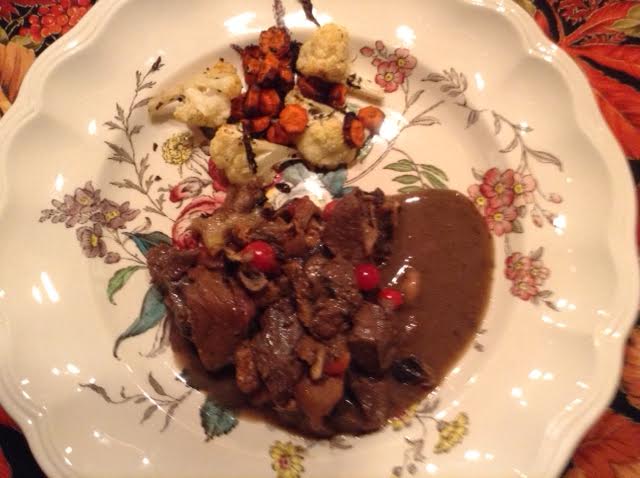
Pheasant Casserole: 250 calories 9.5 g fat 5.4 g fiber 22.5 g protein 21.6 g carbs [19 Complex] 86 mg Calcium   PB  This recipe is based on one from English Provincial Cooking by Elisabeth Ayrton and it dates back to the 18th century, when whole partridges were stewed with onion, carrot, and cabbage for 2.5 hours and served on thick slices of bread. Well, this is a modified version and it is delicious. This uses left over cooked pheasant meat and works well. You could substitute cooked turkey or chicken.

2½ oz cabbage, sliced 1-1½ ” thick 1½ oz baby carrots, cut in half lengthwise ¼ oz onion, cut in rings [which I forgot to put on the top] 2 Tbsp chicken or pheasant gravy 2 oz pheasant meat, cooked and taken off the bone ½ Arnold Multi-Grain Sandwich Thin

Prepare the carrots, cabbage, and steam them for 25 minutes until the carrots are tender. If the cabbage is not yet done, leave it in the steamer with the lid on but off the heat until needed. Warm pheasant meat in the gravy + 2 tsp of the water from the steaming-liquid. Warm the Arnold Thin in the toaster oven. Plate the bread. Spoon a tablespoon of gravy on top. Place the meat atop the bread. Stir the warm vegetables into the warm gravy and plate them. Put the raw onion rings on top and pour any remaining gravy over the meat.

Ingredients for next week: Breakfast, single portion for Monday …………………………… single portion for Thursday:

1 two-oz egg + zucchini1.5 two-oz eggs 
garlic powder + low-fat cottage cheesegreen bell pepper + onion
Parmesan cheese + cayennecatsup, no corn syrup 
pear/strawberries + herbes de Provenceraspberries
Optional smoothieoptional smoothie
optional hot beverageoptional hot beverage

Dinner, single portion for Monday:………………………….. single portion for Thursday:

lobster meat + heavy cream + Bechamel sauceground bison meat + egg
Dijon mustard + flat-leaved parsleycilantro + canned black beans
Green beans or Side Salad with tomatoescoleslaw
raspberries + peaches for dessertslider bun, 90 calories
Sparkling waterSparkling water

Pheidippides, Marathon messenger

How this Fast Diet Lifestyle works: Eat these meals tomorrow, for a calorie total of less than 600. On another day this week, eat the meals from a different post, another day of eating 600 calories or less. Eat sensibly the other days of the week. That’s it: a simple way to lose weight and be healthier. Welcome to Highwaypay who is now Following.

Everyone knows the story of the Battle of Marathon, which happened in September of the year 490 BCE, and of the messenger who raced the 25 miles to Athens with news of the outcome. Famously, he arrived, panting, at the Acropolis, announced the victory, and fell over dead. And people know that his name was Pheidippides. Or was it? Pheidippides was one of Athens’ professional couriers, a hemerodrome, or ‘day-long runner.’ In ancient Greece, the best way to communicate between city states was to send a runner with a message. Φειδιππίδης [his name in Greek] was one such man. When the Persians landed on the shores of Greece at field planted with ‘marathon’ — what we call fennel — the Athenian solons sent the 40-year-old Pheidippides to Sparta to ask for help. He ran the 150 miles in under 35 hours and delivered the message. The Spartans agreed to help, but would not start out for six days, as their practice was to fight by full moon. Since Athens needed to know that, Pheidippides had a meal and a nap and set out for Athens again. Thus he ran an ‘ultra-marathon’ — 300 miles/246 km — in four days. Sometimes he was running in his sleep and famously he had an exhaustion-induced vision of the deity Pan. All of this was recorded by the historian Herodotus who famously wrote about the Persian War. After the Greeks defeated the Persians, someone had to tell the home crowd, so a runner was sent, with the well-known result. But was it Pheidippides? Plutarch, writing much later, said that it was Thersippus. The 1879 Robert Browning poem names Pheidippides as the messenger, but omits the prior trip to Sparta, which was much more impressive. Organizers of the Modern Olympics in 1896, loving the romance of the fallen courier, included a 26.2 mile/42 km race called the Marathon. Maybe they thought the racers would die. The rest is history, as marathons are run all over the world, along with ultra-marathons and triathlons.

Our breakfast echoes the flavors of the Mediterranean, and provides protein for healthy muscles. Since modern marathoners like to ‘carbo-load’ the day before a race, our dinner involves a healthy pasta. In truth, hemerodromes ate figs, olives, cured meats, and a honey-sesame paste to keep them going.

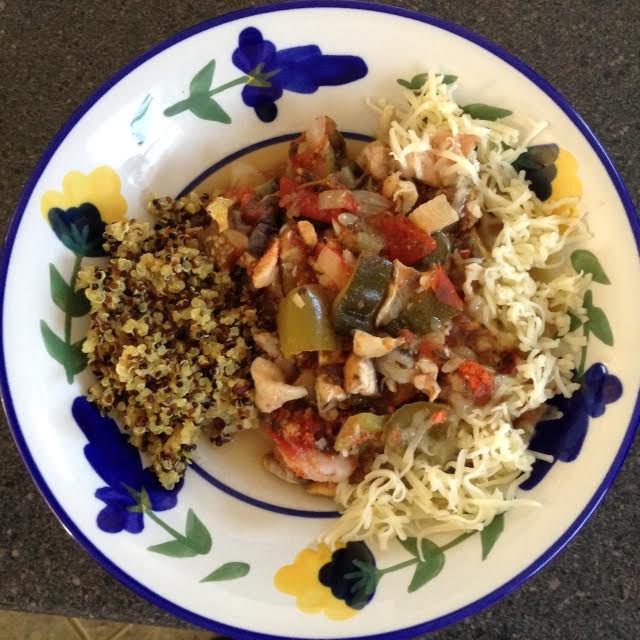
Mediterranean Bake: 138 calories 2 g fat 1.4 g fiber 10.4 g protein 8.4 g carbs [7.5 g Complex] 55 mg Calcium  NB: The food values given above are for the egg bake and fruit only, not the optional beverages.  PB GF  Oh! Those sunny flavors!

one 2-oz egg 1 Tbsp chevre cheese 4 Tbsp Mediterranean Vegetables without chickpeas  salt + pepper large pinch of Herbes de Provence 2 oz melon   Optional: 5 oz fruit smoothie or berry-yogurt smoothie [88 caloriesOptional: blackish coffee [53 calories] or blackish tea or mocha cafe au lait [65 calories] or lemon in hot water

Set the toaster oven at at 350 degrees F. Spritz a ramekin with oil or non-stick spray and spoon in the Med. Veg. Pop the ramekin in the warming toaster oven for 30 seconds to warm the vegetables. Whisk the egg with the cheese and seasonings. Pour in the egg mixture over the vegetables and bake in the toaster oven for 12-15 minutes, depending on how you like your eggs. Brew your optional warm beverage, shake and pour the optional smoothie, plate the melon. A fine way to start the rest of your life.

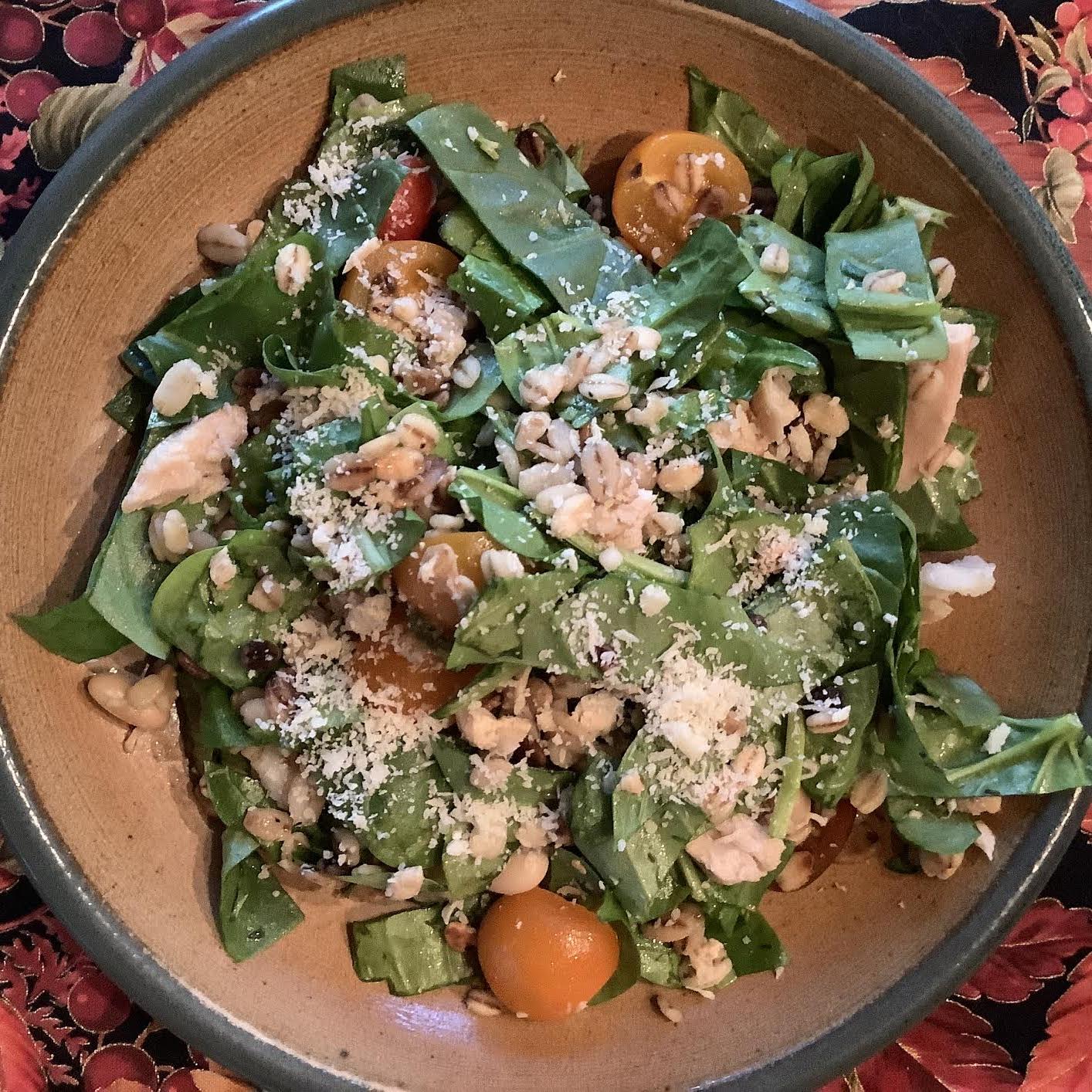
Tortellini with Black Kale:  182 calories 7.6 g fat 3 g fiber 8 g protein 23 g carbs [7.4 g Complex] 164 mg Calcium   PB  Quick, unusual, and good tasting. Dear Husband approved and he ususally says he doesn’t like kale. The recipe comes from theKitchn.com  TIP: This recipe serves 2 [two]

Here is a serving variation: combine the cooked kale with the cooked pasta and the tomatoes, stir, and top with grated Parmesan. The whole-grain bread adds calories and fiber.

56 g dried cheese & spinach tortellini = 210 calories [Barilla brand is good] 3 oz black kale 2 clove garlic 1 tsp olive oil red pepper flakes black pepper ½ tsp kosher salt 2 tsp lemon juice 4 oz tomato 2 Tbsp Parmesan cheese optional: 1 oz whole-grain bread

Preparation for the Kale for two people:

3 oz kale, preferrably Black aka Tuscan or dinosaur KaleUse your hands to pull the kale leaves from their stems. Coarsely chop the leaves. Rinse them, but do not dry.
1 tsp olive oil 2 cloves garlic
pinch red pepper flakes
Heat oil in large, wide, high-sided sauté pan over medium heat until shimmering. Add garlic and red pepper flakes and cook, stirring, until fragrant, about 1 minute (do not let the garlic brown).
¼ tsp kosher salt pinch ground pepper Add kale a few handfuls at a time, stirring as it starts to wilt, until all of the kale is added. Stir in the salt and pepper. Cover and cook, stirring occasionally, until the kale is just tender, about 5 minutes.
2 tsp Lemon juiceTake off heat, stir in the lemon juice, and plate.

For the Dinner: Bring a quart of salted water to the boil. As the kale is almost cooked, add tortellini [56 g (2/3 cup) to serve TWO] to the water. Cook 10 minutes, then drain and return to the pan. Add 2 oz diced tomatoes per person and 2 Tbsp grated Parmesan cheese. Stir gently until tomatoes are warmed through. Place the pasta in the center of the plate and arrange the kale around it. Pour any remaining sauce over the pasta.

Religions: the Shakers

How this Fast Diet Lifestyle works: Eat these meals tomorrow, for a calorie total of less than 600. On another day this week, eat the meals from a different post, another day of eating 600 calories or less. Eat sensibly the other days of the week. That’s it: a simple way to lose weight and be healthier.

Manchester, England [June 23, 2021] was not only a product of the Industrial Revolution, it produced one of the most successful Utopian societies in the United States. The Quaker meeting in Manchester took aspects of the French Camisard Protestants, who had fled to England, and developed a belief that churches did not need preachers or a ‘service of worship.’ Rather, individuals could receive revelations and visions which would tell them how the group should evolve. As mainstream Quakers dropped the shaking motions which gave them their nickname, the group in Manchester retained the practice. When they formed as separate sect in 1742, they called themselves the United Society of Believers in Christ’s Second Appearing, but the world called them ‘shaking Quakers’ and then Shakers. One of the early members was Ann Lee, a blacksmith’s wife who had worked in the textile mills since childhood. Her’s was a miserable marriage, marred by the death of her 4 children and her husband’s drunkenness. In 1770, she became the group’s leader. Four years later, she and seven followers [plus her husband] departed to America, determined to start a utopian living style that would be a Paradise on Earth. In Watervliet, New York, they founded their settlement: it was lead by one man and one women, since the sexes were equal. There was no marriage and no sex, all members living in two wings of the main house — men on one side, women on the other, each with their own staircase. Work and products were shared equally. Men worked heavy labor jobs in rotation: one week of stock-keeping, one of agriculture, one of building. Women did domestic chores in rotation: some days one would spin, other days work in the bakery or laundry. No one was locked into a job for life. Everyone was free to contribute an idea about anything. One day a woman noticed men working with a cross-cut saw. She went to the kitchen and cut a toothed-edge on a pie plate, thus inventing the circular saw. As the settlement prospered, local families came to join, since this communal way of life had appeal to struggling farmers. They gave their lands and livestock to the group, expanding the group’s wealth and productivity. In this way, the Shakers grew in population. Children were educated and had a free choice at age 21 to stay or to go. The Shakers also provided a social safety net for orphans. Mother Ann Lee died on September 7, 1784, just as Shakerism was beginning to catch on. They were known for their plain clothing and the singing and dancing at worship. By the end of the 1700s, there were 10 communities in the North-East. In the early 1800s, new groups were formed in Ohio, Kentucky, and Indiana. But after the Civil War societal and economic changes caused fewer men to join and by the early 1900s many villages had closed. There are only two Shakers remaining today, in Maine, but the legacy of inventions, distinctive architecture, and elegant furniture are testaments to their innovation and work ethic. “Hands to work and hearts to God,” said Mother Ann. Several historic sites are open to give a view of the unique Shaker lifestyle. They are well worth a visit.

Shaker cuisine was simple, good, and close to the land. They raised and processed all the food that they ate, flavouring it with herbs and fruits from their gardens. Our meals today incorporate those principles.

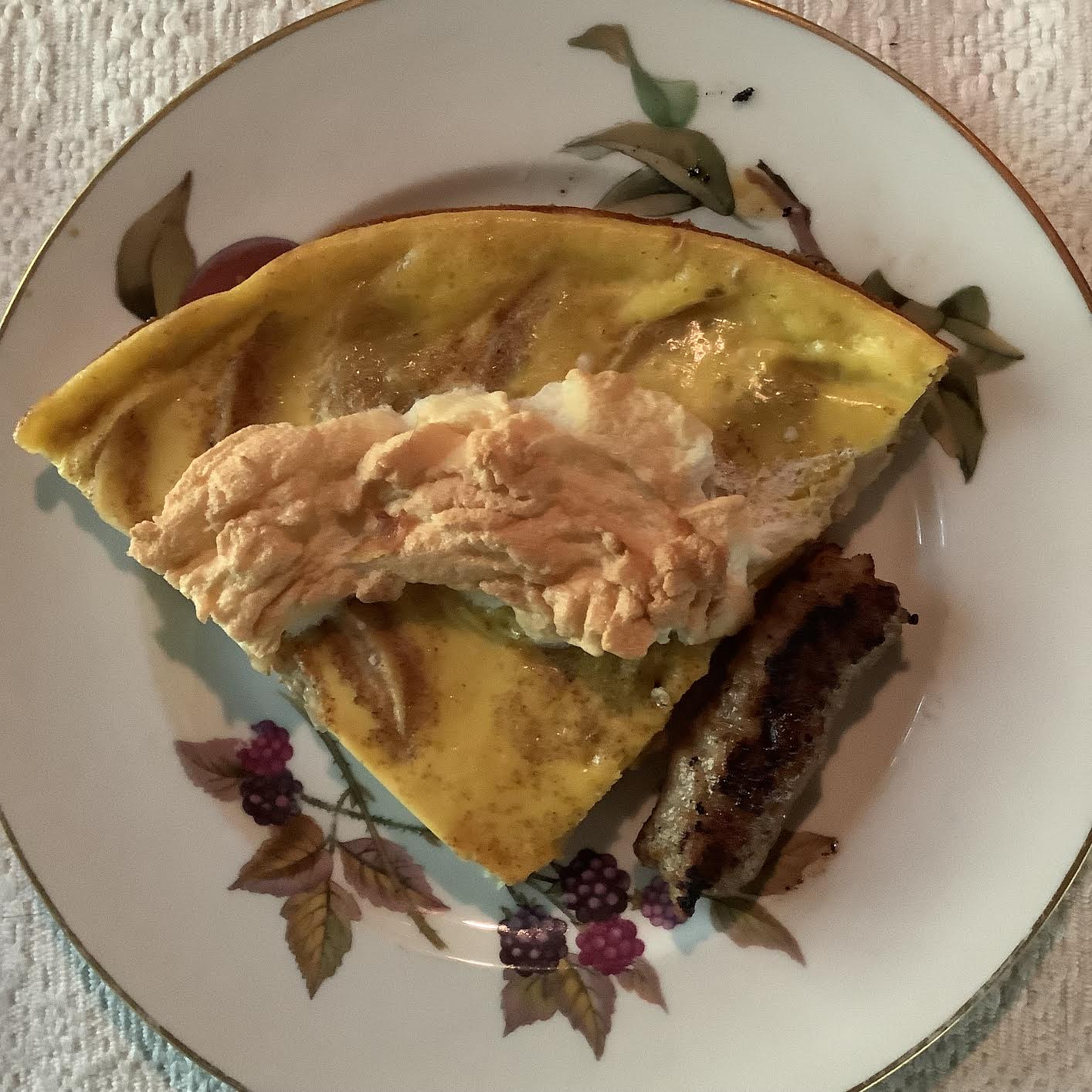
Ricotta-Herb ScrOmelette: 253 calories 7.5 g fat 0.7 g fiber 13 g protein 5.4 g carbs 61.5 mg Calcium  NB: Food values shown are for the ScrOmelette and fruit only, and do not include the optional beverages.  PB GF Easily prepared with ingredients on hand.

1 ½ two-oz eggs  HINT: If you are serving one person, crack three 2-oz eggs into a small bowl or glass measuring cup. Whip up those eggs and pour half of their volume into a jar with a lid and put it in the ‘fridge for next week.   1 Tbsp low-fat ricotta cheese, drained in a sieve overnight, if necessary 3-4 Tbsp fresh herbs – any ones you have – chopped salt & pepper 1.5 oz applesauce   Optional: blackish coffee [53 calories] or blackish tea or mocha cafe au lait [65 calories] or lemon in hot water   Optional: 5 oz fruit smoothie or berry-yogurt smoothie [88 calories]

Whisk the cheese and herbs into the eggs. Scramble or cook as a folded omelette. Enjoy with the beverages of choice and applesauce.

Zucchini, Stuffed:  300 calories 6 g fat 5.4 g fiber 29 g protein  25.5 g carbs 141.5 mg Calcium   PB GF  This Summer favorite is easy to prepare and very easy to eat.  HINT: this recipe makes enough for 2 [two] servings 

1 pound Zucchini = 3 slim eight-inch zucchini OR use one larger zucchini 4.5 oz chicken, cooked ¼ tsp olive oil ½ cup onion, chopped 1 clove garlic ½ cup cooked brown rice 2 Tbsp Parmesan cheese, grated ½ tsp salt + ¼ tsp paprika + ½ tsp dill weed + black pepper 2 Tbsp tomato juice, purchased

If using small squashes: Poach the whole zucchinis in simmering water for 3 minutes, then remove. Slit each one lenghtwise and scoop out the insides to leave a thin-walled boat.  If using large squash: Cut the zucchini in half and scoop out the insides. Then poach the zucchini in simmering water for 3-4 minutes, then remove. Chop the zucchini insides. Cook in olive oil and non-stick spray with the onions and garlic. Mince the chicken. Combine the contents of the saute pan with the chicken and all other ingredients, except the Parmesan. Spoon into the zucchini boats and use it all up. Sprinkle with Parmesan. Bake at 350 for 20 minutes. Plate and drizzle 1 Tablespoon of tomato juice over each portion.

Ingredients for next week: Breakfast, single portion for Monday …………………………… single portion for Thursday:

1 two-oz egg + herbes de Provence1.5 two-oz eggs 
chèvre cheese3%-fat ham
Mediterranean Vegetables without chickpeasmushrooms + herbs
melonraspberries
Optional smoothieoptional smoothie
optional hot beverageoptional hot beverage

Dinner, single portion for Monday:………………………….. single portion for Thursday:

dried cheese & spinach tortellini2 oz cooked pheasant meat + carrots
Black Kale + garlic pheasant or chicken gravy
olive oil + tomatoCabbage + onion
Parmesan cheese red pepper flakesArnold Multi-Grain Sandwich Thin
Sparkling waterSparkling water

Treaty of Portsmouth

How this Fast Diet Lifestyle works: Eat these meals tomorrow, for a calorie total of less than 600. On another day this week, eat the meals from a different post, another day of eating 600 calories or less. Eat sensibly the other days of the week. That’s it: a simple way to lose weight and be healthier. Welcome to Amol Sonawane who is now Following.

In January of 1904, Japan and Russia were rattling their sabers over Manchuria. Why? Because Russia wanted to pass through it to trade with China; because Japan thought it should be part of neighbouring Korea which Japan controlled; and because both wanted the natural resources there. Russia moved in extra troops, and Japan had to escalate. In early February, before Moscow knew that war had been declared, Japan attacked the Russian fleet at Port Arthur in a surprise raid — precursor for tactics at Pearl Harbor?? The two nations fought on the land and on the sea. All through 1904 and into 1905 they fought, with a terrible toll of blood and treasure. By late the end of the summer, both nations were exhausted and impoverished. They wanted the war to conclude — but on their terms. The Japanese asked Theodore Roosevelt, President of the United States to arbitrate. Negotiators met for months on the island of New Castle, New Hampshire, near Portsmouth. Everyone stayed and met at Wentworth-by-the-Sea, a grand hotel on the island. The local was splendid, but the way ahead was rocky. Issues at stake were the possession of Manchuria, the possession of Sakhalin Island, access to warm-water ports [for Russia], and what war reparations would be paid [by Japan]. Roosevelt popped in and out of the deliberations, making useful suggestions, and eventually everything was settled. Nobody ‘won’ the war and nobody was happy with the Treaty of Portsmouth which was signed on September 5, 1905, at the Portsmouth Naval Shipyard. The two nations divided the island and Manchuria, and no one payed any money. Impoverished Russia saw riots in 1905, and protests rocked Tokyo because of the treaty. American prestige was raised when President Roosevelt received the Nobel Peace Prize for his work, but relations with Japan were weakened. Wentworth-by-the-Sea is open for guests and it is a lovely place. Portsmouth is proud of the important treaty that bears its name, and there is an excellent display about the Russo-Japanese War at the John Paul Jones House in the city. History buffs and military enthusiasts will enjoy it.

Meals in honor of the treaty come from the nations of the antagonists: a very typical Russian breakfast and a simple sushi dinner from Japan.

Mushroom Smitane Scramble: 147 calories 7.5 g fat 1.5 g fiber 11.5 g protein 9 g carbs 67.4 mg Calcium  NB: Food values shown are for the ScrOmelette and fruit only, and do not include the optional beveragesPB GF  A recipe from Craig Claiborne’s NYT International Cookbook inspired this breakfast of Russian flavors. 

1½ eggs HINT: If you are serving one person, crack three 2-oz eggs into a small bowl or glass measuring cup. Whip up those eggs and pour half of their volume, into a jar with a lid and put it in the ‘fridge for next week.   2 Tbsp chopped scallion ½ oz mushrooms, chopped 1 Tbsp plain, fat-free yogurt big pinch paprika big pinch marjoram 1½ oz pear   Optional:blackish coffee [53 calories] or blackish tea or mocha cafe au lait [65 calories] or lemon in hot water   Optional: 5 oz fruit smoothie or berry-yogurt smoothie [88 calories]

Spritz a non-stick saute pan with non-stick spray. Put the mushrooms and scallion into the pan over-medium-high heat and cook them until they begin to wilt. Whisk the eggs with the yogurt and seasonings, and pour into the pan. Scramble to your liking, plate with the pear, and pair with the beverage of choice.

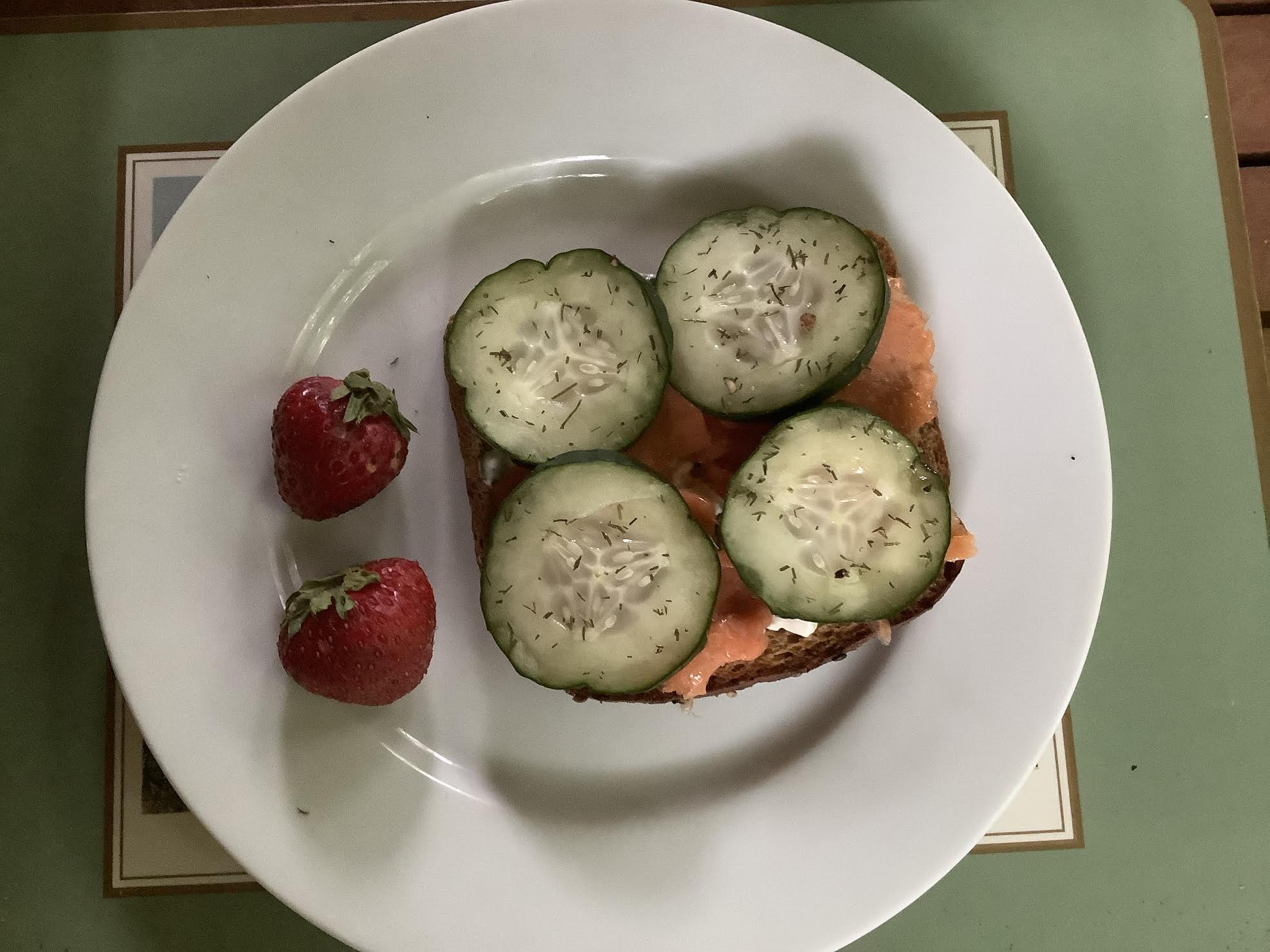
Mixed Sushi: 275 calories 11.6 g fat 5 g fiber 16 g protein 28 g carbs 39 mg Calcium  PB GF  Our younger son introduced us to this recipe. Imagine: ‘Sushi’ without raw fish or seaweed. Good use for leftover beef and avocado. HINT: This serves 2 [two]. Invite a friend or save for lunch or dinner another day. Made to be served at room temp.

1 cup brown rice, cooked and cooled  HINT: Make rice the day before and refrigerate or use leftovers from a previous meal  1 tsp rice wine vinegar 1 two-oz egg 1 tsp soy sauce 3 oz avocado, in long slices 1 oz grilled beef, in long strips OR substitute grilled chicken 2 oz smoked salmon, in long slices 2 oz cucumber OR zucchini, cut in long slices 2 spears asparagus

Combine the rice with the vinegar and let sit. Whisk the soy sauce with the egg and cook the egg as a flat omelette in a lightly-spritzed non-stick pan. Remove from the pan and cut egg into long strips. Slice the avocado, beef, salmon, and cucumber in long strips, but not longer than the diameter of the bowl in which you will serve it. Put the rice into two bowls with a wide diameter. Distribute the rice evenly over the bowl. Lay the other ingredients on top of the rice in what ever arrangement pleases you. Serve with extra soy sauce and enjoy a quick meal.

Slow Days: Granola

People who are new to Fasting often pose the questions: “Can I really eat ‘anything I want’ on a Slow Day?” and “What should I eat on Slow Days?” To answer those questions, I have decided to add some blog posts to show some of the foods we eat on what the world calls NFDs [non-fast days] but which, in our house, we call ‘Slow Days.’ This feature will appear sporadically. 

Now for the answers. Can you really eat ANYTHING you want on a Slow Day? Not really. If you eat too many calories every Slow Day, you will not lose weight. There are many questions asked on the Fast Diet Forum which attest to that. Once in a while you can splurge, as long as it isn’t everyday. For what to eat on Slow Days, Dr. Mosley recommends a Mediterranean Diet. As for how we eat, an example follows.

Granola is a cereal made of whole grains, nuts, and dried fruit. It differs from muesli in that granola is sweetened and baked. Good Friend Ann wanted to make some granola. She had a recipe from the box of Quaker Oats, then sent out a call to her circle of friends to solicit recipes, receiving two responses. Reading the three recipes got me curious about the history and nutrition values of granola.

In 1847, James Caleb Jackson set up a sanatarium in Dansville, New York. Like Maximilian Bircher in Switzerland [see Dr Bircher, August 21], Jackson thought that eating a better diet would improve physical health. One of the key ingredients was whole grains. Toward that end, he developed a dry cereal which he called ‘granula’ which was made of granules of dried Graham flour paste. John Kellogg, who had a health spa in Battle Creek, Michigan, ‘appropriated’ the recipe and marketed it for his own profit. A law suit caused Kellogg to change the name to ‘granola.’ In the 1970s, granola was rediscovered by the counterculture. Then it was commercialized and turned into a sweet, fatty product that neither Jackson nor Kellogg would neither recognize nor serve.

As you can see from this chart, granola packs a wallop when it comes to calories and fat per cup. But if you read the ‘suggested serving guide,’ one serving is usually 1/2 to 3/4 cup. Very few people think that 3/4 cup of cereal is sufficient, since they eat with their eyes rather than their brain, so sitting down to a big [read: 2 cups] bowl of granola for breakfast will give one lots of fiber and some protein, but a TON of calories, fat, carbs, and sugar. Then they add full-fat yogurt and chocolate chips and think how healthy it is. Good Grief.

Per batch# cupsCaloriesFat g Fiber gProtein gCarbs gCalcium mgSugar gr
MFE’s recipe7 cups3206106.75458543.5166240
Per cup45815.27.78.277.623.734.3
AHM’s recipe6 cups3152196.53449.5343.6193132.5
Per cup525325.68.2573222
DCP’s recipe~11 cups8074415.6140178.5944327.5377
Per cup73437.712.71685.829.734

Our family enjoys a recipe from the Peter Rabbit Cookbook, which our son was given as a toddler. This is easy to prepare and delicious. I find a 1/2 cup serving with milk to be quite satisfying.

Johnny Town-Mouse Granola from the Peter Rabbit Cookbook by Arnold Dobrin.

Makes 7 cupsPreheat oven to 250F.
4 Tbsp canola oil
½ c honey
Stir oil and honey together and warm in the microwave until they are liquid.
4-5 cups rolled oatsPut oats in a 9×13” pan and pour in the warm honey-oil. Stir until oats are all coated with the honey-oil. Bake 30 mins.
1½ cups total of any of the following: 
chopped nuts
chopped dried apples
chopped dried apricots
Take pan from oven and stir in these add-ins.
Distribute the granola evenly over the surface of the pan. Return to oven and bake 15 minutes.
½ cup raisins +/or dried cranberriesRemove pan from oven, stir in raisins/cranberries.
Let cool in the pan, then store in glass jars.

Saint Giles

How this Fast Diet Lifestyle works: Eat these meals tomorrow, for a calorie total of less than 600. On another day this week, eat the meals from a different post, another day of eating 600 calories or less. Eat sensibly the other days of the week. That’s it: a simple way to lose weight and be healthier.

 Αἰγίδιος was born in Greece, part of the Eastern Roman Empire, around 650 CE. His life may or may not have occurred, but his story is a good one. He joined the church as a young man and, according to the legend, he sought the life of a simple hermit. This was not possible for him in Greece, so he moved to Marseille, a former Greek port in Provence [France], then a part of the Frankish Empire. There his name turned into Giles/Gilles. Going farther from civilization, he lived in seclusion near what is now St-Gilles near the Rhone Estuary. He ate locally foraged foods and the milk of his friend, a doe [often referred to as a hind]. When the hind was pursued by the local headman [called Wamba in the legend] and his hunters, she ran to the safety of Giles’ hermitage. An arrow shot at the deer, struck Giles in the knee [and/or hand]. The headman met Giles and was so impressed by his patience and humility that he gave Giles land on which to build a monastery. The arrow wound left Giles with a limp, making him a Patron of the differently-abled. A chapel was built in the 7th century, but was not named for St. Giles until the 900s. It can be seen today with its 12th century exterior, although the interior was remodelled often. The saint is said to be buried in the crypt, although other churches claim that honor too. Giles became a popular saint after his death around 710 CE. He is considered to be one of the Holy Helpers, and his story is an excellent example of living gently with nature.

For his supposed Greek origin, a breakfast with cheese — in honor of the milk of the hind. For dinner, a meal without meat, befitting a Christian vegetarian like Giles. You can eat like a saint on his Feast Day, September 1st.

Greek ScrOmelette: 152 calories 9 g fat 0.6 g fiber 12.6 g protein 4 g carbs [3 g Complex] 88.5 mg Calcium   NB: Food values shown are for the ScrOmelette and fruit only, and do not include the optional beverages.  PB GF  Feta cheese is such a lovely ingredient — we should use it more often.

1½ two-oz eggs  HINT: If you are serving one person, crack three 2-oz eggs into a small bowl or glass measuring cup. Whip up those eggs, pour half of their volume into a jar with a lid, and put it in the ‘fridge for next week.  0.37 = 3/8 oz feta cheese, reduced fat 1 Tbsp tomato puree [not tomato paste] large pinch of cinnamon + of oregano 1 Tbsp pomegranate seeds –OR– 1¼ oz applesauce sprinkled with cinnamon -OR- 1¼ oz apple  Optional: blackish coffee [53 calories] or blackish tea or mocha cafe au lait [65 calories] or lemon in hot water   Optional: 5 oz fruit smoothie or berry-yogurt smoothie [88 calories]

Cream the tomato puree with the feta cheese and seasonings, then whisk in the eggs. OR Whisk the eggs and pour into the pan. As soon as the bottom of the eggs sets, spread the cheesse-tomato-seasonings on top of the egg. Scramble or cook as an omelette. Prepare the beverages and spoon out the pomegranate/apple for a real taste of Greece.

Galettes w/ Mediterranean Vegetables: 266 calories 7.6 g fat 6.5 g fiber 16 g protein 35 g carbs 282 mg Calcium  PB  This simple meal comes together in no time flat. [It does help if your have previously prepared galettes and Mediteranean Vegetables on hand, so keep some handy in the freezer.]

2 buckwheat galettes 1 cup Mediterranean Vegetables with chickpeas 1 oz mozzarella

Gently warm the galettes on a griddle. Warm the Vegetables in a sauce pan, then stir in the mozzarella, and heat briefly. Divide between the galettes and dinner is served.

Ingredients for next week: Breakfast, single portion for Monday …………………………… single portion for Thursday:

1.5 two-oz eggs + pear1.5 two-oz eggs 
scallion + mushrooms reduced-fat ricotta
plain, low-fat yogurtapplesauce or apple
paprika + marjoramfreshest herbs possible
Optional smoothieoptional smoothie
optional hot beverageoptional hot beverage

Dinner, single portion for Monday:………………………….. single portion for Thursday:

cooked brown rice + 1 two-oz egg 1 pound zucchini + paprika + dill weed
avocado + soy sauce + rice vinegar cooked chicken + Parmesan cheese
cucumber or zucchini + smoked salmonolive oil + onion + garlic
grilled beef or chicken1/2 cup cooked brown rice
Sparkling waterSparkling water

Star-Crossed Lovers, Abelard & Heloise

How this Fast Diet Lifestyle works: Eat these meals tomorrow, for a calorie total of less than 600. On another day this week, eat the meals from a different post, another day of eating 600 calories or less. Eat sensibly the other days of the week. That’s it: a simple way to lose weight and be healthier. Welcome to johnjo2016 who is now Following.

My mother said that there are seven basic plots in literature, and one of them is the story of the “Star-Crossed Lovers.” This plot centers around two people who are in love yet fate intervenes, in one way or another, to keep them apart. Shakespeare coined the term, implying that one’s astrology [one’s stars] controlled one’s destiny. In real life there are star-crossed lovers and one such famous pair is that of Abelard & Heloise. When they first met in 1115 CE, he was a 37-year old academic, theologian, and a renowned philosopher. She was a teenaged academic phenom and an acclaimed beauty. In the 12th century, only places of learning were the religious houses and institution. Heloise, of uncertain heritage, had been adopted by her uncle Fulbert, who, although not a churchman, held a high post at Notre Dame Cathedral. He had seen to it that she had an excellent education in philosophy and theology and letters. As a young woman, her writings were widely read and admired. Canon Fulbert seems to have esteemed his niece and loved her perhaps too jealously. Abelard was from a minor noble family in Brittany. Instead of becoming a Breton knight like his father, he became a philosopher, studying all over France. He did not take holy orders, despite years of theological training, and became the head of the school of Notre Dame in Paris. Young Heloise, eager to pursue her education but unable to attend university with all the men, was to be tutored at her uncle’s house. Abelard took the position of tutor, with free room and board as payment. First there was a meeting of minds, as two of the most recognized philosophers of the day. Then there was a meeting of the flesh. Heloise was firm in her beliefs that there is no sin if the intent is not sinful. She also viewed marriage as ‘contractual prostitution,’ no doubt referring to arranged marriage in which the woman had no say and was sent off to live with a stranger. Their affair resulted in a pregnancy. Abelard sneaked Heloise off to his sister in Brittany, where baby Astrolabe [!? Why name your baby after an Arab astronomical instrument??] was born. Despite her reservations about marriage, Heloise agreed to wed Abelard in secret. At the time, the church was beginning its preference for celibate leaders, hence the secrecy. Uncle Fulbert grudgingly agreed to the marriage, but when Abelard hid Heloise from him in a convent, Fulbert thought that Abelard had sent her there to get rid of her. While Heloise waited for her husband, Fulbert sent a pack of men by night to attack Abelard in his bed and castrate him. Retiring from the world, Abelard joined a monastery. Heloise eventually took the veil. He became a bishop, she became an abbess. And they wrote letters to each other, reliving their love affair and discussing questions of philosophy and religion. The talk of the town in their own day, their story was revived a century later by troubadours. A translation of their letters was published in 1713. The Romantics of the 1800s, recast the lovers in art and literature to appeal to the time. Today, the reaction is likely to be ‘ick!’ due to the age disparity and seeming power imbalance. In his letters, Abelard implies that he was the aggressor in the relationship — perhaps to absolve Heloise of any blame. Yet Heloise counters that she initiated the liaison and was a willing participant. A different type of ‘he said-she said’ indeed! She died around 1163 and they are supposedly buried in Pere Lachaise Cemetery in Paris. Young lovers of today leave letters for them at the site.

For their escape to Brittany, a breakfast with curry, artichokes, and apples — perfect for a new start in life. For dinner, two flavors that go together like Abelard and Heloise: mussels in tomato broth.

Breton Bake: 149 calories 6.5 g fat 3.4 g fiber 9.4 g protein 13.5 g carbs 103 mg Calcium NB: The food values given are for the egg dish and the fruit only, and do not include the optional beverages. PB GF Delicious. Filling. Different.

1 two-oz egg 2 Tbsp crushed tomatoes 2 Tbsp artichoke hearts, canned or frozen ½ tsp curry powder 1 Tbsp fat-free ricotta 2 oz applesauce, unsweetened   Optional:  5 oz fruit smoothie or berry-yogurt smoothie [88 calories]   Optional: blackish coffee [53 calories] or blackish tea or mocha cafe au lait [65 calories] or lemon in hot water

Chop the artichoke hearts. Stir together the artichokes, tomatoes, curry, and ricotta. Whisk in the egg and pour into an oven-safe dish which has been spritzed with non-stick spray. Bake at 350 degrees F. for 20 minutes. Meanwhile, brew prepare any optional beverage and portion the applesauce. Enjoy your breakfast on the Cote d’Amor.

Mussels in Tomato Broth: 275 calories 7 g fat 4 g fiber 18 g protein 32 g carbs 84.5 mg Calcium  PB GF — if using GF bread  Another wonderful way to enjoy these best of bivalves, without the mess of the shells. Rich and flavorful!

3 oz steamed mussel meat [1# mussels steamed with garlic + thyme + parsley in 1” water, 15 minutes. Drain, saving the broth. Remove shells, saving the meats — you will have extra.]  ¾ c tomato-mussel broth, below Side Salad, below fresh basil 1.5 oz whole wheat baguette.

Add the mussels and ¾ cup Tomato Broth to a pan and simmer until warmed through. Pour into a pasta bowl and top with fresh basil. Serve with salad and bread on the side.

Tomato-Mussel Brothmakes 2¼ cups
1 tsp olive oil  ¼ c onion, choppedHeat oil in 8-9” saute pan, then cook onions until transluscent.
2 cloves garlic, choppedAdd garlic and cook less than a minute. 
1 cup mussel broth
15 oz diced or whole tomatoes, canned  1 tsp Italian Herbs 
pinch red pepper flakes  2 tsp capers
Add to the pan and bring to a boil.
Turn down heat and simmer until broth measures 2¼ cups. Divide in 3 equal portions of ¾ cup.

Side Salad: 1 cup baby greens or sliced lettuce leaves ½ tsp olive oil ½ tsp cider vinegar pinch salt grind of black pepper

Saint Louis

How this Fast Diet Lifestyle works: Eat these meals tomorrow, for a calorie total of less than 600. On another day this week, eat the meals from a different post, another day of eating 600 calories or less. Eat sensibly the other days of the week. That’s it: a simple way to lose weight and be healthier.

Louis Capet, the ninth of his name, became King of France in 1226, when he was 13 years old. His mother, the formidable Blanche of Castile, had been regent for seven years — a ‘tiger mom’ fighting for the rights of her son against nobles who would have weakened his power, and her’s. Influenced by his mother, Louis was strong in his Christian faith. He attended mass twice each day and spent great sums of money to bring relics such as the Crown of Thorns to France. To house it, he ordered the construction of La Sainte Chappelle, an exquisite jewel-box of a church which is shaped like a reliquary — only fitting since its sole purpose is to house a relic. The Chapel is a breath-taking masterpiece of Gothic design. To his detriment, Louis lead two crusades to the Holy Land. On the first, much of the army died of disease and Louis was captured. On the second, he died of scurvy in Tunisia on August 25, 1270. He was canonized only 17 years later, due to many miracles in his name. Saint Louis is also the name of the principal city of Missouri, USA. Its location at the confluence of the Mississippi and Missouri Rivers made it a center of Native American culture. They built extensive mounds on both sides of the rivers, such as those seen at Cahokia, Illinois. French fur traders arrived in 1764, starting a settlement which they named after the 9th Louis of France. The area was held by the Spanish for a bit, then became part of the United States in 1804 with the Louisiana Purchase. Today, St Louis is known for the Gateway Arch, its Blues Music, its sports teams, its style of pork BBQ, and as the home of Budweiser Beer. It was the location of the 1904 World’s Fair which prompted the 1944 Judy Garland film Meet Me In Saint Louis.

Today’s meals are from the American heartland in the Missouri and Mississippi River watershed. Louis’ death from scurvy was preventable had he eaten more fruit and vegetables. As an ardent religious faster, he had an unbalanced diet. Had he partaken of today’s menu, he might have survived longer.

Pineapple Pompeii: 205 calories 5.4 g fat 3 g fiber 10 g protein 27 g carbs 26.6 mg Calcium  NB: Food values shown are for the plated foods only, and do not include the optional beverages.  PB GF  This is served in in the Mid-West as a side dish to baked ham, but I put the ham in the casserole to make a complete meal. The fanciful name is unique to the neighbor who gave me the recipe.  HINT: Serves 8 as breakfast.

Here, the pineapple Pompeii is cut into 3 pieces, as is the peach.

1 piece of Pineapple Pompeii 1 oz peach   Optional: blackish coffee [53 calories] or blackish tea or mocha cafe au lait [65 calories] or lemon in hot water   Optional: 5 oz fruit smoothie or berry-yogurt smoothie [88 calories]

Serve with the peach and optional beverage. Freeze the pieces that you don’t use today for another meal.

Pineapple Pompeii  8 pieces
1 Tbsp butter  ¼ cup loosely-packed brown sugar Cream the butter and sugar together.
5 cups whole-grain bread cut in cubes 4 two-oz eggs Add bread cubes and eggs to the bowl. Stir to combine. 
20 oz can crushed pineapple, drained and saving the juice 2/3 cup 3%-fat ham, cut in ¼” dice Add these. Stir to combine. Batter should be moist — add some drained pineapple juice to bring it to the right consistancy. 
Spray a 6×10” baking pan with non-stick spray and pour in the batter. Smooth it into the corners and bake 25 mins at 350F for, until set and starting to brown. Cut in 8 pieces.

Chicken-Stuffed Tomato: 293 calories 16 g fat 4.5 g fiber 25 g protein 13 g carbs 64.5 mg Calcium  PB GF  This is certainly a staple of the late-Summer repertoire, lightened considerably from the standard recipe.

5 oz tomato, about 3” in diameter 3 oz cooked chicken meat, from thighs/breast 2 Tbsp chopped scallion 1 Tbsp mayonnaise [60 cal/Tbsp] 1 tsp capers 2 tsp caper juice 3 oz string beans, yellow + green

Put the chicken in the food processor and pulse it until it is shredded but not turned into a paste. There will be about 1-1/3 cups of meat. Add the scallion, mayonnaise, capers, and caper juice. Pulse two or three times to combine. Slice the tomato ‘on the latitude lines’ to produce 3 thick slices. Salt them and place on the serving plate. Steam the beans. Using a scoop or large spoon, portion the chicken salad on the tomato slices. Arrange the cooked beans on the plate, add a sprinkle of finishing salt, and enjoy a colorful Summer repast.

Ingredients for next week: Breakfast, single portion for Monday …………………………… single portion for Thursday:

1 two-oz egg1.5 two-oz eggs 
curry powder crushed tomatoescinnamon + oregano
lower-fat ricottafeta cheese + tomato puree
artichoke hearts applesauce or slicespomegranate seeds or applesauce
Optional smoothieoptional smoothie
optional hot beverageoptional hot beverage

Dinner, single portion for Monday:………………………….. single portion for Thursday:

Mussel meats + olive oil  + whole-wheat baguettebuckwheat galettes
onion + garlic + mussel broth + capersMediteranean Vegetables with chickpeas
Canned tomatoes + Italian Herbsmozzarella
red pepper flakes + salad greens + vinegar
Sparkling waterSparkling water

Dr Bircher

How this Fast Diet Lifestyle works: Eat these meals tomorrow, for a calorie total of less than 600. On another day this week, eat the meals from a different post, another day of eating 600 calories or less. Eat sensibly the other days of the week. That’s it: a simple way to lose weight and be healthier. Welcome to Tamara Hoerner who is now Following.

Dr. M.O. Bircher

The 1800s saw many changes in the world and changes in people’s commonly-held beliefs. There were revivals in religion, leading to the start of many new sects. There were new discoveries in medicine regarding germ theory and vac-cines. And there were new ways of eating. On one hand, processed foods were developed, while on the other hand, people flocked to sanatoriums and health spas to change their diets. One such spa was the Vital Force Sanitarium, run by Maximilian Oscar Bircher. [The name acquired a hyphen when he married Elizabeth Benner.] Bircher was a trained medical doctor who became increa-singly interested in nutrition as a tool for making people well. A bout of jaun-dice convinced him that eating raw apples promoted health. From there, he developed the idea that fruits, nuts, and vegetables derived and stored sig-nificant ‘vital force’ from the sun — a force that was weakened when foods were cooked. Bircher gave up meat, claiming that, being dead, it introduced decay into the body. Bircher’s sanitarium was wildly successful. Patients were evaluated by the staff, then followed an individualized program of diet [raw food at every meal, preceded by a mixture of soaked oats and grated apples invented by his sisters]; exercise [working in the spa’s vegetable gardens]; hydrotherapy [cold baths and showers]; and brisk walks in the sunshine. The spartan routine of early-to-bed-early-to-rise, the rigor of the therapies, and the absence of alcohol, coffee, sweets, and processed food lead Thomas Mann to call it a ‘health jail.’ But it proved the theory that the harder people have to work to achieve a goal, the more they embrace it. Medical professionals scoffed at Bircher’s views of nutrition, but his idea that it was healthy to eat lots of fruits and vegetables was verified in the 1930s with the discovery of the importance of vitamins and minerals. The spa outlived Bircher’s death in 1939, but closed decades later. Today in Braunwald, one finds the Centre for Scientific Natural Medicine where ‘the tonic and balancing result of the water, the sun, the light, cold and warmth, as well as physical exercise, revive therapeutic properties in the patient; they help sustain the enlivening effect of the diet.’ They purport to treat an array of illnesses but I don’t know if they serve muesli.

For breakfast, Dr Bircher’s famous muesli, of course. Although Bircher called it d’Spys, people began to call it ‘muesli’ meaning ‘little mush’. Sounds better in German. For dinner, a meal heavy on the vegetables. Dr Bircher would have preferred that the vegetables would be raw, but a light steaming won’t hurt.

re Muesli: the following recipe is almost identical to Bircher’s own — I reduced the apple amount and added the blueberries. Modern-day muesli was first packaged in the 1950s. Today it is conceived as a mixture of overnight-oats, honey, lots of seeds, yoghurt, dried fruit, and nuts — packing tons of sugar and fat and calories. Dr Bircher would not approve.

Muesli: 211 calories… 7.4 g fat… 5.5 g fiber… 7.5 g protein… 33.5 g carbs… 117.6 mg Calcium…  PB GF – if oats are truly GF  This is a smaller, leaner portion of the original recipe of the Bircher-Benner muesli. It is truly a delicious and satisfying way to start the day.

1 serving
2 Tbsp rolled oats
4 Tbsp whole milk
In a cereal bowl, mix oats and milk, cover, and refrigerate overnight to soften the oats.
5 oz apple, with skin on
2 tsp lemon juice
Grate apple, mix with lemon juice. HINT: do this the night before. Next, morning, add to the oat mixture, stir to combine.
5 raw hazelnuts, or almonds, chopped
2 Tbsp blueberries
Sprinkle with nuts and berries, and serve.
Herbal tea, no sweetener, no milk Serve with herbal tea of your choice.

Antipasto with Tuna: 282 calories… 10.6 g fat… 9 g fiber… 20 g protein… 24 g carbs… 250 mg Calcium…  PB GF  This one is a keeper: simple, off the shelf, pretty on the plate, good to eat. The photo shows enough for 2 people. Invite a guest who is Fasting, too.

++ 2 oz roasted red pepper, without oil [roast your own, slice and freeze them] ++++ 2 oz mozzerella, cut into ‘sticks’ ++++ 3 oz tuna, packed in water, drained and broken into large chunks ++++ 5 oz tomato slices ++++ 3 oz whole green beans, steamed ++++ 1½ oz marinated mushrooms ++++ 1/3 c. canned garbanzo beans, drained ++++ 4 black olives, pitted and sliced ++++ 3 slices pepperoni, chopped ++++ 1 tsp flavored oil ++++ flavored salt ++++ chopped fresh herbs ++

Prepare the ingredients and keep separate. On a platter, arrange the ingredients in rows as shown in the photo. Suit your own artistic nature as to what goes where. Be liberal with the fresh herbs.

Saint Helena

How this Fast Diet Lifestyle works: Eat these meals tomorrow, for a calorie total of less than 600. On another day this week, eat the meals from a different post, another day of eating 600 calories or less. Eat sensibly the other days of the week. That’s it: a simple way to lose weight and be healthier.

Flavia Iulia Helena was born around 250 CE in Roman Anatolia to an undistinguished family. While occupied as a stable-hand or inn-keeper [rendered as ‘stabularia’ in the histories], she caught the eye of Flavius Valarius Constantius, a Roman military officer. Was she his mistress? or his lawful wife? or his common-law consort? Even Saint Jerome, who wrote her biography, couldn’t say. They had a son in 272 named Constantine. In 293, while he was fighting to maintain Roman dominance in Britain and Gaul. Constantius ‘put aside’ Helena and married the daughter of the powerful Maximillian. When his father died, Constantine was hailed as leader of the Western Empire, becoming full Emperor in 324. Helena was very close to her son and he honoured her with titles. Somewhere along the line, she had become a Christian convert. In 325, she set off for Jerusalem to find relics. When she located a holy site, she tore down what was on it and built a church. In the area which she believed to be Golgotha, she began to dig. She found three wooden crosses and nails. To test her idea that one of them was the True Cross, Helena presented a dying woman with three pieces of wood. When the woman touched the third one, she was cured. Helena took the pieces of the True Cross and nails from the Crucifixion to Rome. Jesus’ tunic, which she also found, was sent to Trier where it is still at the cathedral. In the British Isles, the legend says that Helena was a British princess who buried part of the True Cross in Wales. Not true. Helena died around 328 and was buried in Rome. She was named a saint, as was her son.

Turkey Picatta ScrOmelette: 145 calories 7.5 g fat 1 g fiber 13.6 oz protein 5.5 oz carbs 51 mg Calcium  NB: Food values shown are for the ScrOmelette and fruit only, and do not include the optional beverages.  PB GF  Delicious morning meal.

1½ two-oz eggs  HINT: If you are serving one person, crack three 2-oz eggs into a small bowl or glass measuring cup. Whip up those eggs and pour half of their volume into a jar with a lid and put it in the ‘fridge for next week.  1/3 oz turkey breast, cooked or raw 1 tsp capers ½ Tbsp shallots, minced ½ Tbsp lower fat cottage cheese 1 oz pear  Optional: blackish coffee [53 calories] or blackish tea or mocha cafe au lait [65 calories] or lemon in hot water   Optional: 5 oz fruit smoothie or berry-yogurt smoothie [88 calories]

Chop the shallot and turkey. Spritz a fry pan with olive oil or non-stick spray and stir the shallot-meat until they are cooked. Whisk the eggs with the cheese and capers. Pour into the pan, stirring to mix with the shallots and turkey. Cook to your liking, fold and plate with the fruit. Pour your beverages of choice.

Turkey Picatta: 257 calories 5 g fat 1.3 g fiber 31 g protein 21 g carbs 28 mg Calcium  PB GF Rush Hour Cooking provided this recipe which is one of our all-time favorites. Quick and delicious.

4 oz uncooked turkey breast salt & pepper  ½ tsp olive oil 1 Tbsp white wine 2 tsp capers 1/3 cup chicken stock 1.5 tsp lemon juice 2 Tbsp shallots, minced pinch garlic powder 3 oz tomatoes, sliced ¼ cup brown rice, optional

Combine the wine, stock and lemon juice. Pound the turkey meat, if needed, to even out the thickness. Sprinkle with salt & pepper. Heat olive oil over medium-high heat and cook the turkey on both sides until cooked through, adding a little of the stock mixture if needed. Remove turkey to a plate and keep warm. Add the stock mixture and shallots to the pan along with the garlic powder, stirring up the brown bits on the pan. Cook down until only 3-4 tablespoons of sauce remain. Lastly add the capers. Warm the rice [if using cooked left-over rice] and slice the tomatoes. Plate the rice, drizzling 1 Tbsp sauce over it. Plate the turkey, pouring the remaining sauce on it. Plate the tomatoes.

Ingredients for next week: Breakfast, single portion for Monday …………………………… single portion for Thursday:

rolled oats + apple2-4 two-oz eggs  + 3%-fat ham
whole milkwhole grain bread + butter
lemon juicecanned crushed pineapple
hazelnuts or almonds peach + brown sugar
optional smoothie
optional herbal tea optional hot beverage

Dinner, single portion for Monday:………………………….. single portion for Thursday:

roasted red pepper + pepperonifresh red ripe tomato
fresh herbs + olive oil + tomatocooked chicken meat
mozzarella + chickpeas + marinated mushroomsmayonnaise + capers + scallion
canned tuna + green beansstring beans
Sparkling waterSparkling water