Marie Tharp

How this Fast Diet Lifestyle works: Eat these meals tomorrow, for a calorie total of less than 600. On another day this week, eat the meals from a different post, another day of eating 600 calories or less. Eat sensibly the other days of the week. That’s it: a simple way to lose weight and be healthier. Join me in the Fasting Lifestyle.
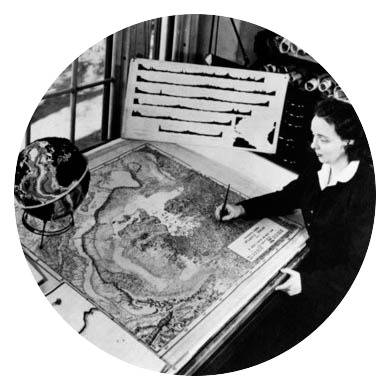
Perseverance and insight were the keys to success for Marie Tharp, explaining how she went from being a simple cartographer to over-turning the entire field of Earth Science in the 1970s. Marie was born on July 30, 1920, in Michigan, but she did not stay there long. Her father was a soil surveyor with the US Department of Agriculture. He moved his family frequently so that he could do field work on the nature and extent of soil bodies. Little Marie would go out into the field with him often, although at the time she was not interested in science. At the University of Ohio, she first studied art, then German [her mother had been a German teacher], and at last she discovered geology. This was not a field open to women at that time, so her professor suggested that she take the course in drafting [drawing geologic maps] to maximize her job opportunities. By then, WWII was on, and the University of Michigan advertised for women to study petroleum geology. Marie applied and received a Master’s Degree. Her first job was in Oklahoma to work for Stanolind Oil. As a woman, Tharp was given desk work and she dealt with boredom by earning a degree in math from University of Tulsa. In 1948, she accepted a job with Lamont Geological Laboratory (now the Lamont-Doherty Earth Observatory at Columbia University) — hired not as a research scientist, but as research assistant to help undergraduate boys with their work. Again, she was bored, so she quit. Quickly rehired, Tharp was assigned to work with Bruce Heezen who was working on a project to lay under-sea cables. To do that, they had to know what the sea floor looked like — and no one knew. Alfred Wegener had put out his theory that the sea floors were flat and that the continents slid around over them, sometimes bumping into each other. These ideas were considered absurd. Using the new technology of radar/sonar soundings, Heezen set out to study the floor of the North Atlantic. He and his crew sailed across the ocean, taking soundings all the way. It would have made sense for his cartographer, Marie, to be on board to work with these data, but women were not allowed as crew on research vessels. When she finally received the data, Tharp used them to draw a profile of the sea floor. It wasn’t flat! In the middle of the ocean was a high mountain range, with a deep valley in the center. Heezen did five more trans-ocean voyages, and Marie’s cross-sections showed the same thing each time. Then Heezen compared the location of this central valley with earthquake data, and found that there was a correlation. What was the connection? When Tharp suggested that the valley was a ‘rift’ in the Earth’s crust, where the crust was moving, Heezen dismissed the idea as ‘girl talk’, worried that such an idea would bring scorn and ridicule. Marie persevered, making a map — based on Heezen’s data and her insights — of the Atlantic Ocean sea floor that showed a 10,000 mile long ridge with a rift valley in the center. When it was presented in 1956 at a conference, it was greeted with surprise and disbelief. Twenty more years of research and cartography ensued, and when in 1977, the most complete map of the sea floor was produced, the long-held ideas were overturned, and the field of “Plate Tectonics” was born. Without Marie Tharp’s maps we would not have a fuller understanding of how the crust’s plates move, or how such motion causes mountain ranges. Also, I would not have had such interesting topics to teach to my Earth Science students! There have been several major earthquakes lately, and volcanic activity, all located on plate boundaries such as rift valleys or convergences. Rather than thinking that they were random events, we know their cause — even if we cannot predict them or stop them from happening.

Our breakfast is from the Asores, volcanic islands in the middle of the North Atlantic Ocean. Tharp’s map showed that they were located where three plates came together, causing a volcanic hot spot where lava built up the islands. Our dinner features seafood — what better way to honor the maker of the most famous map of the sea floor?

Azorean Queso Egg:  158 calories… 8.5 g fat… 1 g fiber… 10 g protein… 10.4 g carbs… 71 mg Calcium…  NB: The food values shown are for the plated foods, not for the optional beverages. PB GF Two of the favorite flavors of the Azores combine for this egg dish, and the pineapple completes the triad.
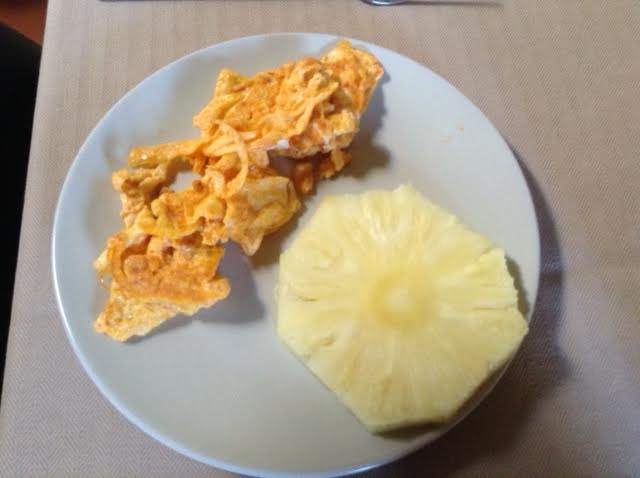
++ 1 two-oz egg ++++ 1.5 tsp Queso Fresco ++++ 1 tsp Chorizo Paste ++++ 1½ tsp  Pimenta do Quejio sauce ++++ 2 oz pineapple -OR- ¼ cup blueberries -OR- 1.5 oz banana ++++  Optional: blackish coffee [53 calories] or blackish tea or mocha cafe au lait[65 calories] ++

Cream the cheese, chorizo paste, and Pimenta sauce until smooth. Whisk in the egg, then bake in an oven-proof dish or cook in a saute pan. Slice the fruit and sip some Brazilian coffee for a delicious meal. Pass the Pimenta Sauce!

Haddock w/ Farro & Chickpeas: 252 calories… 3.6 g fat… 7 g fiber… 19 g protein… 38.4 g carbs… 37.5 mg Calcium…  PB GF The whole grains and chickpeas help to make a small amount of fish taste like a lot more. Then you add a vegetable of your choice. Good stuff.
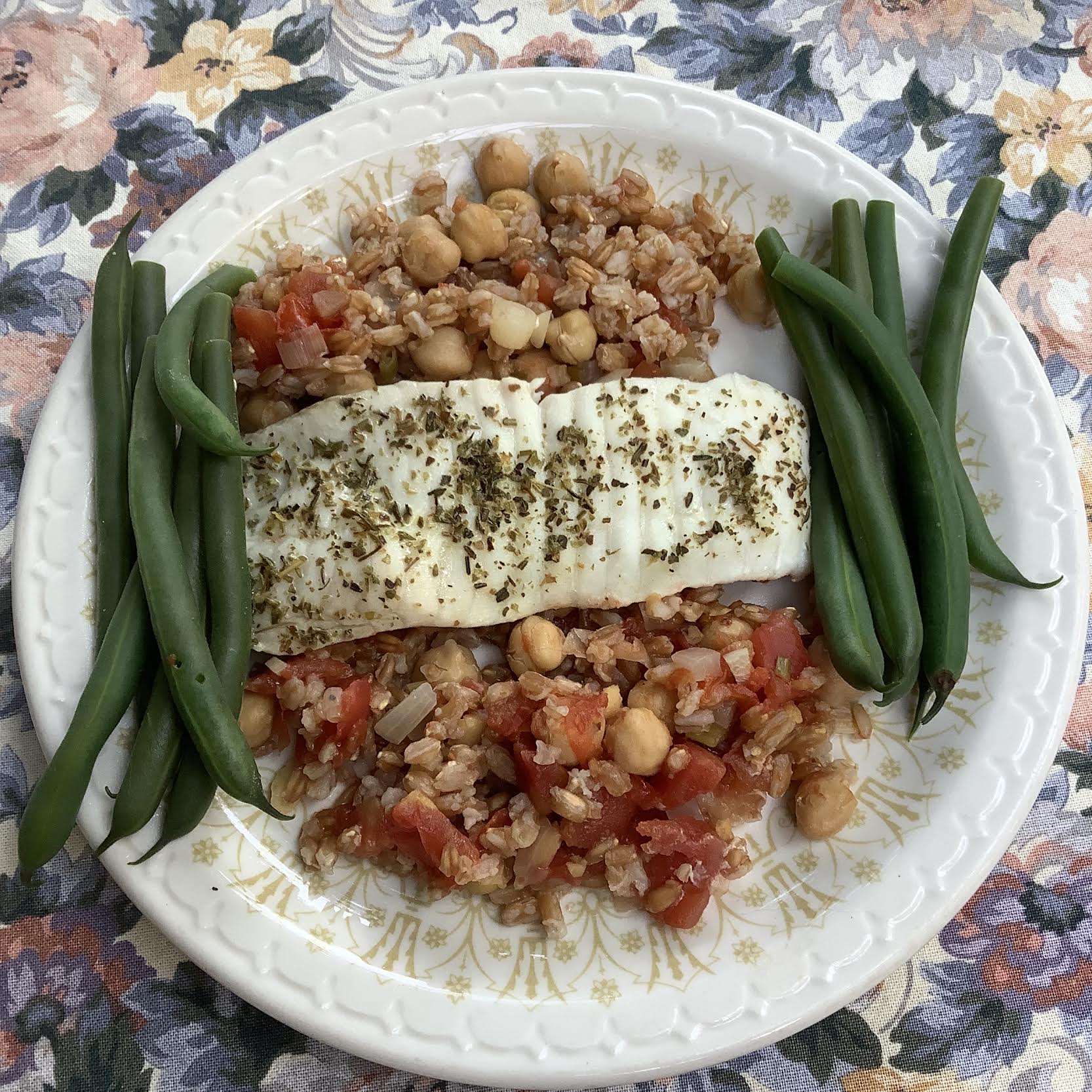
++ ¾ cup chickpea ragout ++++ ½ c cooked farro ++++ 2.5 oz raw haddock ++++ PLUS: 2 oz broccoli OR 2½ oz carrots OR 2½ oz green beans OR 2 oz beets  each adds about 20 calories and an average of 2 g fiber to the meal

Cook the farro in one pan and the vegetable in another. Combine the cooked farro with the chickpea ragout and season to taste.  If the fish is raw, place on top of farro-ragout in a pan, cover and cook until everything is warm and fish is cooked.  If fish is cooked, add to cooked vegetables and heat gently. Plate alongside vegetables.
Saint Robert Flower of Knaresboro

How this Fast Diet Lifestyle works: Eat these meals tomorrow, for a calorie total of less than 600. On another day this week, eat the meals from a different post, another day of eating 600 calories or less. Eat sensibly the other days of the week. That’s it. Simple way to lose weight and be healthier.

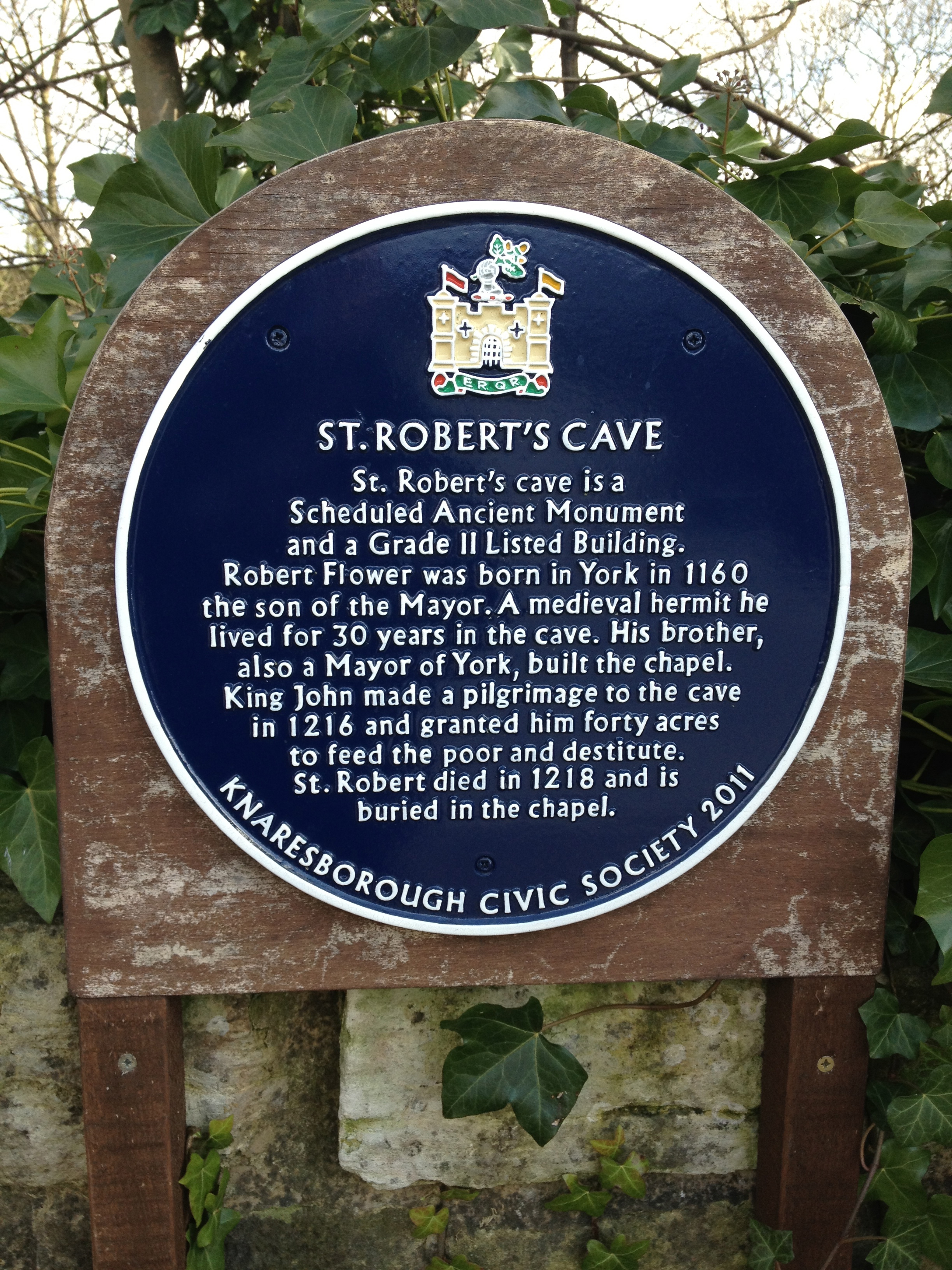
A fun thing about delving into one’s genealogy is the discovery of some unusual characters in the family tree. One such find was St Robert of Knaresboro. A saint!! An eccentric hermit!! What fun. He was born in Yorkshire around 1160, the son of the Mayor of York. From an early age, Robert Flower knew he wanted a religious life, so he became a novice of the Cistercian Abby at Newminister while yet a child. He then decided that the life of a hermit was what he wanted. Robert was forced to move from place to place — he should be the Patron of Displaced Persons. Along the way, he gained a reputation as a holy person who gave good advice. He settled in Knaresboro, near York, in a cave that was chiseled from solid rock. People came to see him and to drink from his holy well — from King John to common pilgrims. Robert was never actually canonized as a saint, but the Trinitarian friars deemed him venerable and there are churches and stained glass windows dedicated to this kindly man who helped the poor and worked to free the prisoners. St Robert’s Cave is open to visitors.

September 24 is the day Saint Robert Flower died in 1208. You will ask why the breakfast planned for him relates to Tolkien‘s Hobbits. The first line of The Hobbit reads, “In a hole in the ground, there lived a Hobbit.” Saint Robert lived in a hole in the ground. In addition, September 22 is the birthday of the Hobbits Frodo and Bilbo Baggins. Furthermore, St Robert’s father’s first name was “Took,” used as a surname for a prominent Hobbit family. Continuing that theme, the dinner is a simple soup prepared from the leftovers of a famous meal from the Azores: Cozido, cooked in a pot in a hole in the ground. Saint Robert Flower would have enjoyed its simplicity.

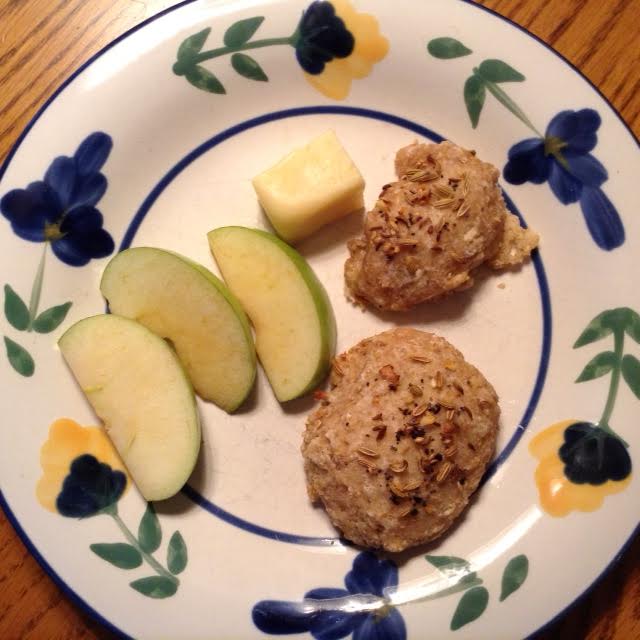
Hobbiton Breakfast:  217 calories 6 g fat 3.4 g fiber 5.7 g protein 29.4 g carbs [11 g Complex] 60 mg Calcium   NB: These values are for the plated foods only, and do not include the optional beveragesPB  A simple-to-prepare and delicious combination of textures and flavors. For Halflings and Big People alike.

1 full-size or 2 half-size [from 3 Tbsp Scone ‘Mix’.] Seedy Scones*** ½ oz Camembert cheese   3 oz apple Optional: blackish coffee [53 calories] or blackish tea or mocha cafe au lait [65 calories

***Seedy SconesThis makes 2 cups of ‘Mix’. 1 cup all-purpose flour 1 cup white whole wheat flour 3 Tbsp sugar 1 tsp baking soda 1.5 tsp cream of tartar 2 Tbsp unsalted butter buttermilk or sourmilk, as needed mixed seeds + a pinch of salt Combine the dry ingredients [except seeds] in a bowl. Cut in the butter until well incorporated. 

Prepare the Scone Mix. Take out 3 Tbsp [1.6 oz] of the mix and stir in just enough buttermilk or sour milk [1-1/2 Tbsp? 2 Tbsp?] to cause the dough to come together in a rough ball. TIP: store the remaining mix in the refrigerator in a glass jar with a lid. Ready to use when you wish. Knead briefly on a lightly floured surface. Pat out into one scone, or divide into 2 scones. Brush the surface with milk and scatter the seeds on top. Place in a buttered dish to bake  HINT: I did this the night before and left it on the counter to bake in the morning. Slice the apple and cheese. Bake the scone[s] at 400 F. for 7-10 minutes. Plate to please the eye. Serve with the beverage of your choice.

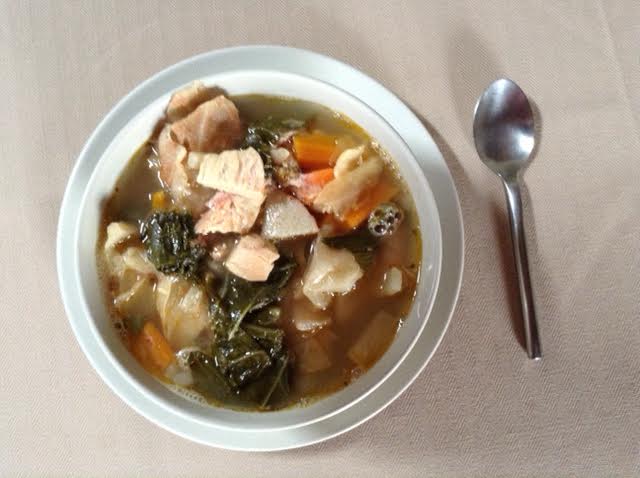
Cozido Soup: Cozido  is a specialty of the Azores island of Sao Miguel. Some of the dormant volcanoes still have warm magma and send out steam through vents and fissures. Local people lower cauldrons of meats and vegetables into steaming wells, then serve the cooked meal at restaurants or at home.. The serving for two at O Miroma in Furnas consists of vast quantities of beef, pork knuckles, blood sausage, carrots, potatoes, collards, cabbage, and turnips. Like a New England Boiled Dinner, but cooked in a volcanic vent! We took the remainders from our meal home. 

The next day, I put the bones, sausage, and juices in a pot with water and Piment da Queijo. While that simmered, I cut up the vegetables and meat into bite-sized pieces [discarding the blood sausage to which I have an aversion]. Combined, it provided a hearty, nourishing, and low-calorie soup for a Fast Day.

Ingredients for next week: Breakfast, single portion for Monday ……… single portion for Thursday:

1.5 two-oz eggCamembert or Hermelin cheese
apple + heavy cream3%-fat ham
sugar + cinnamonsourdough rye bread
butter + peachplums, preferably yellow
Optional smoothieoptional smoothie
optional hot beverageoptional hot beverage

Dinner, single portion for Monday: ……………………………. single portion for Thursday:

green peppers + cucumber + garliceggs + streaky American bacon
white wine vinegar + tarragon Parmesan-Reggiano cheese
olive oil + shrimp + onionasparagus + scallion
piment d’esplette + dry white wineside salad with beet + tomato
Sparkling waterSparkling water

Traveling While Fasting

How this Fast Diet Lifestyle works: Eat these meals tomorrow. On Thursday, eat the meals that will be posted on Wednesday.  Eat sensibly the other days of the week.  That’s it.  Simple way to lose weight and be healthier.

Can’t tell you how often people say, “Well I’m off on holiday and of course that means I won’t be Fasting, since that would be impossible.”  And I think, “Why would you say that?”  Having been at this for 5 years, perhaps it is easier for me to see the possibilities on a menu and do a mental calculation of calories.  But even without that, if one sticks to lean proteins, fruits, and vegetables at meals on Fast Days, then one might even allow the odd glass of wine! Other days, enjoy whatever local fare is offered. The bottom line is this: Fasting on vacation does not mean ruining your trip or spoiling the fun. Rather, it gives you a framework which enables you to partake of local foods sensibly without the groans of disappointment when you read the scales upon your return.

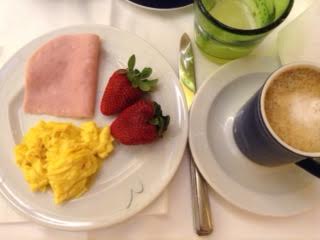
Breakfast the Hotel: Most hotels serve a Breakfast Buffet,   Fasting breakfast in Rome                                                                     often of grandiose proportions. If you view it                                                                                 with a Faster’s eye, you will spot some                                                                                                offerings which exactly fill the bill.   On Slow Days, one can sample more freely from the other tempting treats.                                                                                  Breakfasting from the buffet in Rome looked like this: It was the perfect prelude to a day at the Colosseum and the Church of San Clemente, with its 5 levels of historic interest.
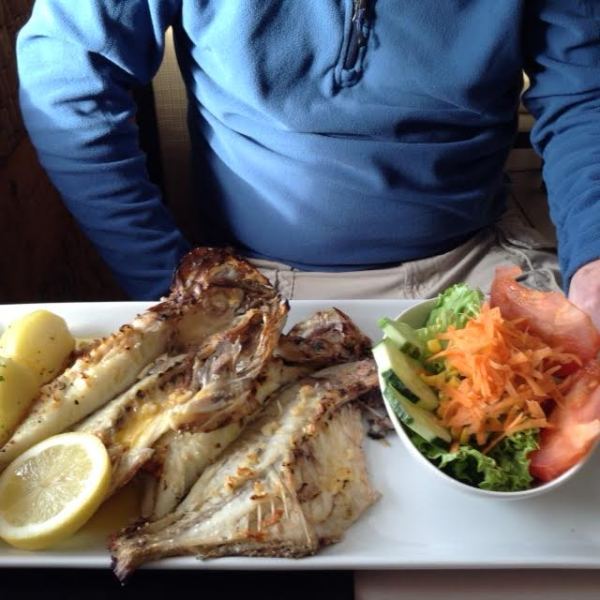


Dinner at the Restaurant:  If your     Fasting dinner in the Azores                                                                         accommodations are not of the self-                                                                                            catering type, you will find yourself                                                                                             dining in a restaurant on a Fast Day.                                                                                            Seafood to the rescue!  At Botequim Açoriano in Rabo de Peixe, Sao Miguel, Azores,                                                                                                                                                                                               grilled fish with a side salad was a great meal. Enough for two, it just what we needed.
Acores I

How this Fast Diet Lifestyle works: Eat these meals tomorrow. On Monday, eat the meals that will be posted on Sunday.  Eat sensibly the other days of the week.  That’s it.  Simple way to lose weight and be healthier.

The first time I ever heard about the Azores [‘Açores’ in Portuguese] was in a poem by Joaquin Miller which praised the glories of Christopher Columbus and begins, “Behind him lay the gray Azores…”  Miller was a good-enough poet, but he was wrong about several things: Columbus was no saint; Columbus would never have heard of the Azores, since they had not yet been discovered; and the Azores are definitely NOT ‘grey.’  We visited the island of Sao Miguel in early May and found a riot of flowers covering steep, verdant volcanic mountains, herds of placid cows, and fruits of all sorts, surrounded by a thundering ocean.  It was marvelous, which means ‘a thing of marvels.’  When we travel, we like a self-catering accommodation, so we can have some say about what we eat and so we can cook with local foods. We did a lot of touring, some hiking, and enjoyed some very satisfactory dinners.  Portions were large, so there were leftovers and we enjoyed them too. The cheeses, the native wines, and specialties like ‘chorizo paste‘ and Pimenta da Queijo were great.  Want to go to a beautiful location that is off the beaten track?  The Açores are for you!

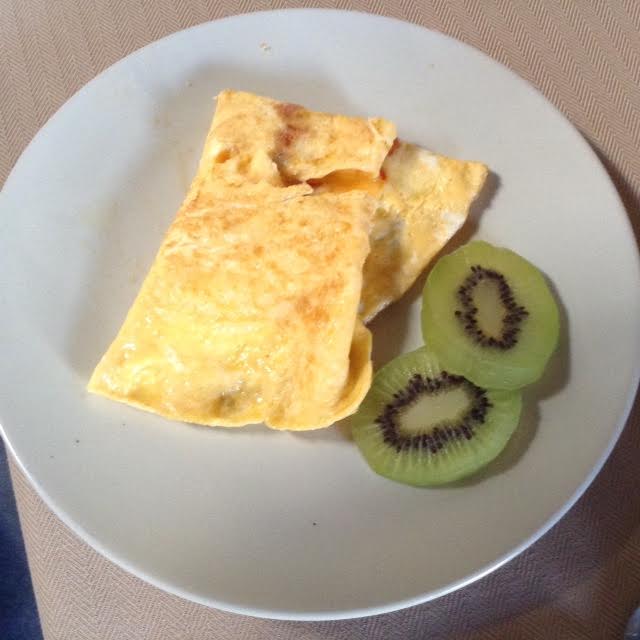
Azorean Omelette:  250 calories   10.7 g fat   0.9 g fiber   17 g protein   13.5 g carbs [6 g Complex] 276 mg Calcium PB GF  When on vacation in the Azores, these local ingredients made for a wonderful breakfast.Azorean Cheese ScrOmelette

1-1/2 two-oz eggs  HINT: If you are serving one person, crack three 2-oz eggs into a small bowl or glass measuring cup. Whip up those eggs and pour half of their volume into a jar with a lid and put it in the ‘fridge for next week.                                                                                    1/2 oz Azorean cheese OR Gouda                                                                                                                       1/2 oz Pimenta da Queijo                                                                               2 oz kiwi fruit                                                                                                                                                     blackish coffee [Portugese or Brazilian] or blackish tea [from the Gorreana Tea Plantation] or lemon in hot water

Grate/shred the cheese. Whisk the eggs with the pepper sauce and turn into a lightly-oiled nonstick pan. Sprinkle the eggs with the cheese and cook as you would an omelette. Plate with the fruit and serve one of those delicious beverages. Excellent.

Cozido Soup: Cozido do Furnas is a specialty of the Azores island of Sao Miguel. Some of the dormant volcanoes still have warm magma and send steam out through vents and fissures. Locals lower cauldrons of meats and vegetables into steaming wells, then serve the cooked meal at restaurants. The serving for two at O Miroma in Furnas consists of vast quantities of: beef, pork knuckles, blood sausage, carrots, potatoes, collards, cabbage, and turnips. Like a New England Boiled Dinner, but cooked in a volcano! We took the remainders from our meal home.Cozido Soup

The next day, I put the bones, sausage, and juices in a pot with water and Piment da Queijo. While that simmered, I cut up the vegetables and meat into bite-sized pieces [discarding the blood sausage to which I have an aversion]. Combined, it provided a hearty, nourishing, and low-calorie soup for a Fast Day.

Ingredients for next week: breakfast, single portion

1 two-oz egg 1.5 two-oz eggs
 queso fresco  mushrooms
 chorico paste  bleu cheese
 pineapple  leeks
Whatever you need for your smoothie Whatever you need for your hot beverage
Whatever you need for your hot beverage Whatever you need for your smoothie

Dinner, single portion:

 cod  cooked pork tenderloin
 carrots  lettuce   +   tomatoes
 broccoli  fresh cranberries
 cauliflower  zucchini  + red bell peppers
 green + black olivesÇ  balsamic vinegar + olive oil
 excellent mustard
Sparkling water Sparkling water