Slow Days: Making Peach Wine, DIY Day 2

People who are new to Fasting often pose the questions: “Can I really eat ‘anything I want’ on a Slow Day?” and “What should I eat on Slow Days?” To answer those questions, I have decided to add some blog posts to show some of the foods we eat on what the world calls NFDs [non-fast days] but which, in our house, we call ‘Slow Days.’ This feature will appear sporadically. 

Now for the answers. Can you really eat ANYTHING you want on a Slow Day? Not really. If you eat too many calories every Slow Day, you will not lose weight. There are many questions asked on the FastDiet Forum https://thefastdiet.co.uk/forums/ which attest to that. Once in a while you can splurge, as long as it isn’t everyday. For what to eat on Slow Days, Dr. Mosley recommends a Mediterranean Diet. As for how we eat, an example follows.

On a Fast Day, the empty calories of wine are not a good choice. But wine in moderation on a Slow Day is alright. We are making Peach Wine in this blog, continuing from two previous blogs on the topic. THIS IS THE 3RD POST IN THIS SERIES.

DAY 2: Combine all the ingredients and pour into the glass fermentation vessels.

Starter bottle from previous blogThe bottle contents should be bubbly on the top. If not, gently shake it to see if bubbles rise to the top. This tells you that the yeast is activated.
Camden Solution from previous blog large bowl/colanderSterilize a large bowl and a colander with Camden Solution. Pour excess Solution back into its jar.
Mashed peaches in waterStrain the peaches through the colander into the bowl, saving the juice. 
This peach mush can be used to make jam or mix it with maple syrup to spoon onto waffles. Yum.
2 quarts boiling water 2 ¼ pounds granulated sugar
Bring the water to a boil. Put the sugar into the bucket or bowl that had the peaches last night. Pour the water over the sugar to dissolve it. You may need to stir it with a sterilized spoon to ensure that all the sugar goes into solution. Put the lid on it and let it cool for 1 hour. The liquid ought not to cool to room temperature. 

reseved peach juice
½ tsp pectic Enzyme   1 tsp Citric Acid ½ tsp Grape Tannin
Add the peach juice to the sugar – water mixture when it has cooled a little. Then stir in these additives.  They are necessary to balance the flavors of the fruit and the sugar.
Hydrometer hydrometer jar Camden solutionSterilize the hydrometer jar and the hydrometer.
Pour excess Camden Solution back into its jar. 
Pour some of the peach juice+water+sugar into the hydrometer jar to within 1½” of the top. Put the hydrometer into the liquid and give it a little spin to rid it of any bubbles. Read the scale labled Specific Gravity [S.G.] and the scale labled Potential of Alchohol [P.A.] and write down those values in your notes. Pour the ‘wine’ from the hydrometer jar back into the bucket. The P.A. should read around 12%. If it is lower, add more sugar. If it is higher, add some boiled water. Then take another reading.
Starter Bottle The liquid in the bucket should by now be just a little warm. Pour the contents of the Starter Bottle into it and stir to mix. Cover the bucket and let it sit for 15-30 minutes, until the mixture is bubbling and frothing. You should see and hear it!
Fermentation is well under way. See the big bubbles?
1-gallon glass jug 750-ml glass wine bottle funnel 2 air-locks with 1-hole corks
Camden Solution
With the Camden Solution, sterilize the jug, the bottle, the funnel, the corks. Pour the excess Solution back into its jar. Using the funnel, pour the fermenting peach juice into the jug, filling it almost up to the neck. What remains in the bucket goes into the glass wine bottle. Fit the air-locks into the corks and snug the corks into the tops of the glass vessels. Pour Camden Solution into the air-locks, up to the half-way point. 
Now lable the bottles with a little tag to remind yourself: the type of wine; what day you began to ferment the wine; and the value of the P.A. Put the bottles into a dark, sorta cool place where they won’t be disturbed.
Here is our ‘proto-wine’ all ready to sit quietly and work for a while.

At this point, the wine looks very unappetizing — sludge-colored, cloudy, and that icky foam on top. Fear not: as the days progress, the wine will clear, the color will improve, and all the sludge will go to the bottom.

Here it is, labeled as directed, after a few days. Notice the solids, called lees, settling to the bottom. Notice that the foam has died down and that the color is improving.

All you have to do now is to clean up the kitchen and wait 3 [three] months for the next step. THE NEXT STEP IN THE PROCESS WILL BE IN 3 MONTHS. HOPE TO SEE YOU THEN.

Slow Days: Making Peach Wine, DYI DAY 1

People who are new to Fasting often pose the questions: “Can I really eat ‘anything I want’ on a Slow Day?” and “What should I eat on Slow Days?” To answer those questions, I have decided to add some blog posts to show some of the foods we eat on what the world calls NFDs [non-fast days] but which, in our house, we call ‘Slow Days.’ This feature will appear sporadically. 

Now for the answers. Can you really eat ANYTHING you want on a Slow Day? Not really. If you eat too many calories every Slow Day, you will not lose weight. There are many questions asked on the FastDiet Forum which attest to that. Once in a while you can splurge, as long as it isn’t everyday. For what to eat on Slow Days, Dr. Mosley recommends a Mediterranean Diet. As for how we eat, an example follows.

On a Slow Day, you can drink wine with dinner. Why not make your own? THIS IS THE 2ND POST IN THIS SERIES.

On Day 1, we make a Starter Bottle of yeast mixture and prepare the peaches:

1 pint glass jar, sterilized
8 oz apple or orange juice
½ oz/ 4.5 tsp sugar
½ tsp yeast nutrient
Heat to boiling and put in the sterilized jar. I use a 1-pint canning jar with a ring.
Put a piece of cloth or paper towel over the top of the jar, then screw on the ring. Let it cool.
¼ tsp yeastOnce the liquid cools, add the yeast. Agitate the jar, cover again, and let sit until tomorrow.

Here is the Starter Jar. This gives the yeast a head start.

Prepare the peaches:
Camden Solution
the 2-gallon bucket/bowl with lid
Sterilize bucket by pouring in some Camden Solution and sloshing it around. Use a paper towel or your hands to make sure that the Solution touches every surface. Wash your hands. Pour any extra Solution back into its jar
2 quarts waterBring water to a boil.
2½ pounds whole, ripe peaches
nb: I’ve used white peaches, yellow free-stone peaches [Red Haven variety], and very red yellow peaches.
Don’t bother to peel the peaches, but if there are some bruises, remove them. Cut the peaches in half, remove the pits, then squish the peaches in your hands before they go into the bucket.
Pour boiling water over the peaches. This cooks the fruit a bit so it will release its juice. It also kills any germs or wild yeast on the fruit. Cover with a lid and put the bucket in a corner where it can cool for 12-24 hours.

Squished peaches covered with boiling water in the sterilized bucket. The covered bucket cools over night.

The next post in this series will be tomorrow [in one day].

Slow Days: Making Peach Wine, DIY

People who are new to Fasting often pose the questions: “Can I really eat ‘anything I want’ on a Slow Day?” and “What should I eat on Slow Days?” To answer those questions, I have decided to add some blog posts to show some of the foods we eat on what the world calls NFDs [non-fast days] but which, in our house, we call ‘Slow Days.’ This feature will appear sporadically. 

Now for the answers. Can you really eat ANYTHING you want on a Slow Day? Not really. If you eat too many calories every Slow Day, you will not lose weight. There are many questions asked on the FastDiet Forum  which attest to that. Once in a while you can splurge, as long as it isn’t everyday. For what to eat on Slow Days, Dr. Mosley recommends a Mediterranean Diet. As for how we eat, an example follows.

Usually, I talk about food. At this time of year, the peaches are ripe — and do I love peaches! Sliced on cereal, chunks in yogurt, in pie, in your hand as you bite into it. Peaches rule! And, for your next Lock-Down [bite my tongue] Project, you might want to make peach wine. Full disclosure: a peach wine will not taste like peaches. It will taste like a dry white wine. The less dry you make it, the more fruity it will be. But it will not taste like a fresh peach.

On a Fast Day, you don’t want to waste calories on a non-food like wine. On Slow Days, drinking in moderation is perfectly acceptable. For many years now, I have made ‘Country Wines.’ That appellation designates a fermented beverage made from fruits that are not wine grapes. Good Friend Donna Ohlweiler, who was a Summer Neighbor of our’s, taught me the basics. We drink wine with dinner, but usually it is a splendid product of the grape, chosen by Dear Husband who is an able sommelier. [to see what I mean, check out peterspicksblog] Still, I think it is fun to turn fruits into wines and the results are nice to serve to guests as an aperitif or to use as hostess gifts.

Peach Wine was the second recipe that I ever made, in October of 2001. The recipe is from First Steps in Winemaking by C.J.J. Berry. My initial notes cover 6 pages, detailing all the steps I took and all the things I did wrong. It was a learning experience. Since peaches are ripe in New Hampshire now, I thought I would show you the steps of making what Berry calls “Peach Perfection.” Rather than giving you the entire process at once, I will show you how to make it ‘in real time’ — that is to say, each day that I do something with the wine, I’ll explain what I did, and tell you how long to wait until the next step. The entire process takes the better part of a year, but aside from 2 days at the beginning and 2 days at the end, it is like stirring together a batch of dough and letting it rise overnight, then knocking it down and letting it sit again — small, short bursts of activity for you, and a long slow fermentation for the wine.

Making Peach Wine yield: five 750 ml bottles bottles

Before you start, you will need:

A good beer/wine-making store sells these. They are available on-line too.

2.5 pounds ripe peaches 2.25 pounds sugar Grape Tannin
Camden tablets
Yeast Nutrient
White wine yeast
Acid Blend
Pectic Enzyme
Clean 1-gallon glass jug
clean 750ml glass wine bottle
2-gallon capacity enamel or plastic bucket or bowl with a lid
1 air-lock with a cork to fit the gallon jug
1 air-lock with a cork to fit the wine bottle
Hydrometer
hydrometer test jar you will need a dedicated set of pages to write down what you did and when you did it — I have two school ‘composition books’ full of notes

In a few months you will need: five 750 ml wine bottles 5 corks for the bottles a corking device to drive the corks into the bottles

You will need to prepare a Camden Solution for sterilizing all your vessels and equipment.

Put 2 cups water in a jar with a lid. Add 6 camden tablets and ½ teaspoon Acid Blend. Let it sit to allow the tablets to soften, then shake/stir until all is blended and dissolved. THIS STUFF IS TOXIC AND THE FUMES FROM IT ARE UNHEALTHY TO BREATHE. Label with a poison alert sticker and store out of reach of children.

THE NEXT POST IN THIS DIY PROJECT WILL BE IN THREE DAYS.

The Bench on the Back Porch

How this Fast Diet Lifestyle works: Eat these meals tomorrow, for a calorie total of less than 600. On another day this week, eat the meals from a different post, another day of eating 600 calories or less. Eat sensibly the other days of the week. That’s it. Simple way to lose weight and be healthier.

In South-Central Pennsylvania, where my family originated, there is a traditional piece of furniture: a bench on the back porch. The fancier front porch faced the road or street in town. It might have comfortable rocking chairs on which to sit in the evening, watching the world go by and conversing. The more simple back porch was tucked into the ell of the house, facing the garden. Furniture there was more utilitarian and in my experience it included a wooden bench about 6′ long. The bench was painted and had been built by an earlier ancestor who had perhaps built the house. I like to imagine an ancestress, perhaps my great-grandmother Annie Ely Bertholet [1850-1919] or her mother-in-law Hannah Mattis Berthelot [1818-1853], coming out of her hot, dark kitchen in Oley on a summer day, to sit on the bench, with her back to the brick or stone wall of the house. Was she taking a coffee break? No, she would be pitting cherries in July and peaches in August, peeling apples in September. She would be shelling peas or stringing beans or shucking corn in season. Working, yes, but in a pleasant location where she could feel the breeze and enjoy the hummingbirds in the Trumpet Vine. My mother inherited the bench, using it to store cushions for the terrace furniture. And now the bench is mine. It lives inside and serves as a plant stand in the Sun Room during the winter. It is in retirement after many, many decades of service on the back porch.

The summertime ingredients for today’s meals can be shucked, pitted, peeled, and cut while sitting on the Bench.

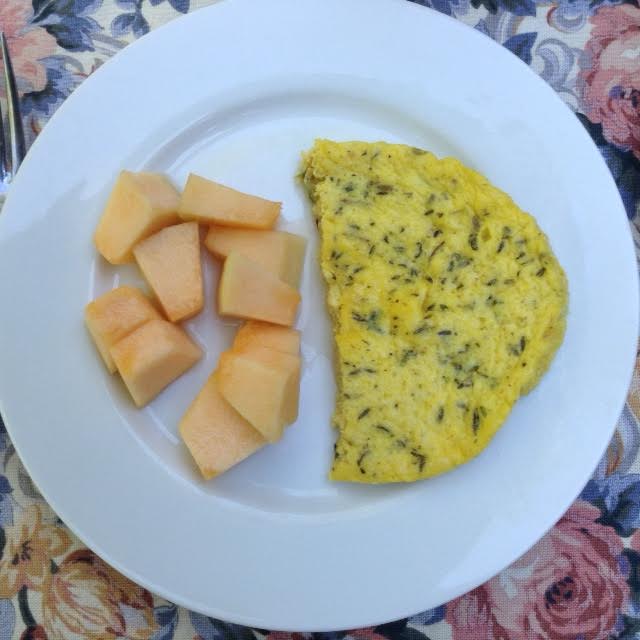
Corn Scramble: 130 calories 7.6 g fat 1 g fiber 10 g protein 6 g carbs 44 mg Calcium   PB GF  If you enjoyed corn on the cob for dinner previously, and cut off some of the kernels, then that’s what goes into the eggs. What a fine late summer meal!

1½ two-oz eggs  HINT: If you are serving one person, crack three 2-oz eggs into a small bowl or glass measuring cup. Whip up those eggs and pour half of their volume into a jar with a lid and put it in the ‘fridge for next week.  2 Tbsp/ ½ oz cooked corn kernels 1 Tbsp chives    1 oz peach   Optional: blackish coffee [53 calories] or blackish tea or mocha cafe au lait [65 calories] or lemon in hot water Optional: 5-6 oz fruit smoothie or berry-yogurt smoothie  [88 calories]

Put the corn and snipped chives into a non-stick pan spritzed with cooking spray for long enough to heat them. Whisk the eggs with salt and pepper then pour over the corn and scramble to your liking. Plate with the peach. If possible, enjoy your breakfast on the porch.

Minestrone Soup:  1 cup = 145.5 calories 3 g fat 5 g fiber 8 g protein 27 g carbs 86.4 mg Calcium  ½ cup = 73 calories 1.5 g fat 2.6 g fiber 4 g protein 14 g carbs 43 mg Calcium PB  GF [if you use GF pasta] This recipe can be doubled easily, and it is a fine dinner soup for a hot Summer day. Prepare it in the cool of the morning so it can be served in the evening.   

1 tsp olive oil
1 cup onion, chopped
2/3 cup carrot, chopped 
½ cup celery, chopped
2 cloves garlic, chopped 
3 slices pepperoni, chopped 
Prepare these ingredients as described, and put into a sauce pan together.
Cook over medium heat until onions begin to wilt. 
½ cup sweet potato, cubed
½ cup zucchini, diced 
½ cup mushrooms, chopped
2 cups crushed tomatoes 
¾ cup small white beans, canned
lots of sage and rosemary, chopped
1 cup water 
2 cups chicken broth/stock
Prepare the vegetables as described. Drain and rinse the canned beans. Add these to the pan, along with the water and broth. Cook at a simmer for about 20 minutes


NB: low sodium broth is preferred
1 oz pasta, whole wheat is preferred to boost fiber [orzo/ dinetelli/broken spaghetti]Add the pasta and cook until it is soft, 5-6 minutes.
2 tsp Parmesan cheese, grated 
salt and pepper to taste
Add remaining seasonings and adjust to taste. TIP: Soup is always improved by letting it sit for several hours before reheating and serving hot.

HINT: One serving is one cup, but you could go to 1¼ cups each. This recipe made 4 cups for me – multiple meals from one prep!

Ingredients for next week: Breakfast, single portion for Monday …………………………… single portion for Thursday:

1 two-oz egg + 10%-fat cream1.5 two-oz eggs 
yellow curry powder + cooked brown riceyellow curry powder
smoked haddockfresh tomatoes
asparagus + nutmegstrawberries
Optional smoothieoptional smoothie
optional hot beverageoptional hot beverage

Dinner, single portion for Monday:………………………….. single portion for Thursday:

sole or perch fillets + scallionsolive oil + onion + garlic +canned whole tomatoes
96% fat-free ham, sliced at delicarrot + thyme + low-salt chicken/vegetable stock
70-calorie whole-grain bread1 slice 70-calorie whole-grain bread + Swiss cheese
Worcestershire sauce + carrots + beets 97% fat-free ham + ricotta + plain non-fat yogurt
Sparkling waterSparkling water

Cuvier

How this Fast Diet Lifestyle works: Eat these meals tomorrow, for a calorie total of less than 600. On another day this week, eat the meals from a different post, another day of eating 600 calories or less. Eat sensibly the other days of the week. That’s it. Simple way to lose weight and be healthier. Welcome to betterweightloss29 who is now Following.

In 1800, the field of ‘science’ was fairly new. One had a day job and dabbled in natural science. Ben Franklin and the Comte de Buffon in the 1700s were such men. Georges Cuvier broke the mold. His work as a naturalist earned him a professorship at the Musée National d’Histoire Naturelle, during the French Revolution. He maintained the post during Napoleon’s reign and into the Empire. In that time, he became the most knowledgeable person in the Western world in the field of vertebrate paleontology. Paleontology was a new field too. Since it is the study of fossils, that assumes that fossils are the ‘preserved remains of ancient life’ as my textbooks used to say. This was not everyone’s assumption. Many people of that time thought that ‘fossils’, such as shells, were mere designs in rock to confuse the unwary and unwise. Further, the idea that entire species of animals had lived and become extinct was considered to be anti-religion. Yet Cuvier made a career of studying and identifying fossil bones and promoting the idea of extinction as scientific fact. Continuing the work of Hutton and Smith [correlation], Cuvier studied the layers of rock that rimmed the Paris Basin. He concluded that the area had once been a warm shallow sea, and that the rock strata changed over time — in direct opposition to prevailing thought. So well-known and widely-published was his work [Cuvier would work on 9 projects at the same time] that scientists from all over would send him fossils to identify. It was said that he could name the original animal from seeing one bone or one tooth. The only time he was stumped was by the first dinosaur fossil — no one had ever seen that before! Then next time you visit a natural history museum, think about Cuvier’s contributions to our knowledge of the ancient world.

During his hours of study in the Paris Basin, perhaps Cuvier packed a lunch of cheeses and sausage meat. Those are the core of our breakfast. Even though he was a student of bones, he had used fossil shells to help him to correlate the layers of rock across the Paris Basin. Our dinner can be served in clam shells on his birthday, August 23. Cuvier was a ‘catastrophist‘ and his way of eating was a catastrophe. Very slim as a young adult, he became very fat at maturity. We can admire his scientific intelligence but not his nutritional choices.

Charcuterie Bake: 137 calories 10 g fat 1 g fiber 11.4 g protein 8 g carbs [6.6 g Complex] 37 mg Calcium   NB: The food values given above are for the egg bake and fruit only, not the optional beveragesGF  One Sunday, we invited friends over for what we call a “French Lunch” – bread, sausage, cheese, fruit, wine, and good fellowship. Dear Husband thought, “I know what breakfast will be.” And he was correct: left-overs reborn as breakfast.

One 2-oz egg ½ oz chorizo sausage ½ Tbsp chevre cheese, the creamy type ¼ tsp Dijon mustard herbes de Province 1½ oz pear  Optional: blackish coffee [53 calories] or blackish tea or mocha cafe au lait [65 calories] or lemon in hot water Optional: 5-6 oz fruit smoothie or berry-yogurt smoothie [88 calories]

Set the toaster oven at 350 degrees F. Cut the sausage into a small dice, then cream it together with the goat cheese, mustard, and herbes. Spritz an oven-proof ramekin/dish with olive oil or non-stick spray. Whisk the egg with the sausage mixture and pour into the dish. Bake for 12-15 minutes while you pour the beverages and slice the pear. As simple as the meal which preceeded it.

Stuffed Clams:  262 calories 7.5 g fat 5 g fiber 28 g protein 34 g carbs 423 mg Calcium  PB GF– if using GF bread crumbs  If you served stuffed clams to guests, they would not consider themselves to be ill-used. The inspiration for this dish was a meal at the Georgetown Inn, Georgetown, PEI, Canada.

1 oz red bell pepper, slicedIn a small pan, cook the pepper in a small amount of water. Reserve water.
2½ oz [½ medium] tomato
1½ purchased turkey meatballs
Chop the pepper, dice the tomato, dice the meatballs.
4 oz asparagus OR
2½ oz broccoli florets OR
 2½ oz carrots
Choose your vegetable and prep it for cooking. Add water to the pan in which you cooked the red pepper, then put in the prepped vegetable.
½ c [2 oz] clams, diced
½ slice 70-cal bread, diced
1½ Tbsp plain non-fat yogurt  garlic powder, thyme, salt, pepper
Combine these with the chopped pepper/tomato/meatballs, and gently stir to combine.
2 oz carrotsHeap into two [2] large, clean, empty clam shells or oven-proof dishes which have been lightly sprayed with cooking oil. Bake 10 mins at 350F while you cook the vegetables.
½ Tbsp Parmesan cheese
Sprinkle cheese on the stuffed clams in the last minutes of baking.
Plate with the vegetables.

Coco

How this Fast Diet Lifestyle works: Eat these meals tomorrow, for a calorie total of less than 600. On another day this week, eat the meals from a different post, another day of eating 600 calories or less. Eat sensibly the other days of the week. That’s it. Simple way to lose weight and be healthier.

Gabrielle Chanel was born on August 19 in 1883. Her father placed her in a church orphanage at age 12, where the nuns taught her to sew. There the young girl was impressed with the plain lines of the Romanesque architecture and the ornate fabrics in the garb of the priests. On her own at age 19, Gabrielle became a hat-maker, with cabaret singing as a side hustle. Audience members called her “Coco” after a song she sang frequently. Using money from her polo-player boy friend, Coco opened a hat shop in Paris in 1910. In her hands, hats were stripped of feathers and bows, looking more mannish and very modern. The shop was such a success that she was able to pay back all the loaned money — Coco was fiercely independent in everything she did. A dress shop followed, and her styles became le dernier cri for modern Parisiennes. Over the decades, Coco Chanel became a major force in fashion, an influencer and style mavin. Chanel’s hallmarks were fluid fabrics such as jersey; the sailor shirt; pants for women!; knitted twin sets; the signature suit with the boxy jacket; and the little black dress with pearls. Fashion was never the same once Coco began changing the rules. Elegant, ground-breaking, stylish, comfortable clothes…what more does one want? Well, then there was WW2… Was Coco Chanel a Nazi collaborator? So it seems. Do with that as you will.

Coco makes me think of cocoa, so I’ll give you some beverages that contain cocoa yet make it possible to maintain Chanel’s slim profile. The dinner is also slimming and elegant.

Mocha Cafe au Lait: 65 calories  4 g fat 1 g fiber 4.4 g protein 10 g carbs [1.5 g Complex] 168 mg Calcium  PB GF  High in Calcium, this has 4.5x the protein and 5x the Calcium for only 10 calories more than Black-ish coffee. Some might call this a mocha latte, since it is made with regular coffee instead of espresso. So what.

½ cup cocoa milk [½ cup skim or whole** milk + 1½ teaspoons unsweetened cocoa powder] ½ cup hot black coffee ½ level teaspoon sugar

**values when using whole milk: 87 calories 4 g fat 0.5 g fiber 4 g protein 9.4 g carbs 140 mg Calcium

The night before, put the milk and cocoa powder in a jar with a tight lid. Shake it well, then put in the refrigerator over-night. TIP: It is necessary to combine the cocoa powder and milk hours before, since they do not readily mix. Next morning, shake the coffee-milk well, and warm it in the microwave or in a hot water bath on the stove. Pour the coffee into a large [one cup+] cup or mug. Pour in the warm cocoa milk and sugar. Use a frother to whip up the milk and coffee. Elegant.

Cocoa-Banana Smoothie: 250 calories  4 g fat 6 g fiber 14 g protein 44 g carbs 405 mg Calcium  PB GF  If you were in a hurry, this makes a complete breakfast meal. Lots of protein to keep you going. Lucious and chocolatey. Or, this could be a lunch on a Slow Day.

1 cups fat-free milk ¼ cup/ 2 oz regular tofu OR 2 Tbsp/1 oz part-skim ricotta 2.5 oz banana 2 Tbsp cocoa powder 1.5 deglet noor dates, minced 4 ice cubes grated nutmeg

Put everything in the blender and wizz it on “Low” until it is all blended. Then run it at a higher speed until it is smooth. Top with grated nutmeg.

Grapefruit-Avocado Salad: 289 calories 20 g fat 6.4 g fiber 18 g protein 15 g carbs [14.5 g Complex] 75.5 mg Calcium   PB GF  This is delicious, nutritious, and satisfying. Real food. Good food.

1 two-oz egg, hard-boiled 2½ oz avocado [this was half an avocado], sliced in 4 pieces 4 sections of pink grapfruit 1¾ cups lettuce, sliced/shredded 1 oz cooked chicken breast [you could substitute 4 shrimp for a meatless meal] ½ tsp white wine vinegar + ½ tsp lime-infused olive oil + ¼ tsp ground ginger lemon finishing salt

Whisk the oil, vinegar, and ginger in a meduim-sized bowl. Add the lettuce and toss to coat with the dressing. Remove the lettuce to a serving plate, letting some of the dressing drip back into the bowl. Spread the lettuce evenly over the plate and sprinkle with the finishing salt. Starting at the center with the egg, arrange the grapefruit and avocado around the plate. Place the chicken as you wish. Brush the remaining dressing on the grapefruit and avocado. 

Ingredients for next week: Breakfast, single portion for Monday …………………………… single portion for Thursday:

1 two-oz egg1.5 two-oz eggs 
chorizo + creamy chevrecooked corn kernels
Mustard + herbes de Provencechives
peach
Optional smoothieoptional smoothie
optional hot beverageoptional hot beverage

Dinner, single portion for Monday:………………………….. single portion for Thursday:

Clam meat, fresh, frozen or canned + Parmesan cheeseolive oil + zucchini + pepperoni
Tomato + red bell pepper + Garlic powder carrot + celery + small pasta + onion
½ slice 70-calorie whole grain bread + thyme crushed tomatoes + mushrooms + garlic
Purchased Turkey meatballs + Plain, non-fat yogurtsmall white beans + sweet potato + Parmesan
Sparkling waterSparkling water

T.E. Lawrence

How this Fast Diet Lifestyle works: Eat these meals tomorrow, for a calorie total of less than 600. On another day this week, eat the meals from a different post, another day of eating 600 calories or less. Eat sensibly the other days of the week. That’s it. Simple way to lose weight and be healthier. Welcome to Blox Food who is now Following.

Thomas Edward Lawrence was born on August 16, 1888, offspring of a nobleman and the family governess. His parents and siblings, moved to Oxford where Ned was schooled. He loved history and on a study-abroad in Syria, Lawrence hiked 1000 miles to examine Crusader Castles, about which he wrote a book in 1910. Along the way, he learned Arabic and immersed himself in the culture. Ned put his archeology knowledge to use on a dig in Syria, 1910-1914. Wishing to help the war effort, Lawrence was posted to Cairo. He was the liaison between the English army and the Arab rebels who were fighting to overthrow the Ottoman Turks. Lawrence made a name for himself with the daring, unsanctioned, and successful strike against the Turks in the capture of Akaba. While flush with his successes, Ned Lawrence was disturbed by the knowledge that his Arab allies and friends were fighting to free the land from foreign rulers, while his English commanders were fighting the Turks so that Britain could expand its Empire. In 1926, his wartime autobiography, Seven Pillars of Wisdom, was published. Later in life, Lawrence refused a knighthood because the British would not consider an Arab State. He was made famous by journalist Lowell Thomas in the 1920s and the 1962 film Lawrence of Arabia, where he was portrayed by 6′ 4″ Peter O’Toole.

Lawrence was a little man, only 5′ 5″, slim and fit. On a Fast Day, we eat little meals so you can remain slim and fit. Since Lawrence was not following the army’s playbook, we will enjoy an ‘improper’ breakfast. The dinner would have hit the spot with his Syrian-Arab allies.

Improper English:  148 calories 2 g fat 5 g fiber 11.4 g protein 37.6 g carb 24.5 mg Calcium NB: the food values shown are for the plated foods only and do not include the optional beverages.  PB GF – if using GF bread or eliminating the bread. A “proper English” is the full Victorian breakfast, serving every conceivable food you can imagine. This version leaves out the eggs, cold toast, and kippers [how improper!], but keeps the protein-rich baked beans along with the rest of the usual stand-bys.

¼ cup baked beans one oz 3%-fat ham ½ of a 2.5” diameter tomato 1 oz mushrooms 1 oz apple or a few grapes  Optional: blackish coffee [53 calories] or blackish tea or mocha cafe au lait [65 calories] Optional: 5 oz fruit smoothie or berry-yogurt smoothie  [88 calories]

Cut the tomato around its equator and put one half away for another use. Salt the tomato and put under the broiler until it softens. Cook the ham and mushrooms in the same pan to heat through. Warm the beans – perhaps in the microwave. Toast the bread and brew the optional hot beverage. Pour the optional smoothie and plate everything. Cheerio!

Felafel with Red/Green Salad: 287 calories 14.5 g fat 9 g fiber 11.6 g protein 29 g carbs 113 mg Calcium  PB GF  Looks great, tastes great, SO healthy. Win-win-win.

5 felafel patties   1 cup baby spinach leaves ½ cup red cabbage slaw** ¼ c pickled beets, sliced or cubed ½ hard-boiled egg, chopped 1 tsp olive oil + 1 tsp lemon juice

**Red Cabbage Slaw makes 2 cups, serves 3-4

2 c. thinly sliced red cabbage 1 Tbsp finely chopped red onionPrepare and set aside.
1 Tbsp plain yogurt, drained1 ½ tsp apple cider vinegar1 tsp sugar or maple syruppinch dried dillpinch celery seed2 pinches Kosher saltfreshly ground pepper Drain 3 Tbsp plain nofat yogurt through paper toweling for 15 minutes. Measure 1 Tbsp into a large bowl, then whisk in these ingredients.
Add the cabbage and red onion and toss to combine.
Serve immediately or refrigerate until serving.

Thaw the felafel patties and warm them. If unbaked, heat them in a 400 F. oven for 10-15 minutes. Prepare the vegetables for the salad. Whisk the lemon juice and oil, then toss the salad vegetables in the dressing. Top with the felafel and the chopped egg. Quick and easy.

Slow Days: Cajun Catfish Sliders

People who are new to Fasting often pose the questions: “Can I really eat ‘anything I want’ on a Slow Day?” and “What should I eat on Slow Days?” To answer those questions, I have decided to add some blog posts to show some of the foods we eat on what the world calls NFDs [non-fast days] but which, in our house, we call ‘Slow Days.’ This feature will appear sporadically. 

Now for the answers. Can you really eat ANYTHING you want on a Slow Day? Not really. If you eat too many calories every Slow Day, you will not lose weight. There are many questions asked on the FastDiet Forum https://thefastdiet.co.uk/forums/ which attest to that. Once in a while you can splurge, as long as it isn’t everyday. For what to eat on Slow Days, Dr. Mosley recommends a Mediterranean Diet. As for how we eat, an example follows.

Catfish are a fresh-water fish found in many countries around the world, with 30 species in the USA. The states in the center-east of the country are where catfish are most likely to be. Because they are common and can grow quite large, catfish are popular sport and eating fish. Here in New Hampshire, the native species is Ameiurus nebulosus, known to scientists as the Brown Bullhead, and to locals a the ‘horned pout’ [pronounced ‘hornpout‘]. Lakes of easy access sport boats at night, trawling back and forth with lanterns illuminating the water. Everyone knows that means people are hornpoutin’. After seeing catfish at the supermarket a few years ago, and knowing that there was Cajun Seasoning in the pantry, I was seized by inspiration: Cajun Catfish Sandwiches!!

To serve two, we have slider buns, Cajun Seasoning, and 6-8 oz catfish, cut into 4 pieces. The catfish pieces are dredged in the seasoning on all sides, then pan-cooked with a bit of butter/ cooking spray/ or olive oil until done, 3-4 minutes per side. Here’s how to prepare your own seasoning:

Cajun Seasoning:  4 Tablespoons  A dry powder to add to soups, stews, eggs, or fish. 1 tsp salt 2 tsp garlic powder 2½ tsp paprika 1 tsp ground pepper 1 tsp onion powder 1 tsp cayenne 1¼ tsp dried savory 1¼ tsp dried thyme ½ tsp red pepper flakes

I suggest that the slider buns be toasted. For a real summer treat, serve with some form of corn, such as fresh polenta or corn-tomato salsa. Oh! Yummy! Catfish can be sustainably and environmentally raised on fish-farms, making them a good choice when you are looking for fish to buy. An excellent Summer meal.

Gargantua meets Diamond Jim

How this Fast Diet Lifestyle works: Eat these meals tomorrow, for a calorie total of less than 600. On another day this week, eat the meals from a different post, another day of eating 600 calories or less. Eat sensibly the other days of the week. That’s it. Simple way to lose weight and be healthier.

Francois Rabelais [c. 1489-1533] was a French author who was known for his satire — and his earthy wit. Some would say he went overboard, like an adolescent boy with a locker-room sense humor. In his five-volume series about the giants Pantagruel and Gargantua, he lampooned the upper classes for their conspicuous over-consumption of food. If Rabelais had lived in the late 1800s, readers would have thought that Gargantua was a parody of Diamond Jim Brady, born August 12, 1856. Having acquired a pile of money by legal and ill-legal means, he spent a pile of it on food, diamonds, race tracks, and Lillian Russell. He was obese, with the myriad health issues that go along with that. His reputation was for eating obscene amounts of food at three meals a day, with snacks in between. Despite the fact that his stomach was reported to be 5x the size of others’, there is now some doubt as to whether Diamond Jim actually did eat as his biographers claimed he did..

Our breakfast is luxurious enough for any Renaissance noble and for Diamond Jim. Brady was famous for eating beef steak at fancy restaurants. A 16-oz cut of Prime Rib was called the “Diamond Jim Cut.” Don’t eat like him, but do feel free to indulge in this fabulous filet mignon.

St Denis ScrOmelette: 144 calories 8 g fat 2 g fiber 12.5 g protein 6.4 g carbs [5 g Complex] 57 mg Calcium  NB: Food values shown are for the ScrOmelette and fruit only, and do not include the optional beveragesGF  James Beard’s comprehensive volume American Cooking gives us the recipe for this breakfast. Delicious, and rich, and wonderful. Worth getting up for.

1 ½ two-oz eggs  HINT: If you are serving one person, crack three 2-oz eggs into a small bowl or glass measuring cup. Whip up those eggs and pour half of their volume into a jar with a lid and put it in the ‘fridge for next week.   1 Tbsp leek or scallion, minced ½ clove garlic, minced ¼ oz mushrooms ¼ oz ham [3% fat], minced 1 tsp chicken liver OR chicken liver pate parsley for garnish 4 Bing cherries  Optional: blackish coffee [53 calories] or blackish tea or mocha cafe au lait [65 calories]   Optional: 5 oz fruit smoothie or berry-yogurt smoothie  [88 calories]

Heat a well-seasoned cast iron or non-stick pan and spritz it with oil or cooking spray. Add the leek, garlic, ham, and mushrooms and stir to cook. Whisk the eggs with the pate and pour over the vegetables in the pan. Cook as thoroughly as you like. The optional beverages are prepared and the fruit is plated. What a remarkable start to your day.

Filet Mignon with Tarragon: 278 calories 14 g fat 2 g fiber 28.6 g protein 7 g carbs [6 g Complex] 49 mg Calcium  GF  We have enjoyed this sumutious Joanne Harris recipe for years and we still turn back to her My French Kitchen to make it again. HINT: This recipe is enough for two. Worth sharing with a special friend. If serving one diner, prepare all of the sauce and save it to put in eggs at breakfast or to use at dinner.

2 tsp butter 2 portobello mushroom caps ½ tsp olive oil ½ large shallot [1 Tbsp], minced 2 Tbsp white wine 1 Tbsp heavy cream 1 tsp grainy mustard ½ tsp minced garlic 2-3 Tbsp fresh tarragon two 4-oz filet mignons 10 spears asparagus

Cook the mushrooms on both sides in butter and a spritz of cooking spray. Keep warm off the stove. Heat the oil with a spritz of cooking spray, and cook the shallots until softened. Add the wine to the pan, then simmer for 3 minutes. Lower the heat, add the cream, mustard, garlic, and tarragon. Heat long enough to warm the sauce but do not let it boil. Cook the asparagus. In a separate heavy skillet, heat a drizzle of oil and a spritz of non-stick spray over high. Cook the meat 1½ minutes/side if you like it rare or 2 minutes/side for medium. Place the cooked steak on the mushroom cap, surround it with asparagus, and top it with the sauce. This is easy to prepare and absolutely delicious.

Ingredients for next week: Breakfast, single portion for Monday …………………………… single portion for Thursday:

baked beans + ham next Thursday, 2021-08-25,
tomato I will present some Breakfast Beverages
apple or grapes or strawberriesFind a new favorite breakfast in the Archives
mushrooms
Optional smoothieoptional smoothie
optional hot beverageoptional hot beverage

Dinner, single portion for Monday:………………………….. single portion for Thursday:

felafel pattieshttps://wordpress.com/block-editor/post/fastingme.com/11013salad greens + grapefruit sections
baby spinach leaves + pickled beetsavocado + hard-boiled egg
red cabbage slaw + lemon juicechicken
hard-boiled egg + olive oillime-flavored oil + white wine vinegar
Sparkling waterSparkling water

Hieronymus Bosch

How this Fast Diet Lifestyle works: Eat these meals tomorrow, for a calorie total of less than 600. On another day this week, eat the meals from a different post, another day of eating 600 calories or less. Eat sensibly the other days of the week. That’s it. Simple way to lose weight and be healthier. Welcome to 1981lluciana and Healthy Desire who are now Following.

On August 8, 1516, Hieronymus Bosch died and the legends began. So did the forgeries. Bosch [not his real surname, but he chose it to honor his hometown ‘s-Hertogenbosch] was the most famous painter of his time. While he drew from the compositions of his predecessors, Bosch was the most copied artist for the next century — with many of those works ‘signed’ with his name. His ‘surreal’ style of art struck a real chord with his contemporaries. The late 1400s was a time of pessimism and the church preached that people should fear Divine Retribution. Savonarola with his bonfires was on the same wave-length. Bosch took this to heart since he was a religious conservative who thought that some clergy were part of the problem. His art spotlighted the sins of humankind, constantly repeating that repentance would help us to avoid a horrible punishment in Hell. Few artists were so inventive in their depictions of the netherworld as Hieronymus. One of Bosch’s most famous works is the Garden of Earthly Delights, a triptych begun in 1490. The left-hand panel shows the totally innocent Adam and Eve in Eden, while demons fall from Heaven as Lucifer is thrown out. The middle panel depicts a landscape with rather sex-less, nude, White and Black Barbie-doll figures disporting in all sorts of merriment — activities that will land them in the Hell depicted in the right-hand panel. There, those Barbie-dolls experience the horror of dreadful demons and cruel punishments. The artist was not all about monsters: he produced works on Biblical themes, such as Christ Carrying the Cross [in Vienna]; the Adoration of the Magi; and St Christopher Carrying the Christ Child which show his command of landscape perspective, color use, and depicting the human form. There are only about 20 works which have been attributed to Bosch and many more by his students and copiers.

To me, an hilarious aspect of the Garden of Earthly Delights painting is the giant fruit. In our house, if one picks a particularly large strawberry, it is dubbed ‘an Hieronymus Bosch berry.’ Our breakfast features strawberries and other fruits. To Bosch those represented lust and gluttony — to me, they represent a healthy breakfast. Our dinner involves good ingredients roasted under high heat, but no Fires of Hell are involved.

Red White and Blue150 calories 1 g fat 2.6 g fiber 14.5 g protein 20 g carbs [10.5 g Complex] 331 mg Calcium  NB: Food values given are for the plated foods only, and do not include the optional beverage. PB GF – if using GF bread Ricotta is higher in protein and Calcium than cottage cheese, but you could substitute that if you wish.

½ cup fat-free ricotta ¼ cup blueberries, fresh or frozen [if frozen, keep frozen until ready to use] ½ cup sliced strawberries, fresh or frozen [after slicing, put into a strainer to let the juices drain] 1 slice of 70-calorie multi-grain bread [Nature’s Own/ Dave’s Thin-Sliced] 2 large pinches of cinnamon sugar  Optional: blackish coffee [53 calories] or blackish tea or mocha cafe au lait [65 caloriesOptional: 5 oz fruit smoothie or berry-yogurt smoothie  [88 calories]

Fish Roasted with Vegetables290 calories 5 g fat 5 g fiber 29 g protein 16 g carbs 180 mg Calcium  PB GF Delicious one-pan meal. AND it is low in calories and fat. Can you believe that a women’s magazine had a similar recipe for 425 calories!!

4 oz pollock, halibut, or other white fish 1½ slice [0.2 oz] American/streaky bacon 2 oz carrots in ½” chunks 2 oz Brussel sprouts cut in half 2 oz cauliflower florets, cut in half or quarters 3 oz cherry tomatoes, cut in half 1 Tbsp Parmesan cheese 

Set the oven at 450 degrees F. Cook the bacon in an 8” oven-proof pan, such as cast iron. Remove the bacon, chop it and set aside. Put the prepared vegetables in the pan and toss to coat with the bacon fat. Salt and pepper to taste. Roast for 10 minutes. Remove the pan of vegetables from the oven. If you think they will need more than 10 minutes more of cooking, put them back in for 2-3 minutes. They will not be cooked through at this point. Turn oven down to 400 degrees F. Move the vegetables aside so the fish will sit on the hot pan, with the vegetables nest to it. Salt and pepper the fish. Return the pan to the oven and bake 5-10 minutes more, depending on the thickness of the fish. Sprinkle the entire contents of the pan with Parmesan cheese and bacon. You could eat it right from the pan.