People who are new to Fasting often pose the questions: “Can I really eat ‘anything I want’ on a Slow Day?” and “What should I eat on Slow Days?” To answer those questions, I have decided to add some blog posts to show some of the foods we eat on what the world calls NFDs [non-fast days] but which, in our house, we call ‘Slow Days.’ This feature will appear sporadically.
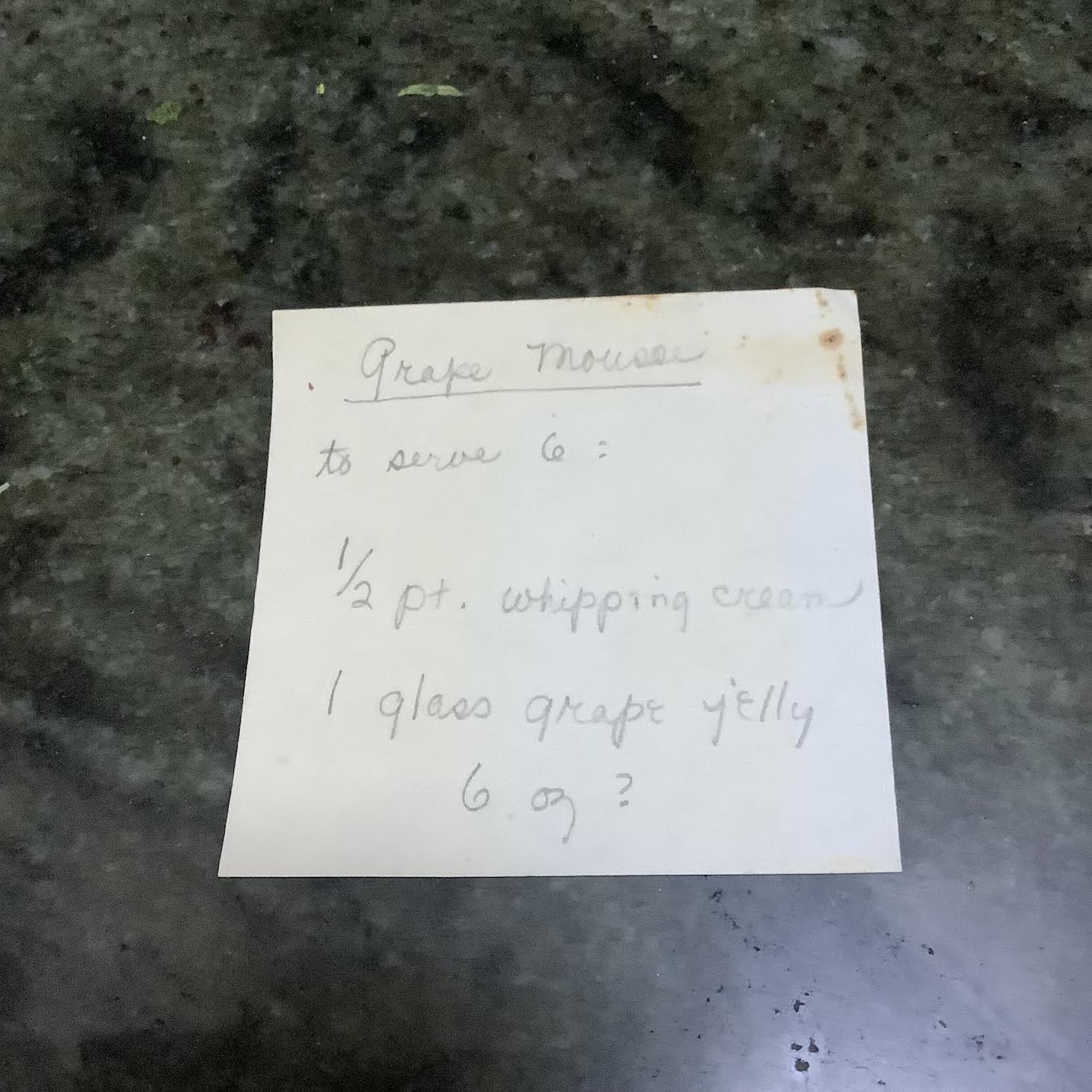
Mary Johnson Dillon published her novel In Old Bellaire in 1906. It is set in Carlisle, Pennsylvania during the Civil War, and depicts life in the college town where the author grew up. Amid the flirting and social customs, a dinner party occurs and one of the desserts served is a ‘grape mousse’. My mother would sometimes be inspired to track down literary food references, so she asked older members of the Carlisle community if they knew the recipe. Sure enough, a recipe [of sorts] emerged. Here it is in my mother’s own hand:
That’s helpful, isn’t it? My mother tried this and it was a hit — a splendid make-ahead treat for hot weather. So I got to thinking — what about other jellies… or even jams…?
Thus I concocted a Strawberry-Rhubarb Mousse. Dear Husband thought it was great, and he was right. This is a taste-and-pour recipe, so adjust the amount of jam to taste. Start out using less than the amount, then adjust to taste. To flesh out the recipe:
Sv 4-6
ramekins or wine coupes
1 cup whipping cream
With electric beaters, whip until almost forming peaks.
4-6 oz strawberry-rhubarb jam
Add jam and continue to beat until incorporated.
Distribute among ramekins or wine coupes. Freeze 2 hrs.
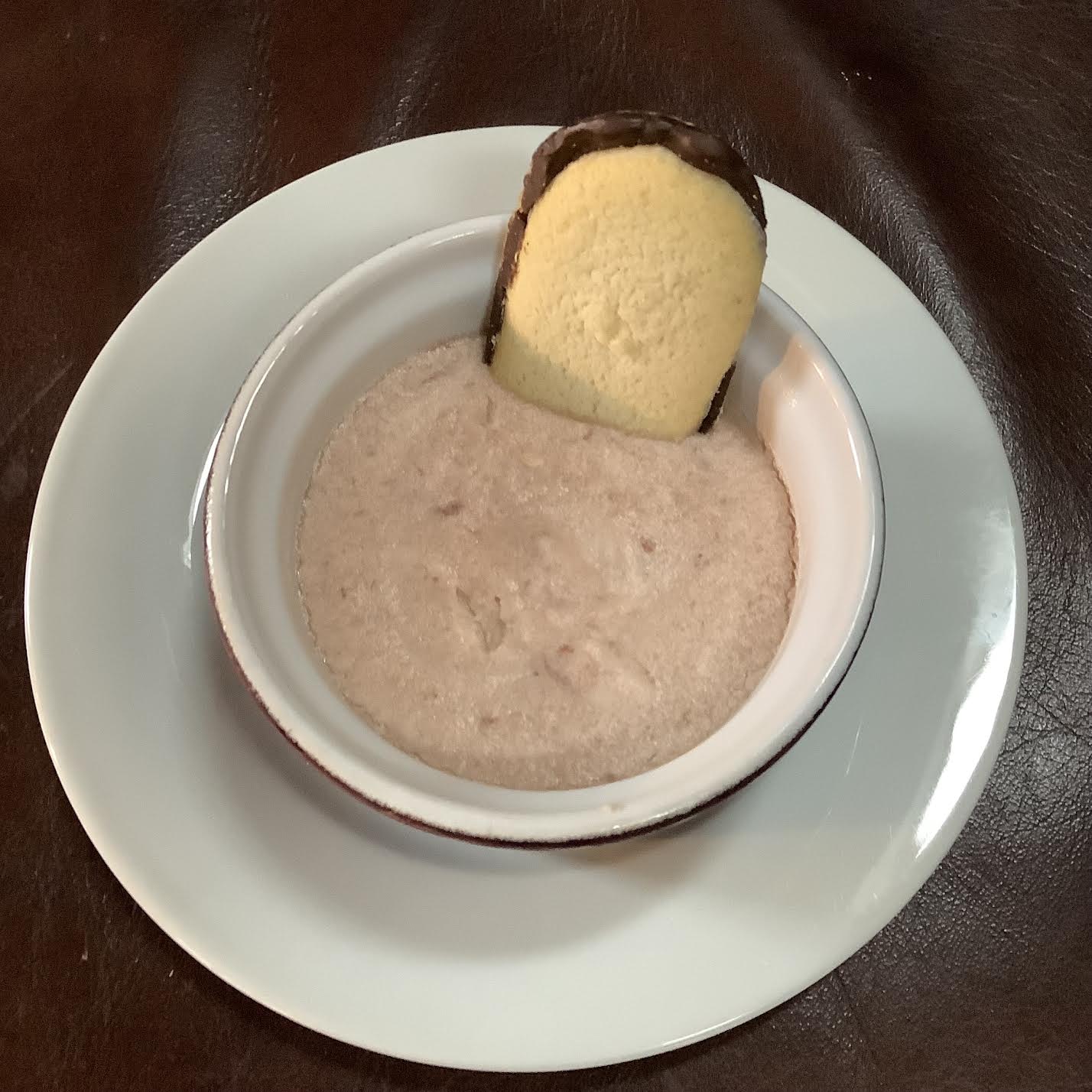
The mousse, served right out of the freezer, adorned with a Milano cookie.
People who are new to Fasting often pose the questions: “Can I really eat ‘anything I want’ on a Slow Day?” and “What should I eat on Slow Days?” To answer those questions, I have decided to add some blog posts to show some of the foods we eat on what the world calls NFDs [non-fast days] but which, in our house, we call ‘Slow Days.’ This feature will appear sporadically.
Who doesn’t like a good cookie? [The Brits call cookies biscuits. The French call cookies bisquits secs. The Germans call them kekse.] Oh, all right, eating cookies year-’round is an American thing, and the Toll House Cookie is now ubiquitous. The trend of cookies the size of a salad plate has no doubt lead to the obesity epidemic. There are specialty cookies — think Christmas Cookies! — and there are everyday cookies. The cookies that I propose today are the ones that I save for Springtime. One is Mary Berry‘s recipe for Easter Biscuits, which I cut out as flowers and butterflies. The other is an Italian confection that looks so cheery that it must be the herald of Springtime temperatures and flowers.
24 Easter Biscuits, 2.5” diameter
Preheat oven 400F/200C/180C Fan. Line 2 baking trays w/ parchment
100g/ 3½ oz unsalted butter 75g/ 2¾ oz caster sugar** egg yolk finely grated lemon zest
Let butter soften at room temperature. Cream butter and sugar in a bowl until well combined and fluffy. Add the yolk and zest.
100g/ 3.5oz plain flour 100g/ 3.5oz white whole wheat flour 50g/ 1¾ oz currants/raisins 1–2 Tbsp milk
Sift in flour and mix well. Stir in currants and enough milk to make a fairly soft dough.
Knead dough on a floured surface + roll out 5mm/ ¼” thick. Cut out using a 6cm/ 2½” fluted cutter. Work quickly in a cool area of the kitchen lest dough becomes too soft. If soft after mixing, chill 10 mins or until easier to handle.
Put on baking trays and bake 8 mins.
Egg white
Lightly beat egg white with a fork until frothy. Take biscuits from oven and brush tops with beaten egg white.
Caster sugar
Sprinkle with caster sugar and bake 5 mins, or until pale golden brown and cooked though. Cool on trays for a few mins, then longer on a wire rack.
96 Ricotta cookies
48 Ricotta cookies
350 F/175 C. Cover baking sheet with parchment.
1 cup butter 1¾ cup sugar
½ cup butter ¾ cup sugar
Add softened butter and sugar to a stand mixer. Mix together until combined.
2 eggs 2 tsp vanilla extract
1 egg 1 tsp vanilla
Add eggs and vanilla extract. Continue to mix.
2 cups ricotta cheese
1 cup ricotta
Add ricotta cheese. Mix again and scrape off bowl sides to be sure that all ingredients are combined.
1 tsp baking powder 1 tsp baking soda 4 cups white flour
½ tsp baking powder ½ tsp baking soda 1 c white flour 1 c almond meal
Pour in flour, baking soda, and baking powder. Mix to form a dough.
Portion dough with a 1.5 tsp scoop and put on the baking sheet. Bake 15-20 mins, until bottoms are golden brown.
Take from oven and cool 10 mins.
1 cup 10X sugar 1 T milk rainbow sprinkles
½ cup confectioners sugar 1.5 tsp milk rainbow sprinkles
Combine sugar and milk in small bowl, Stirring until smooth. Dip each cookie into frosting and top off with rainbow sprinkles. Let frosting dry, then enjoy.
69 calories… 3 g fat… 0 g fiber… 1 g protein… 10 g carbs… 18 mg Calcium
People who are new to Fasting often pose the questions: “Can I really eat ‘anything I want’ on a Slow Day?” and “What should I eat on Slow Days?” To answer those questions, I have decided to add some blog posts to show some of the foods we eat on what the world calls NFDs [non-fast days] but which, in our house, we call ‘Slow Days.’ This feature will appear sporadically.
A look at my father-in-law’s family tree shows lots and lots of German names — husbands and wives alike. And then, in 1903, one of the German sisters married an Irish man! Kate Haggerty was cousin to Dear Husband’s grandfather, but she was known to all as “Aunt Kate”. She was apparently a great baker, because one of the family’s handed-down recipes is for “Aunt Kate’s Chocolate Cake.” A note says that she developed the recipe herself. It came to me via sister-in-law Bev, who sent me a trove of family kitchen lore. Oddly, Dear Husband did not remember eating said cake as a child. But then, his mother was not a baker. So I prepared this one year for his birthday and he was delighted.
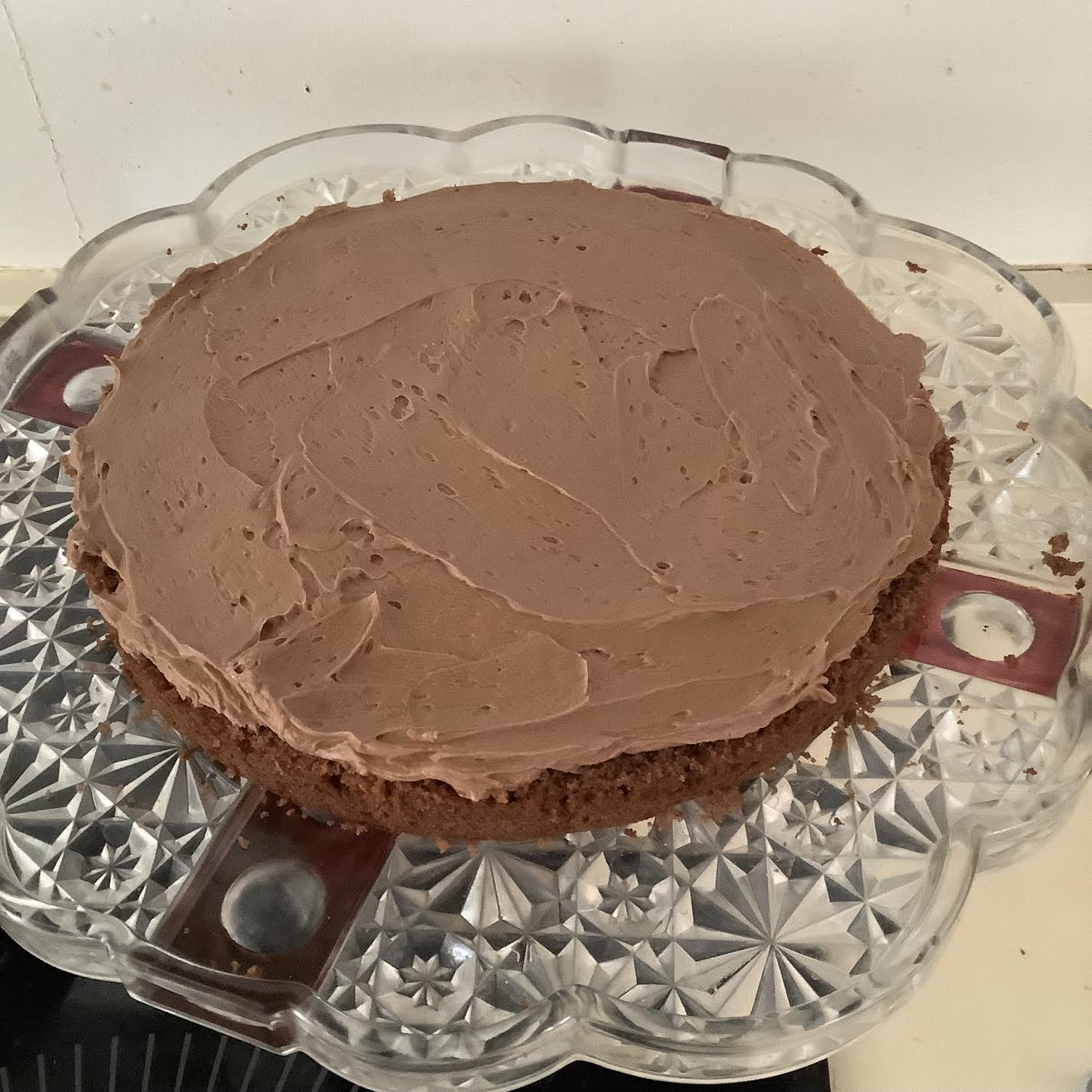
The edges of this cake are iced with the filling mixture, since I had run out of glaze.
One 9” 4-layer cake
Two 9” cake pans, buttered and lined w/ parchment
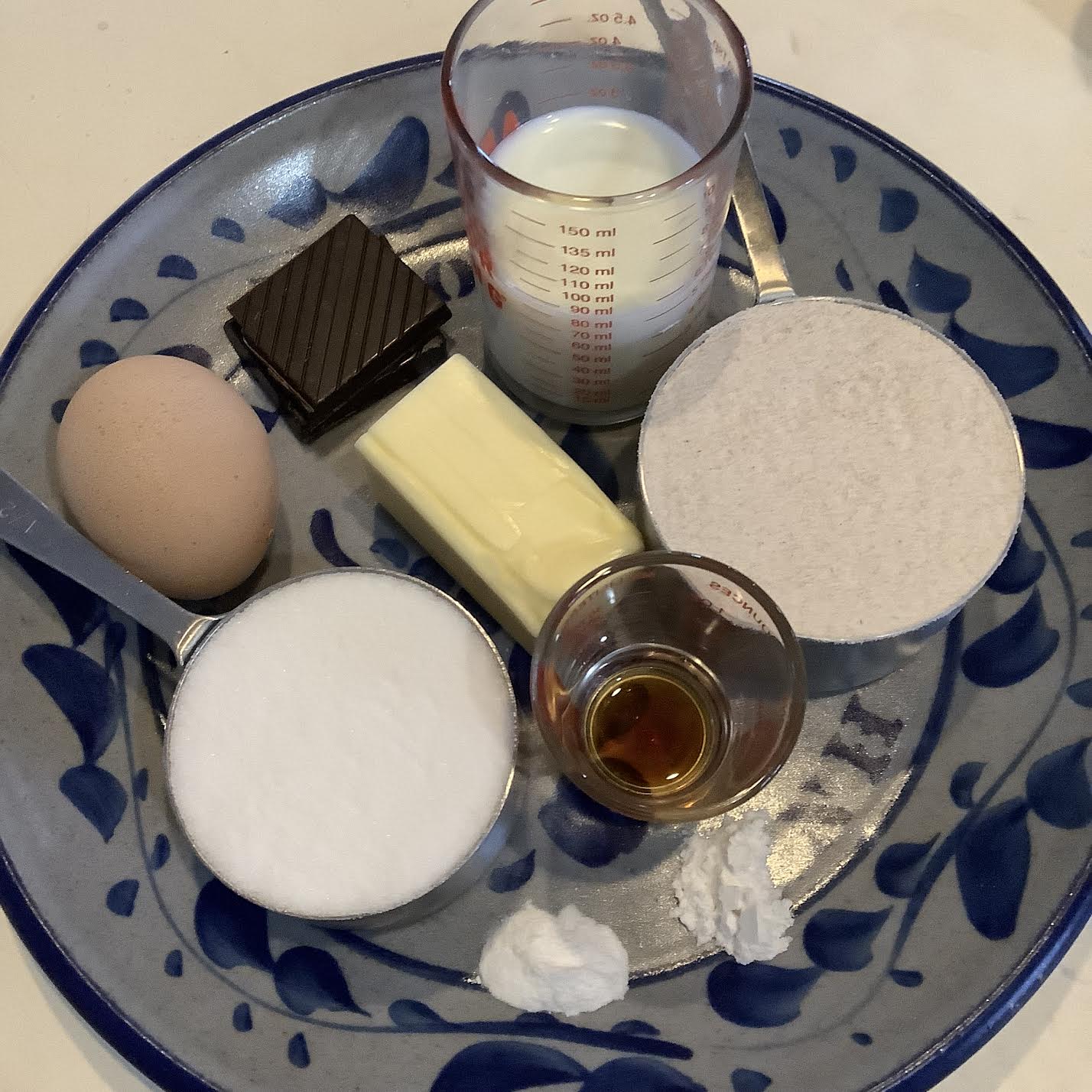
½ c butter 1 cup sugar
Cream together
2 eggs
Whisk and add to creamed butter
2 squares = 2 ounces bittersweet chocolate
Melt and add to batter, stirring well.
1½ c flour ¾ tsp cream of tartar ¾ tsp baking soda
Sift together 3x to combine. NB: when making chocolate cake, I use white whole wheat flour for more nutritional value.
¾ c milk ½ tsp vanilla
Stir together. Add to batter alternately with difted dry ingredients.
Divide between the two pans. Bake at 350F, 25 mins.
Cool, take from pans, slice each layer into 2 layers along the equator.
Spread 3 layers with filling*, stack, cover with glaze**.
The original way to prepare the cake is to bake two layers, and split them to make four layers. For the two of us, or even for a small group of six, I prepare one layer, split it, fill it, and glaze it. Either way, it is a very good cake!
Two layers and lots of filling!
*Chocolate Filling
½ # sweet butter, room temp 1½ c confectioner’s sugar
Cream together.
2 squares bitter chocolate ½ tsp vanilla
Melt chocolate, cool a bit, add to butter-sugar along with vanilla.
Divide equally among 3 of the 4 layers, and spread it evenly.
Melt together over low heat to form a very thin glaze. Put filled cake layers on a cooling rack over a rimmed baking sheet. Pour warm glaze over the cake, letting it drizzle down the edges.
People who are new to Fasting often pose the questions: “Can I really eat ‘anything I want’ on a Slow Day?” and “What should I eat on Slow Days?” To answer those questions, I have decided to add some blog posts to show some of the foods we eat on what the world calls NFDs [non-fast days] but which, in our house, we call ‘Slow Days.’ This feature will appear sporadically.
Valentine’s Day is around the corner, and Galentine’s Day precedes it. When I saw this recipe via Taste of France Magazine, I knew that I had to try it! Claudia Taittinger, of the Taittinger Champagnefamily, offers this recipe in her book Entertaining Chic!. These chocolate desserts are very simple to prepare and the result is fabulous. Since I am not cooking for a crowd, I cut the recipe back to 4 [should we have guests] or 2 servings [for Dear Husband and me]. We enjoy this very much for dessert on Valentine’s day. Prepare only as many as you need for that meal, as they do not reheat or keep for another day. This year, Alas, Valentine’s Day falls on Ash Wednesday. Culinary decisions will have to be made, as this treat is definitely NOT for Lenten eating!
You are asking: How does this possibly fit into the Fast Diet??!??! You must remember that the beauty of the Fast Diet is that one ‘Fasts’ only two days per week. With this lifestyle, one can indulge in food-of-your-dreams once in a while on Slow Days: we have this once a year, which makes it even more of a special treat. Does one eat like this all the time? Of course not! This year, the day after Valentine’s Day happens to be a Fast Day.
Sv 4
Sv 2-modified
Butter 4 or 2 ramekins; set aside.
100 g unsalted butter
40 g unsalted butter
Microwave butter ~ 10 seconds, until softened.
132 g 60% choco
60 g 72% choco
Chop chocolate, melt in a bain-marie or double boiler
100 g caster sugar
40 g caster sugar
In a medium bowl, combine softened butter and sugar.
2 eggs 17 g white flour 17 g white whole wheat flour
1 egg or 1.8 oz egg whites 17 g white whole wheat flour
Have eggs at room temperature. Add eggs, one at a time, alternating with the flour. STOP HERE IF NEEDED
Melted chocolate
Melted chocolate
Stir in melted chocolate, pour 103 g of batter into each ramekin
Put ramekins in freezer 1 hr.
Preheat oven to 300°F /150°C.
Berries Ice cream or crème fraîche
Berries Ice cream or whipped cream
Take ramekins from freezer and put in oven for exactly 20 mins. Unmould and serve hot, with your choice of topping.
People who are new to Fasting often pose the questions: “Can I really eat ‘anything I want’ on a Slow Day?” and “What should I eat on Slow Days?” To answer those questions, I have decided to add some blog posts to show some of the foods we eat on what the world calls NFDs [non-fast days] but which, in our house, we call ‘Slow Days.’ This feature will appear sporadically.
Large cosmopolitan cities around the world have many choices of cuisine, and opportunities to get food that one didn’t cook oneself. Chinese food is very popular for take-away. But out here in the woods of New Hampshire, carry-out might involve a drive so long that the food is cold by the time one gets home to eat it. The solution? Make your own. OK, perhaps there is a bit of Yankee self-sufficiency in that course, but it is need-driven.
Chinese steamed buns, Char Siu Bao, are yummy and really not that difficult to prepare. With Chinese New Year coming up, treat yourself and your friends to steamed buns from home. You can make the filling days in advance. If you wish, the filling, or at least the Chinese Roast Pork, could be purchased at an Asian market or from a co-operative Chinese restaurant — I think I might have seen it at a supermarket in the deli case. Not an option? Then make your own filling.
FOR THE FILLING:
1 T. oil OR 1 tsp oil + spray of PAM ⅓ cup finely chopped shallots or red onion
Heat the oil in a wok over medium high heat. Add the onion and stir-fry 1 min.
Turn heat down to medium-low, and add these ingredients. Stir and cook until mixture starts to bubble up.
½ cup chicken stock 2 Tbsp white whole wheat flour
Add the stock and flour, cooking for a couple minutes until thickened
1½ cups diced Chinese roast pork = 6.75 oz = 193 g
Take from heat and stir in pork. Set aside to cool. If you make filling ahead of time, refrigerate covered to prevent drying.
FOR THE BUN DOUGH:
1 teaspoon active dry yeast ¾ cup warm water
In the bowl of an electric mixer fitted with a dough hook (you can also just use a regular mixing bowl and knead by hand), dissolve the yeast in the warm water.
1 c all-purposeflour 1 c white whole wheat flour 1 c cornstarch 4 tablespoons sugar ¼ c canola or vegetable oil
Sift together flours and cornstarch, and add to the yeast-water along with sugar and oil. Set mixer to lowest setting and let it mix until a smooth dough ball is formed. Cover with a damp cloth and let it rest for 2 hours.
2½ tsp baking powder 2-3 tsp water
Add baking powder and turn mixer to lowest setting. If dough looks dry and baking powder won’t mix in, add water. Gently knead with dough hook until it is smooth again. Cover with damp cloth, let rest 15 minutes. Set up your steamer in the wok.
Roll dough into a long tube and divide into 20 equal pieces. Press each piece of dough into a disc about 4½ inches in diameter (it should be thicker in center and thinner at edges).
Add some filling and pleat buns closed. Place each bun on a parchment paper square or cabbage leaf. Put steamer over wok, being sure boiling water does not touch the buns during steaming process.Once the water boils, put buns in the steamer for 12 minutes over high heat.
Place each bun on a parchment paper square, and steam. I steamed the buns in two batches using a bamboo steamer Be sure boiling water does not touch buns during steaming process. Once water boils, put buns in the steamer, and steam each batch 12 mins over high heat.
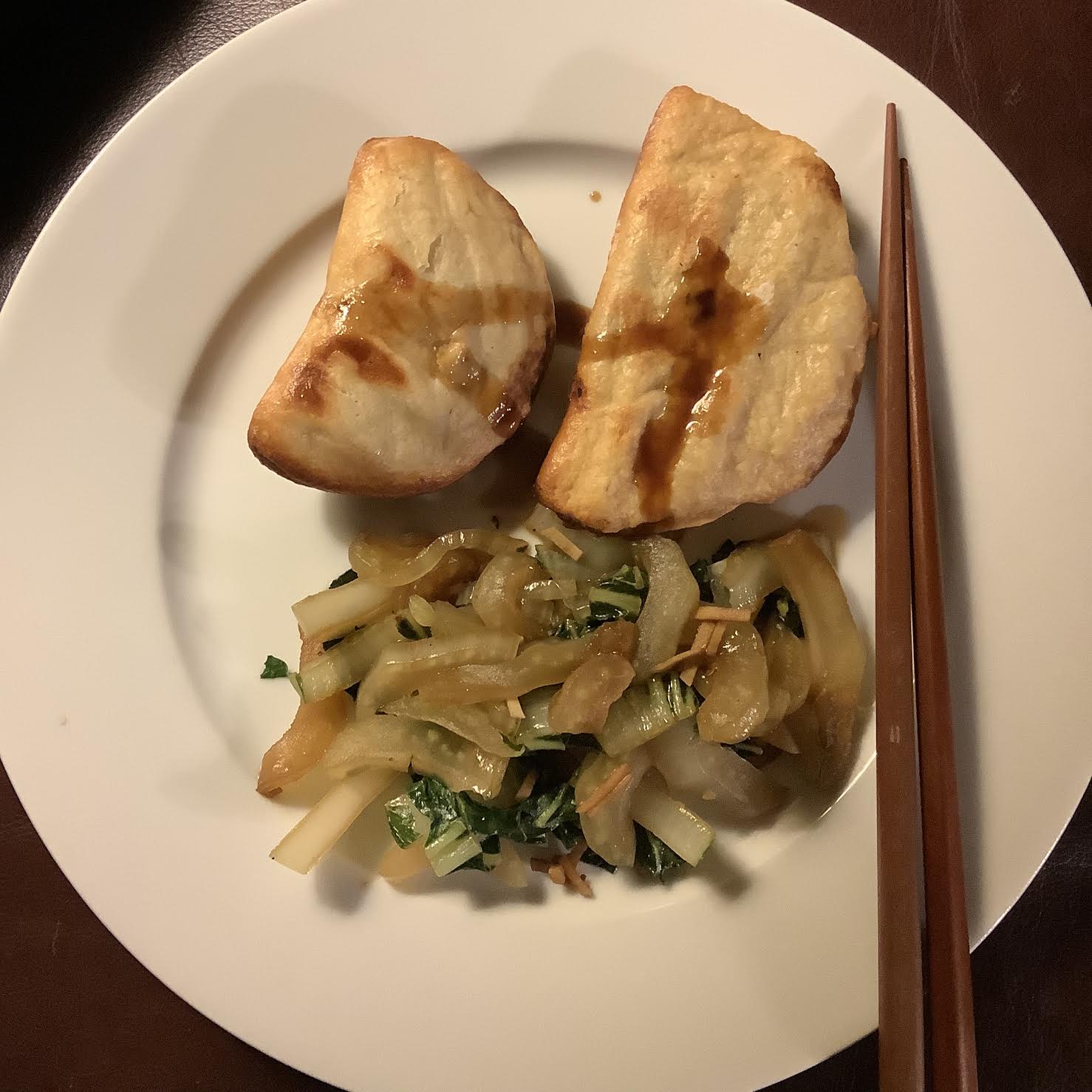
Serve the Cha Siu Bao fresh, with stir-fried vegetables. Freeze any that are left over for a future dinner or even breakfast.
People who are new to Fasting often pose the questions: “Can I really eat ‘anything I want’ on a Slow Day?” and “What should I eat on Slow Days?” To answer those questions, I have decided to add some blog posts to show some of the foods we eat on what the world calls NFDs [non-fast days] but which, in our house, we call ‘Slow Days.’ This feature will appear sporadically.
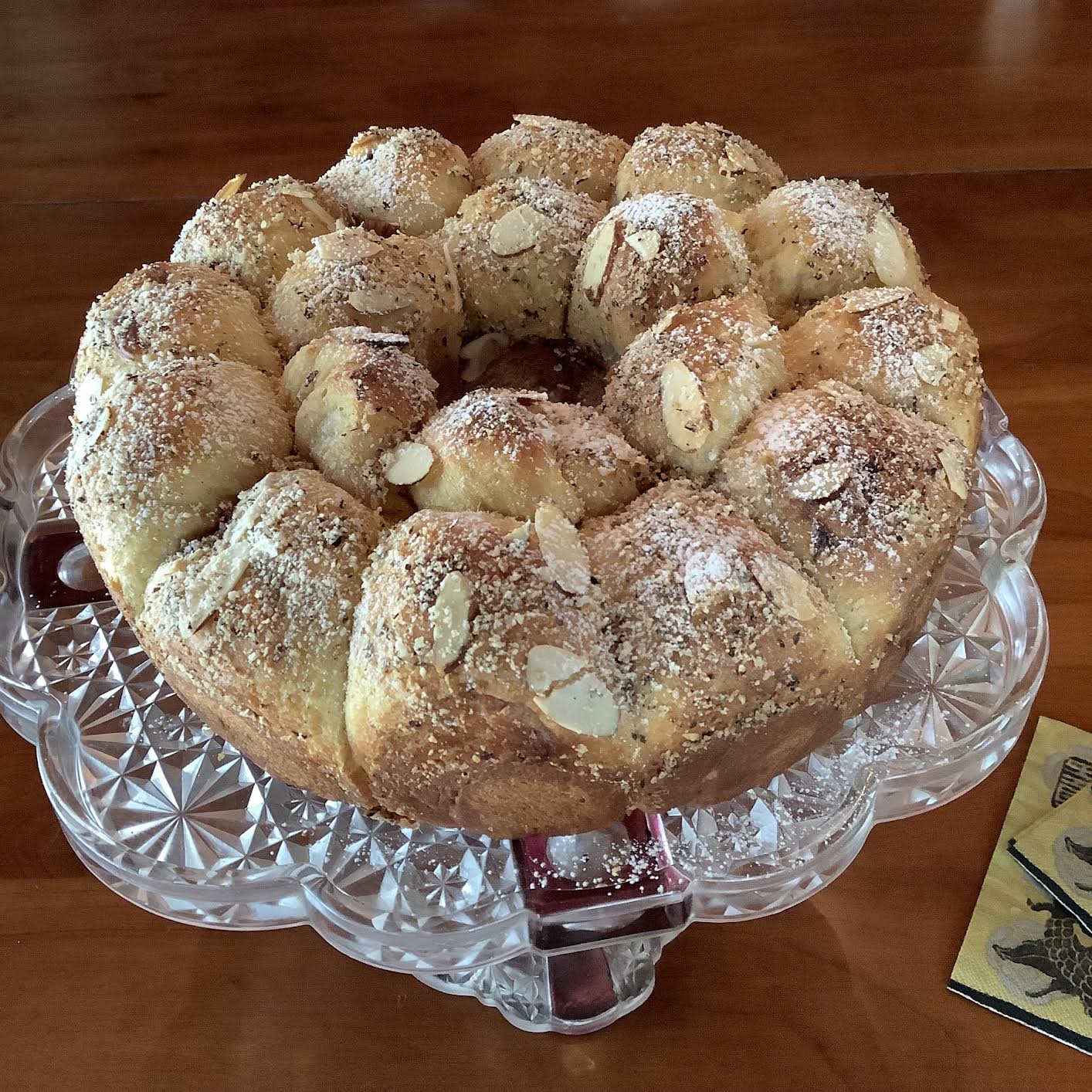
If you want something special for a holiday breakfast, this delightful brioche wreath fills the bill. The recipe is from Bonne Maman, makers of jams, jellies, and spreads, and of course they want you to use one of their products. You may use any quality homemade or purchased jam you wish. I prepared this for a gathering of the knitting group, and it was a success. The step involving the preparation of the jam-filled balls could be a family affair and is a good way to include little hands in the kitchen. I have broken the recipe into steps over two days, which simplifies the process [I think], and breaks it into steps that are not too time-consuming. And the next day, Voila! a splendid breakfast centerpiece that looks spectacular, but was made with little fuss.
1 large wreath of 18 puffs
10” tube pan or 12” pie plate + ramekin
DAY 1, EARLY
7g sachet fast-action dried yeast 25g golden caster sugar 150 g white whole wheat flour 150g strong white = bread flour zest of ½ orange + ½ lemon 1 tsp salt
Caster sugar is a fine-grained sugar from the UK. Blitz granulated white sugar in the food processor to make a substitute. Zest the orange and lemon rinds OR USE 2 Tbsp ORANGE PUREE. [chop an orange into large pieces, run through food processor to make a chunky mush] Mix these in the bowl of an electric mixer with a dough hook. Make a well in the center.
50 ml warm milk 3 large eggs, beaten
Pour these into center well. Mix on a slow speed 2 mins, then on medium 3-4 mins, until dough is soft, glossy and elastic.
225g/16 Tbsp/2 sticks butter, cubed and very soft
Add butter, bit by bit, and mix 4-5 mins. Scrape down bowl to mix thoroughly. Dough will be very soft. Tip into an oiled bowl, cover with film and chill 8-24 hrs until firm.
DAY 1, LATE
18 tsp Bonne Maman Conserve – choose your favorite or make 9 of one flavor and 9 of another
On a lightly oiled surface, divide dough into 18 pieces, ~40 g each. Roll pieces in circles 10 cm in dia. Spoon 1 tsp of jam on centre of each. Bring up sides, pinch together, roll into a ball.
Butter a 10” tube pan. ORPut a greased ramekin in center of buttered 12″ pie plate. Put 6 balls, seam side down, around center tube. Put 12 balls in an outer circle. Cover, let sit 2 hrs until puffy –OR– OVERNight @ 40 degrees
DAY 2, MORNING
Heat oven to 170ºC/340F/ gas mark 5.
Egg wash ½ tsp lemon finishing salt 1 tbsp ground hazelnuts sliced almonds
After rising, brush dough with a little egg wash, sprinkle with salt and nuts. Bake 20 mins, until golden.
Cover with foil and cook 10-15 mins longer.
Icing sugar
Cool slightly, remove from pan. Remove ramekin if using. Dust with icing sugar.
People who are new to Fasting often pose the questions: “Can I really eat ‘anything I want’ on a Slow Day?” and “What should I eat on Slow Days?” To answer those questions, I have decided to add some blog posts to show some of the foods we eat on what the world calls NFDs [non-fast days] but which, in our house, we call ‘Slow Days.’ This feature will appear sporadically.
It is that time of year — time for Christmas cookies!! Some people buy a tin at the super-market and call it ‘done’. My friends in Canada are big fans of bar cookies — lots of product with little effort. My mother, a cookie-lover at any time of year, produced an array of cookies of varying sizes, shapes, and colors. It was spectacular! Once I had my own family, I continued the tradition, sometimes producing 13 different types of Christmas Cookies. [HINT: I bake one variety per day, starting on December 1st, and making 2 dozen of each cookie. Unused dough goes into the freezer for future use.] We start eating the cookies in earnest on Saint Lucy’s Day, December 13, while we decorate the tree.
In Old Germany, Christmas cookies were baked in vast numbers, starting a month or two early. These were the “keeping cookies” — baked hard, and easy to store for weeks until needed. One such cookie is Lebkuchen. The name could be from the German ‘sweet cake’ or from the ancient Roman ‘librum’, a bread made with honey. The oldest references to these cookies are from Ulm in 1296, then in Nurnberg in 1395. The spices and almonds are evidence of trade routes with the Levant and the Mediterranean established by the Hansiatic League.
Makes 5 dozen
Makes 2½ dozen
4 eggs
2 two-oz eggs
Beat until light
2 cups sugar
1 cups sugar
Beat in gradually
1 tsp baking powder 3 Tbsp brandy
½ tsp baking powder 1½ Tbsp brandy
Stir together, add to egg mixture
¾ # ground almonds 1 tsp cinnamon 1 tsp cloves ½ #/8 oz honey ½ #/8 oz finely minced citron 5 cups flour
1/3 # ground almonds ½ tsp cinnamon ½ tsp cloves ¼ #/4 oz honey ¼ #/4 oz finely minced citron 2.5 c. white whole wheat flour
Add and stir into a thick, heavy dough.Wrap in waxed paper/cling film and chill overnight.
Preheat oven to 325F.
Divide dough into 3-4 pieces for easy rolling. On a lightly-floured surface, roll out one portion ¼ “ thick. Square off round edges. Cut in 2×3” rectangles. Gather scraps together to reuse.
Repeat until you have as many cookies as you wish. Wrap and freeze any remaining dough.
Bake on silicon mats or parchment ~ 6-8-10 mins, until bottom is browned and top barely dents when pressed upon. Cool cookies on a rack.
½ c icing sugar enough lemon juice
½ c icing sugar enough lemon juice
Sift sugar. Stir in enough juice to make a thin icing.
Blanched Almonds: slivered or sliced or halved Red glace cherries, halved Candied pineapple, sliced if very thick
Blanched Almonds: slivered or sliced or halved Red glace cherries, halved Candied pineapple, sliced if very thick
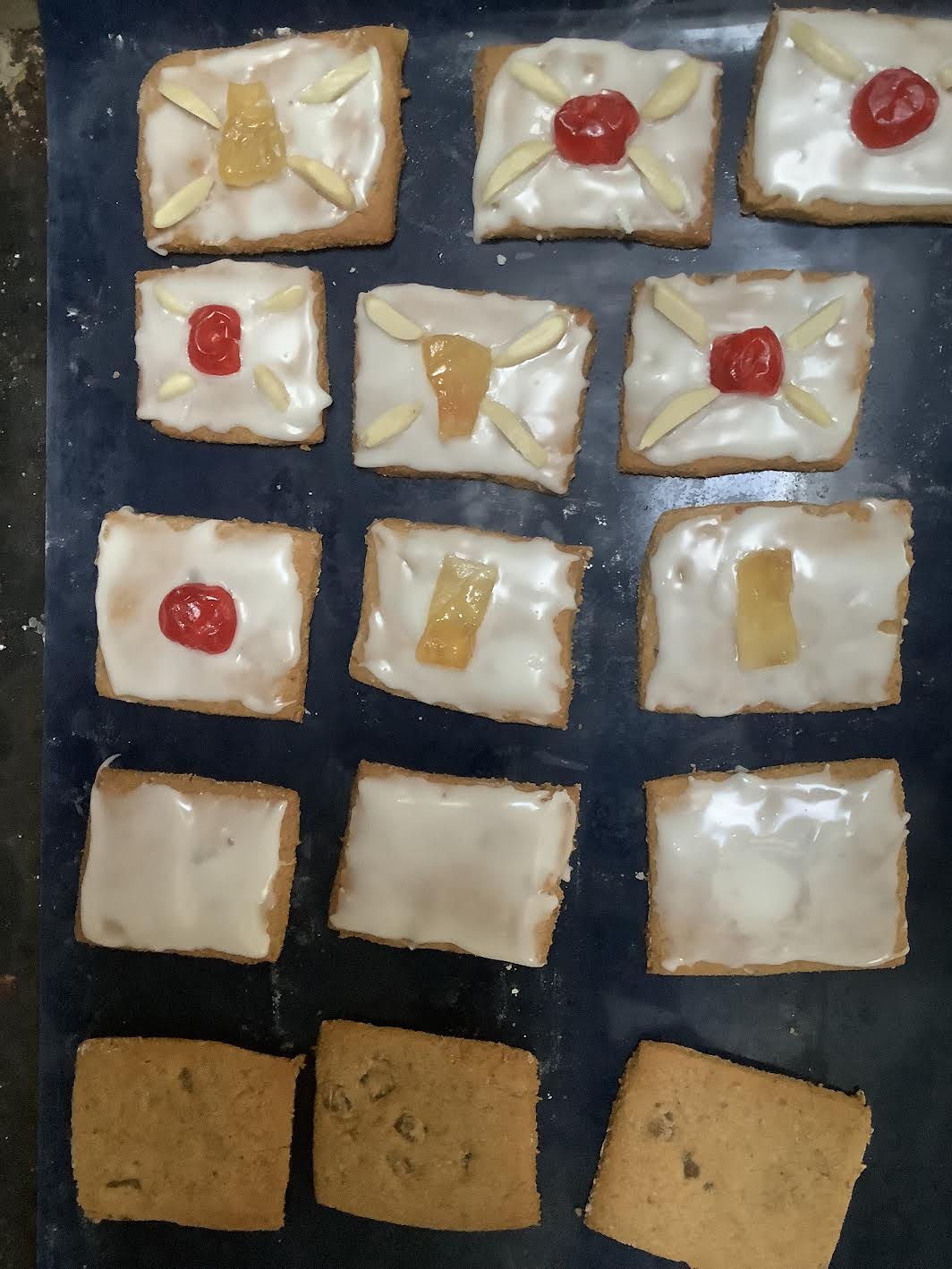
Ice 4 cookies at a time. While icing is still wet, put a piece of fruit in the center of each cookie. Put a nut in each corner, pointing toward the center. Continue.
Baked, the cookies may be stored in a sealed tin for days or weeks before icing and decorating.Ice a few at a time, so the decorations are in place before the icing sets.
The original recipe produces a very hard cookie [read: tooth-breaking], so I reduced the cooking time to produce a softer texture. The cookies, decorated, keep in a tin for weeks. Baked, un-decorated cookies can go into the freezer. I always save some un-decorated cookies to double as “Lembas” when we celebrate our Lord of the Rings Day in March.
People who are new to Fasting often pose the questions: “Can I really eat ‘anything I want’ on a Slow Day?” and “What should I eat on Slow Days?” To answer those questions, I have decided to add some blog posts to show some of the foods we eat on what the world calls NFDs [non-fast days] but which, in our house, we call ‘Slow Days.’ This feature will appear sporadically.
The late, lamented Gourmet Magazine had a practice of publishing favorite recipes from readers. One of them was for this coffee cake. What makes it “Pennsylvania Dutch” is probably the method of cutting the butter into the flour to form a crumb, then combining most of the crumbs with the moist ingredients. This is similar to the process of preparing a Shoo-Fly Pie, a classic of Pennsylvania Dutch cuisine. Since the recipe makes two 8″ cakes, there is one to eat and one for gifting or for the freezer.
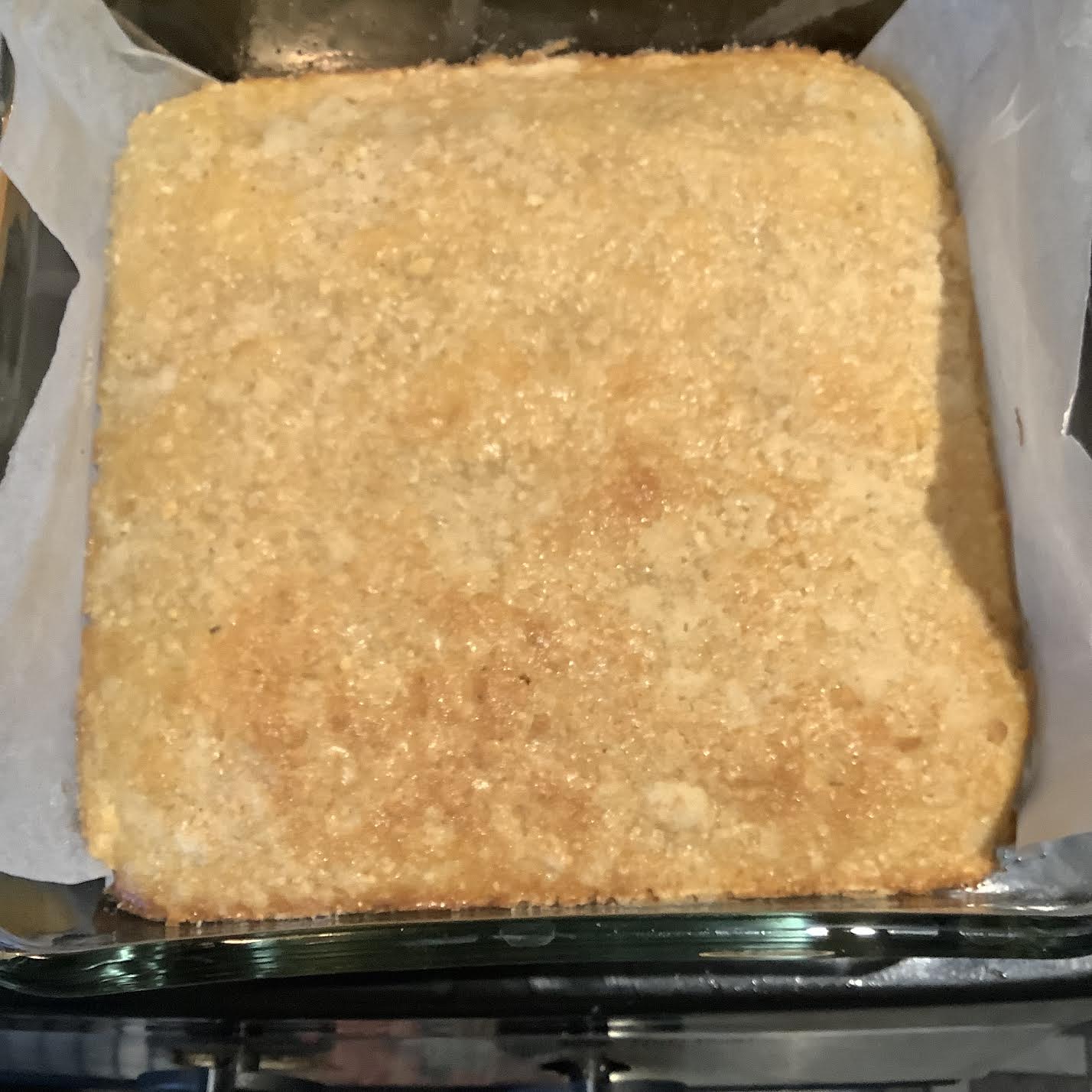
Fresh from the oven, in an 8×8″ pan. Cut into 9 pieces.Served with strawberry yogurt, back bacon, mocha cafe au lait, and orange-rhubarb juice.
The coffeecake is delicious and easy to prepare. Have only one egg to use? You can just as simply make one cake from the recipe. Either way, the cake is moist and flavorful. This is a regular in our breakfast rotation.
Two 8 or 9” cakes
1 cake or 12 muffins
8 or 9” round cake pans
2 eggs 1 c. milk, fat % of your choice
1 eggs ½ c. milk, fat % of your choice
Whisk together and set aside.
2 ½ c. white whole wheat flour 1 ½ c sugar or 1¼ c. ½ tsp salt 1 Tbsp baking powder ¾ c/12 oz butter
1¼ c. white whole wheat flour ¾ c sugar or 2/3 c. ¼ tsp salt 1½ tsp baking powder 1/3 c/ 6 oz butter
With pastry blender or 2 knives, cut together until mixture looks like a coarse meal. SAVE OUT ½ OR ¼ CUP OF CRUMBS, set aside
Stir egg-milk into flour crumbs until combined.
Pour into pans, buttered or lined with parchment paper.
½ cup crumbs
¼ c crumbs
Sprinkle tops with crumbs.
Bake @ 375F 25-30 mins, until top begins to turn golden.
People who are new to Fasting often pose the questions: “Can I really eat ‘anything I want’ on a Slow Day?” and “What should I eat on Slow Days?” To answer those questions, I have decided to add some blog posts to show some of the foods we eat on what the world calls NFDs [non-fast days] but which, in our house, we call ‘Slow Days.’ This feature will appear sporadically.
In mid-September, there are still plenty of tomatoes left in the garden. Even if you don’t have a garden, you can get lots of tomatoes to prepare small quantities of relishes — suitable for use all Winter, or as gifts for friends and relatives. Contact your local farm stand or producer and ask if they will sell you their ‘seconds.’ These are the not-so-good-looking tomatoes that can’t get full price for the grower. Sometimes they are called ‘canners’ or ‘Grade B’ or ‘Number 2s’, and they are sold by the bushel or by the pound. They will all be different shapes and sizes, they might be partially green, they might have blemishes on the surface. But, like people, they are all the same under the skin, no matter their color or appearance or differences.
Grade B tomatoes, after ripening for a few days. The wrinkly one in the lower left ought to be cooked right away, after cutting away the too-soft parts. Use in tomato sauce for pasta.
The greenish tomatoes are perfect for making Chow. Other green ones can be put in a sunny window where they will ripen nicely in a few days. Let the fun begin! You can prepare Tomato Salsa, Bruschetta Relish [the tomatoey stuff for on top of bread], or Corn-Tomato Salsa. These are small-batch recipes, so they are quick to fix and do not need many pounds of materials. If you want to prepare more, double or triple the recipes.
TOMATO SALSA: makes 3 cups This salsa is useful many ways: as a dipping sauce for chips; as a dressing for cooked fish; as an ingredient in tacos.
2 cups chopped tomatoes 1 cup/5.3 oz chopped green sweet peppers 1 cup chopped onion ½ cup jalapeno/serrano peppers, chopped 1 clove garlic, minced 1 tsp salt ¼ c cider vinegar Stir everything together and let sit 15 minutes to marry the flavors.
BRUSCHETTA SAUCE: In addition to serving on bread as an appetizer, spread on toasted bread and top with an egg for breakfast.
makes 2 cups
½ pound plum tomatoes + 1 scallion 3 Tbsp extra-virgin olive oil 1 clove garlic + 1 tsp fresh tarragon ½ tsp crushed red pepper flakes ½ tsp salt + 1 tsp fresh oregano 2 Tbsp fresh basil + 1 tsp fresh marjoram
Core and quarter the tomatoes. Peel and crush the garlic. Slice the scallion. Chop the herbs. Put all of these ingredients into a food processor and pulse off and on to make a chunky sauce.
½ pound plum tomatoes
Core and quarter the tomatoes. Add to food processor, and pulse a few more times.
1 Tbsp balsamic vinegar 1½ teaspoons red wine vinegar
Pour the tomato-herb mixture into a bowl and stir in the vinegars.
CORN-TOMATO SALSAmakes 1½ cups Serve as a side dish or mix with eggs for a bake or scramble.
1 cup corn kernels 1 cup diced tomato 2 Tbsp minced red bell pepper 2 Tbsp diced red onion 2 Tbsp cider vinegar ¼ tsp dry mustard 1/8 tsp turmeric ¼ tsp sugar 2 dashes ground cumin Stir together all ingredients and let sit to mellow the flavors.
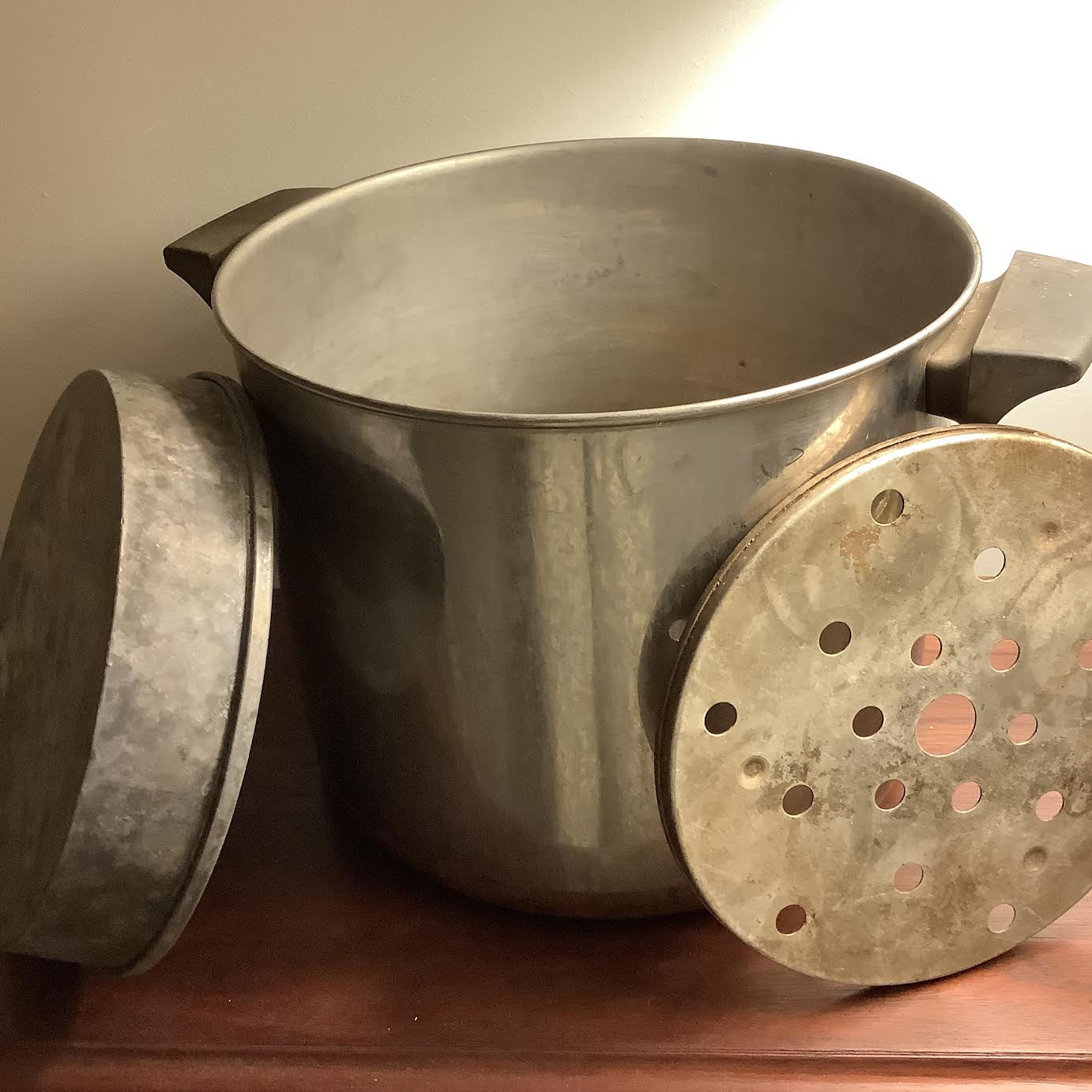
An ordinary stock pot becomes a hot-water-bath canner when you use some kitchen item to raise the canning jars from the bottom of the pot: a small cake pan, left, or a pressure-canner insert, right.
PRESERVING: If you wish to preserve the flavor of Summer, you can “put up” some jars of the Tomato Salsa and Bruschetta using a hot-water bath method. [NB: the Corn Salsa does not have enough vinegar in it to make it safe to can this way.] Canning is rather straight-forward and requires no extra equipment, if you have a nicely-stocked kitchen. You will need: canning jars [1 or 1/2 cup size] and the two-part canning lids that go with them. These are available at hardware and grocery stores. You’ll need a Dutch oven, large saucepan or stockpot deep enough to hold the jars [in one layer] with water covering them by 2 inches. Then you need something to elevate the jars above the bottom of the stockpot: the grill from part of the BBQ; the metal rack from a pressure-canner; a metal pie plate or cake pan that is 1-2″ smaller than the bottom of the stockpot.
Put 4″ water and the empty jars in the stock pot, and bring water to a strong simmer. Using tongs, dip the jar lids into the hot water, then lay them on a dish-towel on the counter. In a saucepan, bring your relish to a low simmer. When relish is hot, remove the sterilized jars to the dish towel and fill them with relish to within 1/2″ of the top. Run a clean chopstick around the inside of each jar, to break any air bubbles and to settle the contents. Wipe the jar tops and rims, and put on the 2-part lids.
Put the ‘bottom-protector’ into the pot, then arrange the jars upright in the simmering water in a single layer. Add enough water to cover the tops of the jars by 2″ and cover the pot. As the water starts a low boil, set the timer for 15 minutes and clean the kitchen. When the timer rings, remove the jars and set them on the dish towel to cool thoroughly.
People who are new to Fasting often pose the questions: “Can I really eat ‘anything I want’ on a Slow Day?” and “What should I eat on Slow Days?” To answer those questions, I have decided to add some blog posts to show some of the foods we eat on what the world calls NFDs [non-fast days] but which, in our house, we call ‘Slow Days.’ This feature will appear sporadically.
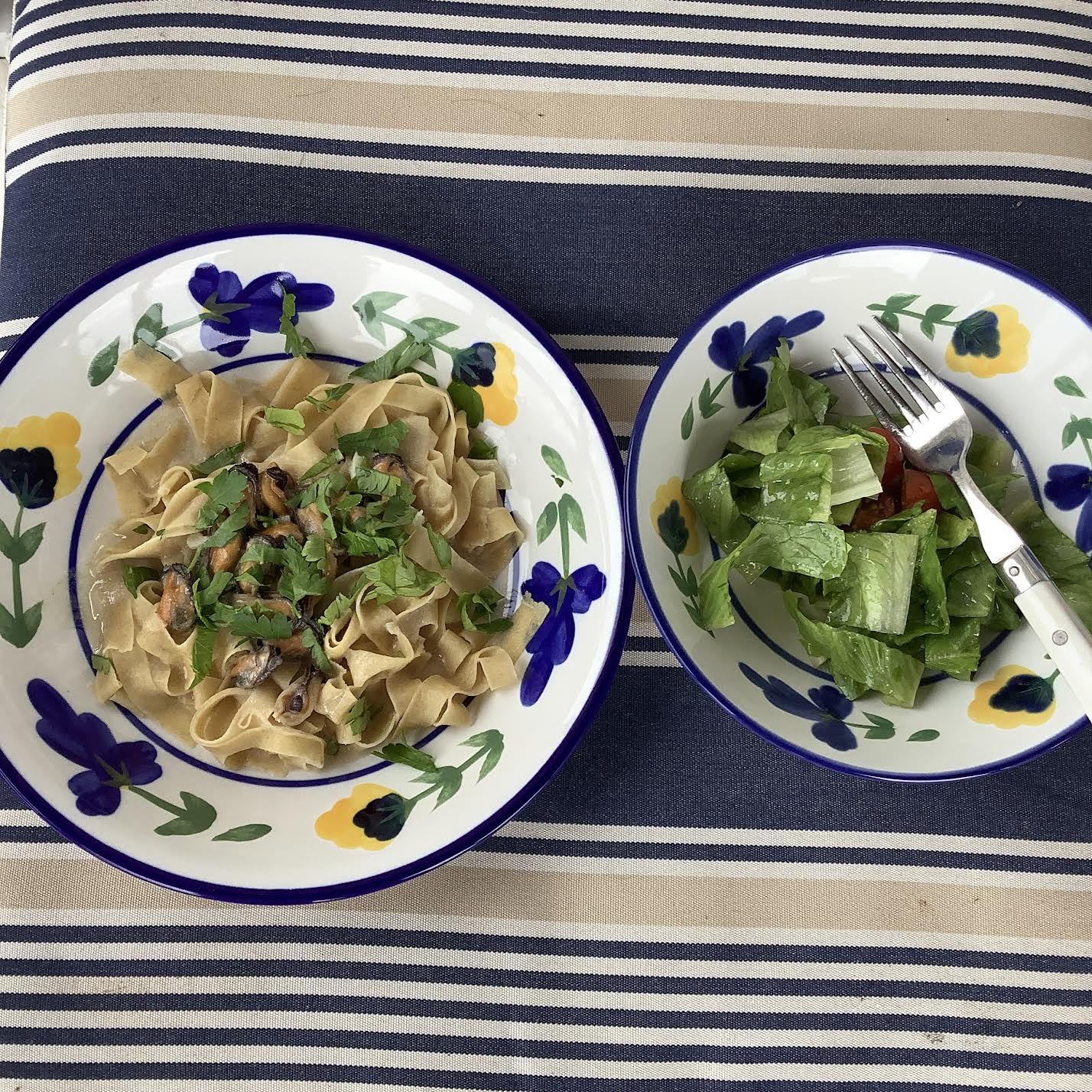
In Summertime, we eat mussels. “Rope-grown mussels” are a big industry where we vacation in PEI, Canada, and we take full advantage of them. Years ago, when we first started going to the local mussel processing plant to buy them, they sold for 50 cents/pound. Even though they are $2/pound now, they are worth it. One of our favorite ways to prepare them is a recipe from A Well-Seasoned Appetite by Molly O’Neil. You can prepare these with fresh mussels in their shells, or use cooked mussel meat that has been removed from the shells. We prefer the latter, and find it to be a good way to use left-over mussels from a previous feed. Very quick, very easy, very good.









 Eating well, with creative recipes, to follow the Fasting Lifestyle according to Michael Mosley's "Fast Diet."