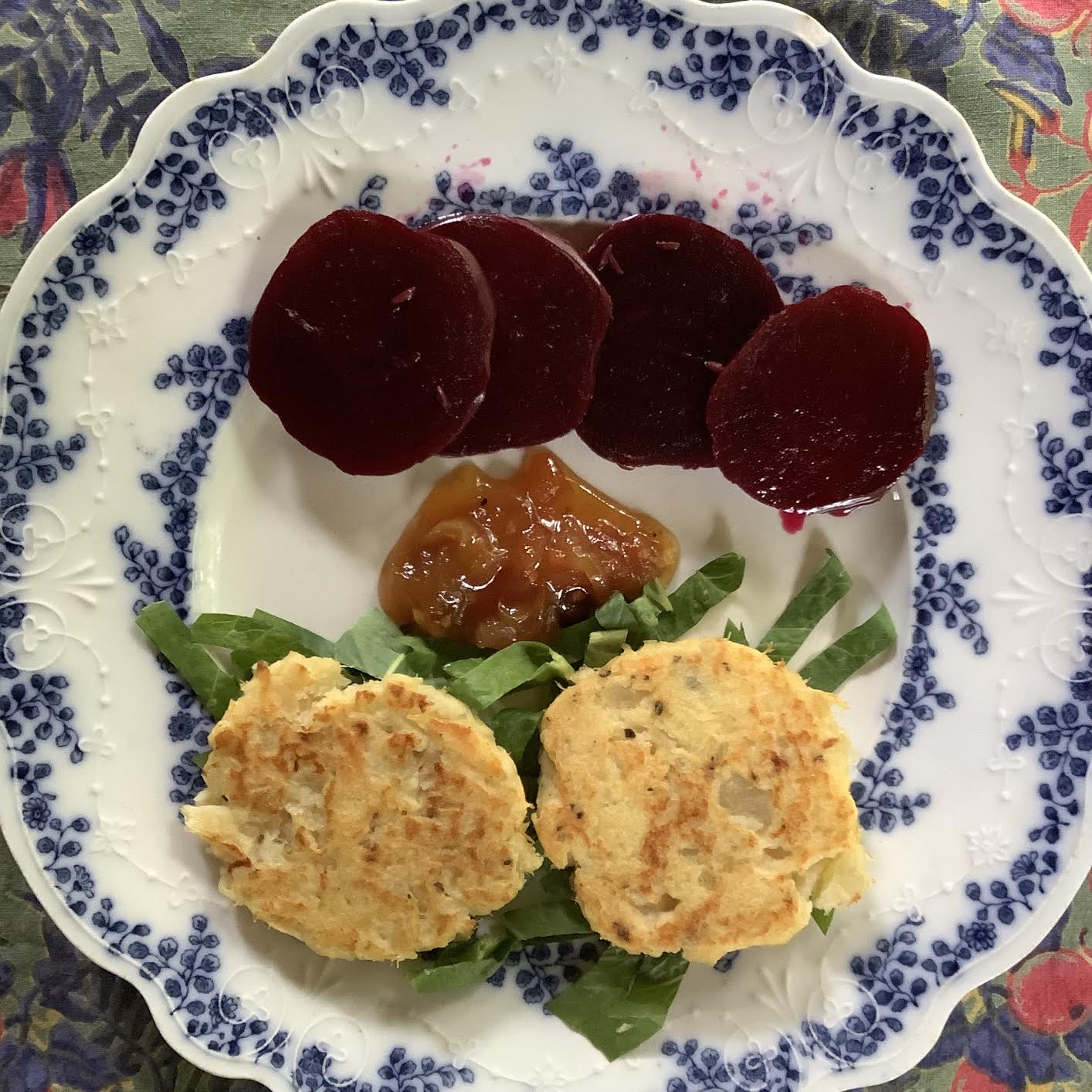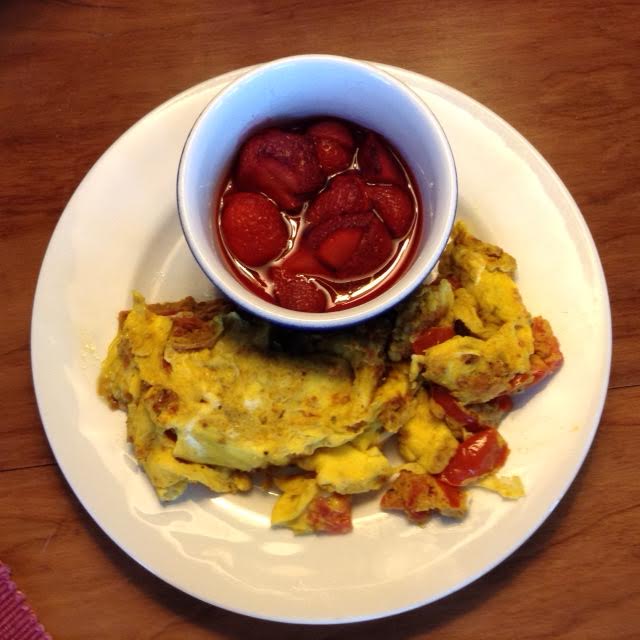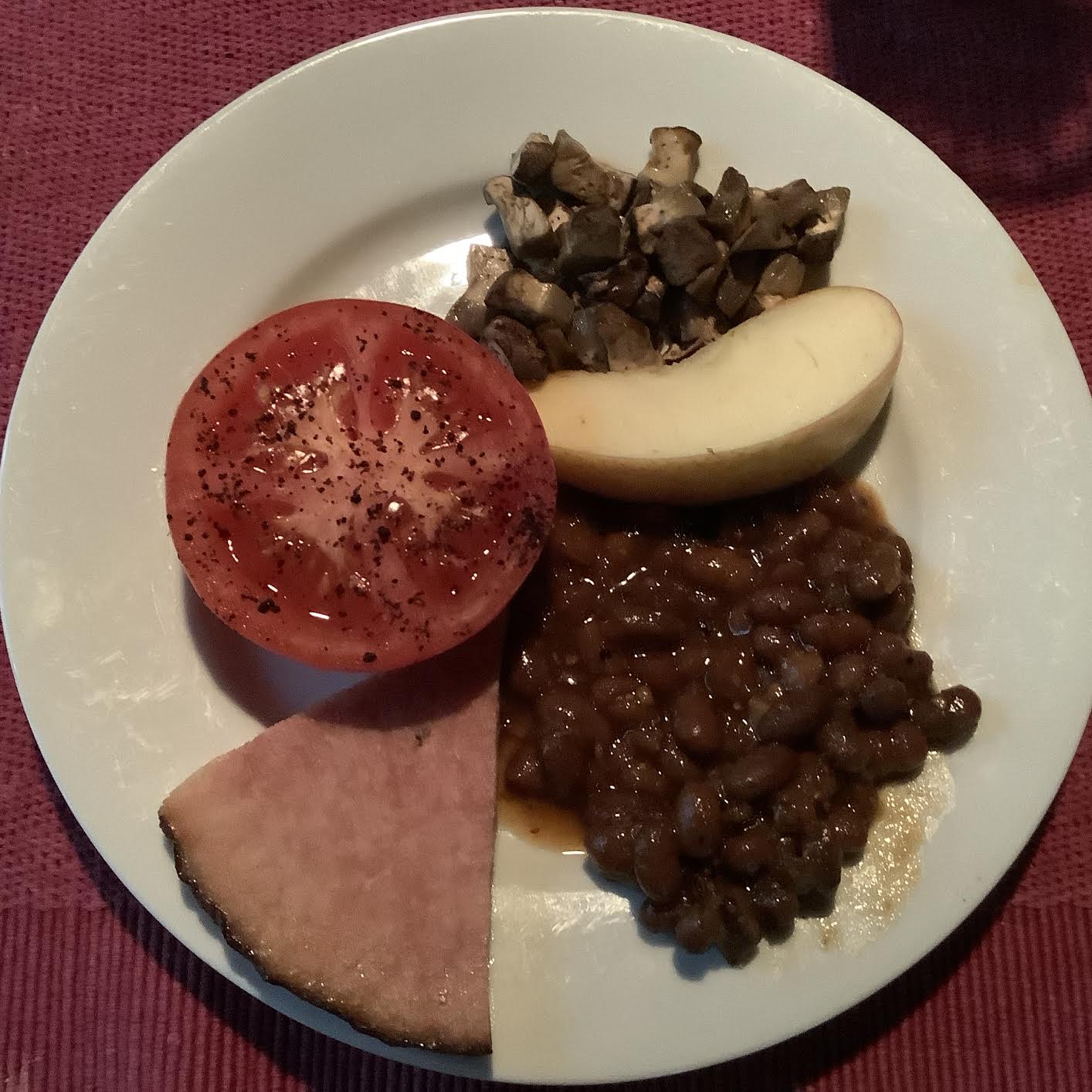
People who are new to Fasting often pose the questions: “Can I really eat ‘anything I want’ on a Slow Day?” and “What should I eat on Slow Days?” To answer those questions, I have decided to add some blog posts to show some of the foods we eat on what the world calls NFDs [non-fast days] but which, in our house, we call ‘Slow Days.’ This feature will appear sporadically.
Time was, salmon ran up the rivers of New England by the thousands every year on the way to their breeding streams. They were so common that servants had clauses written into their contracts to prevent their employers from feeding them salmon every day. By early July, there is a wonderful confluence of ingredients: fresh salmon, the new green peas, and the tiny first potatoes. These became the makings of a classic meal for a traditional 4th of July in the 1800s, before anyone had ever heard of hot dogs and hamburgers and barbecue grills. If you don’t believe me, you may consult James Beard’s American Cookery [pg.119] and the Boston Globe.
The salmon may be grilled, poached, or baked. The peas are newly liberated from their shells. The potatoes are roasted with olive oil, salt, and rosemary. A traditional [and attractive, and delicious] way to celebrate our Independence Day.
How this Fast DietLifestyle works: Eat these meals tomorrow, for a calorie total of less than 600. On another day this week, eat the meals from a different post, another day of eating 600 calories or less. Eat sensibly the other days of the week. That’s it. Simple way to lose weight and be healthier.
Canada Day is July 1st. It is not an ‘independence day,’ but it marks the agreement in 1867, that united Nova Scotia, New Brunswick, and “Canada” [as Quebec and Ontario were called] under one government. This was an out-growth of a conference in 1864, at which ‘confederation’ was discussed. So at last, the disparate provinces agreed to join under one name and one government. Provinces and territories from the West joined in turn. Originally, the July 1st was called “Dominion Day” and for a long time it was a celebration of ‘Canada-ness’ within the British Empire. By the turn of the century, it was a showcase for assimilation of non-Europeans. By 1967, the day became more about Canada as a melting-pot under their new flag. Canada finally became a sovereign nation in 1982. This year’s observation will be filled with mixed feelings due to the ongoing revelations of the horror of government-sponsored ‘residential schools’ for First Nations people and all the damage that caused to generations of indigenous citizens. In 1967, Prime Minister Lester Pearson said, “May the land over which this new flag flies remain united in freedom and justice … sensitive, tolerant and compassionate towards all.” Let us hope that Canada — and all nations — can live up to those words.
For any busy holiday, French Toast is a great choice for breakfast since part of the preparation is done the evening before. To cut out the shapes in the bread, we’ll use a maple-leaf cookie cutter in honor of Canada’s flag. Beef is very popular in Canada — whether pasture-raised PEI beef or steers from the high plains of Alberta — so our sliders will be just the thing.
National Holiday French Toast: 187 calories 6 g fat 2.6 g fiber 12.6 g protein 15 g carbs [4.4 g Complex] 95 mg Calcium NB: Food values given are for the plated foods only, and do not include the optional beverage.HINT: This recipe makes French Toast for 2 people or two breakfasts. If serving one, prepare all the toast, but put the remainder in a bag in the freezer for a really fast breakfast later.
4 slices 70-cal whole grain bread one 2-oz egg 2 Tbsp fat-free milk per person: 1 oz strawberries, fresh or unsweetened frozen 1½ tsp maple syrup one 60-cal chicken sausage Optional:blackish coffee [53 calories] or blackish tea or mocha cafe au lait [65 calories]
THE NIGHT BEFORE: Whisk the egg and milk together. Cut the pieces of bread into appropriate shapes using a cookie cutter — for Canada Day, I used little maple leafs. [This step is important for the calorie count to come out right, so don’t skip it even if it seems too much like ‘crafty food.’ The bread that is left over can be fed to the birds or saved to make Stuffed Clams] Put the bread into a pan with a rim which is just big enough for the bread pieces. Pour the egg/milk mixture over the bread, making sure it is all wetted. Let stand OVERNIGHT. Also combine the strawberries and syrup.
The next morning, cook the batter-soaked bread in a hot non-stick pan with a spritz of non-stick spray. Cook until browned on both sides. NOW PUT 1/2 OF THE PIECES ASIDE TO COOL. PUT INTO A BAG AND FREEZE THEM FOR A LATER DATE. Cook the sausage, too. Mash the berries a bit and add the maple syrup. Warm the mixture a little and smear onto the plated toast. Enjoy with the sausage and beverage of choice.
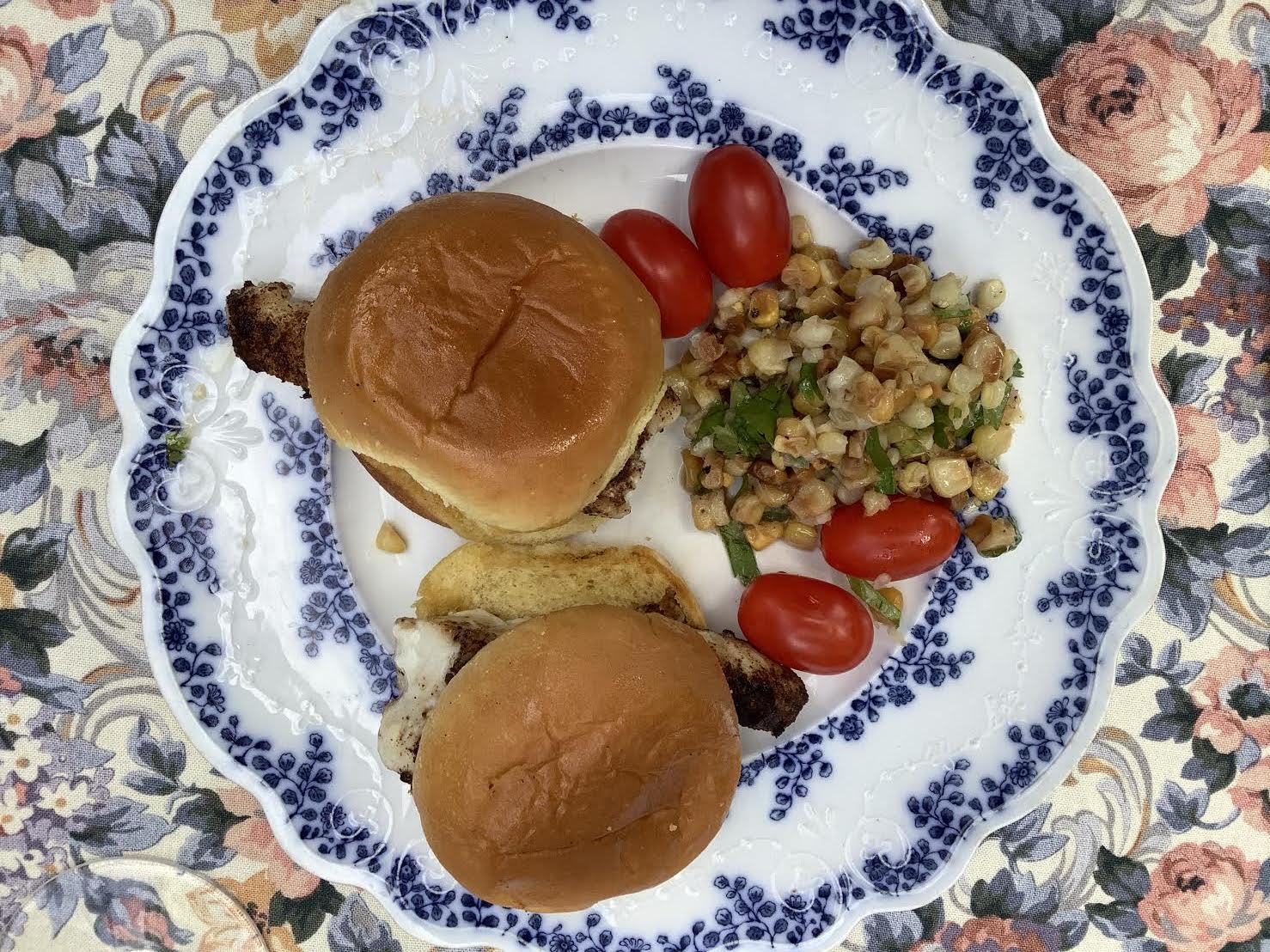
Beef BBQ Sliders: 269 calories 5.6 g fat 5 g fiber 22.6 g protein 31 g carbs 162.6 mg Calcium When a gift box of Corky’s Memphis BarBQue arrived, sliders seemed like a wonderful idea. Such fun to eat and easy to prepare, especially when the sauce and filling have been made for you. HINT: This serves TWO. Share with a friend or save half for lunch tomorrow.
Warm the slider buns while the beef and sauce are heating. Assemble the sliders and cut each in half. NB:Each serving is three halves of slider. Plate with the vegetables. Eat with pleasure.
Ingredients for next week: Breakfast, single portion for Monday …………………………… single portion for Thursday:
2 two-oz eggs + Olive oil
1.5 two-oz eggs
tapioca flour + white whole wheat flour
corned beef + cabbage
Parmesan cheese + uncured bacon
cottage cheese + thyme
applesauce + plain yogurt
caraway seed + apple
Optional smoothie
optional smoothie
optional hot beverage
Dinner, single portion for Monday:………………………….. single portion for Thursday:
two 2-oz eggs
cubed chicken breast + dill pickle + seedless grapes
How thisFast DietLifestyle works: Eat these meals tomorrow, for a calorie total of less than 600. On another day this week, eat the meals from a different post, another day of eating 600 calories or less. Eat sensibly the other days of the week. That’s it. Simple way to lose weight and be healthier. Welcome to My Last Diet Plan and DC/Seasons of Parenting who are now Following.
Dandelions [Taraxacum officinale] originated in Europe and have spread to all temperate regions due to Colonization. Yes, they qualify as an ‘invasive species.’ The English name is a corruption of the French ‘dent de lion’ [lion’s tooth] due to the shape of the leaf. Children love dandelions — to make flower crowns and to blow away the downy seeds in a wishing game. To people who covet a smooth green mono-culture of a lawn, dandelions are the bane of their existence: no sooner have you mowed, than the flower stalks surge upward making the lawn look irregular and raggedy. But dandelions are good for you! They are very versatile in cooking: salad, tea, pesto, soup, wine — all can be made from dandelions. Just be sure that you gather them from a lawn or meadow that has not been exposed to pesticides, herbicides, or machine exhaust gasses.
If your taste buds shy away from foods on the bitter end of the scale[ex: arugula], then you might need to mask the dandelion flavor a bit more. For the rest of us, these recipes give you a chance to eat the ‘alien invaders,’ and put those weeds to use. From morning eggs to a silky smooth soup for dinner, dandelions are on the menu.
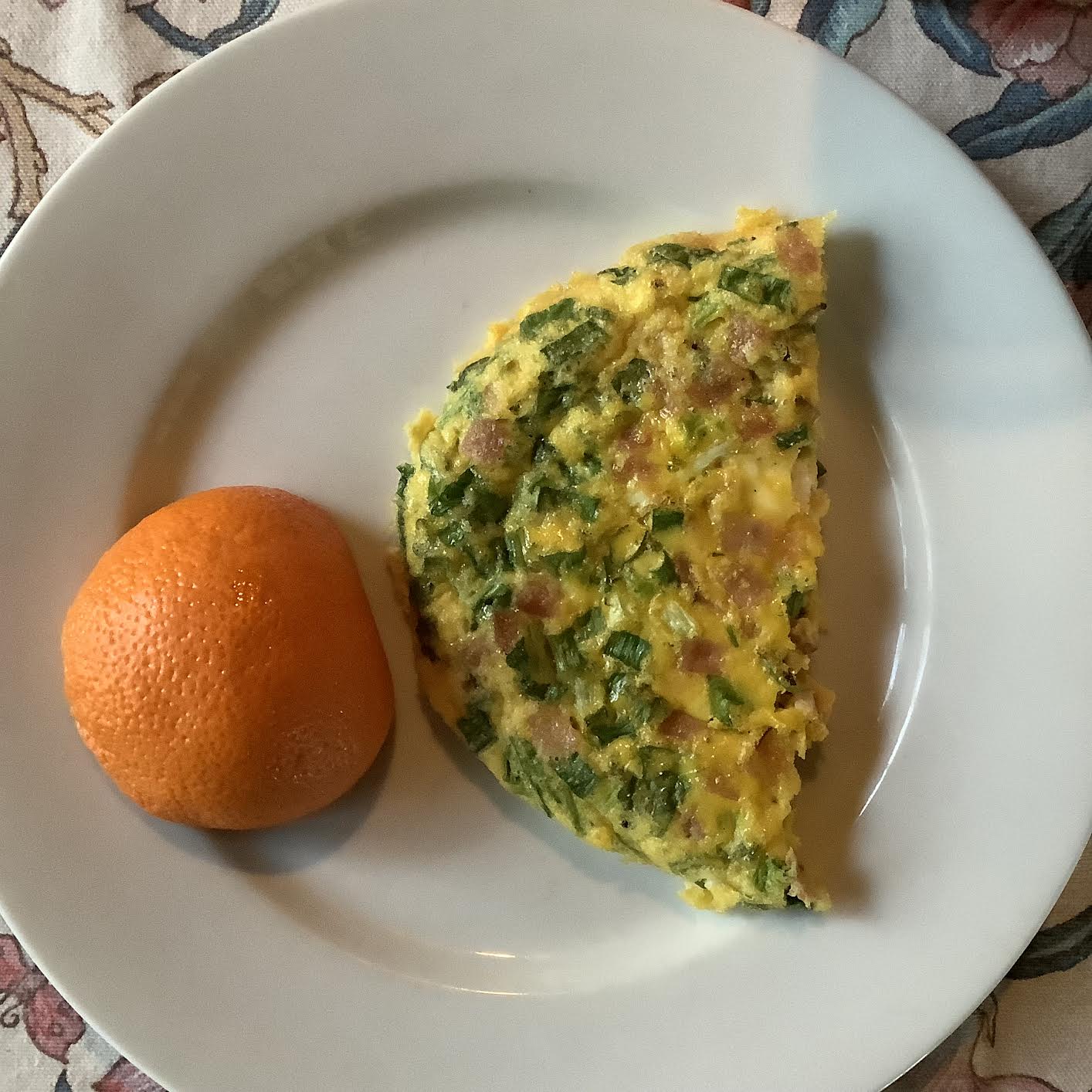
Dandelion ScrOmelette: 147 calories 8 g fat 2 g fiber 11 g protein 9.5 g carbs 103 mg Calcium NB: Food values shown are for the ScrOmelette and fruit only, and do not include the optional beverages.PB GF Since dandelions abound in most lawns during the early Summer, why not try them with scrambled eggs?
1 ½ two-oz eggs HINT: If you are serving one person, crack three 2-oz eggs into a small bowl or glass measuring cup. Whip up those eggs and pour half of their volume into a jar with a lid and put it in the ‘fridge for next week ½ cupdandelion greens 1 clove garlic 1 Tbsp cooked brown rice 1 oz melon Optional:blackish coffee [53 calories] or blackish tea or mocha cafe au lait [65 calories] or lemon in hot water Optional: 5-6 oz fruit smoothie or berry-yogurt smoothie[88 calories]
Chop the dandelion greens and cover them with boiling salted water. Let sit 5 minutes off the heat, then taste a leaf to see if the bitterness is gone. If not, heat the water again to boiling, then take off heat for another 2 minutes. Taste again. If still bitter, drain the water, add fresh salted water and cook 2 minutes more. While that is going on, chop the garlic. Drain the dandelion greens. Heat a non-stick or cast-iron skillet and spray with cooking spray. Cook the garlic over medium for 30 seconds, then add the dandelion and rice. Whisk the eggs with salt and pepper, then pour them into the pan. Scramble or cook like an omelette. Plate with the melon and try something new.
Forager’s Soup: 271 calories 17 g fat 6 g fiber 13 g protein 29 g carbs 250 mg Calcium PB GF Here is an Irish soup made with summer greens. Did I hear you say ‘weeds’? Know that a weed is a plant that is growing in the wrong place. The cook-pot is the right place, where they are splendid. The recipe is one of Darina Allen’s from Reclaiming Ireland’s Culinary Heritage, One Roast Lamb Or Sponge Cake At A Time. HINT: The recipe makes 3 cups, enough for 3 servings.
2 tsp butter ½ c onion ½ potato = 4 oz salt + pepper
Melt butter in pot over medium-high. When it foams, add vegetables, and stir to coat. Season. Turn down to very low, put parchment paper atop vegetables, to trap steam. Put on lid and cook gently 10 mins, until vegetables are soft but not brown.
1 c chicken stock ½ c + 1/3 c whole milk
Heat stock and dairy in a saucepan to simmering. Remove parchment and add hot liquid. Simmer 5-10 mins to cook vegetables fully.
4 oz by weight = 2 c. wild greens: dandelion; garlic mustard; sorrel; chives ¼ c ricotta
Add greens + simmer uncovered 2-3 mins until greens are just cooked through (do not cover pot or overcook, or else bright green color will be lost.) Add ricotta.Purée until smooth. Taste for seasoning.
1 oz chorizo/ bacon per person
Slice chorizo and cook on low in a skillet until fat is rendered and meat is crisp, 5-10 mins. Drain on paper towels.
How this Fast DietLifestyle works: Eat these meals tomorrow, for a calorie total of less than 600. On another day this week, eat the meals from a different post, another day of eating 600 calories or less. Eat sensibly the other days of the week. That’s it. Simple way to lose weight and be healthier. Welcome to mrinspire and Diets & Weight Loss Plans who are now Following.
The Bunsen burner is the work-horse of the laboratory. Except for a beaker or flask, no piece of equipment is as universally recognized. It was invented in 1855 by the German Chemist Robert Wilhelm Bunsen. He had been investigating the fact that different elements [Copper, Strontium, Potassium] gave off distinctive colors [blue-green, hot pink, lilac] when heated, known now as the Flame Test. To pursue this study, he needed a reliable source of flame that would burn with no color of its own. With the assistance of the mechanic Peter Desaga, he developed the method for delivering a controllable, compact, safe jet of flame. Perhaps his quest for a safe lab flame grew from an early science experiment that exploded, blinding him in one eye. Bunsen went on from there to analyze sunlight, drawing the accurate conclusion that the sun was made of Hydrogen and Helium gasses. With Gustav Robert Kirchhoff, Professor Bunsen invented the spectroscope. They were co-discoverers of the elements Cesium [Cs] and Rubidium [Rb].
Our German Breakfast might have been familiar to the professors and mechanics at the University of Heidelberg. When I was a young teacher, I often would rush to work in the morning with a raw egg in my pocket. During the class prior to lunch, I would boil it in a beaker of water over the Bunsen Burner on the lab bench. However you cook your eggs, you will need one for our dinner.
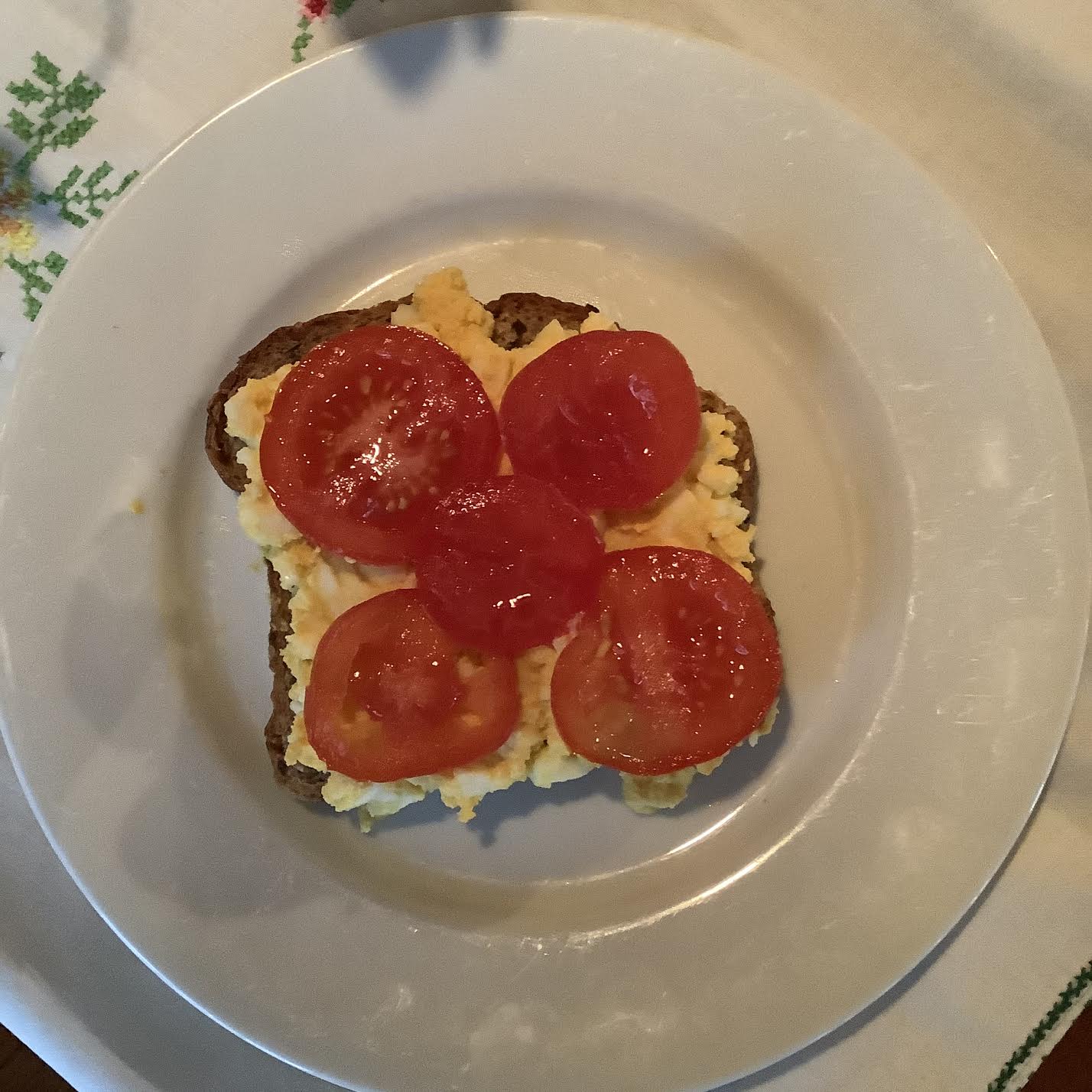
German Breakfast: 136 calories 3 g fat 4.4 g fiber 9 g protein 15 g carbs [3.5 g Complex] 104.4 mg Calcium Sturdy whole-grain bread, some curd cheese with chives and a slice of ham or turkey will get you going in the morning, just as it does for the Germans.
1 slice whole-grain bread [we like Dave’s ‘Good Seed‘] 2 Tbsp small-curd cottage cheese, reduced fat [similar to ‘quark cheese’ in Germany] 1-2 Tbsp chopped chives ½ oz slice of 3%-fat ham** from the deli, thinly-sliced 1 oz pear Optional:blackish coffee [53 calories] or blackish tea or mocha cafe au lait [85 calories] or lemon in hot water Optional: 5 oz fruit smoothie or berry-yogurt smoothie[88 calories] **you could substitute 1 oz turkey breast from the deli, thinly sliced
Toast the bread lightly or not. Spread with the cheese and sprinkle with chives. Top the cheese with the ham and plate with the pear. So nice. This would be a fine lunch for a Slow Day.
Herring Salad: 278 calories 6 g fat 7 g fiber 16 g protein 24 g carbs 103 mg Calcium PB GFLuchöw’s Restaurant in New York will live in memory as long as a certain generation yet breathes. And there was a lot to remember about it: the decor, the old-world service, the menu. Not a hokey tourist trap – it was the genuine German article. This is one of their fine Old World recipes. NB: if you take a MOIA anti-depressent, be aware that herring has high amounts of tyramine.
1½ oz herring marinated in wine, drained ¼ cup beets, cooked, cooled and diced 1½ oz apple, peeled and diced ¼ cup white beans, drained and rinsed ½ hard-boiled egg, sliced 2 Tbsp onion, minced 1/2 oz dill pickle, chopped pinch sugar 2 tsp vinegar, or more 1 cup lettuce, shredded
Put the vinegar and sugar in a bowl and whisk until the sugar dissolves. Add remaining ingredients and toss gently until everything is well-incorporated. Taste to see if it needs more sugar or more vinegar. A herring-lover’s delight.
People who are new to Fasting often pose the questions: “Can I really eat ‘anything I want’ on a Slow Day?” and “What should I eat on Slow Days?” To answer those questions, I have decided to add some blog posts to show some of the foods we eat on what the world calls NFDs [non-fast days] but which, in our house, we call ‘Slow Days.’ This feature will appear sporadically.
Today, I thought it would be fun to make a batch of naan, a bread of India. More than 2500 years ago, ‘chapati’ was the peoples’ bread: unleavened flatbread baked on a griddle. After yeast was introduced to India from Persia or Egypt, experimentation lead to making naan. Originally it was the food of royalty, savored for its light texture. One author says how difficult it is to make, and therefore limited to palace kitchens. When I found out how simple naan is to prepare, I just had to try them. Even thought the dough is made with yeast, it is much less involved than making a loaf of bread. The recipe is by Aarti Sequeira.
1 tsp dry yeast 1 tsp sugar 3/4 c 110 F water
In a large glass or 16-oz measuring cup, combine the yeast, sugar and water. Let stand until foamy, 5 to 10 minutes.
2 c white whole wheat flour** 1 tsp salt 1 tsp sugar 1/8 tsp baking powder
Sift the flour, salt, sugar and baking powder into a large, deep bowl. Whisk to blend.
3 Tbsp plain yogurt 2 Tbsp vegetable oil
Once the yeast is frothy, pour the yogurt and the olive oil into the glass, and stir to combine.
****If you would like to make this gluten-free, you can substitute in 2 1/4 cups of gluten-free all-purpose flour mix for the regular flour, plus 1 1/4 tsp xanthum gum.
Ingredients for the first three steps of the recipe await mixing.
Pour the yogurt mixture into the dry ingredients and gently mix the ingredients together with a fork. When the dough is about to come together, use your hands to mix. It will feel as if there isn’t enough flour at first, but keep going until it transforms into a soft, slightly sticky, pliable dough. As soon as it comes together, stop kneading.
mixed with a forkthen mixed with the handsready to rise
Cover the dough with plastic wrap or a damp tea towel and let it sit in a warm, draft-free place for 2-4 hours.
Have two bowls near-by: one with flour in it, + one with water. The dough will be extremely soft and sticky — the way it should be! Divide dough into 8 or 10 or 12 equal portions and lightly roll each portion in the bowl of flour to prevent sticking to each other.
++if using gluten-free flour, pat the naans into shape with your hands and fingers.
With a rolling pin++, roll out each dough ball on a lightly floured work surface into a tear-drop shape about 4-6“ in diameter and 1/4” thick. Lift up by one end and wiggle it — the dough’s own weight will make it stretch a bit. Repeat with remaining dough.
Have: Cast iron skillet lid to fit the skillet
Warm the skillet over high heat until it’s nearly smoking. Dampen your hands in the bowl of water and pick up one of your naans. Patty-cake it from one hand to the other to dampen it slightly.
Gently lay each naan in the skillet + set timer for 1 minute. The dough should start to bubble. Flip the naan. It should be blistered + a little blackened, don’t worry – that’s typical! Cover the skillet with the lid and cook 30 seconds to 1 minute more. Repeat with remaining dough.
Here they are skillet-baked and ready to eat. You have seen the naan in some of my previous recipes, such as Indian Vegetables with Turkey and Naan. Create your own favorite way to eat this bread and imagine that you are an Indian Noble.
People who are new to Fasting often pose the questions: “Can I really eat ‘anything I want’ on a Slow Day?” and “What should I eat on Slow Days?” To answer those questions, I have decided to add some blog posts to show some of the foods we eat on what the world calls NFDs [non-fast days] but which, in our house, we call ‘Slow Days.’ This feature will appear sporadically.
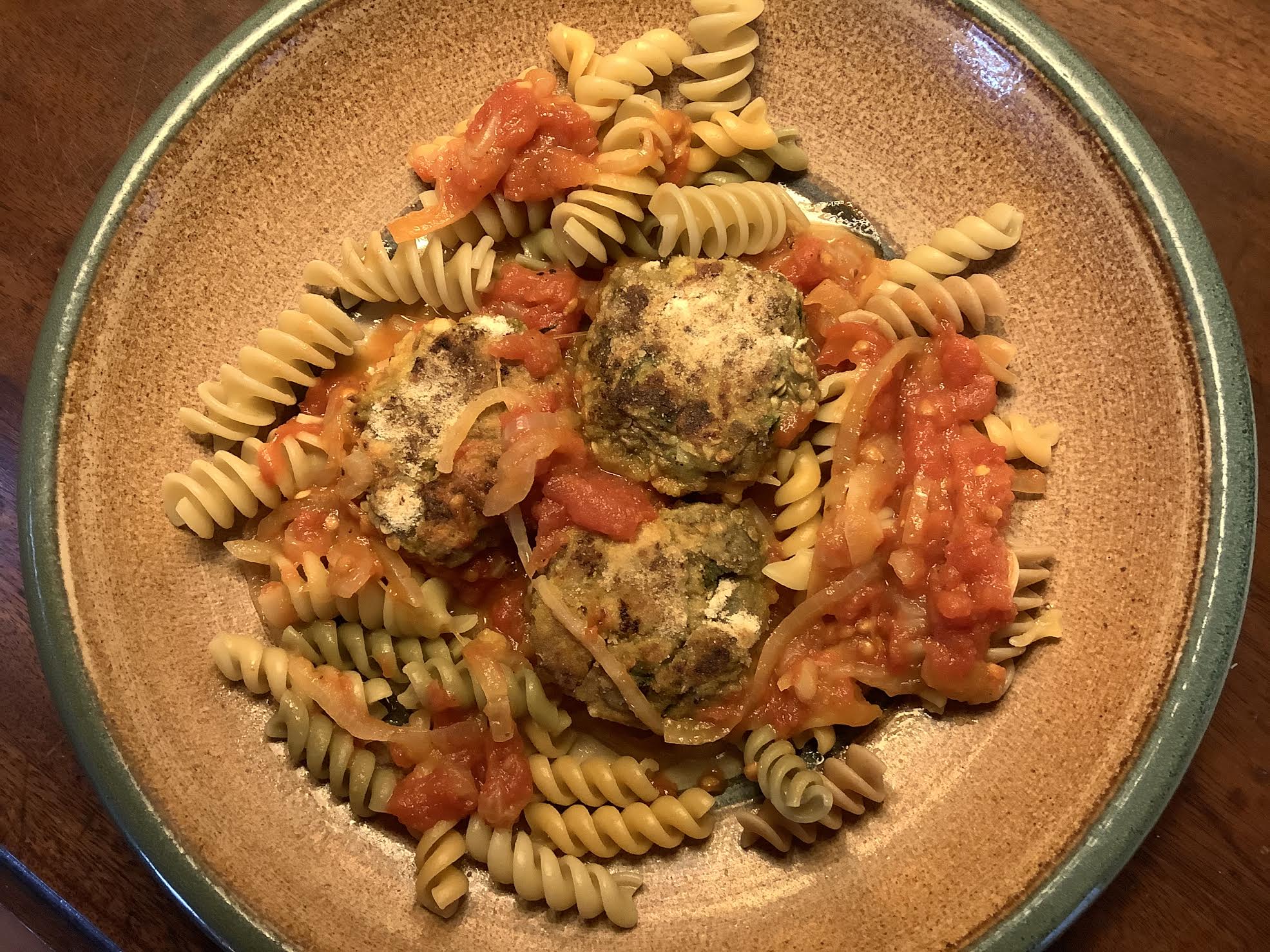
On Wednesday, which is a Slow Day in our house, we invariably dine on a pasta meal. There are so many fine ways to top a plate of pasta that it can be a while until a particular meal is repeated. What follows is a recipe from Diary of a Tuscan Chef by Cesar Casella & Eileen Daspin. The chef calls it “Garganelli con Tonno Fresco,” but we call it Penne with Tuna & Tomatoes. This is so special and so easy to prepare that we schedule it when we want a lot of impact even when there is little time.
My job is to prepare the mise en place and to cook the pasta.
Here we see fresh tuna cut into 1/2 inch cubes, along with garlic chopped with fresh oregano, and 2 cups of halved cherry tomatoes. Cook the pasta of choice in salted water. Meanwhile, saute the garlic and oregano in olive oil until the garlic begins to color. Add the tuna and a pinch of crushed red pepper, and cook, stirring, for 3-4 minutes until the fish is done to your liking. Remove the tuna from the pan to a plate or bowl. Drain the pasta, saving some cooking water. Deglaze the saute pan with about 1/3 cup white wine, and let it cook down while you scrape brown bits off the bottom of the pan. Add the pasta water and the tomatoes to the pan and cook for 2 minutes. Toss in the pasta, some chopped parsley, the cooked tuna, and a sprinkle of salt and pepper. That took less than 15 minutes.
Dear Husband cooks the meal and chooses the wine.
Plate with crusty bread and a crisp salad of many different greens. Easy and delicious — especially when Dear Husband does all the cooking.
Tomorrow marks the 8th anniversary of our Fasting Lifestyle. Our weight is still down where we want it to be, our health is good. And we continue to eat pasta on Wednesdays — what a life!
People who are new to Fasting often pose the questions: “Can I really eat ‘anything I want’ on a Slow Day?” and “What should I eat on Slow Days?” To answer those questions, I have decided to add some blog posts to show some of the foods we eat on what the world calls NFDs [non-fast days] but which, in our house, we call ‘Slow Days.’ This feature will appear sporadically.
The pre-Easter season of Lent calls for Hot Cross Buns. I love to make them and to eat them, but that is for a posting next year. If you want a real treat for a Lenten Sunday morning, try these pancakes. The recipe comes from the website Joy The Baker, where I have found many fine kitchen projects. Below, you will see the mixtures that will be combined for the batter: milk-egg-butter + flour-spices + fruit-zests.
2 T butter, melted/ cooled 1 cup buttermilk/soured milk 1 two-oz egg 1 tsp pure vanilla extract
In a small bowl whisk together butter, buttermilk, egg, and vanilla extract. Set aside.
1 cup white-whole-wheat flour 1 Tbsp brown sugar 1 tsp baking powder ½ tsp baking soda + ½ tsp salt ½ tsp ground cinnamon ¼ tsp freshly grated nutmeg 1/8 tsp ground cardamom
In a medium bowl, whisk together flour, sugar, baking powder, baking soda, salt, and spices. Add the wet ingredients all at once to the dry ingredients. Stir to combine. It is ok if the mixture is a bit lumpy.
Add the currants and fruit zest and stir to combine. Allow mixture to sit for 5 minutes while the griddle heats.
Preheat oven to 150 F. Place an oven-proof plate in the oven. This is where the pancakes will stay warm while the entire batch is cooked.
1 tsp butter for cooking splash oil for cooking pure maple syrup for serving
Heat griddle (or nonstick skillet) over medium. Heat fat until hot, then wipe off with paper towel. Save the towel. Spoon 2 Tbsp batter** onto the griddle for each ‘cake. Fry until golden, flipping once. Place cooked pancakes on warm plate in oven and cover with a clean towel. Wipe griddle with the buttery paper towel and spray with non-stick spray for each batch.
**Dear Husband just free-formed them, yielding 10 pancakes. If one used 2 Tbsp of batter, as described in the recipe, one would probably produce more pancakes. Suit yourself.
Joy The Baker says to top your stack of pancakes with a piped icing cross. Look, when the pancakes are hot off the griddle, we don’t mess around — they go straight to the table for eating. We used a cross of good New Hampshire maple syrup instead of icing. Delicious pancakes!
People who are new to Fasting often pose the questions: “Can I really eat ‘anything I want’ on a Slow Day?” and “What should I eat on Slow Days?” To answer those questions, I have decided to add some blog posts to show some of the foods we eat on what the world calls NFDs [non-fast days] but which, in our house, we call ‘Slow Days.’ This feature will appear sporadically.
My friend Nick, a pure Greek-American from the Greek neighborhoods of Manchester, NH, called pastitsio ‘Greek macaroni and cheese.’ If your mac&cheese is in a rut, try this variation — it is really good. And don’t even think of telling Nick’s mom that pastitsio originated in Italy!
Ground lamb meat, onion, tomatoes, cinnamon, Greek oregano, butter [not the entire stick], elbow macaroni — here is the basis of Pastitsio. The oregano and cinnamon tell you how Greek it is. Nick always wondered how the early Greeks got tomatoes, but he was willing to give that a pass….
Pastitsio Sauce + Casserole
1 cup chopped onion ½ pound ground lamb
Saute onion and meat in a heavy saucepan while stirring sometimes until the meat is brown and the onions are golden.
1 cup crushed or whole tomatoes 1½ tsp salt freshly ground pepper 1 tsp Greek oregano 1½ tsp cinnamon
Stir in these ingredients and simmer 5 mins.
½ cup Gruyere cheese, grated
Stir in the cheese and taste for seasonings.
3 oz elbow macaroni
Cook the elbows. Stir them into the tomato sauce and turn the mixture into an oil-sprayed 1-Qt casserole.
Salsa Besamel
Top with salsa besamel and bake at 350F for 30 minutes.
The meat sauce is combined with cooked pasta and then you prepare a besamel…..
The salsa besamel goes on top. Milk thickened with a butter-flour mixture, grated cheese and egg all combine in a sauce that is poured on top of the pasta and sauce prior to baking.
Salsa Besamel
2 Tbsp butter
Melt butter in a saucepan. Take off heat.
1 Tbsp flour ½ tsp salt 1/8 tsp white pepper 1 cup milk
Stir in flour, salt, and pepper, then add the milk gradually and stirring all the time. Put on low heat and stir for 5 minutes.
1 egg yolk ¼ c grated Parmesan cheese
Beat together in a small bowl, then slowly add the warm white sauce and stir constantly.
Baked to a golden turn.
Serve with Winter Vegetables, as seen here, or with a Greek Salad, Pastitsio makes for a hearty mid-Winter meal. Delicious.
People who are new to Fasting often pose the questions: “Can I really eat ‘anything I want’ on a Slow Day?” and “What should I eat on Slow Days?” To answer those questions, I have decided to add some blog posts to show some of the foods we eat on what the world calls NFDs [non-fast days] but which, in our house, we call ‘Slow Days.’ This feature will appear sporadically.
I like sauerkraut. My mother served it, redolent with caraway seeds and topped with pork. Dear Husband used to dislike it — but he has since come around. How delighted I was to find out how easy it is to prepare one’s own pickled cabbage: from huge batches to one jar at a time. The method is from James Beard‘s American Cookery, page 500. For each quart jar, you need enough sliced cabbage to fill it and 1 Tablespoon of kosher salt.
Lightly pack the cabbage into the jar, add the salt, and pour in lukewarm water up to within a 1/2 inch of the top of the jar. You want to keep the cabbage submerged in the water so it doesn’t turn brown. I floated a small, upturned lid on the jar contents and then weighted it with one of those tiny jam jars. That worked. Then you put the jar in a not-too-cold place — mine was in the coolest corner of the kitchen, but the unheated basement would have been OK too. Check the jar every day or so — you are looking for bubbles to form amid the cabbage. It could be that you don’t see them until you jiggle the jar and then they emerge and race to the top. Depending on the temperature, this can take 5-10 days.
In the jar, with water and salt, weighted down.
After several days, it has fermented.
If using it within a week, put a lid on it and keep it in the refrigerator. If you are a canner, you may process it in a hot-water bath in the same jar in which it fermented. Process for 20 minutes in boiling water to cover. When cool, store on the shelf to use for all sorts of good meals. Once the jar is opened, left-over ‘kraut can be kept in the refrigerator for weeks.
Our’s is braised in stock [the Alsacians will add white wine, the Germans will add beer] with sliced onions and caraway seed, then baked with chunks of sausage. Served with mashed potatoes, as my mother did, along with some rye bread. A feast! For a Fast Day, you could use the sauerkraut to prepare dinners such as: Sauerkraut & Sausage, or Baltic Bake. Or at breakfast in Reuben Matzo Egg.
People who are new to Fasting often pose the questions: “Can I really eat ‘anything I want’ on a Slow Day?” and “What should I eat on Slow Days?” To answer those questions, I have decided to add some blog posts to show some of the foods we eat on what the world calls NFDs [non-fast days] but which, in our house, we call ‘Slow Days.’ This feature will appear sporadically.
In French Canada, Christmas is marked by a series of events. Beginning on December 24, there is a meatless meal for dinner — often including oysters. Then midnight mass and then the Revillion: dining with family into the wee hours to celebrate the birth of baby Jesus. And what do they eat on this special night? Tourtiere. The recipe for this pork pie goes back to medieval times: you can tell by the combination of ‘exotic’ spices with meat. The preparation of the pie begins in November [St Martin’s Day perhaps?], when the pig would be slaughtered. Bits of meat left over from other cuts would be ground or minced, combined with spices, and wrapped in a lard pastry. It could be shaped as a boule or in a pie plate. As many of these pies as possible would be put into the cold shed off the kitchen, where they would freeze for the rest of the winter, ready to be taken out and baked for a meal — the original convenience food.
Our recipes, for the tourtière and its crust, are from Craig Claiborne’s NYT International Cook Book. We enjoy tourtiere for dinner on some evening in December [not Christmas Eve, for then we dine on Dear Husband’s Seafood Chowder]. Since it can be prepared in November or even October, tourtière makes a perfect ‘prepared meal’ to whisk from the freezer for dinner on a busy day.
Ground pork, spices, savory [of course!], onions, garlic, stock — simple ingredients for an old-fashioned meal.
Since I don’t know how many you will be serving, I’ve written the recipe for 6 or 3 or 2 persons. We will be serving only two this year.
Sv 6
Sv 3
Sv 2
1 cup 1 clove 2 Tbsp
½ cup ½ clove 1 Tbsp
1/3 cup chopped onion ½ clove minced garlic 2 tsp butter
Chop the onion and garlic an cook in the butter until wilted.
1 ½ #
¾ #
½ # /8 oz ground pork
Add to the pan and cook, breaking up lumps.
¾ tsp ¾ tsp ¾ tsp 1 leaf ¾ cup ad lib
3/8 tsp 3/8 tsp 3/8 tsp ½ leaf 1/3 cup ad lib
2 Large pinch cloves 2 large pinch cinnamon 2large pinch savory 1/3 leaf bay ¼ cup pork stock salt & pepper to taste
Add the seasonings and stock to the pan and simmer for 30 minutes, stirring sometimes.Cool the mixture and run it through a food processor to chop the filling more thoroughly. Scrape into a bowl and chill thoroughly.
**This lard pastry is traditional and is perfect for a savory pie.
1 cup white whole wheat flour ½ cup all-purpose flour ½ tsp salt
Cut together with a pastry blender or 2 table knives until ingredients are uniformly crumbly.
3+ Tbsp cold water
Using a 2-pronged fork, stir the water into the pastry crumbs, adding more if needed, until it all comes together in a ball.
Roll out the pastry and fit into an appropriate pie plate or into a bowl large enough to contain the filling. If baking as a pie or tart, cover filling with a top crust. If baking as a boule, line the bowl with pastry, with a generous overhang. Put the filling in the bowl and trim the pastry to enclose, without too much bunching or overlap. Seal edges.
If cooking as a boule, turn out the boule onto a glass pie plate so that the round side is up and the gathered side is on the bottom. This year, I used some extra dough to make some decorations. Been watching too much Great British Baking Show, I guess.
Freeze the pie – overnight or for weeks.
The day before baking: Thaw the pie in the refrigerator. To bake, set oven at 425F. Bake for 10 minutes, then turn down temperature to 350F and bake for 30-40 minutes [check it at 25 minutes]. Crust should be cooked and beginning to turn golden.
The tourtière is best served with gravy, winter vegetables, and ‘chow‘, a green tomato relish beloved in Quebec and the Maritime Provinces of Canada. What a fine meal for a winter night.