Slow Days: New England 4th of July  

People who are new to Fasting often pose the questions: “Can I really eat ‘anything I want’ on a Slow Day?” and “What should I eat on Slow Days?” To answer those questions, I have decided to add some blog posts to show some of the foods we eat on what the world calls NFDs [non-fast days] but which, in our house, we call ‘Slow Days.’ This feature will appear sporadically. 

Now for the answers. Can you really eat ANYTHING you want on a Slow Day? Not really. If you eat too many calories every Slow Day, you will not lose weight. There are many questions asked on the Fast Diet Forum which attest to that. Once in a while you can splurge, as long as it isn’t everyday. For what to eat on Slow Days, Dr. Mosley recommends a Mediterranean Diet. As for how we eat, an example follows.

Hot dogs. Hamburgers. Potato Salad. Macaroni Salad. Rich desserts that are Red, White, & Blue. These are typical 4th of July fare all across the country, so it must be all-American, right? No, actually. Hot dogs, hamburgers, and potato salad came to us from German immigrants in the 1800s. Macaroni salad is a combination of Italian and German culinary traditions. Where do you go for an ‘authentic American’ meal for Independence Day? New England, of course. Salmon was very common in New England during the 1600s and 1700s, before the Industrial Revolution dammed the rivers. If you wanted inexpensive protein, salmon was the thing. In early Summer, salmon would return to the rivers, swimming far up-stream to spawn. At the same time, the first peas were available in the gardens. By coincidence, the first new potatoes could be found in the fields. [Potatoes originated in South America, were taken to Spain by Columbus, then to Ireland by Walter Raleigh, then to New Hampshire by Scottish settlers.] Thus, by early July, a fine dinner was available to all and sundry: cooked salmon served with peas and new potatoes.

Coat the salmon fillets with olive oil on a plate, then strew with salt and pepper. Put the shelled peas into cold water, ready to cook. In a bowl, put small new potatoes — preferably with flesh of different colors — salt, pepper, and olive oil to coat. Stir well to cover the potatoes all over with oil. Put the potatoes on a glass pie plate into a 400F. oven and set the timer for 25 minutes. By now the grill is hot. Cook the salmon, undisturbed, for 5 minutes on each side. Turn on the heat under the peas and simmer them uncovered. The peas will be done first, so keep and eye on them. Drain and salt them, cover the pan and let them wait.

And there you have it: a fine meal for early Summer. For a delightful wine paring go to peterspicks.com.

The Seven Sleepers

How this Fast Diet Lifestyle works: Eat these meals tomorrow, for a calorie total of less than 600. On another day this week, eat the meals from a different post, another day of eating 600 calories or less. Eat sensibly the other days of the week. That’s it: a simple way to lose weight and be healthier.

Around 250 CE, the Roman Emperor Decius visited Ephesus [now in Turkiye] to crack down on Christianity. He interviewed seven young men about their beliefs and, finding them to be recalcitrant, he gave them a couple of days to recant. Rather than face the Emperor again, the men retreated to a cave to hide from him. Once there, they fell into a deep and lasting sleep. Either the vengeful Emperor walled up the entrance or a rock-fall blocked it, the seven men were walled up inside. 200 years [or was it 10?] later, the men woke up, thinking that they had slept only through the night. They left the cave and were amazed to find that the world had changed and that Christianity was widely accepted. The local bishop heard their story and believed it. It came just in time to settle a theological dispute as to whether or not one could rise from the dead. The men later died of natural causes and were buried in their cave. Some legends says that their remains were later taken to Marseille, France. No one knows exactly, but their story lived on and became widespread. Versions of it are told by Western and Eastern Christians and also by the Muslims. Several caves are said to be the site of the miracle sleep: in Turkiye and in Jordan.

The legend of the Seven Sleepers begins in the Eastern Mediterranean and ends in the Western area of that sea. Our breakfast is from the Levant, our dinner from the southern coast of France. Don’t be a ‘seven-sleeper’ and miss breakfast — in some European countries that is the name given to someone who oversleeps. June 27 is the Feast of the Seven Sleepers.

Felafel Bake: 142 calories 6.4 g fat 2.5 g fiber 8.5 g protein 41.4 g carbs 44.4 mg Calcium  NB: The food values shown are for the egg bake and the fruit, not for the optional beveragesPB GF Here we use felafel patties which we prepared and froze earlier. Great time-saver!  Good felafel is amazing in eggs!

1 two-oz egg 1½ uncooked felafel patties, thawed 1 Tbsp tomato puree or crushed tomatoes  ¼ c blueberries or 1 oz pear Optional: 5 oz fruit smoothie or berry-yogurt smoothie [88 caloriesOptional:blackish coffee [53 calories] or blackish tea or mocha cafe au lait [65 calories] or lemon in hot water

Spritz a ramekin with non-stick spray and set the toaster oven to 350 F. Whisk together the felafel and the tomato until well blended. Whisk the egg into the felafel and turn into the ramekin. Bake about 15 minutes while you portion the berries and prepare the beverages. What a simple, delicious breakfast.

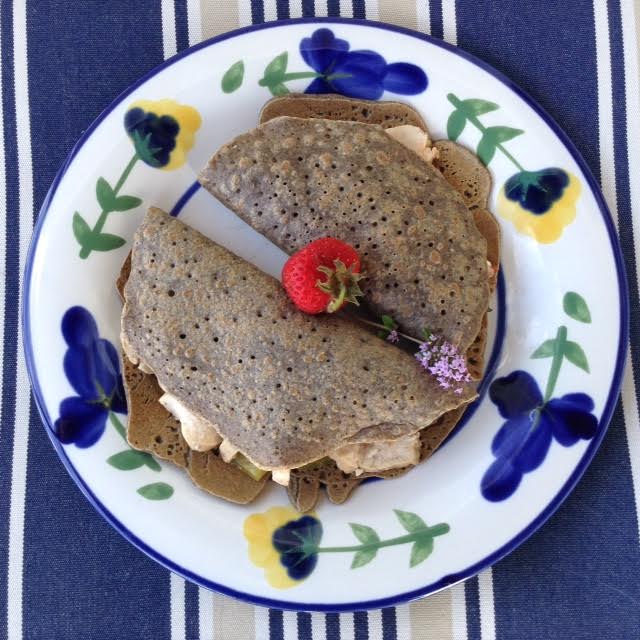
Chicken Ratatouille Galette :  267 calories 7.6 g fat 5 g fiber 24 g protein 38 g carbs 321 mg Calcium  PB  Galettes/Crepes are wonderful to have on hand for use with a variety of fillings. If you had the galettes/crepes and the filling previously-made, then the meal goes together in no time.

buckwheat crepes [galettes]  1.5 oz chicken breast ½ cup Mediterranean Vegetables  1 Tbsp goat cheese 1 oz mozzerella cheese herbes de Provence OR tarragon 

If making crepes/galettes from scratch now: prepare the batter and let stand 30+ minutes. If using frozen crepes, put them in a plastic bag on the counter and let them thaw. Turn on the oven to 250 F. Cut or shred the chicken into small pieces. Put into pan with the Med.Veg. and heat to warm the vegetables, to reduce the liquids, and to cook the chicken. Take off heat. Prepare the crepes/galettes: either cook them now from batter or finish the thawing process by putting them in a warm oven. Add cheeses to mixture in the pan, and stir to combine. Toss in lots of herbes de Province or fresh herbs and taste for seasoning. Arrange the crepes/galettes on a cookie sheet and divide the filling among them. Fold over, pressing down gently. Heat in the warm oven.

Slow Days: Spiced Cauliflower Pasta  

People who are new to Fasting often pose the questions: “Can I really eat ‘anything I want’ on a Slow Day?” and “What should I eat on Slow Days?” To answer those questions, I have decided to add some blog posts to show some of the foods we eat on what the world calls NFDs [non-fast days] but which, in our house, we call ‘Slow Days.’ This feature will appear sporadically. 

Now for the answers. Can you really eat ANYTHING you want on a Slow Day? Not really. If you eat too many calories every Slow Day, you will not lose weight. There are many questions asked on the FastDiet Forum https://thefastdiet.co.uk/forums/ which attest to that. Once in a while you can splurge, as long as it isn’t everyday. For what to eat on Slow Days, Dr. Mosley recommends a Mediterranean Diet. As for how we eat, an example follows.

As Summer turns to Autumn in the Northern Hemisphere, our taste buds seem to want the warmth of spices in our food. “Pumpkin Spice,” anyone? [Which is not derived from an actual pumpkin. It refers to the spices used in pumpkin pie. But I digress.] This pasta dish is excellent. The curious addition of spices tells us that its origin was in Medieval Times. Nobles returning from the Crusades [this is the one good thing to result from the lamentable Crusades] brought with them ‘exotic’ spices: cinnamon, nutmeg, cloves. European cuisine embraced them, often producing daring parings of spices with meat [as in Tourtiere] and vegetables. Of course the tomatoes in this recipe did not show up in Europe until the early 1500s, and they are a good addition. Sicily was a port of call for Crusaders and Lynne Rossetto Kasper is the source of this Sicilian recipe found in her The Italian Country Table.

The mise en place for 2 servings.
Serves 4 — original recipeServes 2 — how I do it
Large head cauliflower florets370 g cauliflower floretsBlanch in boiling water 1 minute. Keep water on the heat.
EVOO
1 cup onion, chopped
salt & pepper
EVOO
½ c onion, chopped
salt & pepper
Film bottom of a non-stick saute pan with oil and heat to medium-high. Stir-fry cauliflower 2 minutes, then add onion and seasoning and stirfry until golden.
Large pinch red pepper flakes
ditto for ground cloves
ditto ground cinnamon
¼ c basil + Italian parsley
2 cloves garlic, minced
4 oil-packed anchovies
3 Tbsp red wine vinegar
Pinch red pepper flakes
ditto ground cloves
ditto ground cinnamon
2 Tb basil + Italian parsley
1 cloves garlic, minced
2 oil-packed anchovies
1½ Tbsp red wine vinegar
Chop the basil and parsley before packing in the measuring cup. Rinse the anchovies. Add these to the pan and cook for 1 minute. Remove from heat.
4 oz zitti/penne per person2 oz zitti/penne per personCook pasta in salted water until al dente.
2/3 cup pasta water
14 oz canned whole tomatoes
1/3 cup pasta water
7 fl oz canned whole tomatoes
Drain and chop tomatoes. Add pasta water to saute pan and scrape up the brown bits. Add tomatoes, and boil until cauliflower is tender-crisp, ~3 minutes.
Reduce heat and add cooked pasta. Stir to blend. Season to taste
¼ pound ricotta salata OR Parmesan
1/3 c pine nuts
2 oz ricotta salata OR Parmesan
3 Tbsp pine nuts
Shave cheese into curls and add to serve hot, topped with pine nuts.
Plated with a nice piece of sourdough bread. You are correct: the pasta is neither zitti nor penne. You don’t have to stay inside the lines all the time.

Slow Days: Summertime Pasta

People who are new to Fasting often pose the questions: “Can I really eat ‘anything I want’ on a Slow Day?” and “What should I eat on Slow Days?” To answer those questions, I have decided to add some blog posts to show some of the foods we eat on what the world calls NFDs [non-fast days] but which, in our house, we call ‘Slow Days.’ This feature will appear sporadically. 

Now for the answers. Can you really eat ANYTHING you want on a Slow Day?  Not really. If you eat too many calories every Slow Day, you will not lose weight. There are many questions asked on the FastDiet Forum which attest to that. Once in a while you can splurge, as long as it isn’t everyday. For what to eat on Slow Days, Dr. Mosley recommends a Mediterranean Diet. As for how we eat, an example follows.

Jacques Pepin is a darned good chef. Perhaps it is the fact that he was formerly the Executive Chef of the Howard Johnson’s chain that caused him to promote simple-to-prepare food that is achievable for the ‘average’ cook. One such recipe, from his book Fast Food My Way, is called Summertime Pasta. [When he talks about Fast Food, he means the kind that is quick to prepare, not the type we eat on a FAST Day***. ] If ever there was a time when one wants to keep prep time to a minimum, Summer is it. It amazes me how easy this meal is on the cook and how fine it is to eat it. We dine on it ourselves and serve it to company. It is that good.

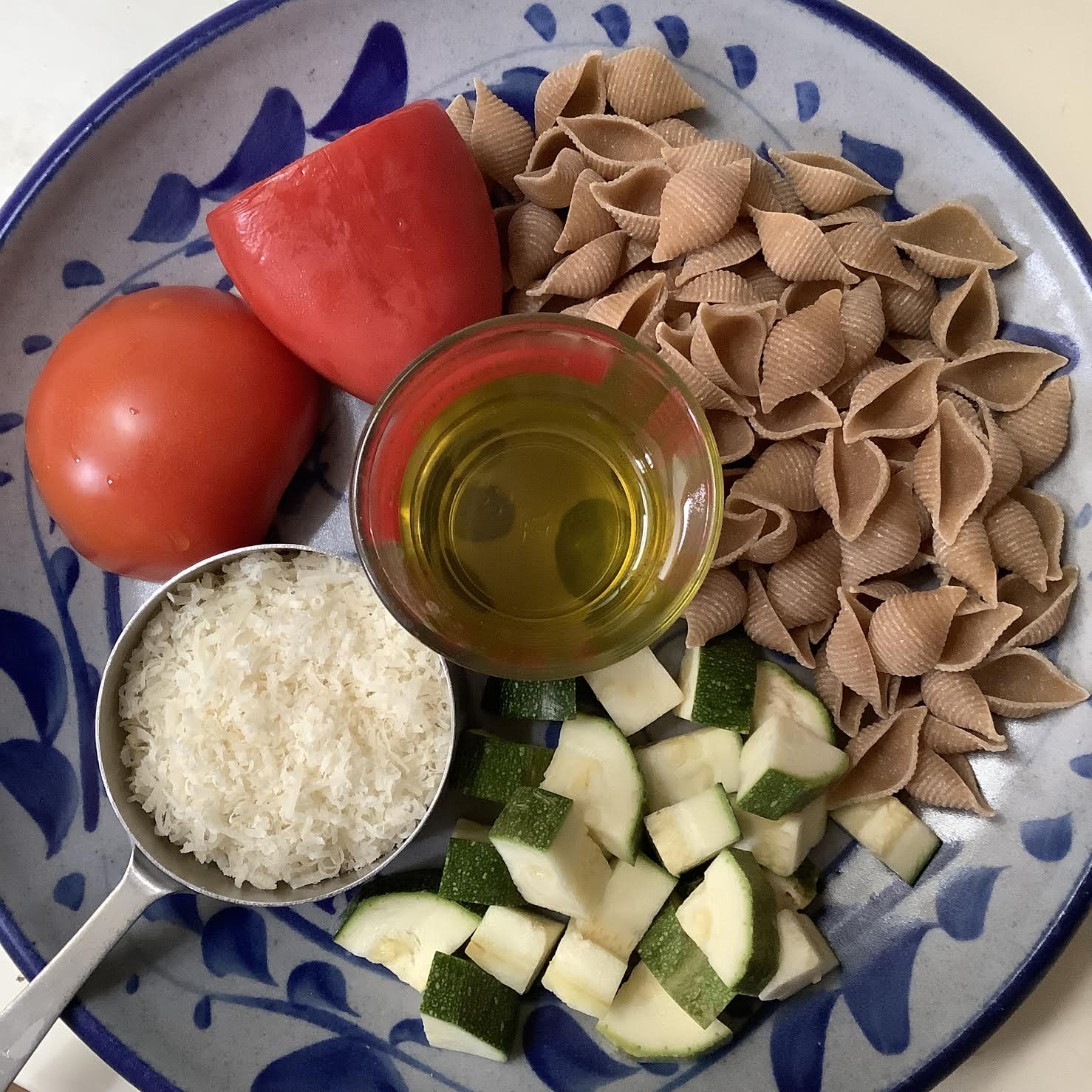
The mise en place for two servings of Summertime Pasta
Sv 4Sv 2 
3 c. tomatoes in ½“ dice
1 ½ c. zucchini in ½“ dice
1 c. white mushrooms, ½” dice
1 tsp salt + black pepper
1/3 c. extra-virgin olive oil  
6 oz diced tomatoes
¾ c diced zucchini
½ c diced mushrooms
½ tsp salt + black pepper
3 Tbsp EVOO
Mix everything in a microwavable glass bowl.
6 oz pasta shells, whole wheat
2 qts water
salt
3 oz shells, whole wheat
1 qt water
salt
20 minutes before serving, bring the water and salt to a boil. Add the pasta and cook about 7 minutes until al dente. Drain.
Microwave the vegetables for 2 minutes or longer until they are lukewarm.
1 c. grated Parmesan cheese ½ c ParmesanCombine the drained pasta with the warm vegetables, then stir in the cheese.
1½ c. Fresh basil leaves, shredded ¾ c. Fresh basil leavesPlate, and top with basil.
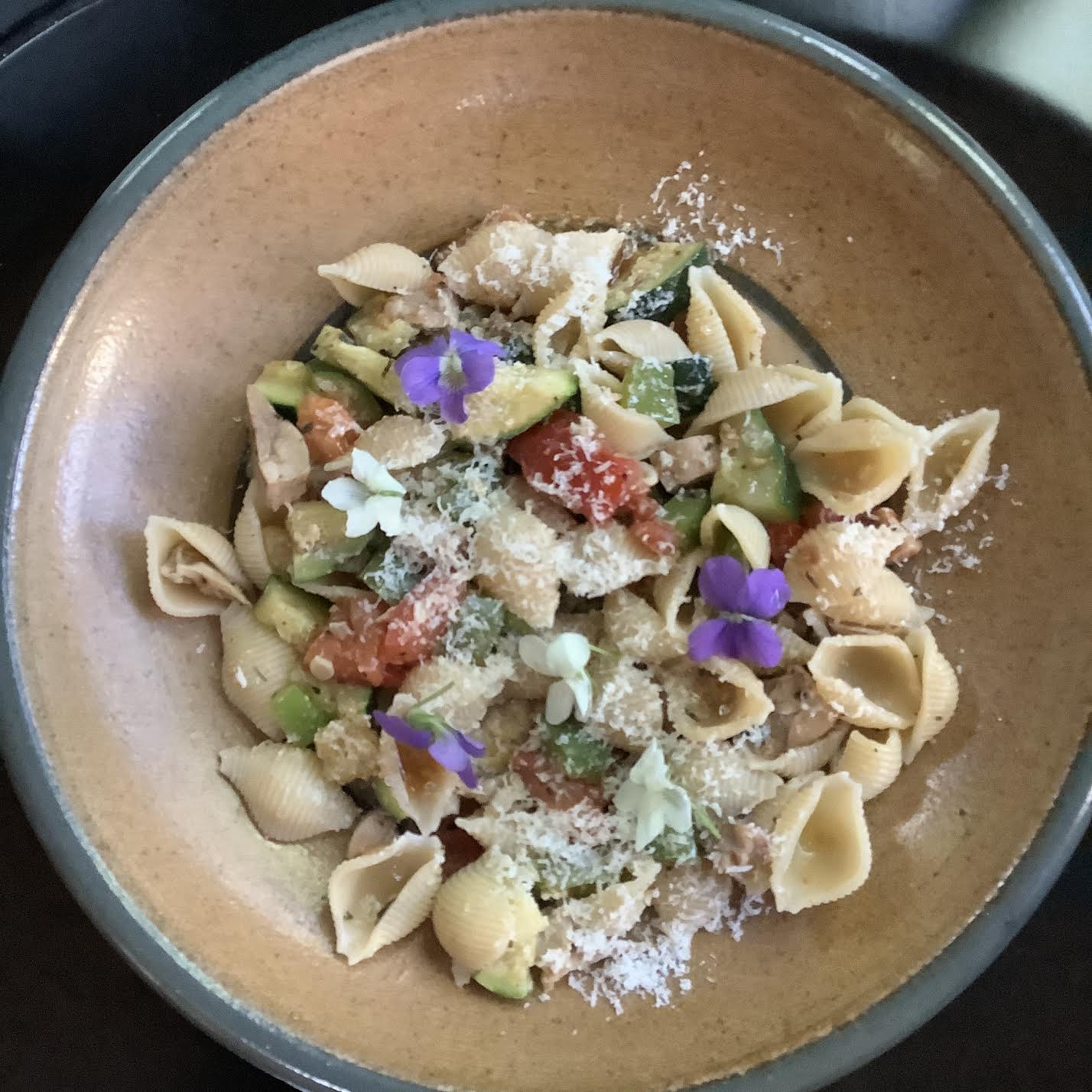
Every meal looks delicious with edible flowers as a garnish.

If you wish, you can add chunks of chicken or grilled shrimp to the dish to add more protein. Delicious.

Snow peas are also a nice addition.

***Truth be told, I do have a version of this recipe that is fine for a Fast Day. One of these days, I will share it with you.

Comparing Plans: 30 per Week

How this Fast Diet Lifestyle works: Eat these meals tomorrow, for a calorie total of less than 600. On another day this week, eat the meals from a different post, another day of eating 600 calories or less. Eat sensibly the other days of the week. That’s it. Simple way to lose weight and be healthier. 

Diets should be designed to help you become healthier, usually by losing weight. And that is a good thing, but often when people diet by cutting out food groups, they become less healthy because there is not enough variety in their food. When that happens, nutrients are lost, along with fiber. But inside your intestines, where your food is digested and absorbed into the body, something else happens: the loss of microbiota. Studies have shown that the less the diversity of your microbiota, the less healthy you are in the long run. The ’30 per Week’ challenge has you aiming to eat at least 30 different plants each week — vegetables, fruits, grains, seeds, leaves — to boost microbiota populations. Think that is difficult? If you eat a slice of whole wheat bread for breakfast, that is from only one plant. If you switch to 10-grain bread, then you are one-third toward the goal! Folks who are following a Mediterranean Diet or a Plant-Based Diet or a MIND Diet will see that this way of eating will be easy to fold into their meal plans.

This plan dovetails nicely with the Fast Diet, since lots of meals can be constructed that meet the <300 calorie goal, but also have a variety of plant matter. It is true that I could eat a breakfast of a cheese omelette which contains no plants at all, but that might be one meal of 14 in a week. Dear Husband and I have found it to be an interesting and highly achievable challenge to eat 30 per Week. Try it!

Is this food allowed on this diet…30 per WeekOn Fast Days
Fatty Animal protein: beef, lamb, porkIn moderationYes
Lean Animal protein: chicken, turkeyYesYes, preferred
Eggs Yes Yes 
Beer, wine, cocktailsWine, maybeOn Slow Days
Grains, starches: whole grain versionsyesin moderation
Nuts + seedsYes in moderation
Beans, legumes: peas, kidney beans, lentils, chickpeasYes Yes 
Seafood protein, especially with Omega-3 fatsYesYes 
Apples, melons, pears, all other fruitsYesYes 
Berries of all kindsYes Yes 
Leafy green vegetables: spinach, chard, kale, lettuceYesYes 
Dairy: Cheese, milk, yogurt In moderationSome 
Vegetable oils: olive, canolaYes in moderation
Animal fat: butterIn moderationin moderation
Root vegetables: beets, sweet potatoes, carrotsYesYes 
Other vegetables: onions, tomatoes, peppersYesYes 
Higher fiberYes Yes
Daily Carb intakeVariety of grainsKeep it low
Whole grains Yes Yes
Simple carbs: cookies, pastries, cake, bread, processed foodsNot recommendedNot on Fast Day
Number of days per week to follow the regimin 7 of 72 of 7
Do calories matter?No Only 600 on Fast Days

The breakfast today contains 5 different plants, while the dinner provides 6 more. See how easy that was?

Flamenco ScrOmelette: 152 calories 7 g fat 2 g fiber 10 g protein 11 g carbs [10 g Complex] 51 mg Calcium  NB: Food values shown are for the ScrOmelette and fruit only, and do not include the optional beverages.  PB GF  The same flavors of a tapas meal now found in your breakfast scramble. Very good.

1½ two-oz eggs HINT: If you are serving one person, crack three 2-oz eggs into a small bowl or glass measuring cup. Whip up those eggs and pour half of their volume into a jar with a lid and put it in the ‘fridge for next week 1½ Tbsp tomato puree ¾ oz bell peppers, chopped 1½ Tbsp onions, chopped 2 pinches cayenne pepper + large pinch chopped parsley + salt to taste 1 oz pear  Optional: blackish coffee [53 calories] or blackish tea or mocha cafe au lait [65 calories] or lemon in hot water  Optional: 5 oz fruit smoothie or berry-yogurt smoothie  [88 calories]

If starting the night before: Put the peppers and onions in a micro-wave safe container and nuke them for 1 minute. Stir in the tomato puree and the seasonings. Leave on counter overnight.

If starting at breakfast-time: Spritz a saute pan with non-stick spray and heat it. Put the vegetables into the hot saute pan to cook, then add the eggs and seasonings. Scramble together [or cook like an omelette] until the way you like it. Plate with the melon, pour your beverages of choice. Great flavors.

Santa Barbara Salad: 280 calories 13 g fat 6 g fiber 16 g protein 21 g carbs 106 mg Calcium  PB GF  From a Washington Post food column, this salad sings of California.  HINT: This amount serves 2 [two]. Invite a friend or save for lunch later in the week.

½ head Boston or buttercrunch lettuce 1 cup grape or cherry tomatoes ½ medium apple, cored and diced ½ cup diced chicken breast ¼ cup chickpeas 1 oz soft goat cheese 1½ tsp pine nuts 1 Medjool date ½ two-oz egg, hardboiled  per serving: 1½ tsp cinnamon dressing

First prepare the dressing and refrigerate. Next, toast the pinenuts until they just begin to brown. Take off heat and set aside. Shred the lettuce and put in a bowl along with all the other ingredients. Toss with 1½ tsp dressing per serving. Play a Beach Boys song and wear your sunglasses.

Ingredients for next week: Breakfast, single portion for Monday …………………………… single portion for Thursday:

1 two-oz egg + whole tomatoes1.5 two-oz eggs 
feta cheese + paprika + garlicroasted green chilis
orange/red bell pepper + onionapple
cumin + cayenne
Optional smoothieoptional smoothie
optional hot beverageoptional hot beverage

Dinner, single portion for Monday:………………………….. single portion for Thursday:

6 felafel patties https://wordpress.com/block-editor/post/fastingme.com/11013chicken breast meat, raw or cooked
fresh tomato + one 140-calorie pita breadbechamel sauce w/ cheese
orange/yellow bell pepper5 buckwheat galettes
red onion + lemon juiceasparagus
Sparkling waterSparkling water

Rome Burned

How this Fast Diet Lifestyle works: Eat these meals tomorrow, for a calorie total of less than 600. On another day this week, eat the meals from a different post, another day of eating 600 calories or less. Eat sensibly the other days of the week. That’s it. Simple way to lose weight and be healthier. Welcome to edwardlorilla2051tower who is now Following.

In 64 CE, the great capital of the Roman Empire caught on fire. This was a serious problem in the closely-packed city with people cooking over fire at home and giving burnt offerings to the gods in temples. The fire seems to have started in the shops on the grounds of the Circus Maximus — the site of chariot race in the movie Ben Hur. Quickly it spread through the crowded city of one million, burning for six days. Once it was out, it started again. Three days later, 10 of the 14 districts of the city were destroyed. Did the Emperor Nero play his fiddle as he watched Rome burn? No, because violins had not yet been invented yet. Besides, he was out of town, vacationing. Nero laid the blame on that new Jewish sect and cheerfully set out to eradicate the Christians. Nero’s detractors said that Nero was happy about the fire — had even started it as a form of urban renewal — so that he could build a huge new palace complex. Indeed, the fire spurred moves toward city planning. Streets by law became wider and less-flammable building materials were mandated. Fire patrols walked the neighborhoods, looking for fires to control. The Pantheon/Church of Saint Mary and the Martyrs was rebuilt of stone and cement as a result. The unsupported dome of the Pantheon influenced architecture for centuries. Should you ever visit the city, think of the horror of ancient Rome on fire.

The Roman Empire surrounded the Mediterranean Sea, called ‘Mare Nostrum’ or ‘our sea’ by the Romans. Our meals come from the island of Sicily and the waters of the Mediterranean. What would Nero have eaten? Let’s not go there.

Sicilian Bake:  138 calories 8 g fat 1 g fiber 10 g protein 8.4 g carbs 88 mg Calcium   NB: The food values given above are for the egg bake and fruit only, not the optional beverages.  PB GF  Lynn Rosetto Kasper tells of shepherds in Sicily spending the summer in the high meadows with their flocks. They make a salad, based on simple ingredients. That recipe informed the flavors of this breakfast.


1 two-ounce egg half of a 3” diameter thin slice of salami ½ clove garlic, minced 2 Tbsp sheep sorrel or arugula, coarsely chopped ½ Tbsp Parmesan-Reggiano cheese or pecorino cheese, grated 1 Tbsp ricotta cheese 5 cherries  Optional: blackish coffee [53 calories] or blackish tea or mocha cafe au lait [65 calories] or lemon in hot water   Optional: 5-6 oz fruit smoothie or berry-yogurt smoothie [88 calories]

Chop the salami and put it in a small, dry, non-stick skillet with the garlic. Cook, stirring, until salami is getting a little crispy. Take pan off heat and stir in the greens. Spritz an oven-safe dish with non-stick spray. Put the warmed ingredients into the prepared dish. Whisk the egg with the cheeses, plus salt and pepper to taste. Pour into the prepared dish, and bake at 350F. For 12-15 minutes. Plate with the cherries. 

Mackerel Puttanesca: 298 calories 17 g fat 3 g fiber 22.6 g protein 7.6 g carbs 66.4 mg Calcium  PB GF Such an easy summer meal, especially if your sauce is left-over homemade or from the supermarket shelf. Delicious and satisfying. [Don’t be concerned about the fat: since the mackerel is high in Omega 3, the fat is ‘good fat’]

4 oz mackerel or other rich, oily fish ¼ cup puttanesca sauce, homemade or from a jar 2 oz green beans

If using fresh fish, broil the fish for 4-5 minutes per side to cook it.   If using mackerel which has been frozen after cooking, thaw to room temperature. NB: Mackerel does not keep well in the fridge uncooked. If you have to buy mackerel prior to the day you will serve it, filet the fish and broil it as soon as you get back to the kitchen. Then you can hold it for a day or two, or freeze it for longer. Mackerel does not freeze well uncooked. Cook the green beans. Gently heat the sauce and mackerel together in a covered pan until warm. Plate. Done in minutes!

Leonardo, artist

How this Fast Diet Lifestyle works: Eat these meals tomorrow, for a calorie total of less than 600. On another day this week, eat the meals from a different post, another day of eating 600 calories or less. Eat sensibly the other days of the week. That’s it. Simple way to lose weight and be healthier. 

Leonardo da Vinci was a polymath of the first order. He had enough endeavors for many people — too many to squeeze into one lifetime. First and foremost, he was a visual artist. Leonardo was born on April 15 1452, and at age 14, he was an apprentice in the studio of Andrea del Verrocchio, the premier place to train in 15th century Florence. In that time, there were three painting media available to an artist: oil on wood or canvas; tempera, an egg-based paint, on wood; or fresco, when water-based colors are painted onto wet plaster. As a painter, Leonardo was always experimenting: his restless intellect wanted to leap to his next project or new innovation. Many of his oil paintings, including the Mona Lisa, were never finished since he went on to a new assignment in mid-stream. He tried out new artistic techniques, perfecting the sfumato where shadow and light have no sharp borders, but rather the vague transition seen in a cloud of smoke. Leonardo seems to have preferred oil paint. When commissioned to paint frescos, such as the Last Supper in Milan, he decided to apply oil paint to the plaster instead of the water colors. The oil paint did not want to stick to the wall and it began to flake off within a few months. One of the great, well-known masterpieces of the world was a technical failure. Restored many times, we can never fully appreciate what it really looked like. The most famous work of all is La Gioconda, aka: the Mona Lisa. It is famous for its technique and for that ‘Smile.’ Much ink has been spilt trying to describe the smile and why she wears it. It is worth noting that she is not the only subject with that look — I think it should be called the “da Vinci Smile.” Look for it in paintings of John the Baptist, Leda, and the Virgin and Child with Saint Anne. Of course, Dan Brown had to create a thriller involving da Vinci’s work, especially the Virgin of the Rocks , the Last Supper, and the drawing of the Vitruvian Man. If all he did was to paint and draw, Da Vinci would be justly famous. But he was so much more.

After training in Florence, Leonardo worked for many years in Milan, then in Rome, and finally in France. For Leonardo’s life in Rome, our breakfast takes its flavors from the well-known puttanesca sauce. The dinner is perfectly French, in recognition of the fact that Da Vinci was working for the French king when he died.

Puttanesca ScrOmelette: 146 calories 8 g fat 1 g fiber 10 g protein 7.5 g carbs 52 mg Calcium  NB: Food values shown are for the ScrOmelette and fruit only, and do not include the optional beverages.  PB GF “Puttanesca” might not actually mean ‘street-walker’… Leonardo didn’t have much time for them, but he might have met these flavors while he worked in Rome. This breakfast is based on the flavors of the iconic Roman pasta dish. When you make a dinner with that sauce, save some out to season these breakfast eggs.

1½ two-ounce eggs HINT: If you are serving one person, crack three 2-oz eggs into a small bowl or glass measuring cup. Whip up those eggs and pour half of their volume into a jar with a lid and put it in the ‘fridge for next week   1.5 Tbsp puttanesca sauce + ½ clementine OR 1 oz blueberries  Optional: blackish coffee [53 calories] or blackish tea or mocha cafe au lait [65 calories] or lemon in hot water  Optional: 5 oz fruit smoothie or berry-yogurt smoothie  [88 calories]

Whisk the sauce into the eggs and scramble or cook as an omelette. Enjoy with the hot beverage, smoothie, and blueberries.

Mackerel with Gooseberry Glaze:  276 calories 16 g fat 1 g fat 22 g protein 7 g carbs 27 mg Calcium  PB GF  This popular dish from Normandy usually features fresh gooseberries. Here in the USA, those are less common so we make a glaze of gooseberry jelly. The zucchini picks up the color of green gooseberries.

3 oz mackerel, frozen or fresh fillets + 2 tsp gooseberry jelly or jam + 4 oz zucchini ribbons

Thaw the fish if frozen. Heat the oven to 350 F. Put fish on a baking tray and brush with melted jelly on both sides. Using a potato peeler, carve long, thin slices from the length of the zucchini until you have 3 oz. Toss the ribbons with salt and pepper. Place the ribbons on the baking tray in a heap [if they are in a thin layer, they will over-cook]. Bake for the tray with the fish and zucchini for 5 minutes. Rearrange the zucchini so that the bottom layer is now on top. Bake 5 minutes more, or until the fish is cooked. Plate the fish with the zucchini ribbons. Sheet-pan dinners are so trendy now.

Ingredients for next week: Breakfast, single portion for Monday ………………………………….. single portion for Thursday:

1.5 two-oz eggs + canned white beans1.5 two-oz eggs 
green onions2 chicken breakfast sausages @ 33 calories each
shrimp + tomatoapplesauce, unsweetened + marjoram
nectarine or peach cottage cheese, reduced fat
Optional smoothieoptional smoothie
optional hot beverageoptional hot beverage

Dinner, single portion for Monday: …………………………….. single portion for Thursday:

crab meat + scallion + Dijon mustardMartin’s whole wheat potato slider rolls or similar
egg white + whole-grain fresh bread crumbschicken breast slices
4 flounder or sole filets + butter + shallotsCorky’s BBQ Sauce
white wine + side salad or green beanscarrot sticks + cherry tomatoes
Sparkling waterSparkling water

Slow Days: Penne with Tuna and Tomatoes

People who are new to Fasting often pose the questions: “Can I really eat ‘anything I want’ on a Slow Day?” and “What should I eat on Slow Days?” To answer those questions, I have decided to add some blog posts to show some of the foods we eat on what the world calls NFDs [non-fast days] but which, in our house, we call ‘Slow Days.’ This feature will appear sporadically. 

Now for the answers. Can you really eat ANYTHING you want on a Slow Day? Not really. If you eat too many calories every Slow Day, you will not lose weight. There are many questions asked on the FastDiet Forum which attest to that. Once in a while you can splurge, as long as it isn’t everyday. For what to eat on Slow Days, Dr. Mosley recommends a Mediterranean Diet. As for how we eat, an example follows.

On Wednesday, which is a Slow Day in our house, we invariably dine on a pasta meal. There are so many fine ways to top a plate of pasta that it can be a while until a particular meal is repeated. What follows is a recipe from Diary of a Tuscan Chef by Cesar Casella & Eileen Daspin. The chef calls it “Garganelli con Tonno Fresco,” but we call it Penne with Tuna & Tomatoes. This is so special and so easy to prepare that we schedule it when we want a lot of impact even when there is little time.

My job is to prepare the mise en place and to cook the pasta.

Here we see fresh tuna cut into 1/2 inch cubes, along with garlic chopped with fresh oregano, and 2 cups of halved cherry tomatoes. Cook the pasta of choice in salted water. Meanwhile, saute the garlic and oregano in olive oil until the garlic begins to color. Add the tuna and a pinch of crushed red pepper, and cook, stirring, for 3-4 minutes until the fish is done to your liking. Remove the tuna from the pan to a plate or bowl. Drain the pasta, saving some cooking water. Deglaze the saute pan with about 1/3 cup white wine, and let it cook down while you scrape brown bits off the bottom of the pan. Add the pasta water and the tomatoes to the pan and cook for 2 minutes. Toss in the pasta, some chopped parsley, the cooked tuna, and a sprinkle of salt and pepper. That took less than 15 minutes.

Dear Husband cooks the meal and chooses the wine.

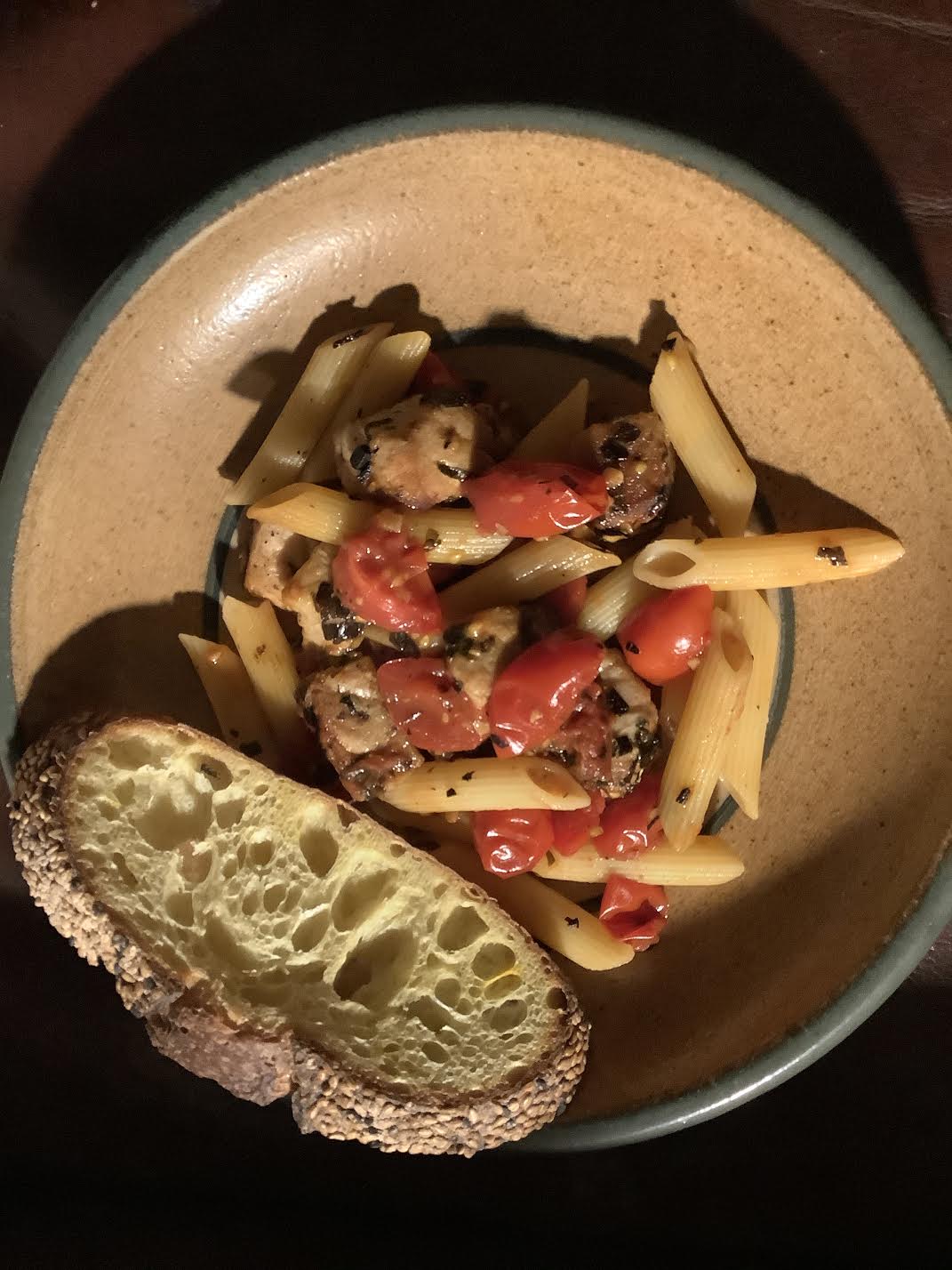
Plate with crusty bread and a crisp salad of many different greens. Easy and delicious — especially when Dear Husband does all the cooking.

Tomorrow marks the 8th anniversary of our Fasting Lifestyle. Our weight is still down where we want it to be, our health is good. And we continue to eat pasta on Wednesdays — what a life!

Slow Days: Pastitsio

People who are new to Fasting often pose the questions: “Can I really eat ‘anything I want’ on a Slow Day?” and “What should I eat on Slow Days?” To answer those questions, I have decided to add some blog posts to show some of the foods we eat on what the world calls NFDs [non-fast days] but which, in our house, we call ‘Slow Days.’ This feature will appear sporadically. 

Now for the answers. Can you really eat ANYTHING you want on a Slow Day? Not really. If you eat too many calories every Slow Day, you will not lose weight. There are many questions asked on the FastDiet Forum which attest to that. Once in a while you can splurge, as long as it isn’t everyday. For what to eat on Slow Days, Dr. Mosley recommends a Mediterranean Diet. As for how we eat, an example follows.

My friend Nick, a pure Greek-American from the Greek neighborhoods of Manchester, NH, called pastitsio ‘Greek macaroni and cheese.’ If your mac&cheese is in a rut, try this variation — it is really good. And don’t even think of telling Nick’s mom that pastitsio originated in Italy!

Ground lamb meat, onion, tomatoes, cinnamon, Greek oregano, butter [not the entire stick], elbow macaroni — here is the basis of Pastitsio. The oregano and cinnamon tell you how Greek it is. Nick always wondered how the early Greeks got tomatoes, but he was willing to give that a pass….

Pastitsio Sauce + Casserole
1 cup chopped onion
½ pound ground lamb
Saute onion and meat in a heavy saucepan while stirring sometimes until the meat is brown and the onions are golden.
1 cup crushed or whole tomatoes
1½ tsp salt freshly ground pepper
1 tsp Greek oregano
1½ tsp cinnamon
Stir in these ingredients and simmer 5 mins.
½ cup Gruyere cheese, gratedStir in the cheese and taste for seasonings.
3 oz elbow macaroniCook the elbows. Stir them into the tomato sauce and turn the mixture into an oil-sprayed 1-Qt casserole.
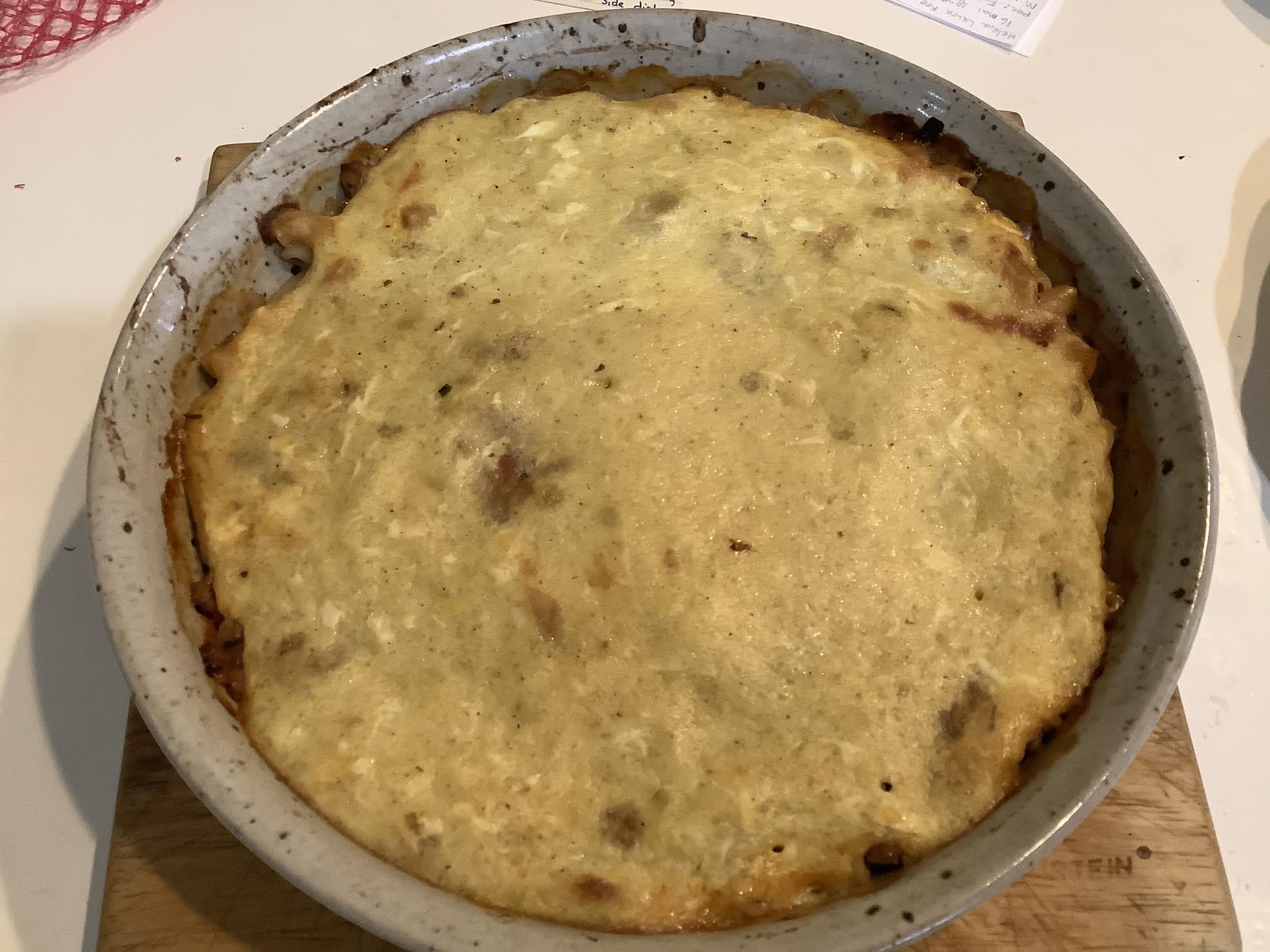
Salsa BesamelTop with salsa besamel and bake at 350F for 30 minutes.

The meat sauce is combined with cooked pasta and then you prepare a besamel…..

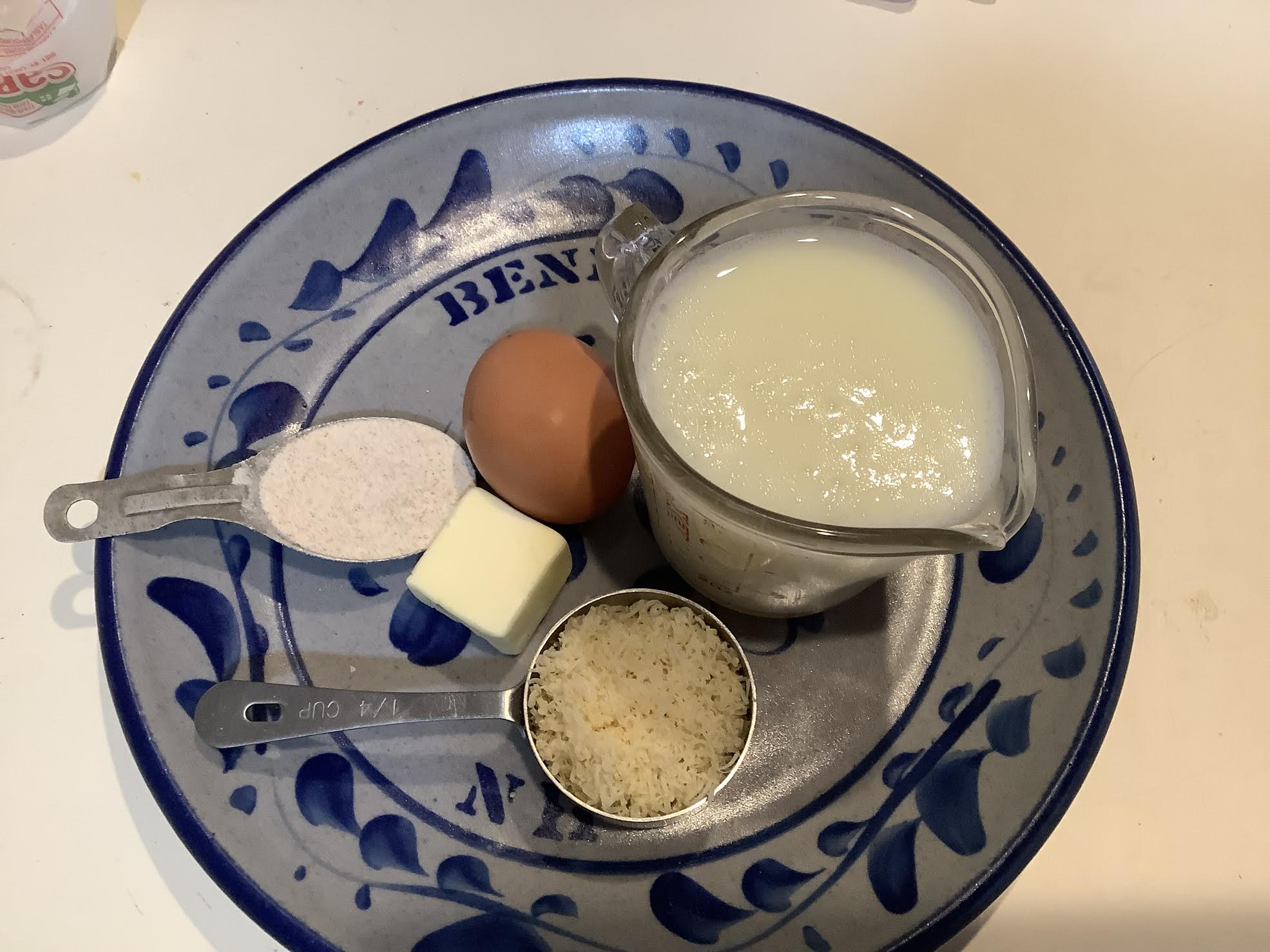
The salsa besamel goes on top. Milk thickened with a butter-flour mixture, grated cheese and egg all combine in a sauce that is poured on top of the pasta and sauce prior to baking.

Salsa Besamel
2 Tbsp butter Melt butter in a saucepan. Take off heat.
1 Tbsp flour
½ tsp salt
1/8 tsp white pepper
1 cup milk
Stir in flour, salt, and pepper, then add the milk gradually and stirring all the time. Put on low heat and stir for 5 minutes.
1 egg yolk
¼ c grated Parmesan cheese
Beat together in a small bowl, then slowly add the warm white sauce and stir constantly.
Baked to a golden turn.

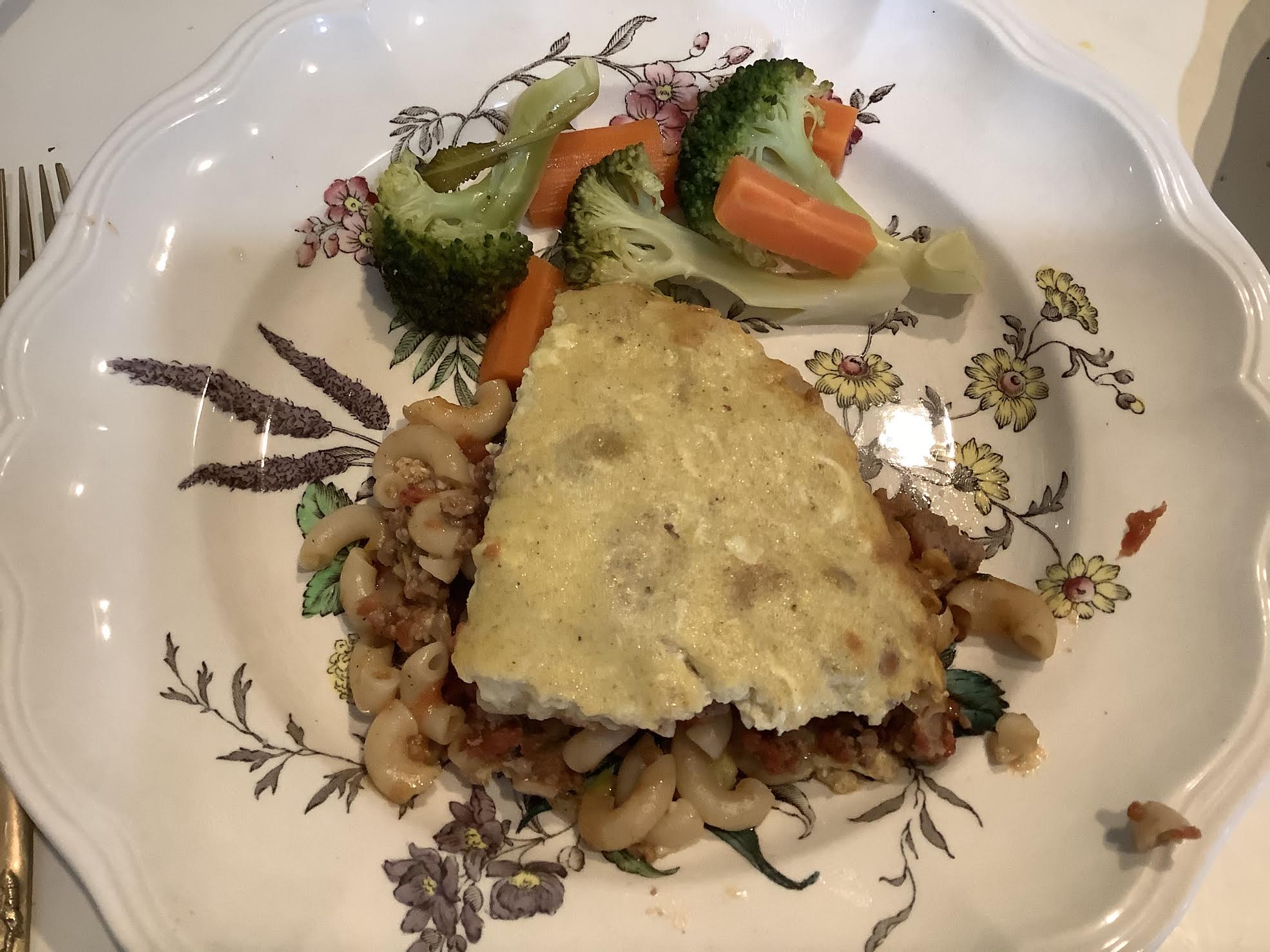
Serve with Winter Vegetables, as seen here, or with a Greek Salad, Pastitsio makes for a hearty mid-Winter meal. Delicious.

Comparing Plans: MIND Diet

How this Fast Diet Lifestyle works: Eat these meals tomorrow, for a calorie total of less than 600. On another day this week, eat the meals from a different post, another day of eating 600 calories or less. Eat sensibly the other days of the week. That’s it. Simple way to lose weight and be healthier.

Paleo and Keto diets are all the rage, but it seems to me that the MIND Diet should be better-known. It was developed in 2015 at Rush University Medical Center in Chicago from two widely-regarded diets: the Mediterranean Diet and the DASH Diet. The name is a real smash-up: Mediterranean-DASH Intervention for Neurodegenerative Delay. As that implies, the diet has genuine benefits for those who wish to forestall neurodegenerative disorders such as Alzheimer’s and Parkinson’s Disease. Furthermore, although it is not an eating plan aimed at weight-loss/body health, it could help to lower cholesterol and weight. Since Dr Mosley recommends a Mediterranean Diet for Slow Days, it is remarkably easy to merge this with a Fasting Diet. Dear Husband and I tried it out, designing a month-long plan of eating, and were glad to see how easy it was to follow. According to a study of 900+ seniors, those who followed the plan religiously reduced their risk of Alzheimer’s Disease by 53%. Those were less punctilious, still reduced their risk by 35%. Those are great numbers. I’m up for that. The chart below shows how nicely the MIND and FAST play together.

Is this food allowed on this diet…MINDOn Fast Days
Fatty Animal protein: beef, lamb, porkNo Yes
Lean Animal protein: chicken, turkey8 oz/weekYes, preferred
Eggs Yes Yes 
Beer, wine, cocktails5 oz red wine dailyOnly on Slow Days
Grains: brown rice, whole wheat pasta, whole cereal Yes Yes, in moderation
Nuts + seeds3 oz/week Yes, in moderation
Beans, legumes: peas, kidney beans, lentils, chickpeas4 oz/week Yes 
Seafood protein8 oz/week or moreYes 
Tropical fruitslimitedYes 
BerriesYes, often Yes 
Leafy green vegetables: spinach, chard, kale, lettuce1 oz/day or moreYes 
Cheese No Some 
Vegetable oils: olive, canolaYes Yes, in moderation
Animal fat: butterNo Yes, on Slow Days
Root vegetables: beets, sweet potatoes, carrotsYes Yes 
Other vegetables: onions, tomatoes, peppersYes Yes 
Higher fatNo No 
Colorful vegetablesYes Yes 
Higher fiberYes Yes
Daily Carb intakeunmeteredKeep it low
Complex carbohydrates: whole grains 3oz/day Yes
Simple carbs: cookies, pastries, cakeNoNot on Fast Day
16:8 intermittant fasting recommendedYesYes 
Number of days per week to follow the regimin 7 of 72 of 7
Do calories matter?No Yes, 600 on Fast Days
source: https://health.usnews.com/best-diet/mind-diet

Our meals today draw from ingredients that hew to the guidelines of the MIND Diet: whole-grain bread and a brightly-colored vegetable for breakfast, followed by beans with leafy greens for dinner. The soup also makes for a fine lunch, which is another time to eat your healthy ingredients.

Bruschetta Toast: 210 calories 12 g fat 4 g fiber 9.5 g protein 20 g carbs [12 g Complex] 56 mg Calcium  PB  This one was a serendipidous invention and it turned out to be yummy.

1 slice whole-grain seedy bread [Dave’s Killer Bread is great] one 2-oz egg 3 Tbsp Bruschetta sauce  – strain it if too liquidy 1 oz pear  Optional: blackish coffee [53 calories] or blackish tea or mocha cafe au lait [65 calories] or lemon in hot water 

Toast the bread lightly and pan-fry or poach the egg. Spread 2 Tbsp of the bruschetta on the toast and top with the egg. Dollop the remaining bruschetta on the egg. Plate the fruit. Eat with knife and fork or with your hands. A taste sensation.

Bruschetta Sauce: makes 2 cups 1 cup= 285 calories 28.5 g fat 3 g fiber 2 g protein 10 g carbs 2 mg Ca
½ pound plum tomatoes
3-4 Tbsp extra-virgin olive oil
1 clove garlic + 1 scallion
½ tsp crushed red pepper flakes + ½ tsp salt
1 tsp fresh oregano, chopped
1 tsp fresh tarragon, chopped
2 Tbsp fresh basil, chopped
1 tsp fresh marjoram, chopped
Core and quarter the tomatoes. Peel and crush the garlic.
Slice the scallion. Put all of these ingredients into a food processor and pulse off and on to make a chunky sauce.
½ pound plum tomatoes Core and quarter the tomatoes. Add to the above and pulse a few more times.
1 Tbsp balsamic vinegar
1½ teaspoons red wine vinegar
Pour the tomato-herb mixture into a bowl and stir in the vinegars.
This is the sauce that I mentioned in SlowDays: Bruschetta https://wordpress.com/post/fastingme.com/14162

Three-Bean Soup:  241 calories 3 g fat 29 g fiber 16 g protein 39 g carbs [32 g Complex] 134 mg Calcium  PB GF   A cold evening and a bowl of bean soup – so satisfying and delicious. HINT: This recipe produces 11 cups of soup. One serving = one cup A fine way to use up some of those beans that you hoarded when the Pandemic began.

1 cup dry navy beans** 1 cup dry kidney beans** 1 cup dry soldier beans** 2 Tbsp salt + water to cover beans 4 oz ham bone or ham hock, with some meat 1 cup onion, chopped 28 oz crushed tomatoes 1 tsp chili powder 1 tsp dried basil 3 Tbsp lemon juice + salt + pepper to taste per serving: 1/2 cup baby spinach leaves cut as chiffonade **Any combination of beans will do. Add other types of beans or pulses, such as lentils, to create a 5-10 bean soup.

Rinse the beans in a collander under running water. Put them into a large bowl or cook pot and cover with 3-4” of water. The beans will double or triple in size as they absorb the water. Add salt and let the beans sit overnight. Next day, drain the water and discard. Put the beans in a large cook pot along with 1½ quarts water and the meaty bone. Bring to a boil, then turn down to a simmer and cover. Let cook slowly for 2 hours. Add the onion, tomatoes, and flavorings. Fish out the ham bone and cut the meat from it. Dice the meat, add back to the pot, and simmer slowly for one hour. Serve with ½ cup fresh baby spinach leaves stirred into the hot soup in each serving bowl at the last minute.

Ingredients for next week: Breakfast, single portion for Monday ……………………………………………… single portion for Thursday:

1 two-oz egg + lots of fresh herbs1 two-oz egg, hard-boiled 
Crushed tomatoes + low-fat cottage cheese1 slice whole-grain dark bread @ 70 calories
anchovy + cooked chicken meatchicken dinner sausage
pear2 prunes + onion
Optional smoothie
optional hot beverageoptional hot beverage

Dinner, single portion for Monday: ………………….. ……………… single portion for Thursday:

quail/pheasant + rabbit liver + peascabbage + onion + rutabaga/turnip
Dijon mustard + fresh cranberries + eggcarrot + parsnip + dry green lentils
rich broth + turkey + onion + wild boarpork loin + frozen spinach + fresh spinach
mace + carrot + Arnold Sandwich Thin [100 calories]mace + dry mustard + caraway seed
Sparkling waterSparkling water