People who are new to Fasting often pose the questions: “Can I really eat ‘anything I want’ on a Slow Day?” and “What should I eat on Slow Days?” To answer those questions, I have decided to add some blog posts to show some of the foods we eat on what the world calls NFDs [non-fast days] but which, in our house, we call ‘Slow Days.’ This feature will appear sporadically.
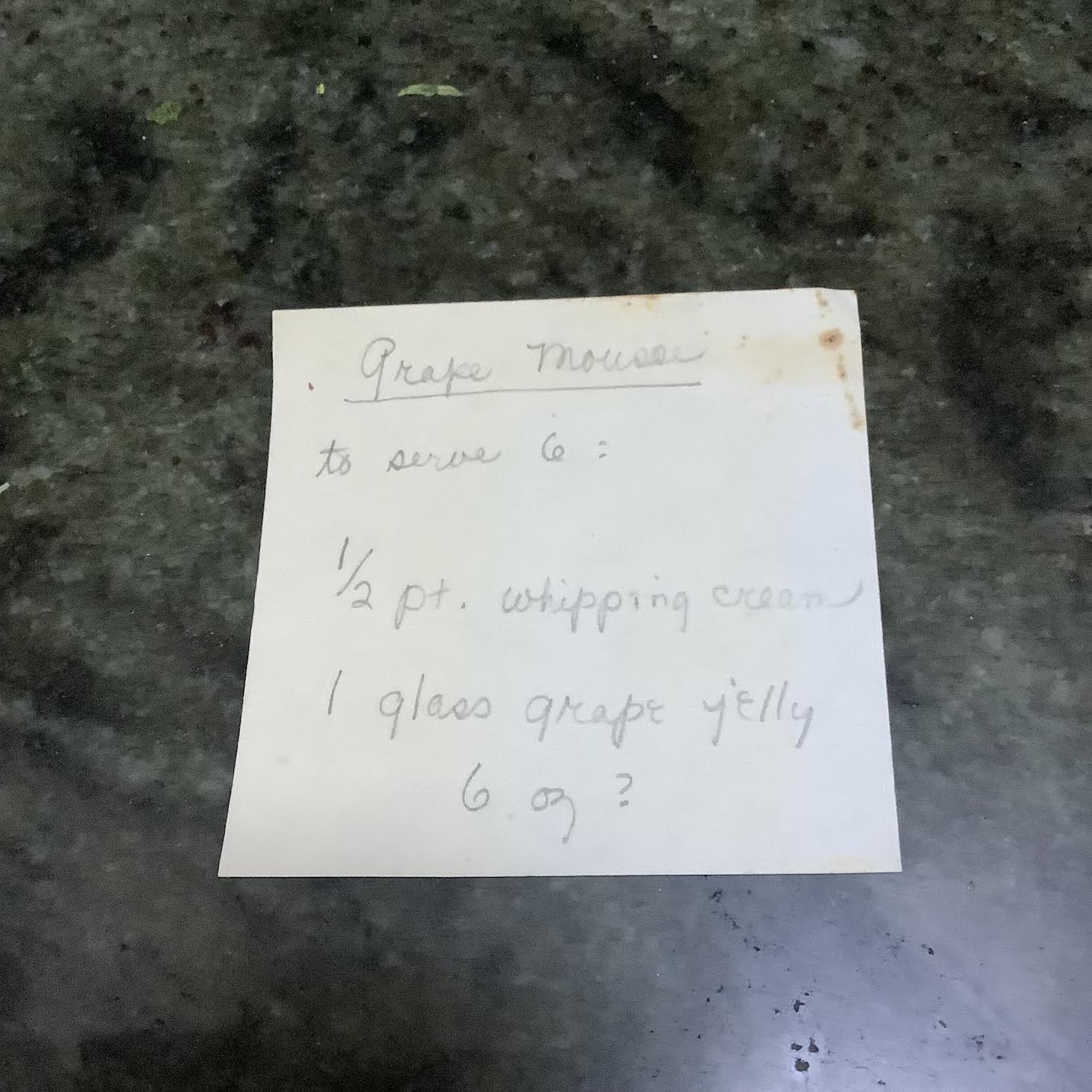
Mary Johnson Dillon published her novel In Old Bellaire in 1906. It is set in Carlisle, Pennsylvania during the Civil War, and depicts life in the college town where the author grew up. Amid the flirting and social customs, a dinner party occurs and one of the desserts served is a ‘grape mousse’. My mother would sometimes be inspired to track down literary food references, so she asked older members of the Carlisle community if they knew the recipe. Sure enough, a recipe [of sorts] emerged. Here it is in my mother’s own hand:
That’s helpful, isn’t it? My mother tried this and it was a hit — a splendid make-ahead treat for hot weather. So I got to thinking — what about other jellies… or even jams…?
Thus I concocted a Strawberry-Rhubarb Mousse. Dear Husband thought it was great, and he was right. This is a taste-and-pour recipe, so adjust the amount of jam to taste. Start out using less than the amount, then adjust to taste. To flesh out the recipe:
Sv 4-6
ramekins or wine coupes
1 cup whipping cream
With electric beaters, whip until almost forming peaks.
4-6 oz strawberry-rhubarb jam
Add jam and continue to beat until incorporated.
Distribute among ramekins or wine coupes. Freeze 2 hrs.
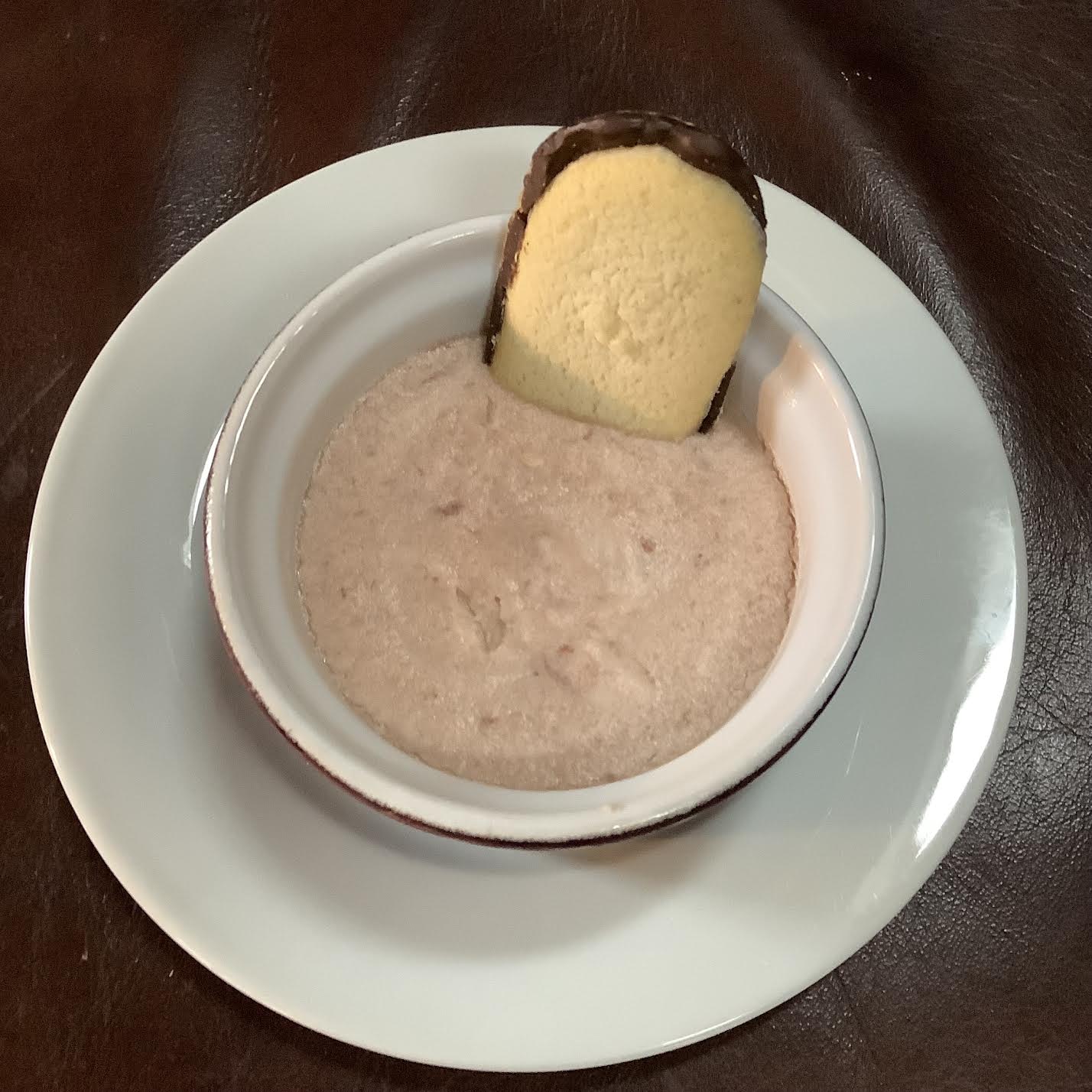
The mousse, served right out of the freezer, adorned with a Milano cookie.
People who are new to Fasting often pose the questions: “Can I really eat ‘anything I want’ on a Slow Day?” and “What should I eat on Slow Days?” To answer those questions, I have decided to add some blog posts to show some of the foods we eat on what the world calls NFDs [non-fast days] but which, in our house, we call ‘Slow Days.’ This feature will appear sporadically.
Shad fish, Alosa sapidissima, used to be the iconic symbol of springtime in coastal New England. The Shadbush would bloom in the woodlands, and the shad fish would migrate up-stream from the ocean to spawn. Then the fishing would begin! The most prized part of the shadfish was the roe — two pink lobes of unlaid eggs. Cookbooks had many recipes for shad roe. The flesh was good, but so full of little bones that it might be off-putting. My grandmother loved it nonetheless, crunching it down, bones and all. Nowadays, shad is less common, due to the damming of rivers during the early Industrial Revolution. Happily, it can still be found in some markets, and then I snatch it up. Even better, modern processing of the fish minimizes the little bones to manageable proportions.
This preparation is a combination of recipes [though mostly for the roe] which I turned into a fine meal. Why the pancake in lieu of potato or some grain? In Rhode Island, they love to eat shad with their local cornmeal pancake called “Johnny Cakes.” I made a batch of corn bread batter [Fannie Farmer Cookbook], and cooked it like pancakes instead. That was a hit!
As you can see, I couldn’t wait to eat this meal, so I took a few bites before I took the photo!
Begin by cooking some bacon in a non-stick pan — 1-2 slices per person. Blot the bacon and pour off most of the fat from the pan, but save what your pour off. Prepare batter for a simple cornbread and cook the batter like pancakes in a bit of bacon fat. Make 1-2 per person. [freeze remaining batter for another meal, like breakfast] Set them aside to stay warm. For the shad, get some very fine yellow cornmeal. [NB: If all you have is meal the texture of sugar, run it through the blender to make it more fine.] Put cornmeal on a plate and sprinkle on salt, pepper, and thyme leaves. Dredge 4-ounce shad fillets in cornmeal, then cook in a bit of bacon fat, about 4 minutes per side. Spray the pan with some cooking spray if the fat cooks away.
Plate the shad with the bacon on top, next to the ‘pseudo-Johnny Cakes,’ and some green beans. This is a genuine old New England treat!
People who are new to Fasting often pose the questions: “Can I really eat ‘anything I want’ on a Slow Day?” and “What should I eat on Slow Days?” To answer those questions, I have decided to add some blog posts to show some of the foods we eat on what the world calls NFDs [non-fast days] but which, in our house, we call ‘Slow Days.’ This feature will appear sporadically.
Valentine’s Day is around the corner, and Galentine’s Day precedes it. When I saw this recipe via Taste of France Magazine, I knew that I had to try it! Claudia Taittinger, of the Taittinger Champagnefamily, offers this recipe in her book Entertaining Chic!. These chocolate desserts are very simple to prepare and the result is fabulous. Since I am not cooking for a crowd, I cut the recipe back to 4 [should we have guests] or 2 servings [for Dear Husband and me]. We enjoy this very much for dessert on Valentine’s day. Prepare only as many as you need for that meal, as they do not reheat or keep for another day. This year, Alas, Valentine’s Day falls on Ash Wednesday. Culinary decisions will have to be made, as this treat is definitely NOT for Lenten eating!
You are asking: How does this possibly fit into the Fast Diet??!??! You must remember that the beauty of the Fast Diet is that one ‘Fasts’ only two days per week. With this lifestyle, one can indulge in food-of-your-dreams once in a while on Slow Days: we have this once a year, which makes it even more of a special treat. Does one eat like this all the time? Of course not! This year, the day after Valentine’s Day happens to be a Fast Day.
Sv 4
Sv 2-modified
Butter 4 or 2 ramekins; set aside.
100 g unsalted butter
40 g unsalted butter
Microwave butter ~ 10 seconds, until softened.
132 g 60% choco
60 g 72% choco
Chop chocolate, melt in a bain-marie or double boiler
100 g caster sugar
40 g caster sugar
In a medium bowl, combine softened butter and sugar.
2 eggs 17 g white flour 17 g white whole wheat flour
1 egg or 1.8 oz egg whites 17 g white whole wheat flour
Have eggs at room temperature. Add eggs, one at a time, alternating with the flour. STOP HERE IF NEEDED
Melted chocolate
Melted chocolate
Stir in melted chocolate, pour 103 g of batter into each ramekin
Put ramekins in freezer 1 hr.
Preheat oven to 300°F /150°C.
Berries Ice cream or crème fraîche
Berries Ice cream or whipped cream
Take ramekins from freezer and put in oven for exactly 20 mins. Unmould and serve hot, with your choice of topping.
People who are new to Fasting often pose the questions: “Can I really eat ‘anything I want’ on a Slow Day?” and “What should I eat on Slow Days?” To answer those questions, I have decided to add some blog posts to show some of the foods we eat on what the world calls NFDs [non-fast days] but which, in our house, we call ‘Slow Days.’ This feature will appear sporadically.
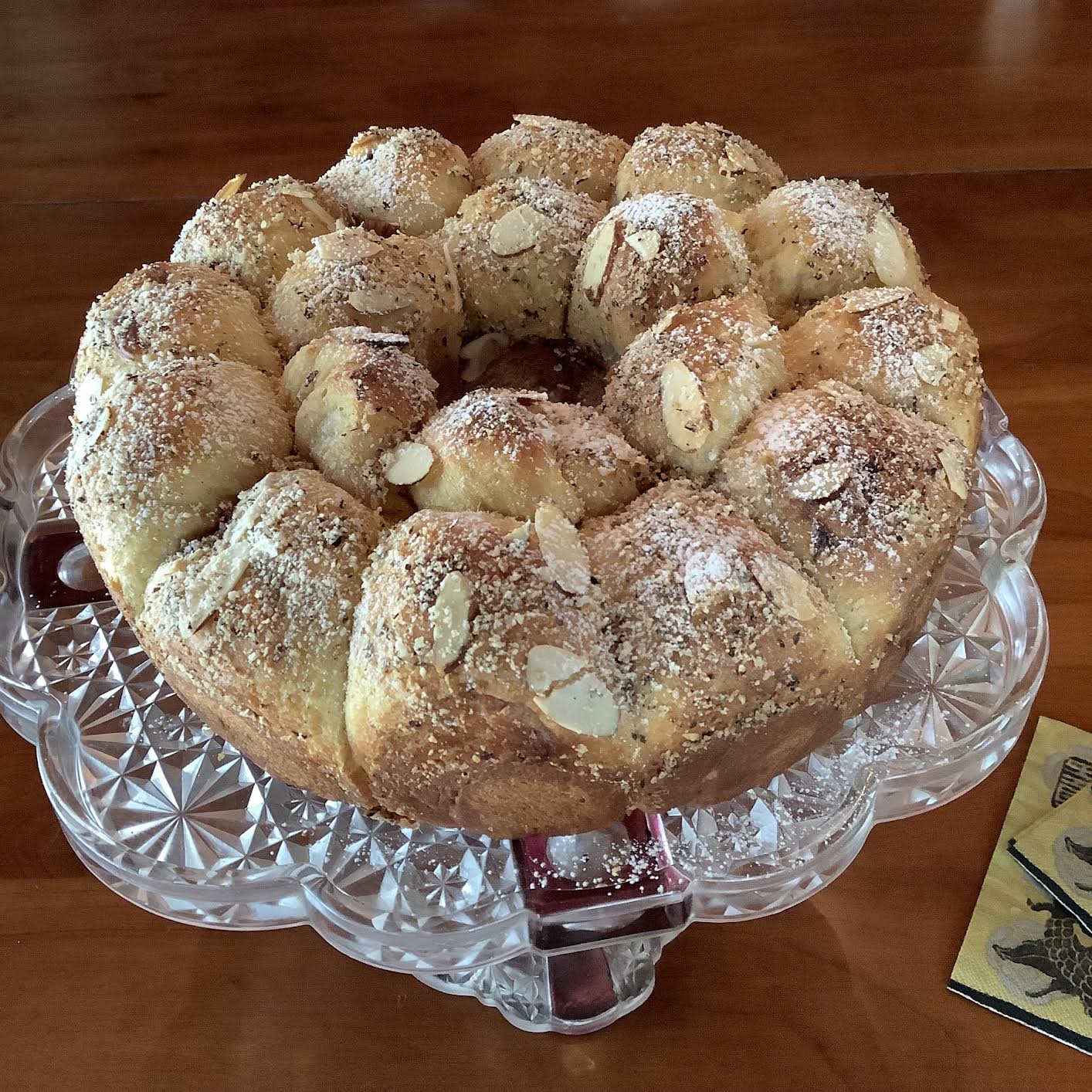
If you want something special for a holiday breakfast, this delightful brioche wreath fills the bill. The recipe is from Bonne Maman, makers of jams, jellies, and spreads, and of course they want you to use one of their products. You may use any quality homemade or purchased jam you wish. I prepared this for a gathering of the knitting group, and it was a success. The step involving the preparation of the jam-filled balls could be a family affair and is a good way to include little hands in the kitchen. I have broken the recipe into steps over two days, which simplifies the process [I think], and breaks it into steps that are not too time-consuming. And the next day, Voila! a splendid breakfast centerpiece that looks spectacular, but was made with little fuss.
1 large wreath of 18 puffs
10” tube pan or 12” pie plate + ramekin
DAY 1, EARLY
7g sachet fast-action dried yeast 25g golden caster sugar 150 g white whole wheat flour 150g strong white = bread flour zest of ½ orange + ½ lemon 1 tsp salt
Caster sugar is a fine-grained sugar from the UK. Blitz granulated white sugar in the food processor to make a substitute. Zest the orange and lemon rinds OR USE 2 Tbsp ORANGE PUREE. [chop an orange into large pieces, run through food processor to make a chunky mush] Mix these in the bowl of an electric mixer with a dough hook. Make a well in the center.
50 ml warm milk 3 large eggs, beaten
Pour these into center well. Mix on a slow speed 2 mins, then on medium 3-4 mins, until dough is soft, glossy and elastic.
225g/16 Tbsp/2 sticks butter, cubed and very soft
Add butter, bit by bit, and mix 4-5 mins. Scrape down bowl to mix thoroughly. Dough will be very soft. Tip into an oiled bowl, cover with film and chill 8-24 hrs until firm.
DAY 1, LATE
18 tsp Bonne Maman Conserve – choose your favorite or make 9 of one flavor and 9 of another
On a lightly oiled surface, divide dough into 18 pieces, ~40 g each. Roll pieces in circles 10 cm in dia. Spoon 1 tsp of jam on centre of each. Bring up sides, pinch together, roll into a ball.
Butter a 10” tube pan. ORPut a greased ramekin in center of buttered 12″ pie plate. Put 6 balls, seam side down, around center tube. Put 12 balls in an outer circle. Cover, let sit 2 hrs until puffy –OR– OVERNight @ 40 degrees
DAY 2, MORNING
Heat oven to 170ºC/340F/ gas mark 5.
Egg wash ½ tsp lemon finishing salt 1 tbsp ground hazelnuts sliced almonds
After rising, brush dough with a little egg wash, sprinkle with salt and nuts. Bake 20 mins, until golden.
Cover with foil and cook 10-15 mins longer.
Icing sugar
Cool slightly, remove from pan. Remove ramekin if using. Dust with icing sugar.
People who are new to Fasting often pose the questions: “Can I really eat ‘anything I want’ on a Slow Day?” and “What should I eat on Slow Days?” To answer those questions, I have decided to add some blog posts to show some of the foods we eat on what the world calls NFDs [non-fast days] but which, in our house, we call ‘Slow Days.’ This feature will appear sporadically.
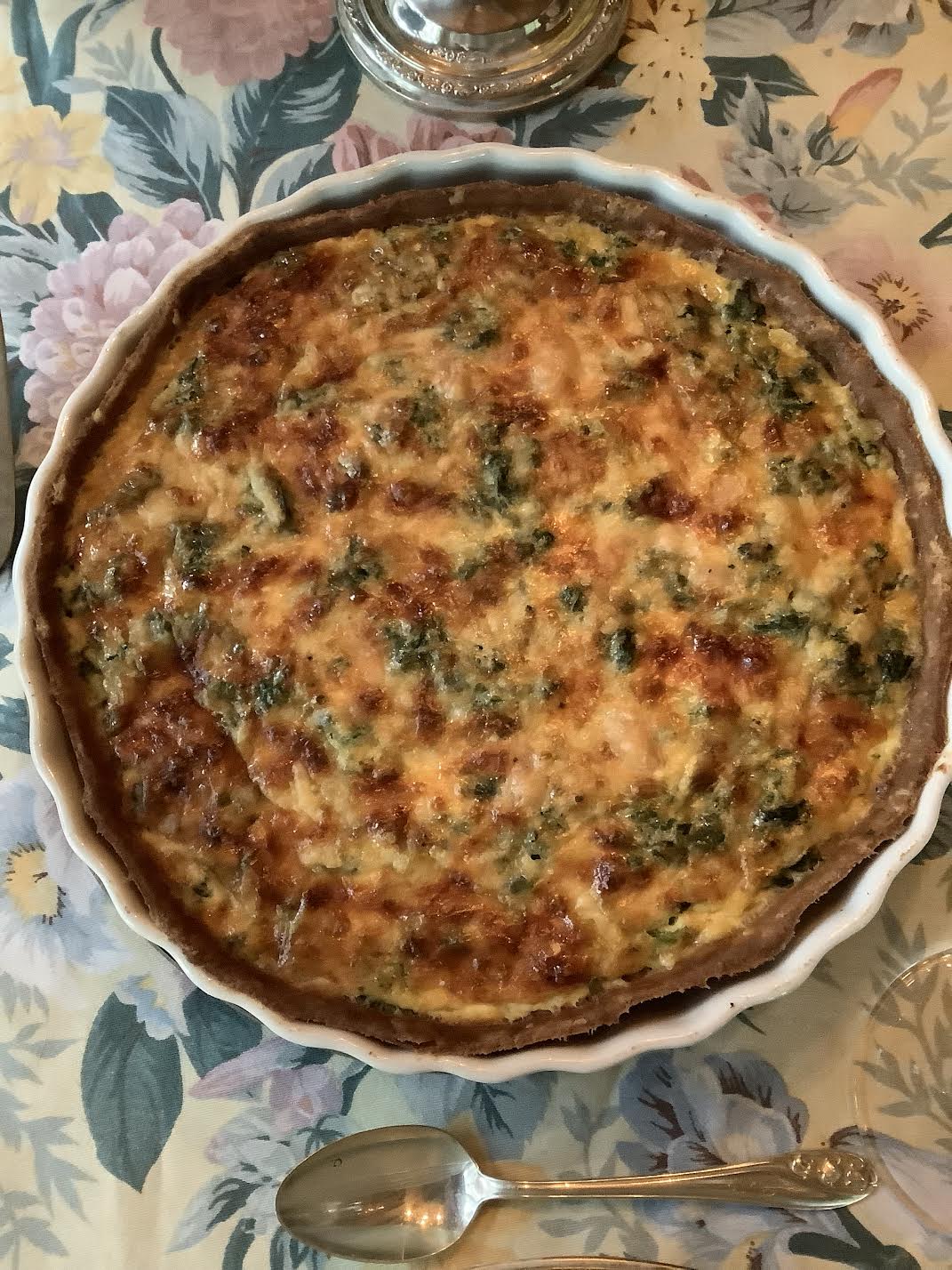
Early May is the mid-way point between the Vernal Equinox [start of Spring in the Northern Hemisphere] and the Summer Solstice [start of Summer in the Northern Hemisphere] — so why not have a special meal? Floral-themed, of course. And since the coronation of King Charles III occasioned much discussion of the Coronation Quiche, that would be the main course. Although I tried to stick to the original recipe, some changes had to be made: 1] No lard to be found, so I prepared the crust using all butter. 2] The amount of milk given was insufficient to moisten the crust ingredients, so I added more, once tablespoon at a time, followed by more water until it was right. 3] In the UK, a ‘large’ egg is larger than a US ‘large’ egg. So I provided the weight of the egg so you will have sufficient liquid in the quiche. 4] I recommend using Half&Half or Blend Cream instead of Heavy/Whipping/Double cream. Same result, less saturated fat. 5] The original recipe has the white beans tossed in whole. I mashed them so the texture would be more creamy. 6] The original recipe does not tell the cook to squeeze the excess liquid from the cooked spinach. This is a necessary step, so I included it. 7] After baking the quiche for the recommended 20-25 minutes, it was not quite set in the center and the top was colorless. I cooked it 10 minutes longer and it turned out very well. 8] Cheese type was unspecified, so I emphasized the upstart colonies and used American and Irish Cheddars. I would definitely prepare this again.
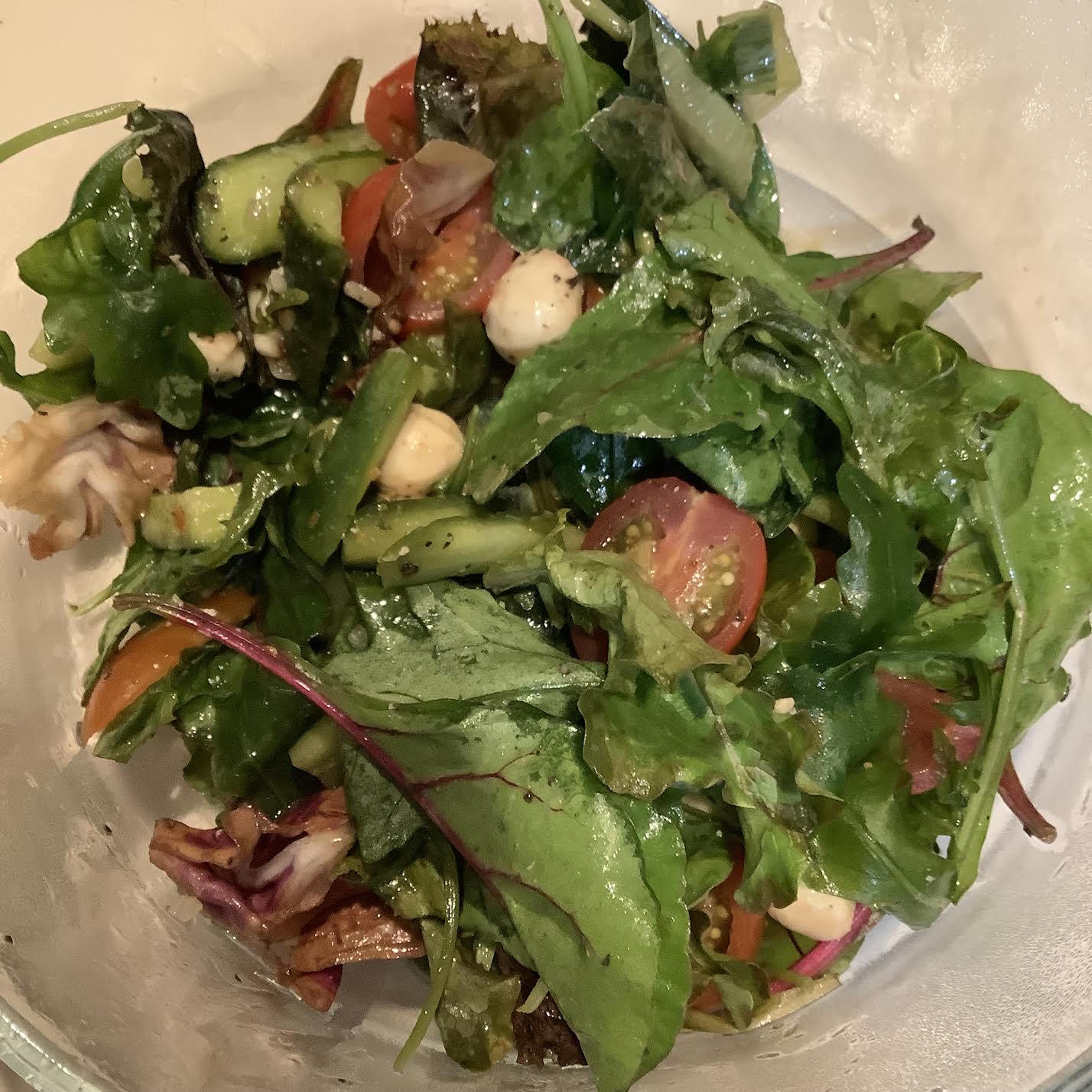
The quiche was delicious!Add a hearty, healthy salad made with Spring Greens and asparagus.
125g white whole wheat flour Pinch salt 50g cold butter, diced
Sift flour + salt into a bowl. Add fats and rub mixture together with finger tips until you get a sandy, bread crumb-like texture.
2 Tbsp milk OR use 250g of ready-made shortcrust pastry
5 Tbsp milk + water
Add milk a bit at a time to bring ingredients together into a ball. Cover, rest in fridge 30-45 mins. Or overnight
On a lightly floured surface, roll pastry to a circle ~5mm thick, a bit larger than tin.
Line pan with pastry, mending any holes. Cover, rest 30 mins in fridge.
Preheat oven to 190°C./375F
OR MAKE A CRUSTLESS QUICHE
Line pastry with parchement + baking weights. Bake 15 mins. Remove paper, weights.
Loweroven to 160°C./320F
125 ml milk 175 ml double/heavy cream two large UK eggs Salt and pepper
125 ml milk 175 ml half + half two 2.7-oz eggs Salt and pepper
Whisk together these ingredients, without making it frothy..
60g canned white beans
30g canned white beans
Puree or mash, add to egg mixture.
180g cooked spinach 1 Tbsp fresh tarragon
180g cooked spinach 1 Tbsp fresh tarragon
Squeeze spinach, roughly chop it along with tarragon.
50 g grated cheese
50 g grated Cheddar I used Irish Cheddar here
Scatter cheese on pie crust, top with spinach, then pour egg-bean mixture evenly over all.
50 g cheese
50 g Cheddar cheese I used Vermont Cheddar here
Sprinkle with cheese. Bake 20-35 mins until lightly golden, set — might take 10 mins more
1 of 6 Sv: 229 calories 18.6 g fat 0.8 g fiber 10 g protein 3.6 g carbs 208 mg Calcium CRUST 1/6: 134 calories 8.2 g fat 2.7 g fiber 2.7 g protein 14 g carbs 2.6 mg Calcium
FILLING 1 of 6 Servings: 166 calories 11.4 g fat 0.8 g fiber 10.4 g protein 6 g carbs 220 mg Calcium
ALL BUTTER CRUST 1/6: 127 calories 7.4 g fat 2.7 g fiber 2.7 g protein 14 g carbs 3.6 mg Calcium
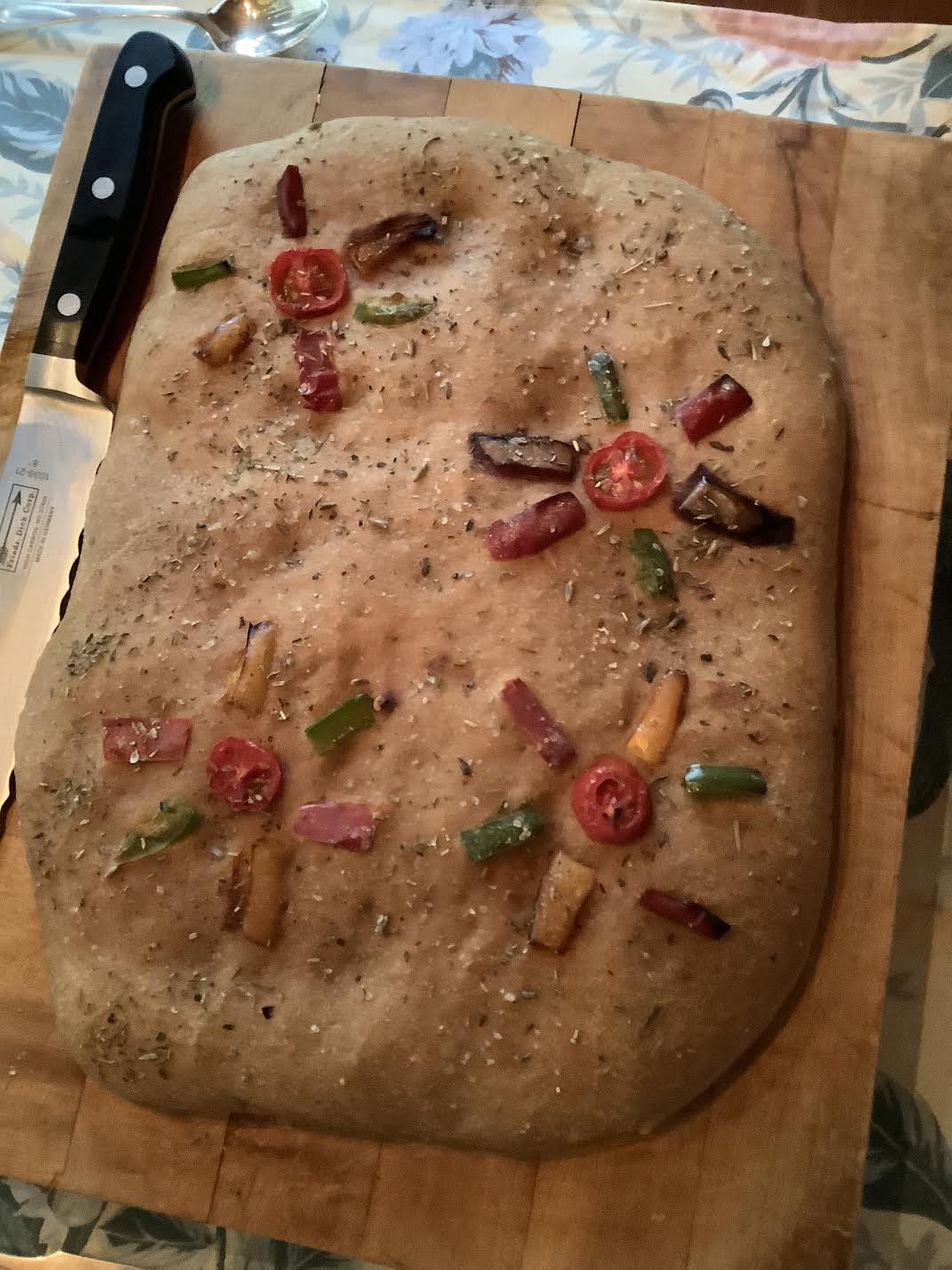
To emphasize the floral theme of the meal, an Artistic Foccacio with vegetable flowers and a Panna Cotta for dessert, topped with a drizzle of Dandelion Jelly and decked with Candied Violets.
The dessert recipe is from Epicurious.com. I am very fond of make-ahead desserts.
makes 6 ramekins or 8 mini-Mason jars
Lightly spray six ¾-cup ramekins or custard cups with nonstick spray or 8 mini-Mason jars with lids
2 tablespoons water 1½ tsp unflavored gelatin
Pour water into small bowl; sprinkle gelatin over. Let stand until gelatin softens, ~10 mins.
1 cup whipping cream 1 teaspoon finely grated lemon peel ½ cup sugar
Heat these in medium saucepan over med-high heat, stirring constantly until sugar dissolves.
Increase heat and bring just to low boil, stirring occasionally. Do not over-heat the mixture!
Add gelatin mixture, take off heat. Stir until gelatin dissolves.
Pour into a bowl. Cool mixture to lukewarm, stirring often.
2 cups buttermilk 2 teaspoons vanilla extract
Stir in these. Divide mixture among ramekins. Refrigerate panna cotta until set, ~4 hours or overnight.
People who are new to Fasting often pose the questions: “Can I really eat ‘anything I want’ on a Slow Day?” and “What should I eat on Slow Days?” To answer those questions, I have decided to add some blog posts to show some of the foods we eat on what the world calls NFDs [non-fast days] but which, in our house, we call ‘Slow Days.’ This feature will appear sporadically.
One day, I got to thinking about making Lavash, an ancient flatbread from Armenia and the surrounding region. Actually, I was thinking about making pita bread, but I’d done that once and was not pleased with the result, so why not do something new, like Lavash? The modern version of this flexible breadstuff is marketed as a ‘wrap.’ Son #1 said that he had made it, which encouraged me to try. Some recipes these days are yeasted, but I wanted to get to the original style. Vera Abitbol @ 196flavors.com is the source of this recipe. Lavash is one of the many ‘flatbreads’ of Asia, the main requirement being that it could be prepared quickly [no yeast to proof and rise] and could be cooked on flat rocks by the campfire. Thus it became a bread for bands of hunters, nomadic herders, and soldiers.
The story is told of an Armenian king who was kept alive by lavash and a clever ploy. King Nebuchadnezzar wanted to conquer neighboring Armenia. In one battle, the Armenian King Aram was captured by his enemy. Game over? Not yet: the Assyrian king wanted to toy with his captive before a final blow. King Aram was to be starved for 10 days before meeting his rival in an archery contest. If Nebuchadnezzar won, Aram would be murdered and his nation forfeit. If Aram won, he would go free and his kingdom would be saved. Aram asked that his near-by army would bring him his most beautiful shield to prepare him for the competition. Sure, said Nebuchadnezzar, why not? When the message was received by the Armenians, they were perplexed — why take a shield to an archery test? Then they guessed that there was a hidden meaning to the request: send. me. bread. So they baked a batch of Lavash, smoothed the thin, flexible strips of bread to the underside of the shield, and delivered it to their king. For the next nine days, the Armenian king ‘peevishly’ demanded a new shield, and thus he was supplied with sustenance instead of starving. On the day of the contest, King Aram won at archery and Armenia was saved. By Lavash bread!
LAVASH Vera Abitbol @ 196flavors.com Makes 16 lavash sheets
Griddle or wide skillet or baking sheets
2 c white whole wheat flour 1 c white flour
Add flour to bowl of a stand mixer with a paddle attachment. Make a well in center of flours.
½ tsp salt 1 c. warm water (95 F/36˚C)
Put salt in well. Knead at medium speed, adding water gradually. Dough will be soft, homogeneous, and come off walls of bowl.
Cover bowl with plastic wrap. Let rest in a warm place 30 mins.
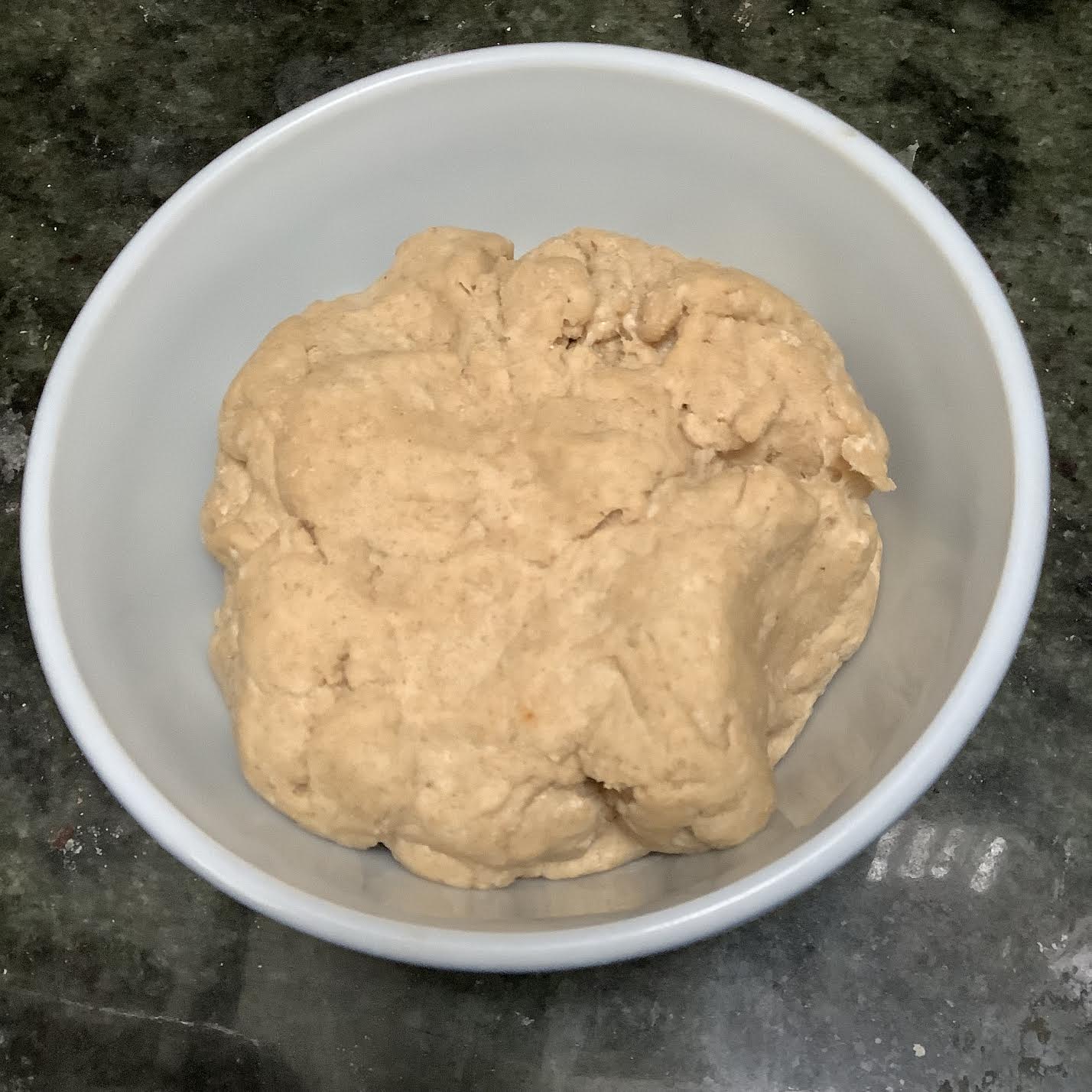
Dough is resting in a small bowl before rolling.
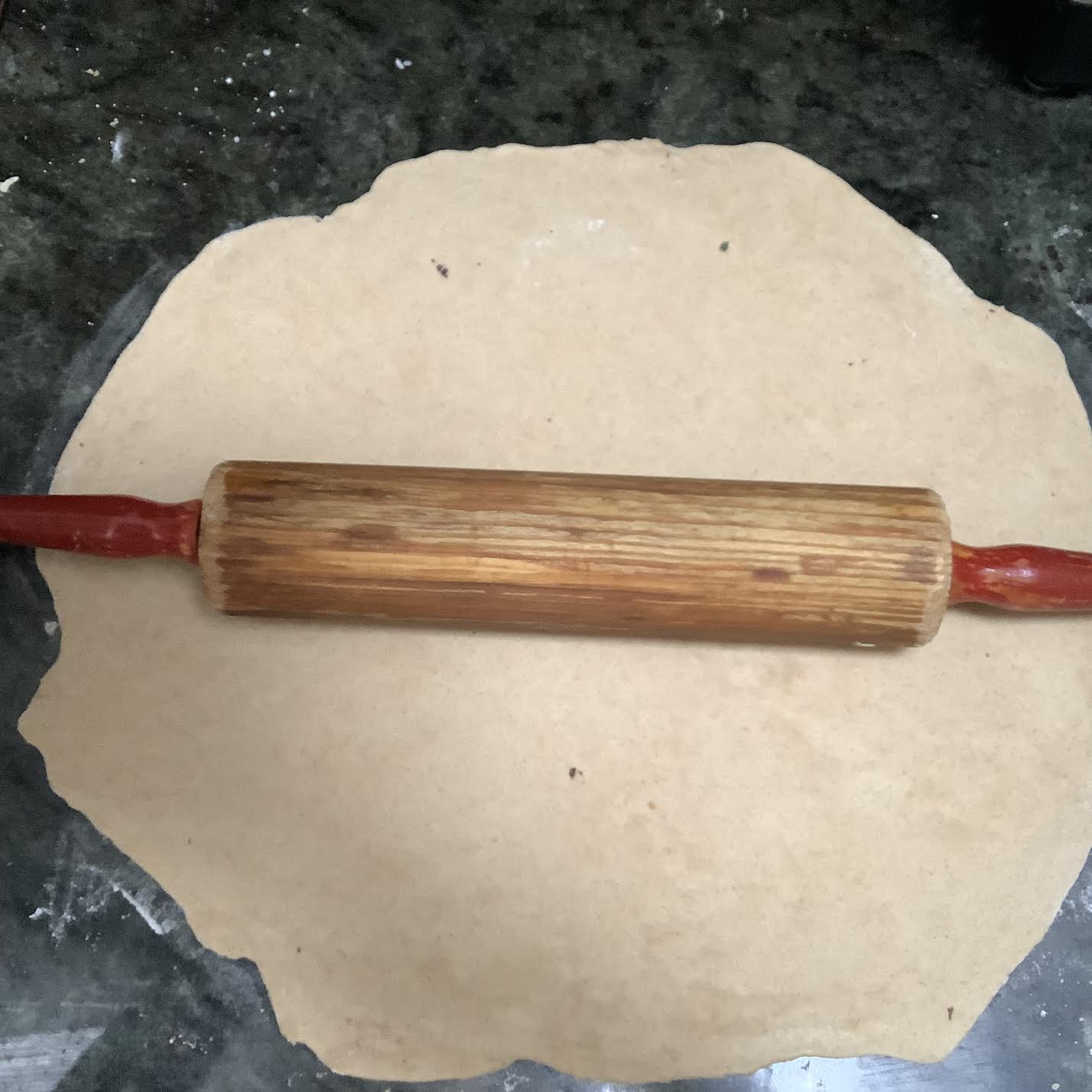
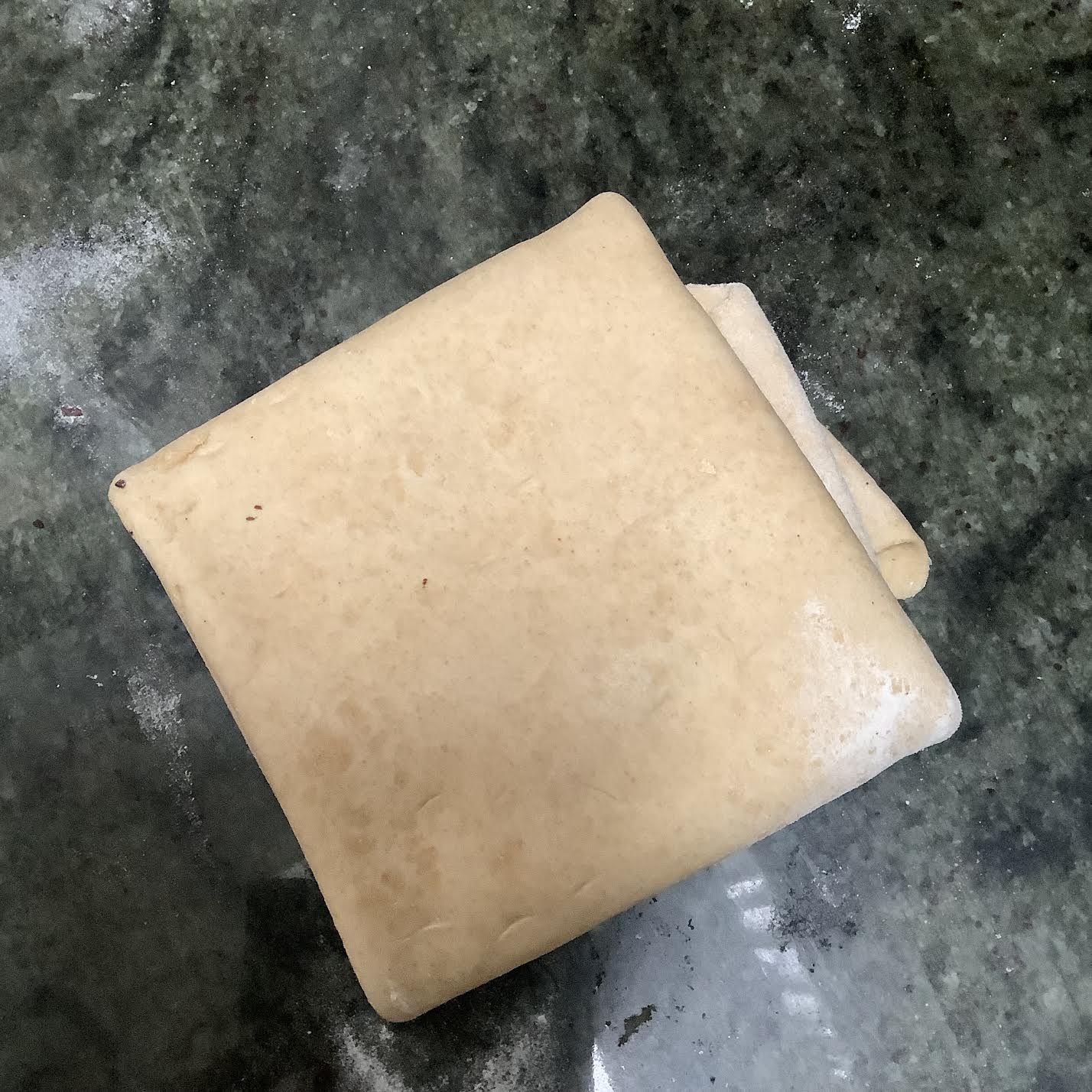
Roll dough thinly on a lightly floured surface. Fold sides in to make 4 layers. Let rest 30 mins in a warm place.
Cut dough in two pieces. Roll and fold each piece 4x to make dough elastic. Preheat oven 30 mins to 430F/220˚C OR heat griddle
As the above directions say, you are now to roll and fold each piece of the dough four times. The goal is to make the dough thinner and more pliable with every turn. While this is supposed to be done with a rolling pin, it struck me as being similar to the process of rolling pasta dough — the successive rolling works the dough into thin, even strips. so I got out the pasta machine, cut the dough into pieces the correct width and ran them through. I started at the thickest setting, then went by steps to the thinnest setting. The dough became smooth, silky, elastic, and cohesive.
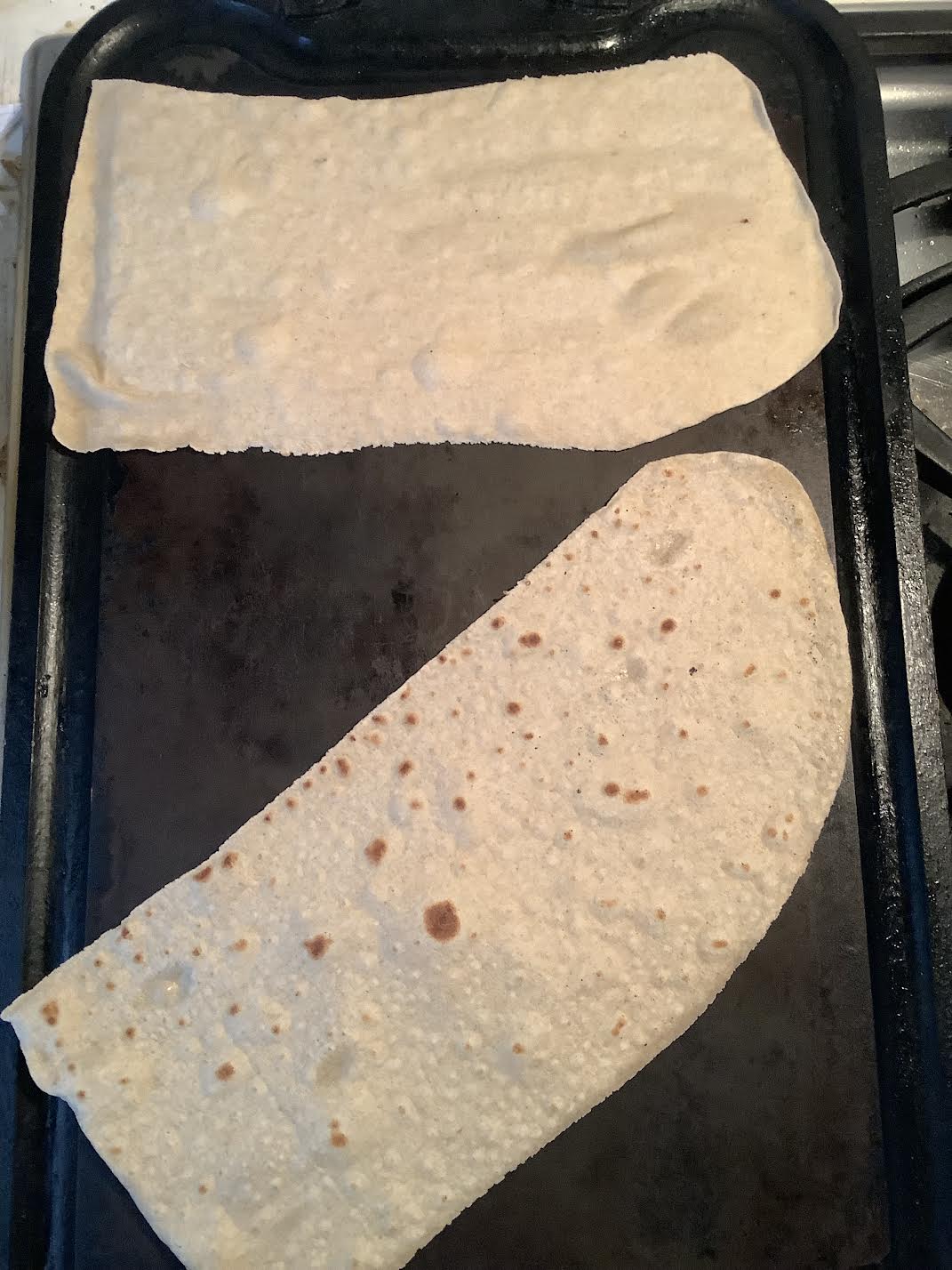
Divide dough into 4 pieces. Roll out to 1/16”/1.5mm thick. OR pass through pasta machine to setting 6 or 7. Put dough one at a time on very hot pan and cook ~1 min per side
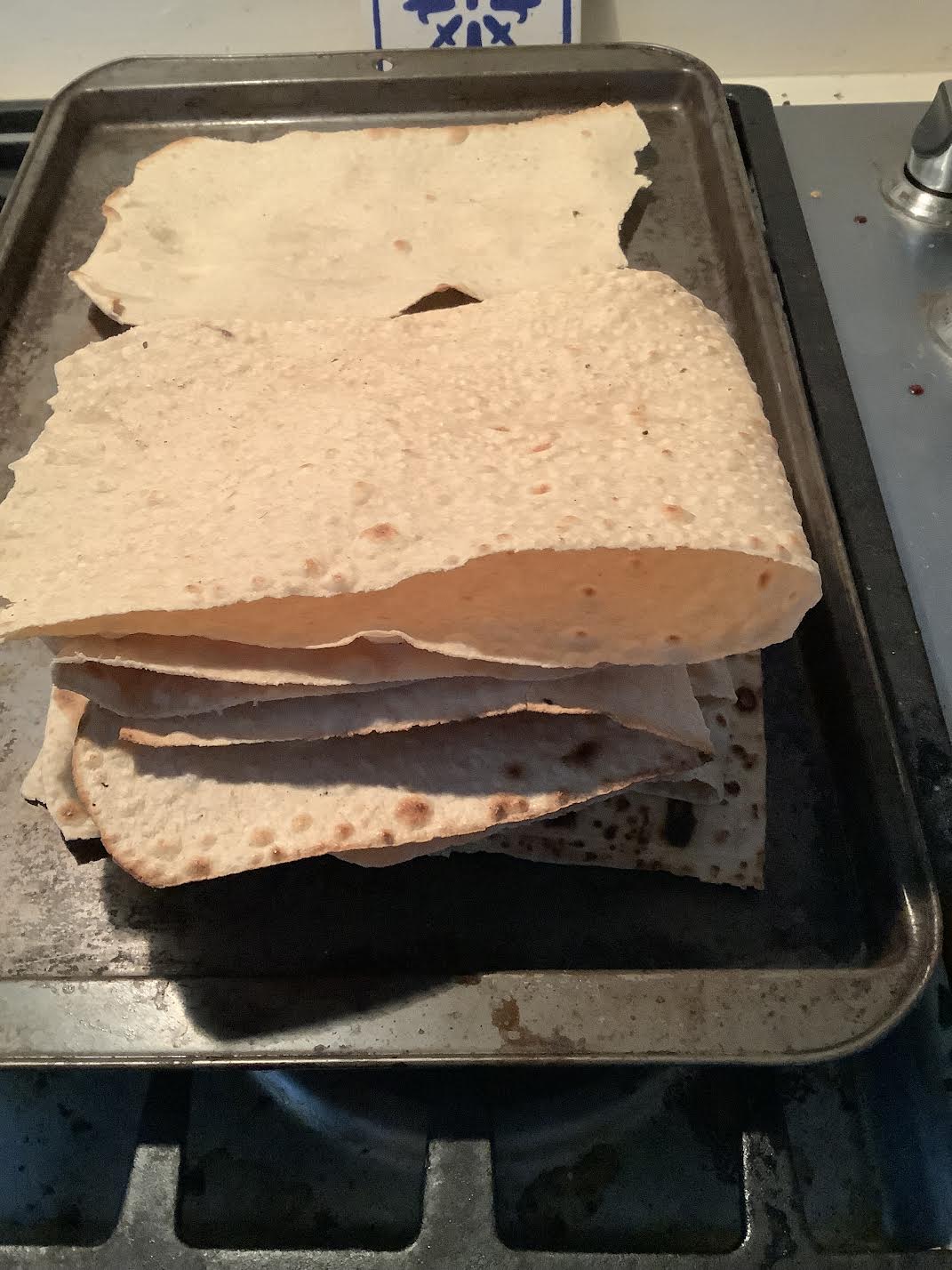
Rolled sheets of Lavash baking on the griddleBaked sheets, folded and ready to use or store.
And there you have Lavash. Roll it up with meat or cheese, spread it with hummus — you will find many ways to enjoy it.



 Eating well, with creative recipes, to follow the Fasting Lifestyle according to Michael Mosley's "Fast Diet."