
How this Fast Diet Lifestyle works: Eat these meals tomorrow, for a calorie total of less than 600. On another day this week, eat the meals from a different post, another day of eating 600 calories or less. Eat sensibly the other days of the week. That’s it: a simple way to lose weight and be healthier. Join me in the Fasting Lifestyle.
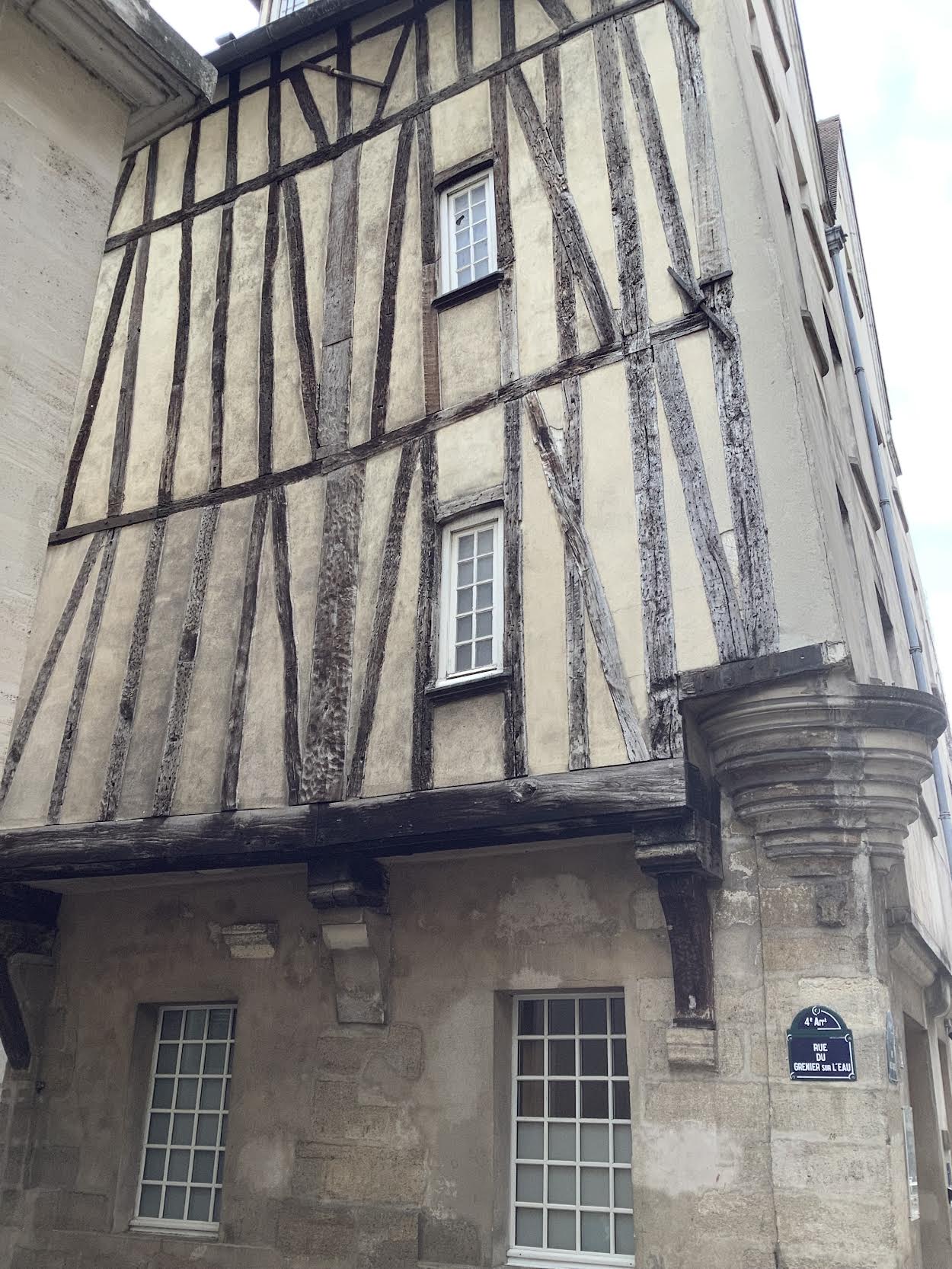
To me, one of the most picturesque styles of old northern European architecture is the ‘half-timbered’ building. These were used for houses and commercial properties from the 13th century into the 1700s. Houses in the past were made from the materials at hand. Stone was used only if you had access to a quarry. Wood was used if you had your own woodlot. Half-timbering was used when timbers was scarce. A stone foundation was laid, if possible. The house in the photo from Paris was built in the 13th century with an entire first floor of stone. Then a framework of timbers was erected, the horizontal pieces called
sablières, the vertical ones called colombes. If there were more timbers to use, then diagonal pieces were put into place. At that point, the walls were only a frame of wood with nothing between the timbers. Then the spaces were filled with hourdage, a mix of gravel, soil, straw, and possibly animal dung to glue it together. In the British Isles, this infilling was done with ‘wattle and daub‘: mats of woven willow branches covered with mud. After time to dry and firm up a bit, a layer of lime and clay called torchis was plastered on the outside and inside of the walls to seal against rain. A final touch might have been a coat of whitewash, giving the characteristic black and white look. During the reign of Henry IV in France, building with wood was outlawed for fear of fire in the crowded cities, so all future structures were made of stone. Domestic buildings in England were so frequently built in this manner from 1485 to 1588 [the reigns of the Tudor line of monarchs], that the method came to be known as ‘Tudor style’. Early houses in the Americas were not built in this way because there was abundant lumber to build either log cabins or houses with wooden walls. In the late 1800s and up to the 1930s, there was a Tudor Revival in the United States, creating a romantic Disney-fied look to the new suburbs around major cities. Whatever you call it, this distinctive look is not just to provide illustrations for cookie tins and chocolate boxes. It was the method of building that gave the rising middle class sturdy, affordable homes and business space during the Renaissance in Europe. I am always tickled to see half-timbered buildings in the old cities, a visible link to the past.
France, especially Normandy, has its share of half-timbered buildings, and our breakfast is French-inspired. England also abounds with charming village structures. Manchester City formerly had so many black and white buildings that it was called Magpie Town. Our dinner is typical of a medieval meal from England or Holland, probably served in a half-timbered house.
Bleu Cheese ScrOmelette: 220 calories… 11.5 g fat… 1 g fiber… 14.5 g protein… 2 g carbs… 129.5 mg Calcium… NB: Food values shown are for the ScrOmelette and fruit only, and do not include the optional beverages. GF PB Bleu cheese is delightful in eggs – do try it this week.
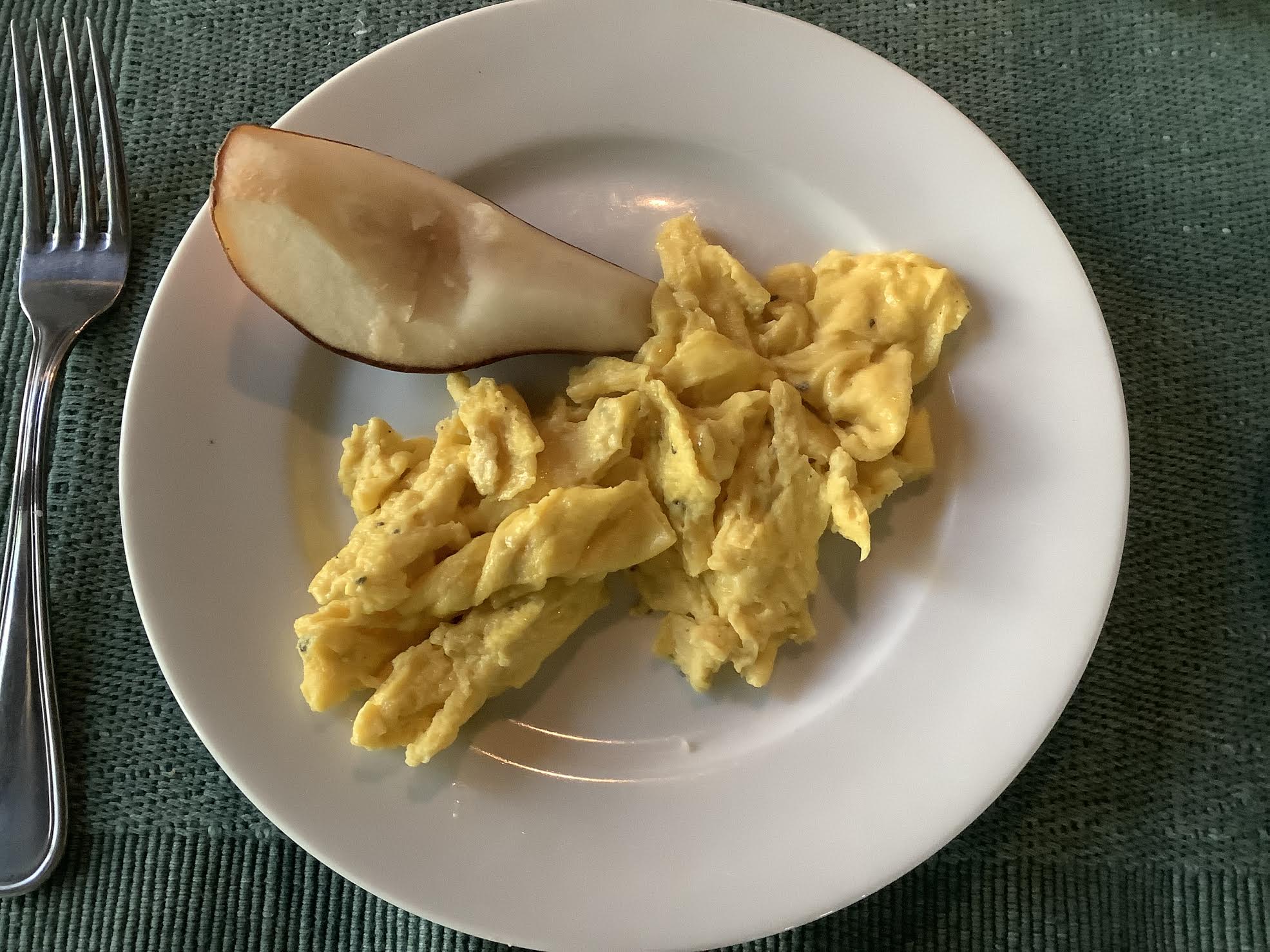
+++ 1½ two-oz eggs HINT: If you are serving one person, crack three 2-oz eggs into a small bowl or glass measuring cup. Whip up those eggs and pour half of their volume into a jar with a lid and put it in the ‘fridge for next week. +++ ½ oz bleu cheese ++++ 1 Tbsp 2%-fat cottage cheese ++++ 1.5 oz pear/1.5 oz blueberries/2 oz applesauce, unsweetened ++++ Optional: blackish coffee [53 calories] or blackish tea or mocha cafe au lait [65 calories] ++++ Optional: 5 oz fruit smoothie or berry-yogurt smoothie [88 calories] ++
Mash the cheeses together with a fork or the back of a spoon. Whisk the eggs and put into a hot pan spritzed with cooking spray. Once the bottom of the eggs are set, dab on the cheese, then scramble or fold into an omelette. Portion the fruit, prepare an optional beverage and get ready to say “Mmm-yummy!”
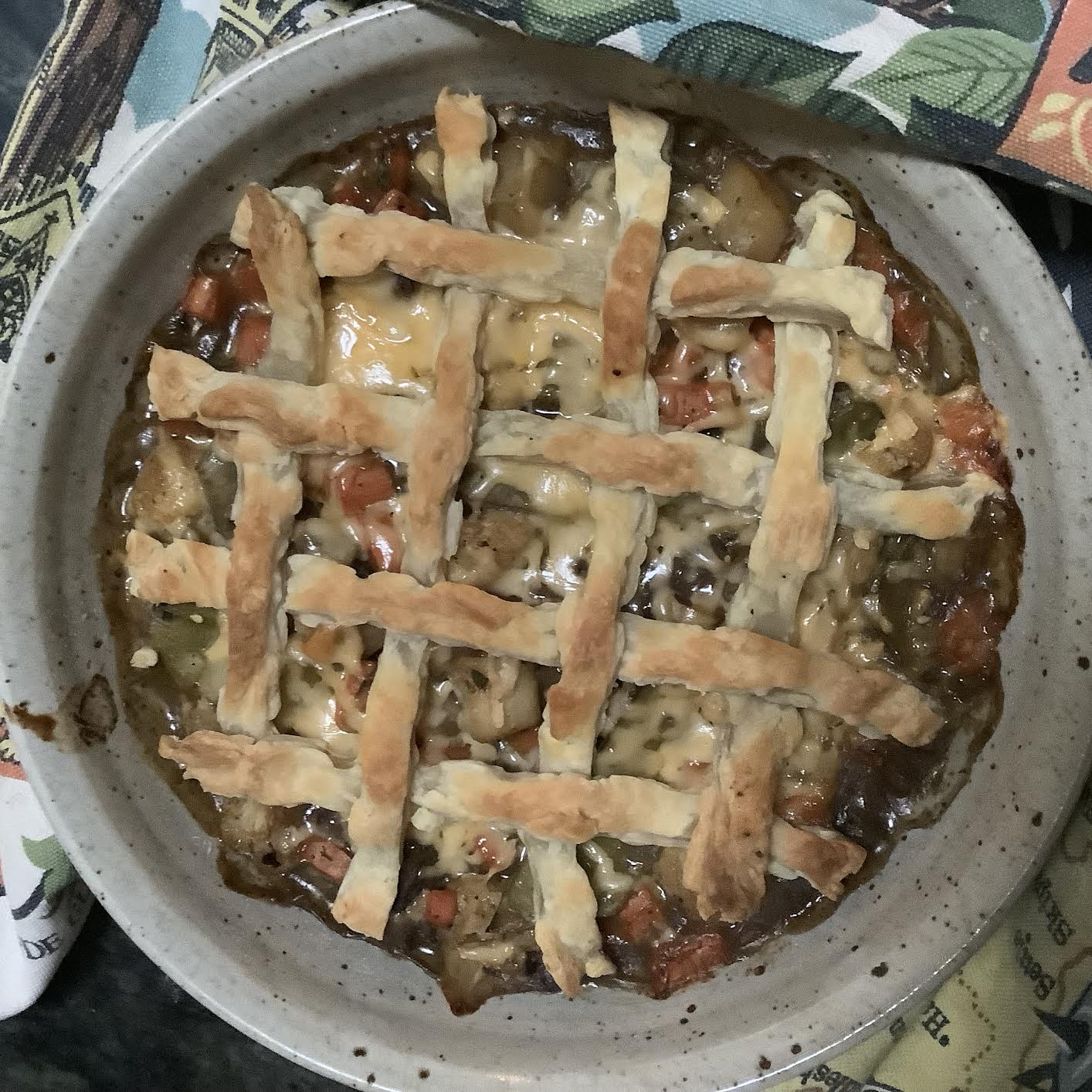
Vegetable Pie: prepared with LATTICE + cheese: 1 Serving = 236 calories… 9.4 g fat… 4.6 g fiber… 7 g protein… 44 g carbs… 115.6 mg Calcium… PB GF – if using GF puff pastry. This excellent recipe is from allrecipes.com. I removed most of the oil and half of the puff pastry, and it still tastes wonderful. The grated cheese is my addition. HINT: This recipe makes enough for 3 servings. For 2 servings, I used an 8” casserole dish.
| Sv 3: 1 Sv= 1¼ cup | Preheat oven to 425 F /220 C |
| 1 tsp oil+ 1 tsp H20—½ c onion—4 oz mushroom—1 clove garlic | Heat oil+water in a large skillet/ saucepan. Chop the vegetables and cook in oil 3-5 mins, stirring often. |
| 1 lg carrot, peeled—¼# potato, peeled—1 7” stalk celery— 1 c. cauliflower—½ c green beans—1½ c vegetable broth— 1 tsp salt—1 tsp black pepper | Dice carrots and potato. Slice celery and beans into 1” pieces. Cut cauliflower into florets. Add all vegetables to pan, then add broth. Bring to a boil, then turn heat down to a simmer. Cover and cook until vegetables are barely tender, ~5 mins. Season with salt and pepper. TIP: I added fresh thyme and rosemary, more salt and pepper, and a sprinkling of za’atar. |
| 1 Tbsp cornstarch—1 Tbsp soy sauce—2 Tbsp water—rosemary + thyme | Mix until cornstarch is completely dissolved. Stir into vegetables, and cook until sauce thickens, ~3 minutes. TIP: can prepare the meal up to this point day before. For 2 servings, remove 1¼ c and freeze for another use or make a 1-person serving. |
| 1 oz Gouda cheese, grated—½ sheet puff paste OR ¼ sheet, cut for lattice | Pour filling into a baking dish. Sprinkle with grated cheese. Roll out dough and arrange over filling. If not using lattice, cut slits to vent steam. |
| Bake until crust is brown and filling is bubbly, ~25 mins |

