People who are new to Fasting often pose the questions: “Can I really eat ‘anything I want’ on a Slow Day?” and “What should I eat on Slow Days?” To answer those questions, I have decided to add some blog posts to show some of the foods we eat on what the world calls NFDs [non-fast days] but which, in our house, we call ‘Slow Days.’ This feature will appear sporadically.
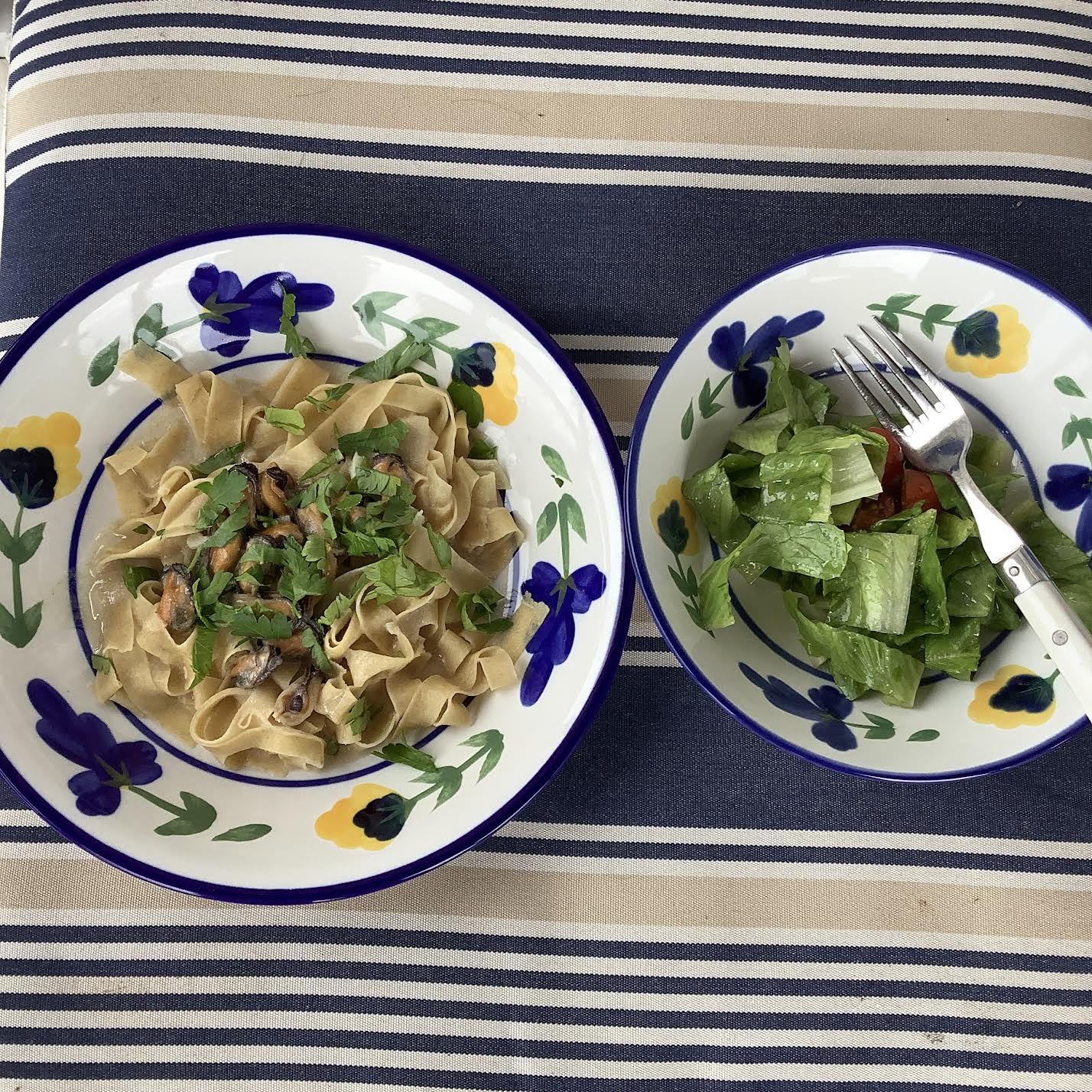
In Summertime, we eat mussels. “Rope-grown mussels” are a big industry where we vacation in PEI, Canada, and we take full advantage of them. Years ago, when we first started going to the local mussel processing plant to buy them, they sold for 50 cents/pound. Even though they are $2/pound now, they are worth it. One of our favorite ways to prepare them is a recipe from A Well-Seasoned Appetite by Molly O’Neil. You can prepare these with fresh mussels in their shells, or use cooked mussel meat that has been removed from the shells. We prefer the latter, and find it to be a good way to use left-over mussels from a previous feed. Very quick, very easy, very good.
People who are new to Fasting often pose the questions: “Can I really eat ‘anything I want’ on a Slow Day?” and “What should I eat on Slow Days?” To answer those questions, I have decided to add some blog posts to show some of the foods we eat on what the world calls NFDs [non-fast days] but which, in our house, we call ‘Slow Days.’ This feature will appear sporadically.
When our sons were young, our Summer Vacation was two weeks at Prince Edward Island in Canada. I would pack up ingredients for the meals we would eat, we would stuff our duffels with bathing suits and snorkel equipment, and off we would go to the old farm house we would always rent on a little lane that went down to the sea. It was delightful.
Early on, I discovered a new recipe: Pecan Rolls that could rise overnight and be enjoyed for the next day’s breakfast. Even better, the recipe made so many that they could be frozen and re–heated for subsequent breakfasts large enough to satisfy two growing boys. Great!! The recipe is from Great Breads by Martha Rose Shulman.
Now we have our own house on Prince Edward Island, built to resemble our former rental, but with some serious updates — like a large, well-equipped kitchen. Every Summer there, I make a batch of Pecan Rolls: some for the next breakfast, many for the freezer to feed our Summer guests. Depending on how you cut the dough, you could make 24-36 large rolls. Have fun with this one!
Mise en place: in big bowl — 2 flours, mace, salt; in smaller vessels, left to right: milk-juice-honey, yeast, pecans, egg-oil, unplumped raisins
24 huge rolls OR 32 regular
12 huge rolls OR 16 regular
1 cup raisins boiling water to cover
½ cup raisins boiling water to cover
Soak 15 mins, then drain, saving the water and raisins.
½ c cooled raisin water 1 Tbsp yeast
¼ c cooled raisin water 1.5 tsp yeast
Pour into 1-Quart bowl. Let sit a few minutes, then stir to dissolve
¾ c warm milk ½ c warm orange juice 1/3 c warm honey
1/3 c warm milk ¼ c warm orange juice 3 Tbsp warm honey
Stir into yeast solution, let stand 5-10 mins.
¼ c oil, ex: canola two 2-oz eggs
2 Tbsp oil, ex: canola one 2-oz egg
Add to the bowl and mix.
1 2/3 c white flour 2 tsp salt ½ tsp mace or nutmeg 4-5 c white whole wheat flour
½ + 1/3 c white flour 1 tsp salt ¼ tsp mace or nutmeg 2-2½ c white whole wheat flour
Combine in a large bowl.
Plumped Raisins 1 cup liquids
Plumped Raisins ½ cup liquids
Stir into dry ingredients.
1 cup liquids
½ cup liquids
Add more liquids and mix.
Remaining liquids
Remaining liquids
Add and mix. Knead and let rise 1½-2 hours.
Punch down, divide dough in half if making larger amount. Roll ½ to an 8×12” oblong.
4 Tbsp melted butter 2 Tbsp honey 1 tsp cinnamon
2 Tbsp melted butter 1 Tbsp honey ½ tsp cinnamon
Stir to combine. Divide into 2 parts, if making larger amount. Brush rolled dough with 1 part butter-honey.
1/3 cup + 1/3 cup chopped pecans
3 Tbsp chopped pecans
Sprinkle dough with 1 part nuts. With long side toward you, roll up dough, slice into 12-16 pieces. Repeat with other ½ of dough, if making larger amount.
Arrange rolls, cut side up, on buttered baking trays.
Let rise on counter 1 hour, or overnight in ‘fridge.
Bake 15-20 mins at 350F.
½ c. icing sugar or more 1 tsp orange juice or more
¼ c. icing sugar or more 1 tsp orange juice or more
Stir together icing. Slather on rolls to serve today. Cool and freeze un-iced remaining rolls in plastic bags.
Pecan Rolls, back bacon, strawberry yogurt — tastes like Summer to me!
People who are new to Fasting often pose the questions: “Can I really eat ‘anything I want’ on a Slow Day?” and “What should I eat on Slow Days?” To answer those questions, I have decided to add some blog posts to show some of the foods we eat on what the world calls NFDs [non-fast days] but which, in our house, we call ‘Slow Days.’ This feature will appear sporadically.
This recipe is from a New York Times article by Yasmin Fahr. Since we wish to add to our repetoire of whole-grain/Mediterranean Diet recipes, I thought this might be good. I like farro. Dear Husband, who is not wildly enthusiastic about my attempts to add whole grains to our diet, was indeed very enthusiastic about this meal. With almost every fork-full, we exclaimed, “Isn’t this delicious!!” We will decidedly prepare and eat this meal again. And again.
4 servings, original
2 servings, my way
Heat oven to 400F.
1 cup raw farro, rinsed 3 cups salted water
½ cup raw farro, rinsed 1½ cups salted water
Bring water to a boil. Add farro and adjust heat to keep a medium boil.
Cook uncovered, stirring a bit so it won’t stick, until tender and a bit chewy, 30 mins.
2 pts cherry tomatoes 7 oz red onion, peeled 2 T. olive oil
People who are new to Fasting often pose the questions: “Can I really eat ‘anything I want’ on a Slow Day?” and “What should I eat on Slow Days?” To answer those questions, I have decided to add some blog posts to show some of the foods we eat on what the world calls NFDs [non-fast days] but which, in our house, we call ‘Slow Days.’ This feature will appear sporadically.
Friends were going to drop by for a summer luncheon. We see them only once a year and don’t really know their eating preferences, so we opted for a ‘grazing meal.’ Call it Mezedakia if you are Greek, call it Tapas if you are Spanish, call it Small Bites if you are writing the restaurant appetizer menu. A meal like this offers flexibility and choices for the people around the table, and this assortment is very much in the Mediterranean Diet mode. One can eat as much or as little as one wants. My kind of meal!
Top Row, left to right: Gozleme Bread, Felafel patties Second Row, left to right: Cucumber-Tomato salad, Tzatziki [white, with spreading knife], black olives, cherry tomatoes, watermelon chunks Bottom Row, left to right: Carrots in lemon marinade, za’atar chicken chunks, White Beans with capers
This menu has many make-ahead components, so there is no scrambling at the last minute. And here are the preparation notes:
Gozleme Bread: make ahead
1¼ c white whole wheat flour ½ tsp salt
Mix in a 1-Qt-sized bowl.
¼ c water ¼ c plain yogurt
Combine yogurt/water and stir into the flour until well-combined. Add a bit more water if too dry.
On a floured surface, knead ~3 mins, until smooth and elastic. Cover and let sit for a few mins on the counter OR overnight in a cool place.
Roll on a floured surface into flat breads. Divide into sizes for your recipe. Cook on an oil-sprayed skillet 3-4 mins per side until turning brown in spots.
FELAFEL: makes 25 patties So convenient to have in the freezer for ‘instant’ meals.
2 cups canned chick peas [if you use dried chickpeas, you will get a grainer product. Factor in the time to reconstitute and cook them] 1.5 cloves garlic, crushed [add as much as you enjoy!] ¼ cup celery, minced ¼ c. scallions, sliced 1 two-oz egg 1½ tsp tahini ½ t. cumin ½ t. turmeric ¼ t. cayenne ¼ t. black pepper 1.5 t. salt
Combine in food processer until ingredients form a uniform paste. Scoop into a bowl and chill 1 hour. Form into balls on a silicone mat or parchment paper on a cookie sheet. I used a 1½ Tbsp scoop and then flattened the patties. TIP: You don’t have to bake them now. You could freeze the patties on a cookie sheet, then put them frozen into bags to cook later. Bake at 400F for 10-15 minutes. The patties should be heated through and have an outside ‘crust’ which is firm to the touch. In most recipes, you will cook them further. At this point you want them to be firm enough to store well. There will be about 25 of them. Use now or cool and freeze for later use.
Cucumber-Tomato Salad: make ahead What a Summer treat!
Sv 4
1 English cucumber, unpeeled
Trim off ends of cuke, halve it lengthwise. Cut into ½” dice.
10 oz grape or cherry tomatoes ½ small red onion
Dice tomatoes and red onion. Put all three veg into a bowl.
2 Tbsp olive oil 2 Tbsp red wine vinegar 1 tsp honey ½ tsp Kosher or fine sea salt ¼ tsp black pepper
Whisk these together.Pour dressing over the salad and toss gently to mix.
1 Tbsp chopped fresh parsley/dill /basil
Gently stir in the fresh herbs, if using.
Serve immediately or chill in ‘frige 1-2 hrs to let the flavors meld before serving.
Tzatziki: make ahead Thisis thetraditional Greek condiment. Very refreshing. The recipe comes from themediterraneandish.com and
2½ cups
1 English cucumber or another variety Kosher salt
Grate cucumbers whole if using English cucumbers. If using cucumbers with waxy skin, peel and cut in half before grating. Remove and discard seeds. Salt lightly.
Squeeze cucumbers in a clean cloth to remove liquid.
4-5 cloves garlic, minced 1 tsp distilled white vinegar 2 tsp extra virgin olive oil
In a big bowl, combine garlic with these and mix.
drained cucumber 2 c plain Greek yogurt Ground pepper + salt 1 Tbsp chopped fresh dill or mint
Add drained cucumber mixture to the above bowl, then add these ingredients. Stir to combine.
Chill 30 mins -2 hrs before serving with fresh veggies and pita or chips
Carrots in lemon marinade:make ahead Prepare the marinade: In a wide bowl, whisk together 1 tsp olive oil, 1 tsp lemon juice, pinch of granulated garlic, pinch oregano. Cook small carrot sticks until tender and put them into the marinade while they are still hot. Stir at whiles, as the carrots cool on the counter.
Za’atar Chicken:make ahead or grill in front of your guests to show off your skills. Serve the chicken meat in large pieces or cut into 1-inch cubes and serve on picks.
Serves 4
Serves 2
5 garlic cloves, pressed zest of 1 lemon 1/3 c yogurt ¼ c chopped fresh cilantro 3 Tbsp EVOO 1½ Tbsp za’atar 1 Tbsp chopped oregano/marjoram 1¾ tsp salt ¼ tsp ground black pepper
MARINADE – In a large bowl or container, stir together these ingredients.
2¼# boneless, skinless chicken thighs
2 thighs with legs, boned
Add chicken and toss until well coated. Cover and refrigerate for 2+ hrs or overnight.
Heat grill to medium or heat broiler with rack 3” from heat. If broiling instead of grilling, line sheet pan with foil for easier clean up. Take chicken from bowl, shaking off excess marinade, and grill/broil on one side until charred in spots, 5-8 mins. Flip, grill/broil 5-8 mins, until just cooked through.
White Beans with capers:make ahead Drain and rinse canned beans, such as navy or cannellini/white kidney. Stir in 1 Tbsp capers for every cup of beans, along with a pinch or two of salt. Let sit at room temperature to marry the flavors.
People who are new to Fasting often pose the questions: “Can I really eat ‘anything I want’ on a Slow Day?” and “What should I eat on Slow Days?” To answer those questions, I have decided to add some blog posts to show some of the foods we eat on what the world calls NFDs [non-fast days] but which, in our house, we call ‘Slow Days.’
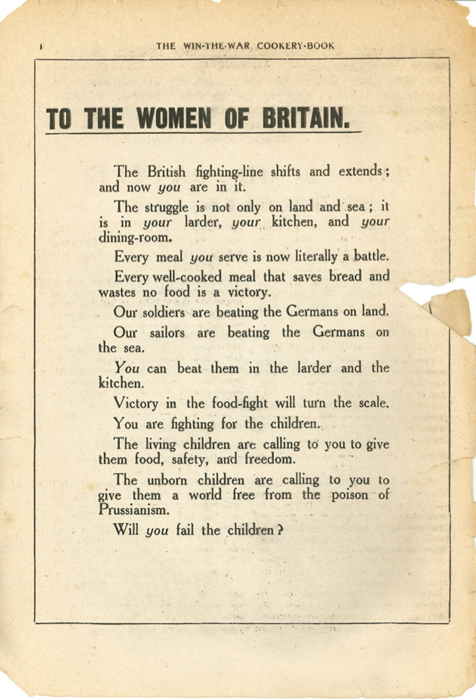
During World War 1 and World War II, the people on the home front in Great Britain, Canada, and the US shared in the war effort. They donated metal to make munitions, they saved cooking fat and sent it to use as a lubricant for machinery. And most of all, they endured years of food scarcity since food was diverted to the troops. At home, eggs, butter, sugar, cheese, and meat were rationed. Each household received a ration card which was taken to the store to determine how you could shop. Each week, the grocer would dole out the commodities needed to run a home kitchen, and it was not enough. Here was the weekly rations per adult in Canada:
sugar: one cup (the average Canadian eats twice that much today)
butter: four ounces (one-quarter pound)
tea: two ounces, or coffee: eight ounces (because these items came from other countries)
meat: 24-32 ounces (less than five ounces per day)
beer, spirits and wine were also rationed, the amount varying between provinces [PEI still had total Prohibition until 1947]
Cooks became creative. No butter? Lard would substitute in baked goods. No milk? Water or tea might suffice. No sugar? Try molasses. No eggs? Oh bother.
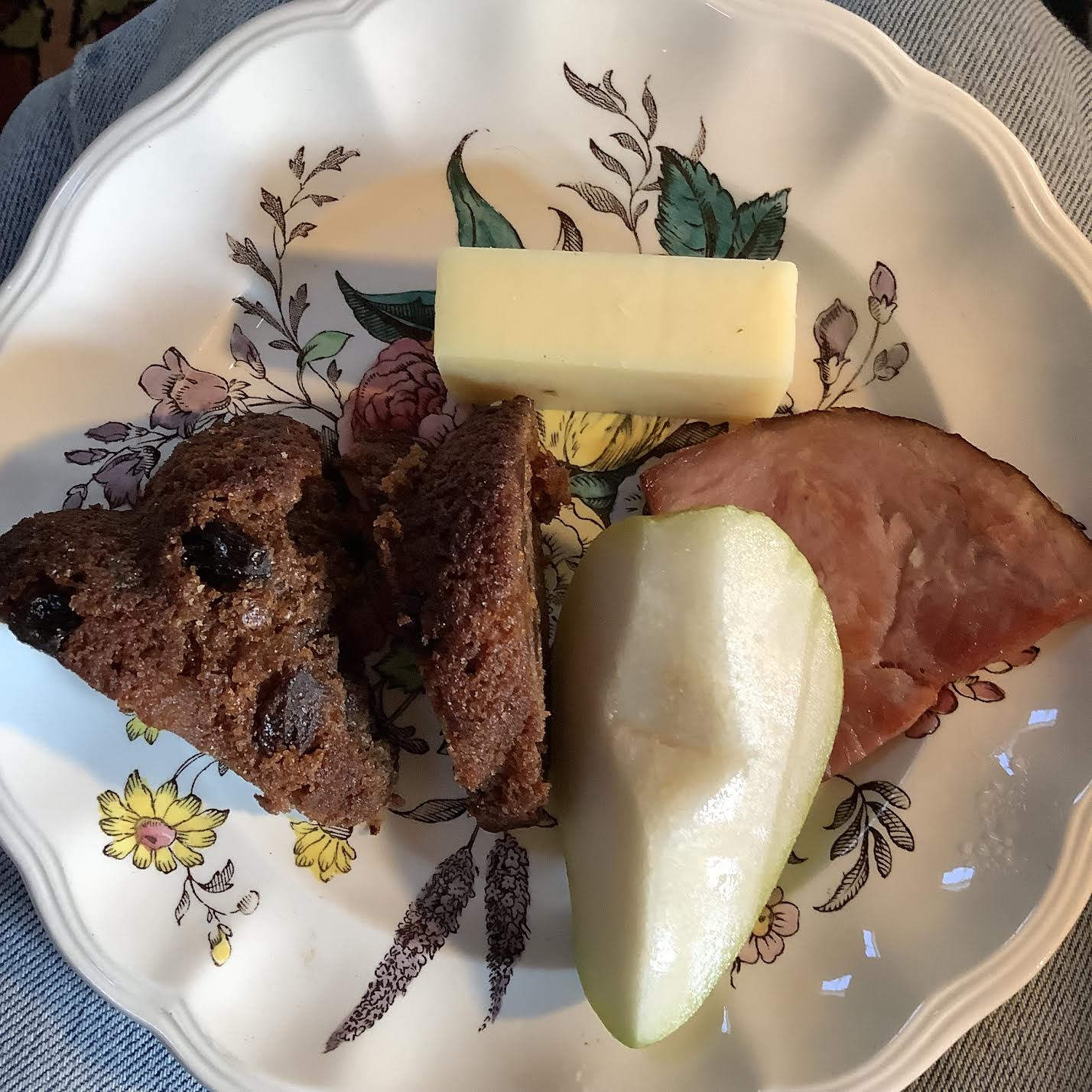
From those privations came ‘War Cake,’ a special bake to make a family celebration more festive in trying times. A housewife had to plan ahead for it, saving out a bit of sugar for weeks before baking. This recipe is from Maritime Canada, where it was often served at Christmas, and still is in some families. In the baking division at the Dundas Plowing Contest in PEI, one category is ‘war cake.’ So I tried this last year and it was a winner — literally and figuratively. It won 1st Prize and has been popular when served to friends and family.
12 servings, 1 cake
Preheat oven to 325 F/165 C. Grease and flour a tube/loaf/Bundt pan.
1 c water/herbal tea 1 c raisins + dried apricots 1/2 c light molasses 1/3 c/5 Tbsp sugar 1/3 c lard
If using dried apricots, dice them. Or use all raisins. Bring these to a boil in a saucepan. Reduce heat to low, and simmer until raisins are plump, ~5 minutes. Let cool, but not so much that the lard solidifies.
1.5 c white whole wheat flour 1/2 tsp baking soda 1.5 tsp cinnamon
Whisk together in a bowl.
Stir flour mixture into raisin mixture until well combined. Pour into prepared baking pan.
Bake until a toothpick inserted near center comes out clean, ~1 hour, less if baked in tube pan.
Serve with slices of Cheddar Cheese and a cup of tea. Splendid for breakfast, elevenses, tea time, or dessert. Enjoy a taste of the past.
People who are new to Fasting often pose the questions: “Can I really eat ‘anything I want’ on a Slow Day?” and “What should I eat on Slow Days?” To answer those questions, I have decided to add some blog posts to show some of the foods we eat on what the world calls NFDs [non-fast days] but which, in our house, we call ‘Slow Days.’ This feature will appear sporadically.
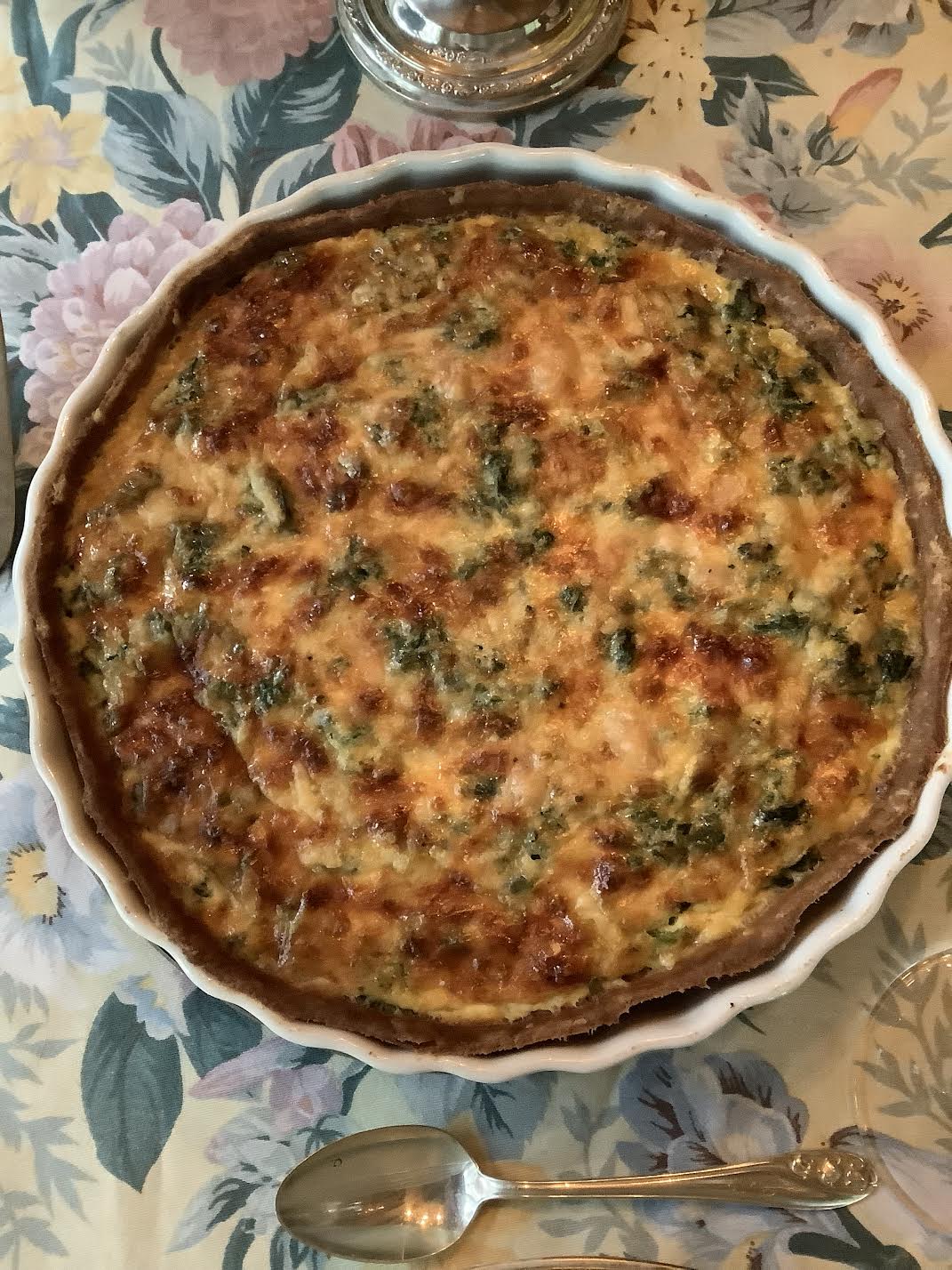
Early May is the mid-way point between the Vernal Equinox [start of Spring in the Northern Hemisphere] and the Summer Solstice [start of Summer in the Northern Hemisphere] — so why not have a special meal? Floral-themed, of course. And since the coronation of King Charles III occasioned much discussion of the Coronation Quiche, that would be the main course. Although I tried to stick to the original recipe, some changes had to be made: 1] No lard to be found, so I prepared the crust using all butter. 2] The amount of milk given was insufficient to moisten the crust ingredients, so I added more, once tablespoon at a time, followed by more water until it was right. 3] In the UK, a ‘large’ egg is larger than a US ‘large’ egg. So I provided the weight of the egg so you will have sufficient liquid in the quiche. 4] I recommend using Half&Half or Blend Cream instead of Heavy/Whipping/Double cream. Same result, less saturated fat. 5] The original recipe has the white beans tossed in whole. I mashed them so the texture would be more creamy. 6] The original recipe does not tell the cook to squeeze the excess liquid from the cooked spinach. This is a necessary step, so I included it. 7] After baking the quiche for the recommended 20-25 minutes, it was not quite set in the center and the top was colorless. I cooked it 10 minutes longer and it turned out very well. 8] Cheese type was unspecified, so I emphasized the upstart colonies and used American and Irish Cheddars. I would definitely prepare this again.
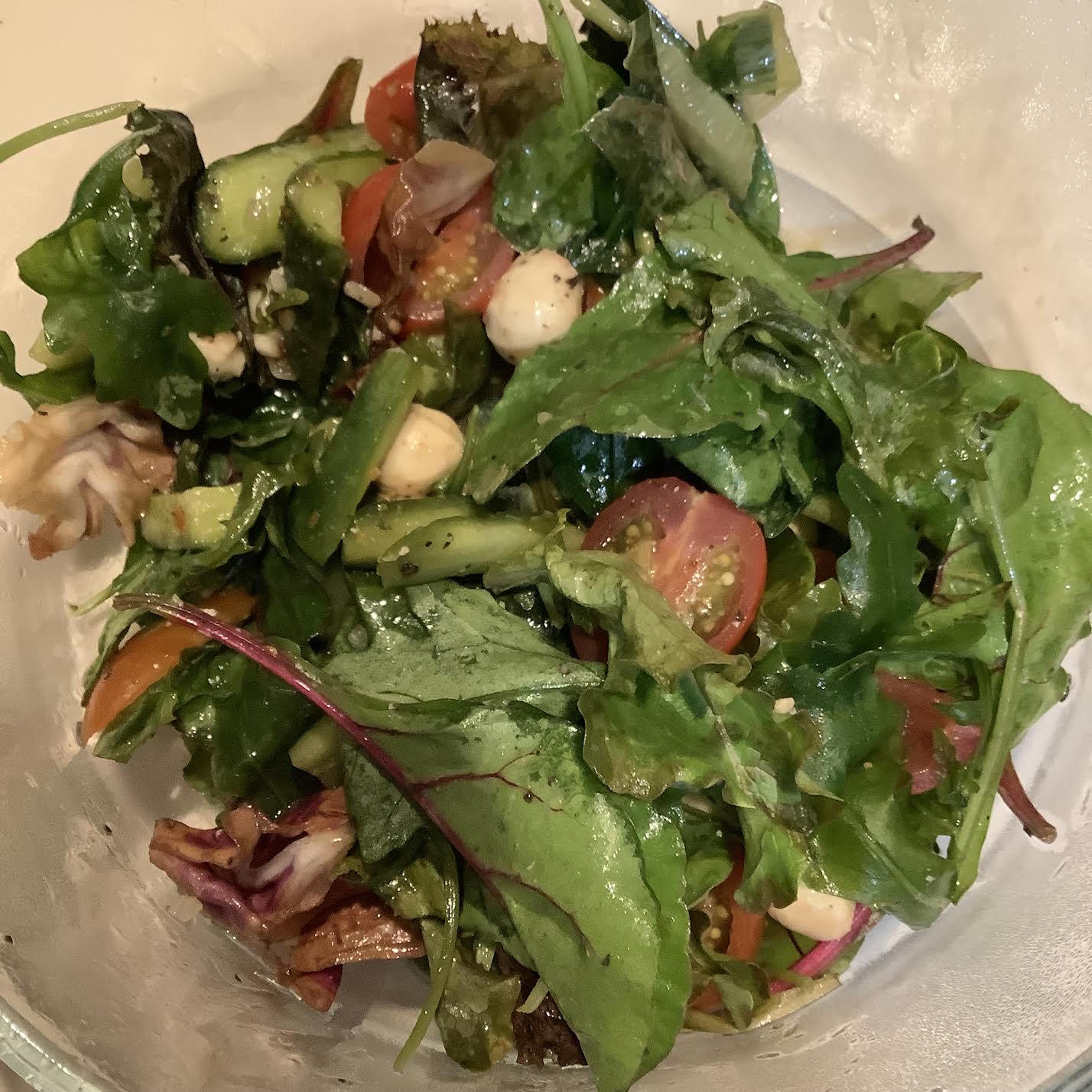
The quiche was delicious!Add a hearty, healthy salad made with Spring Greens and asparagus.
125g white whole wheat flour Pinch salt 50g cold butter, diced
Sift flour + salt into a bowl. Add fats and rub mixture together with finger tips until you get a sandy, bread crumb-like texture.
2 Tbsp milk OR use 250g of ready-made shortcrust pastry
5 Tbsp milk + water
Add milk a bit at a time to bring ingredients together into a ball. Cover, rest in fridge 30-45 mins. Or overnight
On a lightly floured surface, roll pastry to a circle ~5mm thick, a bit larger than tin.
Line pan with pastry, mending any holes. Cover, rest 30 mins in fridge.
Preheat oven to 190°C./375F
OR MAKE A CRUSTLESS QUICHE
Line pastry with parchement + baking weights. Bake 15 mins. Remove paper, weights.
Loweroven to 160°C./320F
125 ml milk 175 ml double/heavy cream two large UK eggs Salt and pepper
125 ml milk 175 ml half + half two 2.7-oz eggs Salt and pepper
Whisk together these ingredients, without making it frothy..
60g canned white beans
30g canned white beans
Puree or mash, add to egg mixture.
180g cooked spinach 1 Tbsp fresh tarragon
180g cooked spinach 1 Tbsp fresh tarragon
Squeeze spinach, roughly chop it along with tarragon.
50 g grated cheese
50 g grated Cheddar I used Irish Cheddar here
Scatter cheese on pie crust, top with spinach, then pour egg-bean mixture evenly over all.
50 g cheese
50 g Cheddar cheese I used Vermont Cheddar here
Sprinkle with cheese. Bake 20-35 mins until lightly golden, set — might take 10 mins more
1 of 6 Sv: 229 calories 18.6 g fat 0.8 g fiber 10 g protein 3.6 g carbs 208 mg Calcium CRUST 1/6: 134 calories 8.2 g fat 2.7 g fiber 2.7 g protein 14 g carbs 2.6 mg Calcium
FILLING 1 of 6 Servings: 166 calories 11.4 g fat 0.8 g fiber 10.4 g protein 6 g carbs 220 mg Calcium
ALL BUTTER CRUST 1/6: 127 calories 7.4 g fat 2.7 g fiber 2.7 g protein 14 g carbs 3.6 mg Calcium
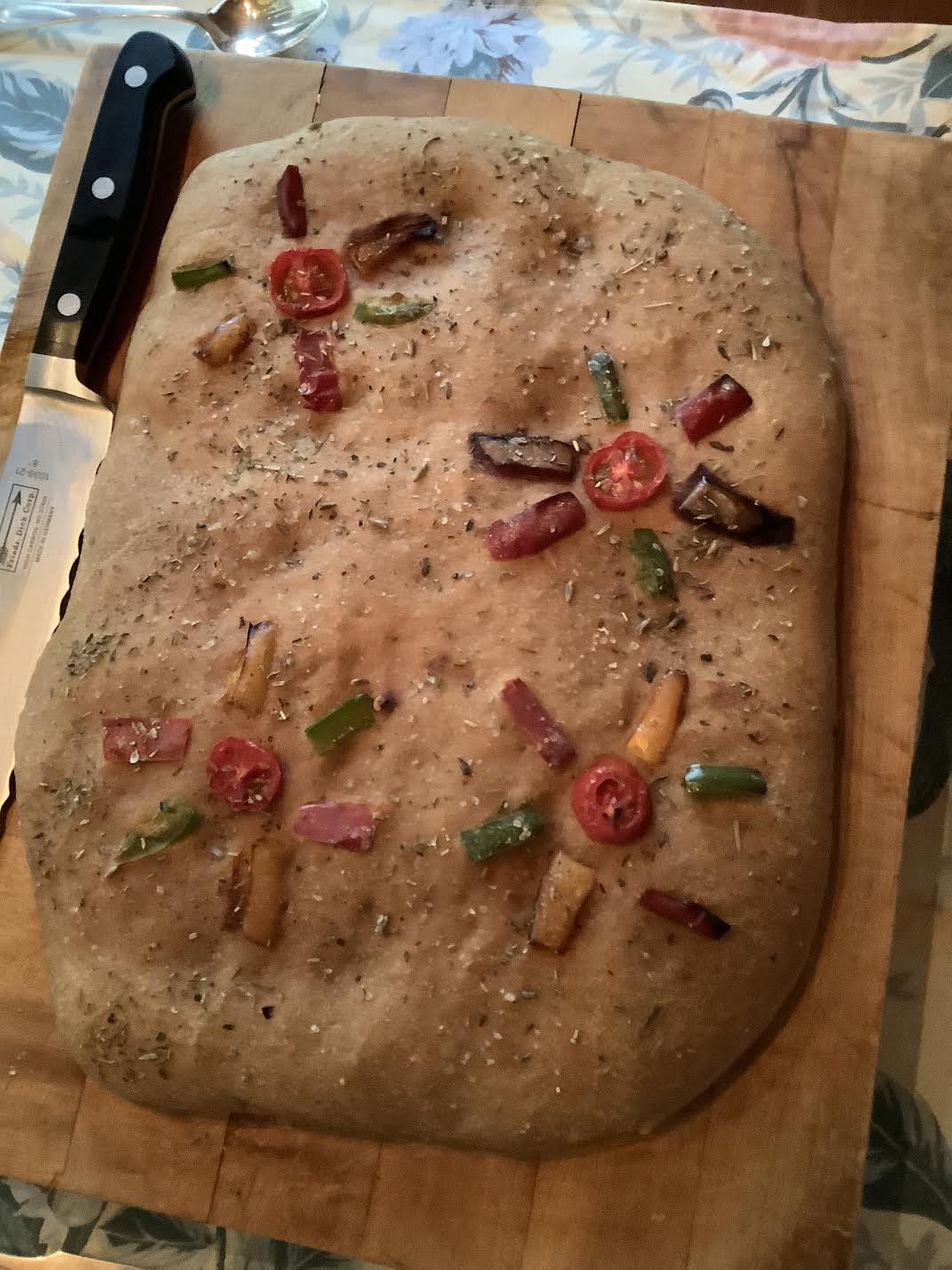
To emphasize the floral theme of the meal, an Artistic Foccacio with vegetable flowers and a Panna Cotta for dessert, topped with a drizzle of Dandelion Jelly and decked with Candied Violets.
The dessert recipe is from Epicurious.com. I am very fond of make-ahead desserts.
makes 6 ramekins or 8 mini-Mason jars
Lightly spray six ¾-cup ramekins or custard cups with nonstick spray or 8 mini-Mason jars with lids
2 tablespoons water 1½ tsp unflavored gelatin
Pour water into small bowl; sprinkle gelatin over. Let stand until gelatin softens, ~10 mins.
1 cup whipping cream 1 teaspoon finely grated lemon peel ½ cup sugar
Heat these in medium saucepan over med-high heat, stirring constantly until sugar dissolves.
Increase heat and bring just to low boil, stirring occasionally. Do not over-heat the mixture!
Add gelatin mixture, take off heat. Stir until gelatin dissolves.
Pour into a bowl. Cool mixture to lukewarm, stirring often.
2 cups buttermilk 2 teaspoons vanilla extract
Stir in these. Divide mixture among ramekins. Refrigerate panna cotta until set, ~4 hours or overnight.
People who are new to Fasting often pose the questions: “Can I really eat ‘anything I want’ on a Slow Day?” and “What should I eat on Slow Days?” To answer those questions, I have decided to add some blog posts to show some of the foods we eat on what the world calls NFDs [non-fast days] but which, in our house, we call ‘Slow Days.’ This feature will appear sporadically.
One day, I got to thinking about making Lavash, an ancient flatbread from Armenia and the surrounding region. Actually, I was thinking about making pita bread, but I’d done that once and was not pleased with the result, so why not do something new, like Lavash? The modern version of this flexible breadstuff is marketed as a ‘wrap.’ Son #1 said that he had made it, which encouraged me to try. Some recipes these days are yeasted, but I wanted to get to the original style. Vera Abitbol @ 196flavors.com is the source of this recipe. Lavash is one of the many ‘flatbreads’ of Asia, the main requirement being that it could be prepared quickly [no yeast to proof and rise] and could be cooked on flat rocks by the campfire. Thus it became a bread for bands of hunters, nomadic herders, and soldiers.
The story is told of an Armenian king who was kept alive by lavash and a clever ploy. King Nebuchadnezzar wanted to conquer neighboring Armenia. In one battle, the Armenian King Aram was captured by his enemy. Game over? Not yet: the Assyrian king wanted to toy with his captive before a final blow. King Aram was to be starved for 10 days before meeting his rival in an archery contest. If Nebuchadnezzar won, Aram would be murdered and his nation forfeit. If Aram won, he would go free and his kingdom would be saved. Aram asked that his near-by army would bring him his most beautiful shield to prepare him for the competition. Sure, said Nebuchadnezzar, why not? When the message was received by the Armenians, they were perplexed — why take a shield to an archery test? Then they guessed that there was a hidden meaning to the request: send. me. bread. So they baked a batch of Lavash, smoothed the thin, flexible strips of bread to the underside of the shield, and delivered it to their king. For the next nine days, the Armenian king ‘peevishly’ demanded a new shield, and thus he was supplied with sustenance instead of starving. On the day of the contest, King Aram won at archery and Armenia was saved. By Lavash bread!
LAVASH Vera Abitbol @ 196flavors.com Makes 16 lavash sheets
Griddle or wide skillet or baking sheets
2 c white whole wheat flour 1 c white flour
Add flour to bowl of a stand mixer with a paddle attachment. Make a well in center of flours.
½ tsp salt 1 c. warm water (95 F/36˚C)
Put salt in well. Knead at medium speed, adding water gradually. Dough will be soft, homogeneous, and come off walls of bowl.
Cover bowl with plastic wrap. Let rest in a warm place 30 mins.
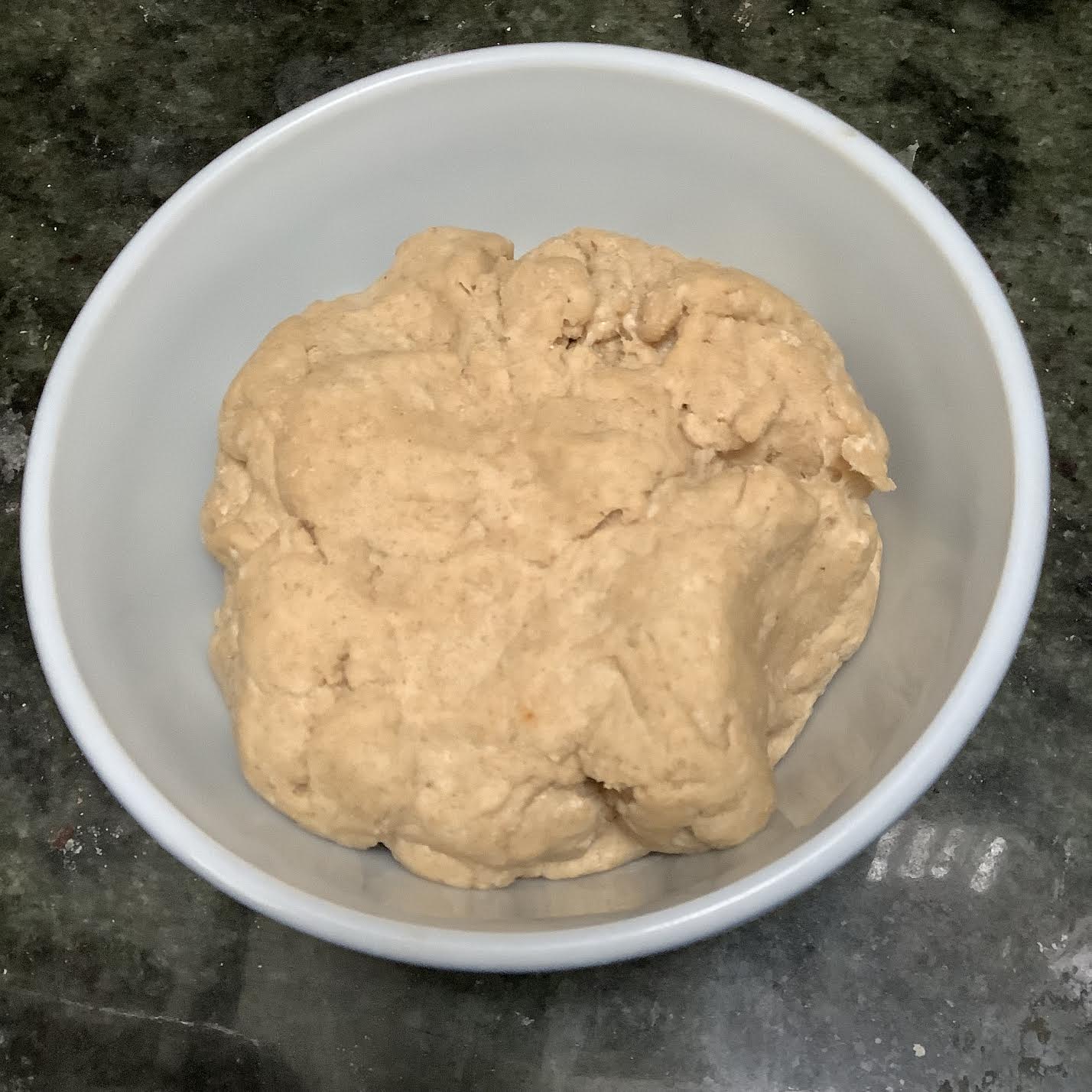
Dough is resting in a small bowl before rolling.
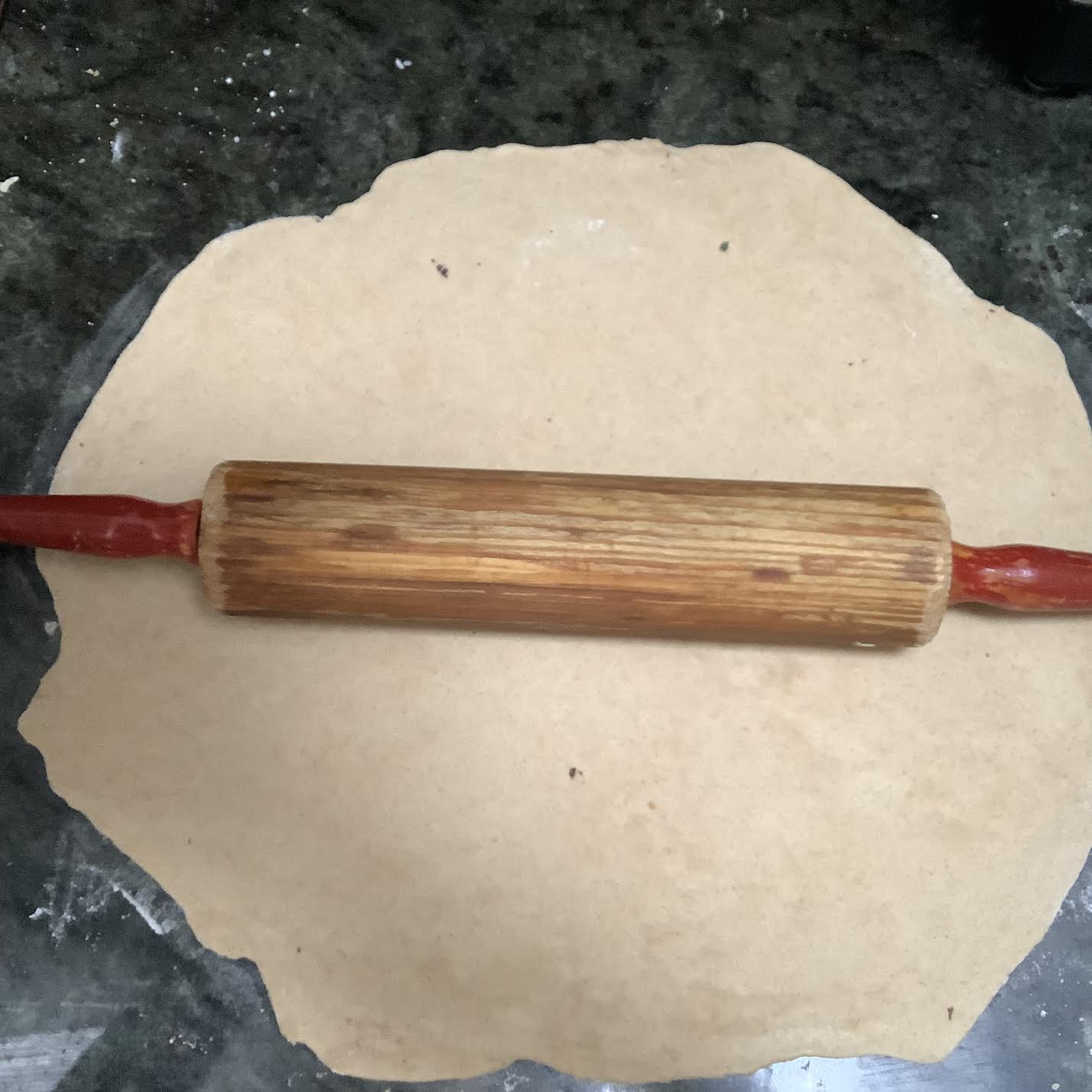
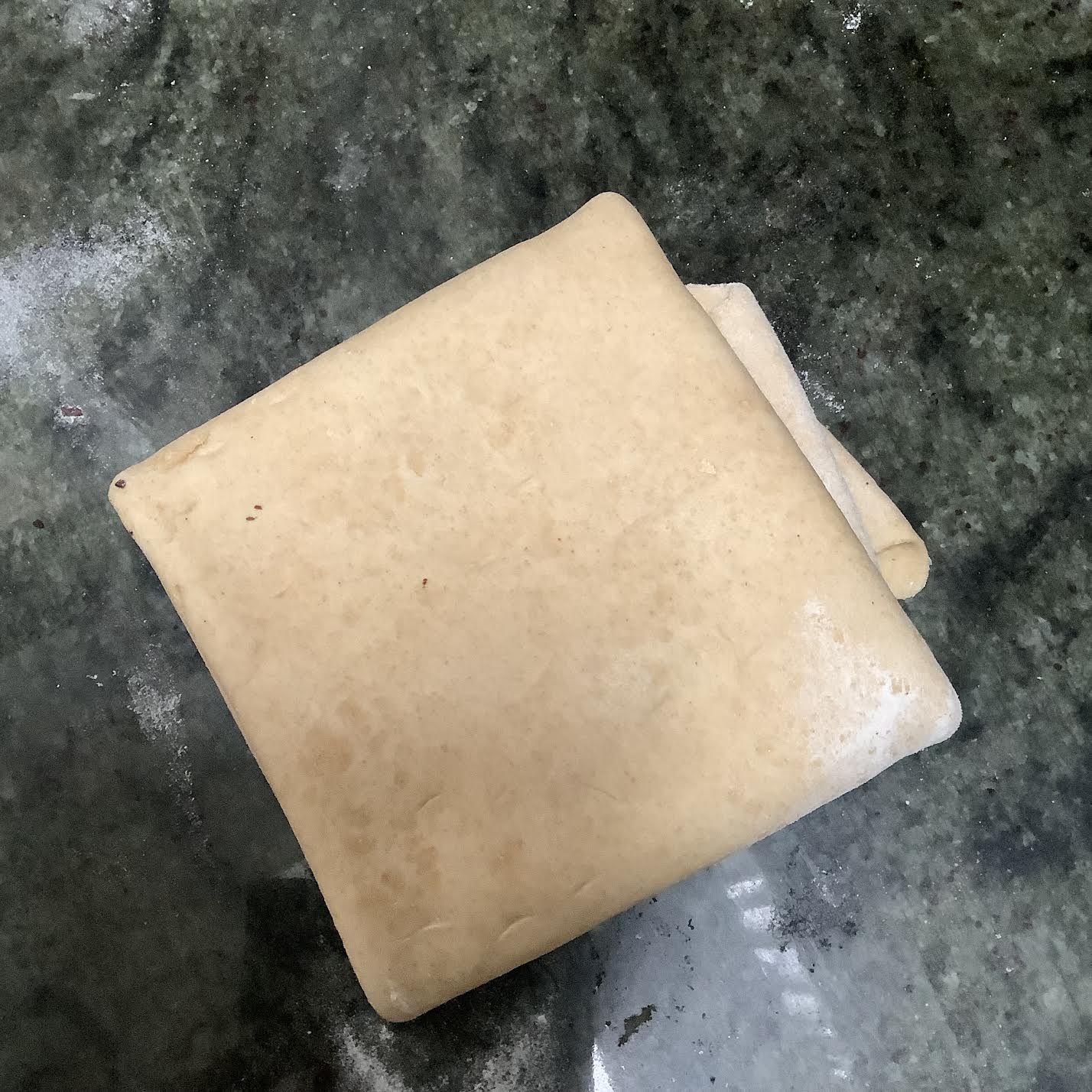
Roll dough thinly on a lightly floured surface. Fold sides in to make 4 layers. Let rest 30 mins in a warm place.
Cut dough in two pieces. Roll and fold each piece 4x to make dough elastic. Preheat oven 30 mins to 430F/220˚C OR heat griddle
As the above directions say, you are now to roll and fold each piece of the dough four times. The goal is to make the dough thinner and more pliable with every turn. While this is supposed to be done with a rolling pin, it struck me as being similar to the process of rolling pasta dough — the successive rolling works the dough into thin, even strips. so I got out the pasta machine, cut the dough into pieces the correct width and ran them through. I started at the thickest setting, then went by steps to the thinnest setting. The dough became smooth, silky, elastic, and cohesive.
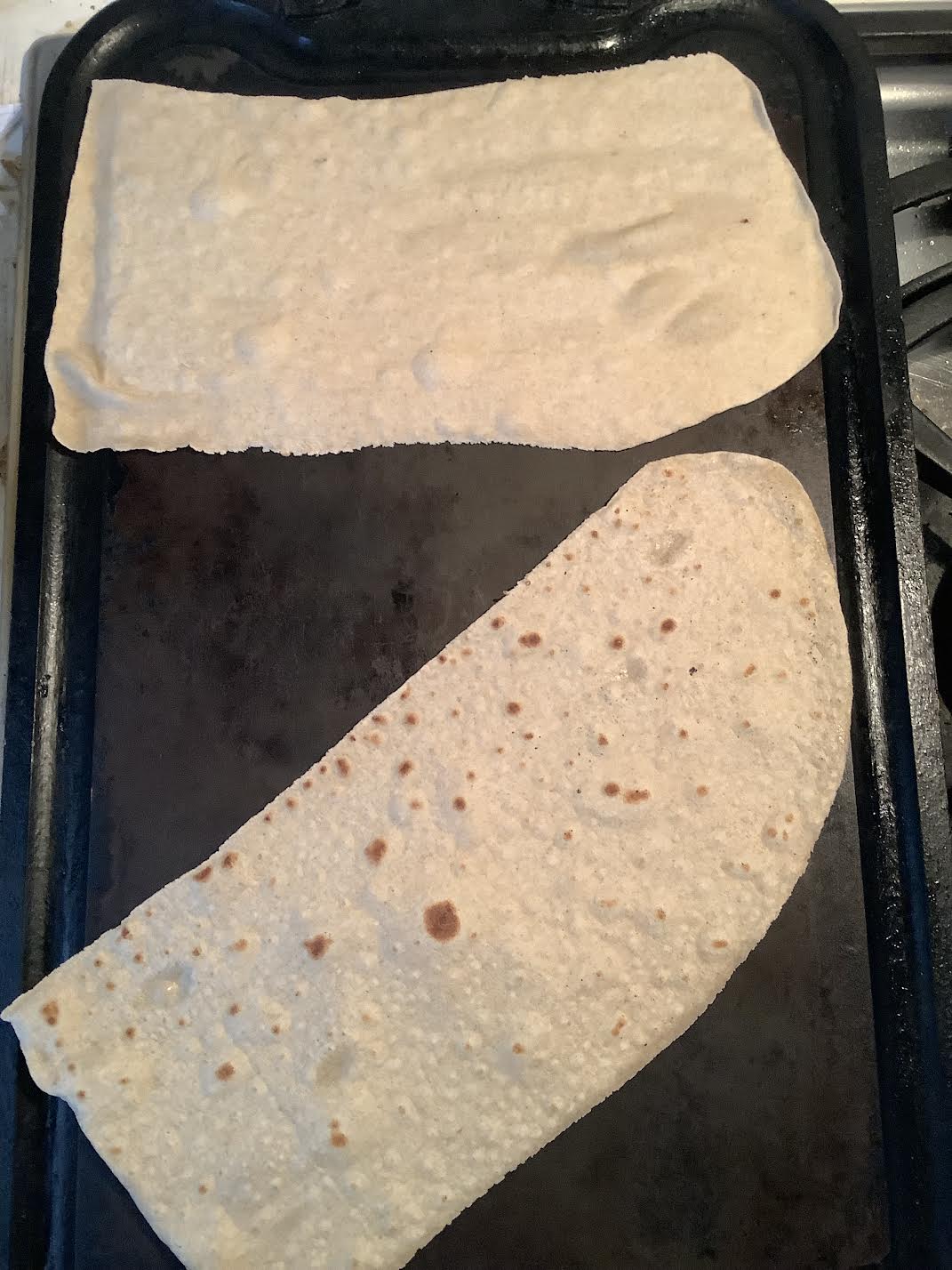
Divide dough into 4 pieces. Roll out to 1/16”/1.5mm thick. OR pass through pasta machine to setting 6 or 7. Put dough one at a time on very hot pan and cook ~1 min per side
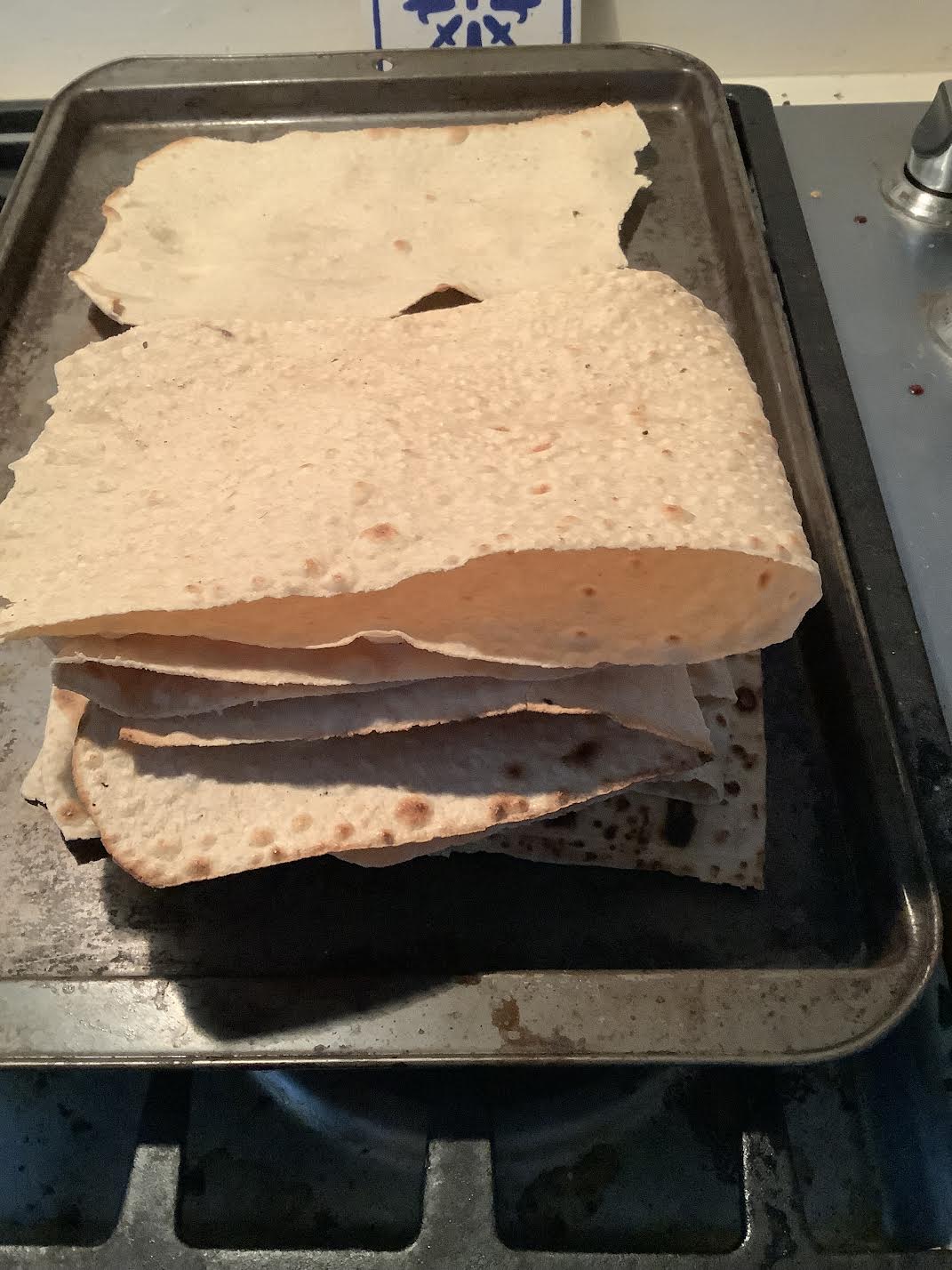
Rolled sheets of Lavash baking on the griddleBaked sheets, folded and ready to use or store.
And there you have Lavash. Roll it up with meat or cheese, spread it with hummus — you will find many ways to enjoy it.
People who are new to Fasting often pose the questions: “Can I really eat ‘anything I want’ on a Slow Day?” and “What should I eat on Slow Days?” To answer those questions, I have decided to add some blog posts to show some of the foods we eat on what the world calls NFDs [non-fast days] but which, in our house, we call ‘Slow Days.’ This feature will appear sporadically.
Saint Patrick’s Day is an occasion that demands to be celebrated with special foods. No, not green beer. No, it doesn’t have to be Corned Beef & Cabbage. Look in most common cook books [James Beard, Fannie Farmer, Joy of Cooking, et alia] for ‘Irish Stew’ and you will find that it is made of lamb. Thus lamb, even better, lamb stew is appropriate for March 17th. When young Patrick was enslaved in Ireland, he worked as a shepherd — so there’s another reason to celebrate good Patrick with lamb. Most recipes are really plain and basic: cubed raw lamb, cubed potatoes, sliced onions, water, salt. We tried many of those recipes, and although they are surely authentic, they are just plain DULL.
How happy we were to find this recipe in the book Salute to Healthy Cooking by the French Culinary Institute! We prepare a large batch periodically, and serve it twice a year: on St Patrick’s Day in March and also in December during the run-up to Christmas. Lamb has much symbolic significance to Christians, so serving it during Lent and Advent makes sense to us.
Lamb Stew for twocan double or triple!
Need: saute pan + Dutch oven with lid + non-stick pan
½ pound boneless lamb shoulder, cubed cooking spray salt + pepper
Sear lamb cubes on all sides in a heavy pan spritzed with non-stick spray or oil. Cook meat in batches so pan doesn’t cool. Put cooked meat in a Dutch oven, sprinkle with salt and pepper.
½ cup onions, chopped
Put onions in saute pan and cook until tranluscent with enough water to make them sizzle .
1 oz dry red wine
Deglaze pan with wine, stirring up brown bits.
Heat the oven to 350 F.
¾ tsp white whole wheat flour water ½ Tbsp tomato paste
Sprinkle deglazed pan with flour and stir. Add to lamb in Dutch oven. Add enough cold water to go to top of the lamb but not cover it. Stir in tomato paste.
1 tsp thyme 1 bay leaf
Add herbs. Heat to a simmer over medium heat. Cover casserole and put in oven. Bake 1 hour, making sure stew is not boiling.
¾ c. carrots, cut in 2” batons
Add carrots, cover pan, bake 15 minutes.
½ cup cubed potatoes
Add potatoes, cover pan, bake 45 minutes. Remove bay leaf.
Salt + pepper
Add salt and pepper. Take off heat and cover until vegetables are cooked.
6 pearl onions, trimmed and peeled 1 cup/5 oz turnips, in 2” batons water ½ tsp sugar 1 tsp butter
Put vegetables in a small non-stick pan with sugar and butter. Add enough water to cover the vegetables half-way up. Simmer 10 minutes, uncovered, shaking pan occasionally.
Plate stew with the glazed vegetables.
Here is the stew in all its glory, served with an individual Soda Bread from Friend Ann.
And while you are doing your Irish thing, the best item to go with Irish Stew is Irish Soda Bread. I usually prepare a batch in the morning, so we can enjoy them for breakfast. Then the remaining ones are served at dinner with the stew. The recipe that I use is based on the Fannie Farmer Cookbook, with a few tweaks.
Makes 12 individual biscuits or 1 large loaf
Preheat oven to 400F. Buttered cookie sheet.
1 cup white flour 1 cup white whole wheat flour 1 tsp baking powder ½ tsp baking soda ½ tsp salt 1 Tbsp sugar 3 Tbsp butter
Cut the ingredients together, using two knives or a pastry blender. Purists would do it with their fingers. Non-purists might blitz this in a food processor.
½ – 1 cup raisins [black or golden] or currants 1 Tbsp caraway seed
Stir these into the dry mixture.
¾ cup buttermilk or soured milk – all of the milk may not be needed, or you might need more
Add milk bit by bit, stiring with a fork, until the dough is moistened and forms a ball.
For 12 individual biscuits
Roll/pat out dough on a lightly floured surface. Cut with a 2” or 3” round cutter. Use a knife to mark an ‘X’ on top of each.
For one large loaf
Gather the dough into a single ball, and flatten slightly. Use a knife to incise an ‘X’ on the top.
Bake at 400F 10-15 mins or 20 mins for large loaf
A portion of Irish Stew with a fruited slice of Soda Bread loaf.
People who are new to Fasting often pose the questions: “Can I really eat ‘anything I want’ on a Slow Day?” and “What should I eat on Slow Days?” To answer those questions, I have decided to add some blog posts to show some of the foods we eat on what the world calls NFDs [non-fast days] but which, in our house, we call ‘Slow Days.’ This feature will appear sporadically.
In the depths of winter, when snow is deep on the ground in the North, lemons are ripening in warmer climes. How cheery they look! How fresh they taste! Lemon-growing spread around the Mediterranean Sea by 1000 CE. Berbers brought their cultivation to Spain, then when Spain took over the Netherlands in the 1500s, lemons went with them to Northern Europe. Eventually, lemons and limes were prized as sources of Vitamin C to prevent scurvy in the winter, when fresh vegetables were scarce. Have you tried Lemon Ricotta Pancakes? They are bright and light in flavor, and are perfect for a February breakfast. If you have left-over pancakes, freeze them. The recipe is from Geneveve Ko, writing in the New York Times.
8-10 pancakes
Heat a griddle or large nonstick pan or well-seasoned cast-iron skillet over medium-low.
33 g/3 Tbsp sugar zest ½ lemon or 1 tsp Lemon Juice 1 tsp vanilla
Put these in a large bowl and whisk to combine.
2 eggs
Add eggs and whisk until foamy.
½ c lower-fat ricotta 3 Tbsp yogurt/buttermilk 20 g butter
Melt butter. Add these to the bowl, and whisk until well blended.
½ c/52 g white whole wheat flour 1 tsp baking powder ½ tsp salt
Add dry ingredients and gently stir until no traces of flour remain.
Optional: drop blueberries on the batter as pancakes cook
Butter griddle. Use a ¼ cup measure to portion batter onto it. Cook 3 mins on each side until golden brown.
Blueberry Maple Syrup or other toppings chicken breakfast sausage
Serve warm, with blueberry syrup and chicken sausages.
People who are new to Fasting often pose the questions: “Can I really eat ‘anything I want’ on a Slow Day?” and “What should I eat on Slow Days?” To answer those questions, I have decided to add some blog posts to show some of the foods we eat on what the world calls NFDs [non-fast days] but which, in our house, we call ‘Slow Days.’ This feature will appear sporadically.
Every Saturday we enjoy pizza for dinner. Not store-bought, not delivered, but home-made. Mostly, we will prepare the red-sauce-mozzarella type, and we vary the toppings week to week. But once in a while, I suggest a “Greek” pizza. This variety was developed by a Greek immigrant who ran a pizzeria in New London, Connecticut in the 1950s. Since then, Greek Pizza has been popular in New England and eastern New York. Very regional. [I’m not going to get in the middle of which culture really invented pizza — I’d rather just eat it.] My version is based on reading many recipes, taking out the best bits, and putting them together in this recipe.
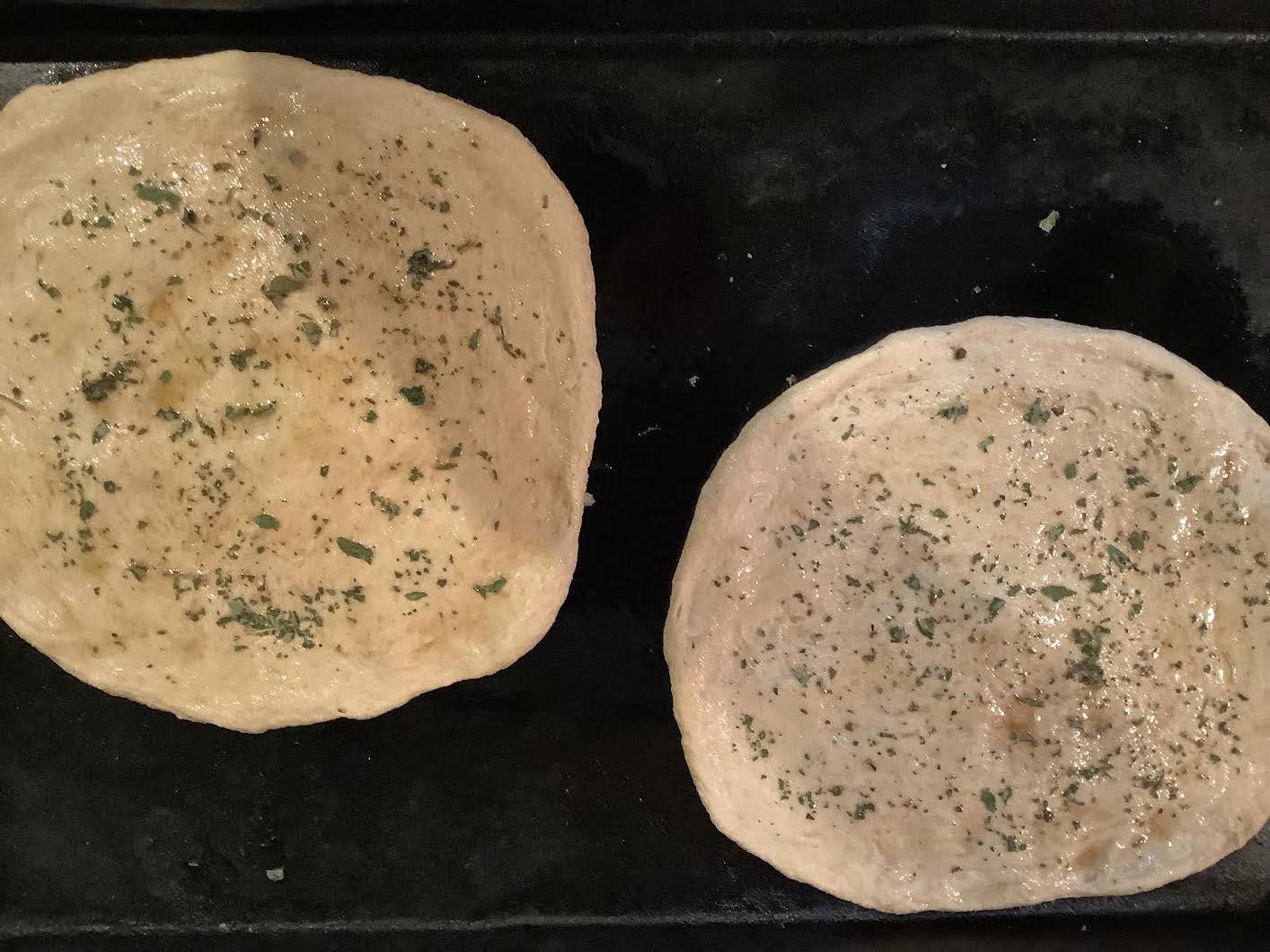
You will need two whole wheat pizza crusts, each 8″ in diameter. This takes [about 6 ounces of dough for each crust] Pat the crusts out on an oiled baking sheet. Preheat oven to 490F.
Salad Dressing makes 7 Tbsp dressing 1/4 cup virgin olive oil 1.5 Tbsp red wine vinegar 1.5 Tbsp lemon juice large pinch oregano Shake together in a small jar with a lid. Brush each crust with 1 Tbsp of dressing. Save the rest for the salad.
Pizza Topping enough for 2 pizza shells thaw or cook 5 oz spinach. Squeeze it in your hands to expel extra liquid. 3/4 cup shredded mozzarella 1/2 tsp garlic powder pinch ground nutmeg pinch crushed red pepper. Toss lightly to combine, and divide between the pizzas.
8″ dough rounds, brushed with salad dressingPizzas topped and ready for the oven.Baked and plated with a salad.
Garnish for each pie: 3/4 cup feta cheese, crumbled 3 black olives, pitted and cut in half or quartered 2-3 cherry tomatoes, halved
Bake at 490F for 4 minutes on an oiled baking sheet on the upper of two oven racks. After the first part of baking, remove the pizzas from the baking sheet and move them to the bottom rack with no pan under them. This bakes the bottom of the pizza nicely. Bake 3-4 minutes longer, until the cheeses melt. Serve with a salad of greens which are tossed with the same salad dressing above. Try this pizza some time — I think you will enjoy it.








 Eating well, with creative recipes, to follow the Fasting Lifestyle according to Michael Mosley's "Fast Diet."