Comparing Plans: MIND Diet

How this Fast Diet Lifestyle works: Eat these meals tomorrow, for a calorie total of less than 600. On another day this week, eat the meals from a different post, another day of eating 600 calories or less. Eat sensibly the other days of the week. That’s it. Simple way to lose weight and be healthier.

Paleo and Keto diets are all the rage, but it seems to me that the MIND Diet should be better-known. It was developed in 2015 at Rush University Medical Center in Chicago from two widely-regarded diets: the Mediterranean Diet and the DASH Diet. The name is a real smash-up: Mediterranean-DASH Intervention for Neurodegenerative Delay. As that implies, the diet has genuine benefits for those who wish to forestall neurodegenerative disorders such as Alzheimer’s and Parkinson’s Disease. Furthermore, although it is not an eating plan aimed at weight-loss/body health, it could help to lower cholesterol and weight. Since Dr Mosley recommends a Mediterranean Diet for Slow Days, it is remarkably easy to merge this with a Fasting Diet. Dear Husband and I tried it out, designing a month-long plan of eating, and were glad to see how easy it was to follow. According to a study of 900+ seniors, those who followed the plan religiously reduced their risk of Alzheimer’s Disease by 53%. Those were less punctilious, still reduced their risk by 35%. Those are great numbers. I’m up for that. The chart below shows how nicely the MIND and FAST play together.

Is this food allowed on this diet…MINDOn Fast Days
Fatty Animal protein: beef, lamb, porkNo Yes
Lean Animal protein: chicken, turkey8 oz/weekYes, preferred
Eggs Yes Yes 
Beer, wine, cocktails5 oz red wine dailyOnly on Slow Days
Grains: brown rice, whole wheat pasta, whole cereal Yes Yes, in moderation
Nuts + seeds3 oz/week Yes, in moderation
Beans, legumes: peas, kidney beans, lentils, chickpeas4 oz/week Yes 
Seafood protein8 oz/week or moreYes 
Tropical fruitslimitedYes 
BerriesYes, often Yes 
Leafy green vegetables: spinach, chard, kale, lettuce1 oz/day or moreYes 
Cheese No Some 
Vegetable oils: olive, canolaYes Yes, in moderation
Animal fat: butterNo Yes, on Slow Days
Root vegetables: beets, sweet potatoes, carrotsYes Yes 
Other vegetables: onions, tomatoes, peppersYes Yes 
Higher fatNo No 
Colorful vegetablesYes Yes 
Higher fiberYes Yes
Daily Carb intakeunmeteredKeep it low
Complex carbohydrates: whole grains 3oz/day Yes
Simple carbs: cookies, pastries, cakeNoNot on Fast Day
16:8 intermittant fasting recommendedYesYes 
Number of days per week to follow the regimin 7 of 72 of 7
Do calories matter?No Yes, 600 on Fast Days
source: https://health.usnews.com/best-diet/mind-diet

Our meals today draw from ingredients that hew to the guidelines of the MIND Diet: whole-grain bread and a brightly-colored vegetable for breakfast, followed by beans with leafy greens for dinner. The soup also makes for a fine lunch, which is another time to eat your healthy ingredients.

Bruschetta Toast: 210 calories 12 g fat 4 g fiber 9.5 g protein 20 g carbs [12 g Complex] 56 mg Calcium  PB  This one was a serendipidous invention and it turned out to be yummy.

1 slice whole-grain seedy bread [Dave’s Killer Bread is great] one 2-oz egg 3 Tbsp Bruschetta sauce  – strain it if too liquidy 1 oz pear  Optional: blackish coffee [53 calories] or blackish tea or mocha cafe au lait [65 calories] or lemon in hot water 

Toast the bread lightly and pan-fry or poach the egg. Spread 2 Tbsp of the bruschetta on the toast and top with the egg. Dollop the remaining bruschetta on the egg. Plate the fruit. Eat with knife and fork or with your hands. A taste sensation.

Bruschetta Sauce: makes 2 cups 1 cup= 285 calories 28.5 g fat 3 g fiber 2 g protein 10 g carbs 2 mg Ca
½ pound plum tomatoes
3-4 Tbsp extra-virgin olive oil
1 clove garlic + 1 scallion
½ tsp crushed red pepper flakes + ½ tsp salt
1 tsp fresh oregano, chopped
1 tsp fresh tarragon, chopped
2 Tbsp fresh basil, chopped
1 tsp fresh marjoram, chopped
Core and quarter the tomatoes. Peel and crush the garlic.
Slice the scallion. Put all of these ingredients into a food processor and pulse off and on to make a chunky sauce.
½ pound plum tomatoes Core and quarter the tomatoes. Add to the above and pulse a few more times.
1 Tbsp balsamic vinegar
1½ teaspoons red wine vinegar
Pour the tomato-herb mixture into a bowl and stir in the vinegars.
This is the sauce that I mentioned in SlowDays: Bruschetta https://wordpress.com/post/fastingme.com/14162

Three-Bean Soup:  241 calories 3 g fat 29 g fiber 16 g protein 39 g carbs [32 g Complex] 134 mg Calcium  PB GF   A cold evening and a bowl of bean soup – so satisfying and delicious. HINT: This recipe produces 11 cups of soup. One serving = one cup A fine way to use up some of those beans that you hoarded when the Pandemic began.

1 cup dry navy beans** 1 cup dry kidney beans** 1 cup dry soldier beans** 2 Tbsp salt + water to cover beans 4 oz ham bone or ham hock, with some meat 1 cup onion, chopped 28 oz crushed tomatoes 1 tsp chili powder 1 tsp dried basil 3 Tbsp lemon juice + salt + pepper to taste per serving: 1/2 cup baby spinach leaves cut as chiffonade **Any combination of beans will do. Add other types of beans or pulses, such as lentils, to create a 5-10 bean soup.

Rinse the beans in a collander under running water. Put them into a large bowl or cook pot and cover with 3-4” of water. The beans will double or triple in size as they absorb the water. Add salt and let the beans sit overnight. Next day, drain the water and discard. Put the beans in a large cook pot along with 1½ quarts water and the meaty bone. Bring to a boil, then turn down to a simmer and cover. Let cook slowly for 2 hours. Add the onion, tomatoes, and flavorings. Fish out the ham bone and cut the meat from it. Dice the meat, add back to the pot, and simmer slowly for one hour. Serve with ½ cup fresh baby spinach leaves stirred into the hot soup in each serving bowl at the last minute.

Ingredients for next week: Breakfast, single portion for Monday ……………………………………………… single portion for Thursday:

1 two-oz egg + lots of fresh herbs1 two-oz egg, hard-boiled 
Crushed tomatoes + low-fat cottage cheese1 slice whole-grain dark bread @ 70 calories
anchovy + cooked chicken meatchicken dinner sausage
pear2 prunes + onion
Optional smoothie
optional hot beverageoptional hot beverage

Dinner, single portion for Monday: ………………….. ……………… single portion for Thursday:

quail/pheasant + rabbit liver + peascabbage + onion + rutabaga/turnip
Dijon mustard + fresh cranberries + eggcarrot + parsnip + dry green lentils
rich broth + turkey + onion + wild boarpork loin + frozen spinach + fresh spinach
mace + carrot + Arnold Sandwich Thin [100 calories]mace + dry mustard + caraway seed
Sparkling waterSparkling water

Slow Days: Fastnachts

People who are new to Fasting often pose the questions: “Can I really eat ‘anything I want’ on a Slow Day?” and “What should I eat on Slow Days?” To answer those questions, I have decided to add some blog posts to show some of the foods we eat on what the world calls NFDs [non-fast days] but which, in our house, we call ‘Slow Days.’ This feature will appear sporadically. 

Now for the answers. Can you really eat ANYTHING you want on a Slow Day? Not really. If you eat too many calories every Slow Day, you will not lose weight. There are many questions asked on the FastDiet Forum which attest to that. Once in a while you can splurge, as long as it isn’t everyday. For what to eat on Slow Days, Dr. Mosley recommends a Mediterranean Diet. As for how we eat, an example follows.

In England, it is Shrove Tuesday. In N’Orleans, it is Mardi Gras. In Brazil, it is Carneval. In Poland, it is Pączki Day. But in Germany and “Pennsylvania Dutch Country”, it is Fastnacht Day. When I was a child, my mother [who’s distant ancestors were French/Swiss/German but who was raised in South Central Pennsylvania] often made doughnuts with us on the last Tuesday before Ash Wednesday, “To use up all the eggs and fat in the house before the start of Lent.” Of course, we still had lots of butter-sugar-Crisco-eggs in the house, so it was more a cultural food tradition. Dear Husband’s father came from a very German family: half of his grandparents were born in Bavaria, where the day is called Fasching. Dear Husband remembers that his father used to fry Fastnachts for breakfast the day before Lent began. I am delighted to have Dear Husband’s grandmother’s recipe for “Fastnacht Kuchen,” as written out by one of her daughters.

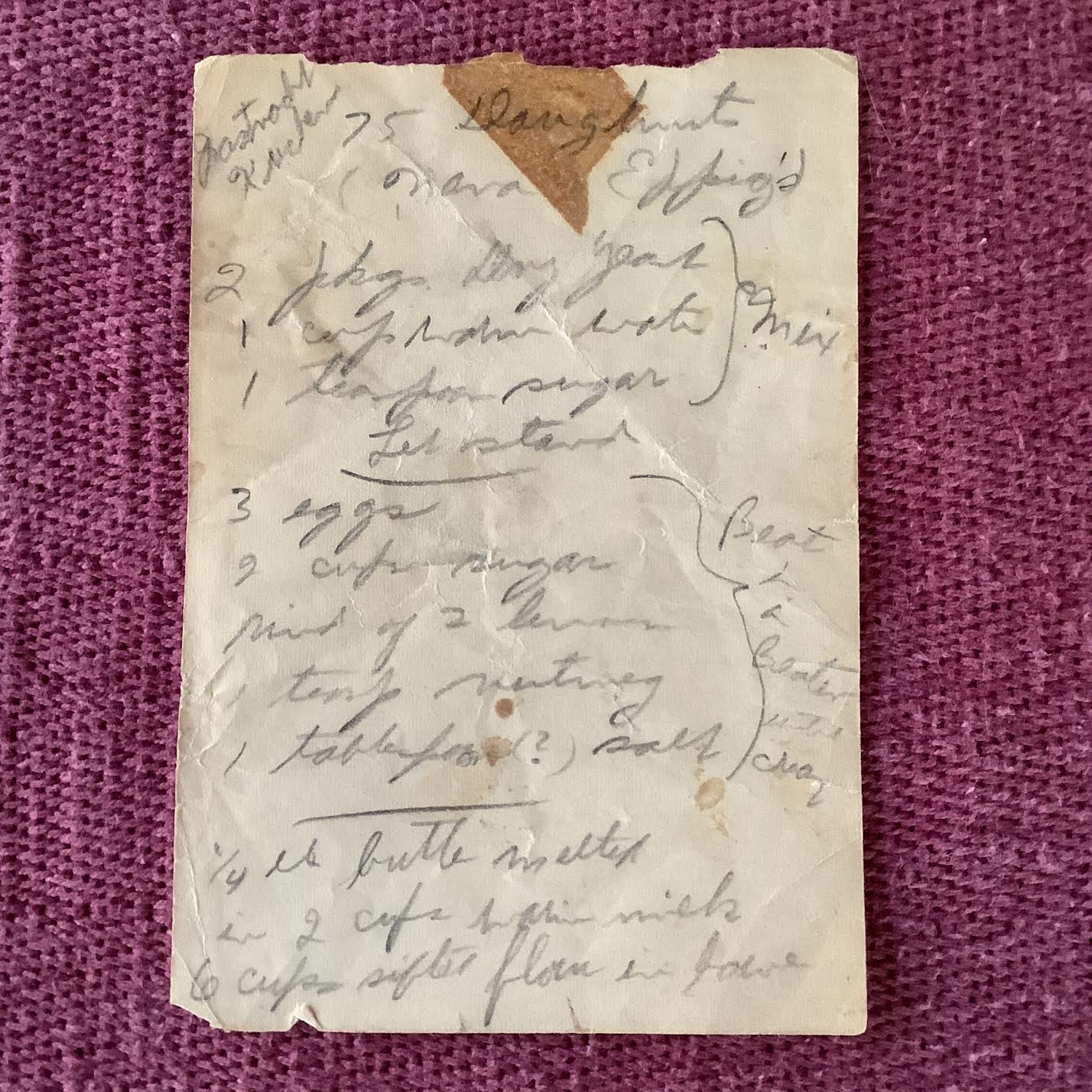
Here is Nana’s recipe, written out by her daughter Josephine.

After struggling with the recipe for years without success [compounded by the fact that I’m lousy at deep-fat frying], I developed my own method while still using the original ingredients and proportions. A major change: mine are baked, not deep fat fried. Dear Husband loves them.

ORIGINAL RECIPE
Makes 75
Original directions MY VERSION makes 10 Here’s how I do it.
1 cup warm water
1 tsp sugar
2 pkg dry yeast
“Mix” 3 Tbsp warm water
pinch sugar
¾ tsp yeast
Start before noon the day before you want to serve them. Combine and let stand until yeast is bubbly.
Three 2-oz eggs
2 cup sugar
rind of 2 lemons
1 tsp nutmeg
1 Tbsp salt
“Beat together with a beater until ___[can’t read]____” 1 oz beaten egg
1/3 c sugar
2 tsp lemon zest  
2 pinches nutmeg
½ tsp salt
Stir together these ingredients in a medium-sized bowl, then add the yeast mixture.
Combine well with a hand-held electric mixer.
¼ pound butter
2 cup milk
“Melt the butter in 2 cups warm milk.” 3 Tbsp butter
1/3 cup milk
Heat milk to scalding and melt butter in it. Let cool to lukewarm.
6 cups sifted flour“In a bowl. Add alternately until mixed well. Let stand overnight in a warm place.”  ½ c white whole wheat flour
¾ c all-purpose flour
Place the flour in a bowl and add the egg mixture and the butter mixture alternately to the flour. Stir to combine well. Let rise, covered, 6 hours in a warm place. Do the next step in the evening.
More flour for kneading
Lard for frying
“Flour waxed paper and knead 2 Tbsp at a time. Cut out doughnuts**. Let rise 2 hours. Fry in lard.” [last word underlined twice!]   More flour for kneading The dough is very sticky. Kneading alone will fix that, trying not to add much flour. Knead on a buttered or lightly-floured board until it can be handled and will hold its shape but is not stiff. Form into balls [non-traditional] or squares with a slit in the middle [traditional] and put in the refrigerator overnight. [**Not supposed to be doughnut-shaped] 
Melted lard for brushing 
Icing sugar
Heat oven to 425 F. Grease a baking sheet with melted lard. Brush the Fastnachts with melted lard and bake 10+ minutes. Shake icing sugar on top and serve warm. They freeze well.

Ready for breakfast, complete with Mardi Gras beads

Slow Days: Chicken Chasseur

People who are new to Fasting often pose the questions: “Can I really eat ‘anything I want’ on a Slow Day?” and “What should I eat on Slow Days?” To answer those questions, I have decided to add some blog posts to show some of the foods we eat on what the world calls NFDs [non-fast days] but which, in our house, we call ‘Slow Days.’ This feature will appear sporadically. 

Now for the answers. Can you really eat ANYTHING you want on a Slow Day? Not really. If you eat too many calories every Slow Day, you will not lose weight. There are many questions asked on the FastDiet Forum which attest to that. Once in a while you can splurge, as long as it isn’t everyday. For what to eat on Slow Days, Dr. Mosley recommends a Mediterranean Diet. As for how we eat, an example follows.

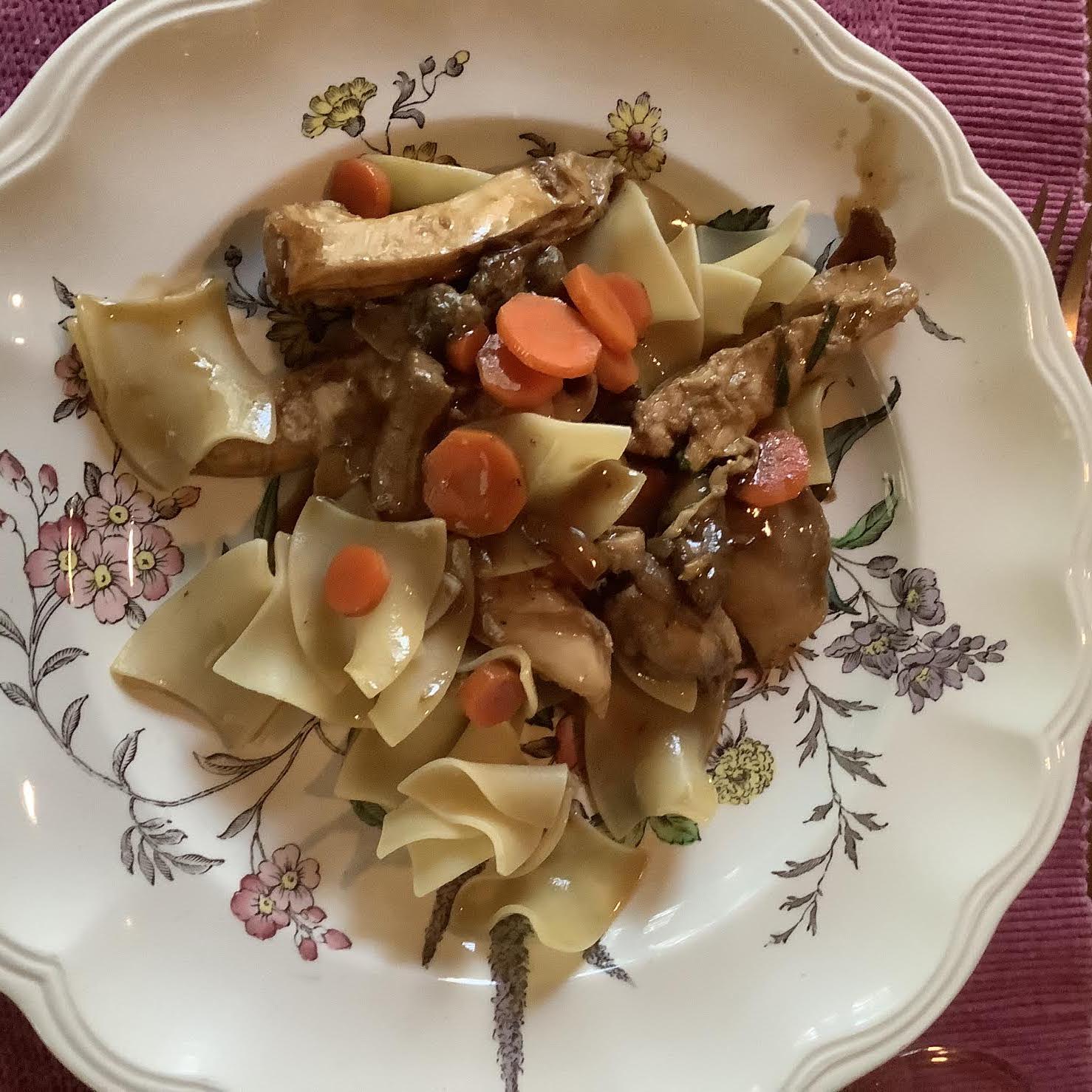
We enjoy eating the chickens that we raised ourselves — it is good to know that we have them in the freezer. Besides that, chicken is good for you: recommended in the Mediterranean Diet and the MIND Diet. When we schedule chicken for two Sundays each month, the cook must have many, varied ways to prepare it. Roast Chicken is wonderful, producing meals and soup stock. And then there is Chicken Chasseur. The name ‘chasseur’ refers to hunters, as does its Italian equivalent ‘cacciatore.’ This marks it as a meal of Autumn, when the hunting parties would be in the woods finding game AND wild mushrooms. Mushrooms are the hallmark of any proper chasseur recipe. We seek wild mushrooms all year ’round, but this meal is specifically for cool weather.

mise en place for Chicken Chasseur Recipe is from Salute to Healthy Cooking by the French Culinary Institute.

To serve two, I’m using two leg-thigh pieces which have been browned in a little oil. Even though the meat will be braised/stewed, it is a good idea to brown it first since that enhances the flavor. Here is the full recipe:

24 oz bone-in chicken parts
salt & pepper
1 tsp oil
Season chicken and sear, skin-side down, for 3 mins in a Dutch oven or heavy cast-iron pan with a lid. Bake 20 mins @ 350F. Remove chicken from the pan, then skin and bone it.
½ cup sliced onion
1 carrot, chopped
2 c. brown stock or Veal stock
Put the veggies in the pan you used to roast the chicken. Cook 3 mins until caramelized. Add stock and simmer until reduced to 1 cup. Strain through a sieve and skim fat.
1 tsp oil
2 c. [5 oz] sliced mixed mushrooms
2 shallots, minced
Good mushrooms can be found in most supermarkets if you are not able to hunt for them. Saute shallots with mushrooms 5 mins or until mushrooms are golden. Add a sprinkle of salt and remove from heat.
2 Tbsp cognacAdd cognac to hot mushrooms and flame the mixture.
1/3 cup dry white wineAdd to pan and return to heat. Bring to a boil, reduce heat, and simmer 10 mins. Add sieved, defatted stock and simmer 5 mins, until sauce coats the back of a spoon.
Fresh tarragon leaves
boned chicken meat
Add to sauce and warm while the noodles and carrots [see below] are cooking.
3 oz broad egg noodles
¾ cup carrot coins
½ tsp sugar
Cook noodles as the package describes. Cook the carrots in as little water as possible, along with the sugar. You want the water to boil away at the point when the carrots cook, which leaves them with a slight sugary glaze.

This is really quite easy to prepare and worth all the little steps. It makes a fine meal for Autumn into Winter.

For the perfect wine to pair with it, go to https://wordpress.com/post/peterspicksblog.com/7063

Slow Days: DIY Sauerkraut

People who are new to Fasting often pose the questions: “Can I really eat ‘anything I want’ on a Slow Day?” and “What should I eat on Slow Days?” To answer those questions, I have decided to add some blog posts to show some of the foods we eat on what the world calls NFDs [non-fast days] but which, in our house, we call ‘Slow Days.’ This feature will appear sporadically. 

Now for the answers. Can you really eat ANYTHING you want on a Slow Day? Not really. If you eat too many calories every Slow Day, you will not lose weight. There are many questions asked on the FastDiet Forum which attest to that. Once in a while you can splurge, as long as it isn’t everyday. For what to eat on Slow Days, Dr. Mosley recommends a Mediterranean Diet. As for how we eat, an example follows.

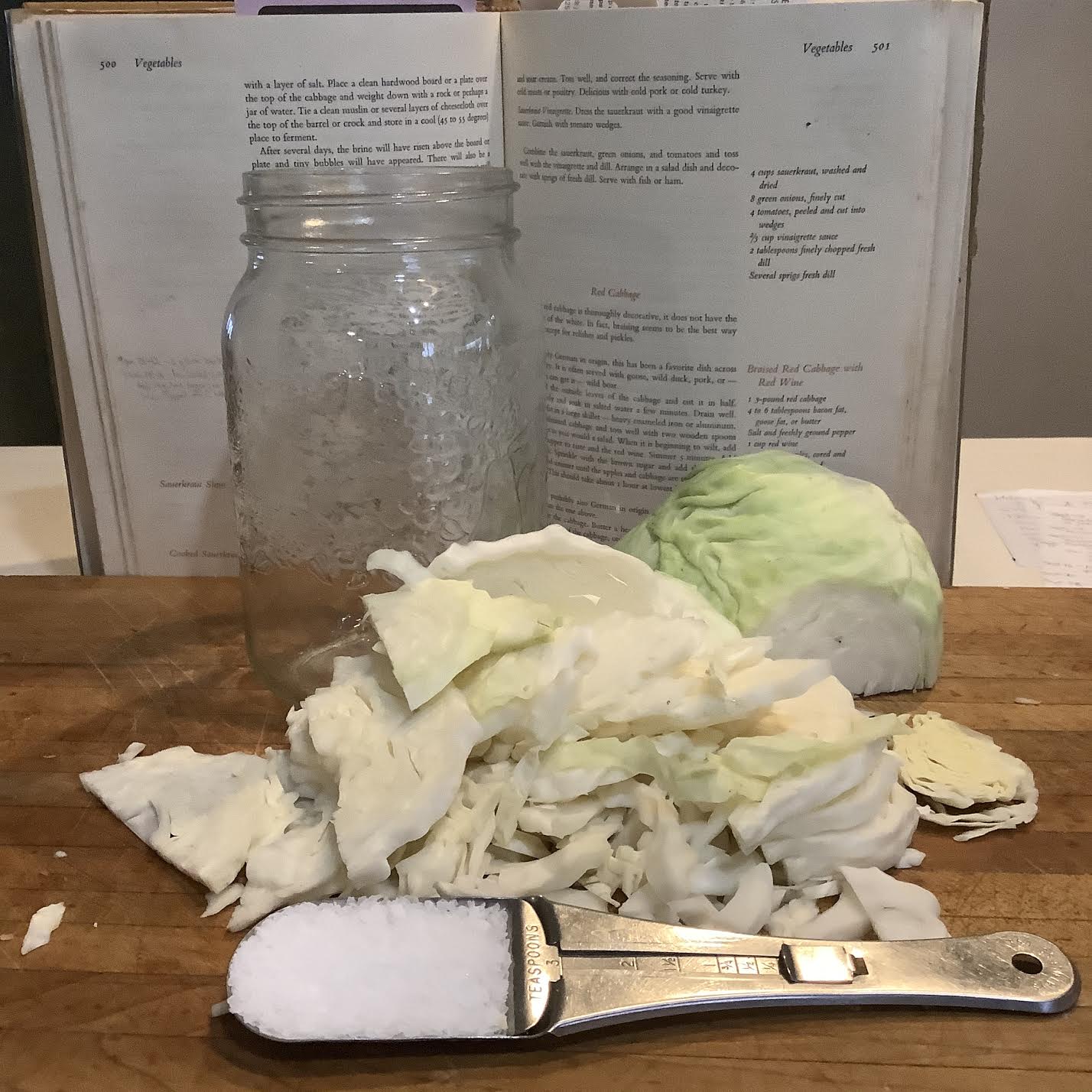
I like sauerkraut. My mother served it, redolent with caraway seeds and topped with pork. Dear Husband used to dislike it — but he has since come around. How delighted I was to find out how easy it is to prepare one’s own pickled cabbage: from huge batches to one jar at a time. The method is from James Beard‘s American Cookery, page 500. For each quart jar, you need enough sliced cabbage to fill it and 1 Tablespoon of kosher salt.

Lightly pack the cabbage into the jar, add the salt, and pour in lukewarm water up to within a 1/2 inch of the top of the jar. You want to keep the cabbage submerged in the water so it doesn’t turn brown. I floated a small, upturned lid on the jar contents and then weighted it with one of those tiny jam jars. That worked. Then you put the jar in a not-too-cold place — mine was in the coolest corner of the kitchen, but the unheated basement would have been OK too. Check the jar every day or so — you are looking for bubbles to form amid the cabbage. It could be that you don’t see them until you jiggle the jar and then they emerge and race to the top. Depending on the temperature, this can take 5-10 days.

In the jar, with water and salt, weighted down.
After several days, it has fermented.

If using it within a week, put a lid on it and keep it in the refrigerator. If you are a canner, you may process it in a hot-water bath in the same jar in which it fermented. Process for 20 minutes in boiling water to cover. When cool, store on the shelf to use for all sorts of good meals. Once the jar is opened, left-over ‘kraut can be kept in the refrigerator for weeks.

Our’s is braised in stock [the Alsacians will add white wine, the Germans will add beer] with sliced onions and caraway seed, then baked with chunks of sausage. Served with mashed potatoes, as my mother did, along with some rye bread. A feast! For a Fast Day, you could use the sauerkraut to prepare dinners such as: Sauerkraut & Sausage, or Baltic Bake. Or at breakfast in Reuben Matzo Egg.

Slow Days: Tourtiere

People who are new to Fasting often pose the questions: “Can I really eat ‘anything I want’ on a Slow Day?” and “What should I eat on Slow Days?” To answer those questions, I have decided to add some blog posts to show some of the foods we eat on what the world calls NFDs [non-fast days] but which, in our house, we call ‘Slow Days.’ This feature will appear sporadically. 

Now for the answers. Can you really eat ANYTHING you want on a Slow Day? Not really. If you eat too many calories every Slow Day, you will not lose weight. There are many questions asked on the FastDiet Forum which attest to that. Once in a while you can splurge, as long as it isn’t everyday. For what to eat on Slow Days, Dr. Mosley recommends a Mediterranean Diet. As for how we eat, an example follows.

In French Canada, Christmas is marked by a series of events. Beginning on December 24, there is a meatless meal for dinner — often including oysters. Then midnight mass and then the Revillion: dining with family into the wee hours to celebrate the birth of baby Jesus. And what do they eat on this special night? Tourtiere. The recipe for this pork pie goes back to medieval times: you can tell by the combination of ‘exotic’ spices with meat. The preparation of the pie begins in November [St Martin’s Day perhaps?], when the pig would be slaughtered. Bits of meat left over from other cuts would be ground or minced, combined with spices, and wrapped in a lard pastry. It could be shaped as a boule or in a pie plate. As many of these pies as possible would be put into the cold shed off the kitchen, where they would freeze for the rest of the winter, ready to be taken out and baked for a meal — the original convenience food.

Our recipes, for the tourtière and its crust, are from Craig Claiborne’s NYT International Cook Book. We enjoy tourtiere for dinner on some evening in December [not Christmas Eve, for then we dine on Dear Husband’s Seafood Chowder]. Since it can be prepared in November or even October, tourtière makes a perfect ‘prepared meal’ to whisk from the freezer for dinner on a busy day.

Ground pork, spices, savory [of course!], onions, garlic, stock — simple ingredients for an old-fashioned meal.

Since I don’t know how many you will be serving, I’ve written the recipe for 6 or 3 or 2 persons. We will be serving only two this year.

Sv 6Sv 3Sv 2
1 cup
1 clove
2 Tbsp
½ cup
½ clove
1 Tbsp
1/3 cup chopped onion
½ clove minced garlic
2 tsp butter
Chop the onion and garlic an cook in the butter until wilted.
1 ½ #¾ #½ # /8 oz ground pork Add to the pan and cook, breaking up lumps.
¾ tsp
¾ tsp
¾ tsp
1 leaf
¾ cup
ad lib
3/8 tsp
3/8 tsp
3/8 tsp
½ leaf
1/3 cup
ad lib
2 Large pinch cloves
2 large pinch cinnamon
2large pinch savory
1/3 leaf bay
¼ cup pork stock
salt & pepper to taste
Add the seasonings and stock to the pan and simmer for 30 minutes, stirring sometimes.Cool the mixture and run it through a food processor to chop the filling more thoroughly.
Scrape into a bowl and chill thoroughly.

**This lard pastry is traditional and is perfect for a savory pie.

1 cup white whole wheat flour
½ cup all-purpose flour
½ tsp salt
Cut together with a pastry blender or 2 table knives until ingredients are uniformly crumbly.
3+ Tbsp cold waterUsing a 2-pronged fork, stir the water into the pastry crumbs, adding more if needed, until it all comes together in a ball.

Roll out the pastry and fit into an appropriate pie plate or into a bowl large enough to contain the filling. If baking as a pie or tart, cover filling with a top crust. If baking as a boule, line the bowl with pastry, with a generous overhang. Put the filling in the bowl and trim the pastry to enclose, without too much bunching or overlap. Seal edges. 

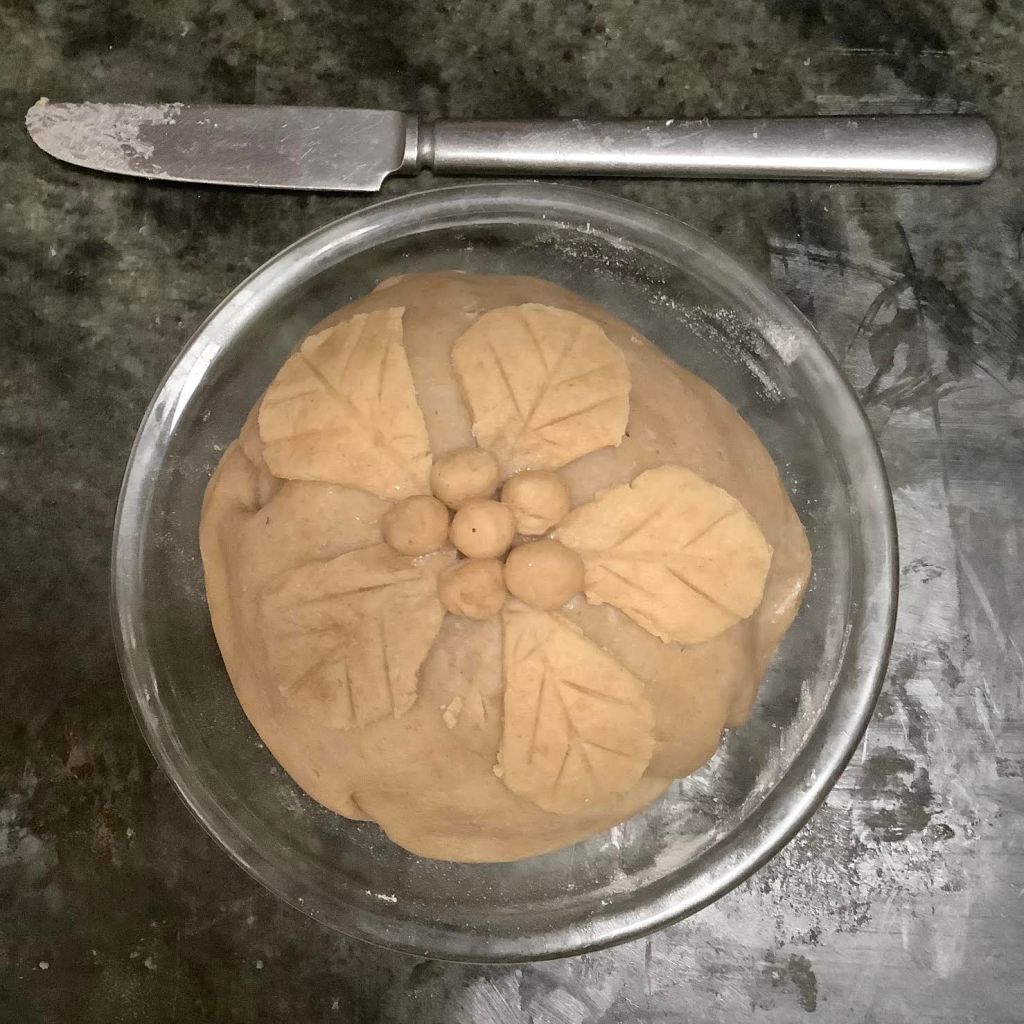
If cooking as a boule, turn out the boule onto a glass pie plate so that the round side is up and the gathered side is on the bottom. This year, I used some extra dough to make some decorations. Been watching too much Great British Baking Show, I guess.

Freeze the pie – overnight or for weeks.
The day before baking: Thaw the pie in the refrigerator. To bake, set oven at 425F. Bake for 10 minutes, then turn down temperature to 350F and bake for 30-40 minutes [check it at 25 minutes]. Crust should be cooked and beginning to turn golden.

The tourtière is best served with gravy, winter vegetables, and ‘chow‘, a green tomato relish beloved in Quebec and the Maritime Provinces of Canada. What a fine meal for a winter night.

Slow Days: Pot Roast

People who are new to Fasting often pose the questions: “Can I really eat ‘anything I want’ on a Slow Day?” and “What should I eat on Slow Days?” To answer those questions, I have decided to add some blog posts to show some of the foods we eat on what the world calls NFDs [non-fast days] but which, in our house, we call ‘Slow Days.’ This feature will appear sporadically. 

Now for the answers. Can you really eat ANYTHING you want on a Slow Day?  Not really. If you eat too many calories every Slow Day, you will not lose weight. There are many questions asked on the FastDiet Forum which attest to that. Once in a while you can splurge, as long as it isn’t everyday. For what to eat on Slow Days, Dr. Mosley recommends a Mediterranean Diet. As for how we eat, an example follows.

I have fond memories of my mother’s pot roast during my Connecticut childhood. No idea what cut or size of beef she used…I do remember long chunks of carrot and large chunks of potato infused with the braising liquid. Probably cooked in a pressure cooker, and following the recipe in Fannie Farmer’s Boston Cooking School Cookbook. Delicious way to fill up a family. Dear Husband suggested recently that we do a Sunday pot roast. It seemed appropriate as the Autumn advances during a deepening season of Covid cases. We looked at Jacques Pepin Celebrates, and there was his ‘Connecticut Pot Roast.’

4.5 pounds of beef bottom round were browned in butter in a large Dutch Oven. Then braised in 1-1/2 cups water with salt for 3 hours in the oven at 275 F. Next, add 1-3/4 pound small red potatoes, one pound of carrots, 1 pound onions the size of large radishes, and 2 oz dried shiitake mushrooms are added, along with 1-1/2 cups water and a bit of salt. The covered pot returns to the oven for 2 more hours. At that point everything should be tender. Remove the meat and vegetables and boil the liquids down to 3 cups. Thicken the broth with 2 teaspoons of potato starch dissolved in 2 Tbsp of red wine.

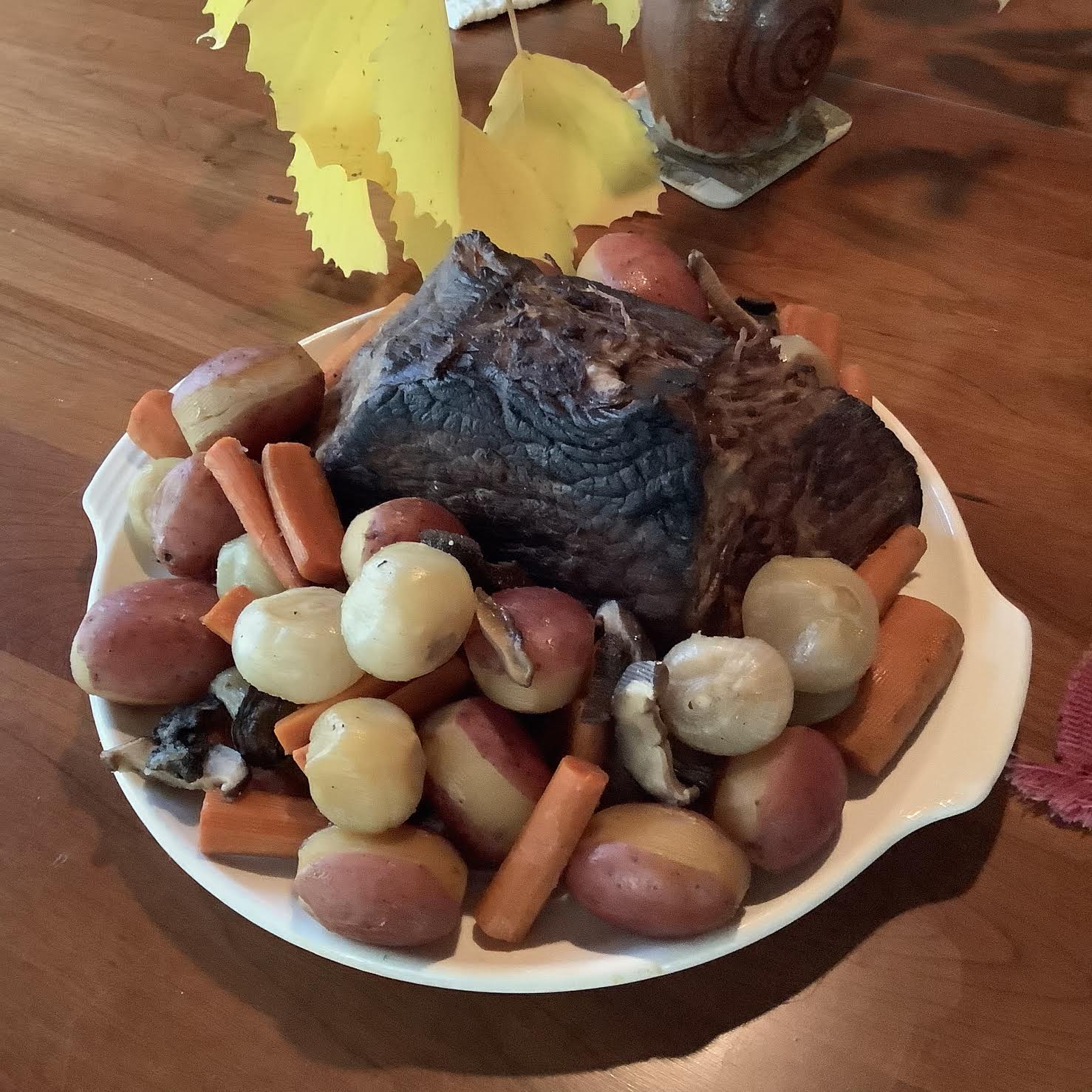
Here is all the meat, with most of the vegetables — wow – that’s a lot of food!

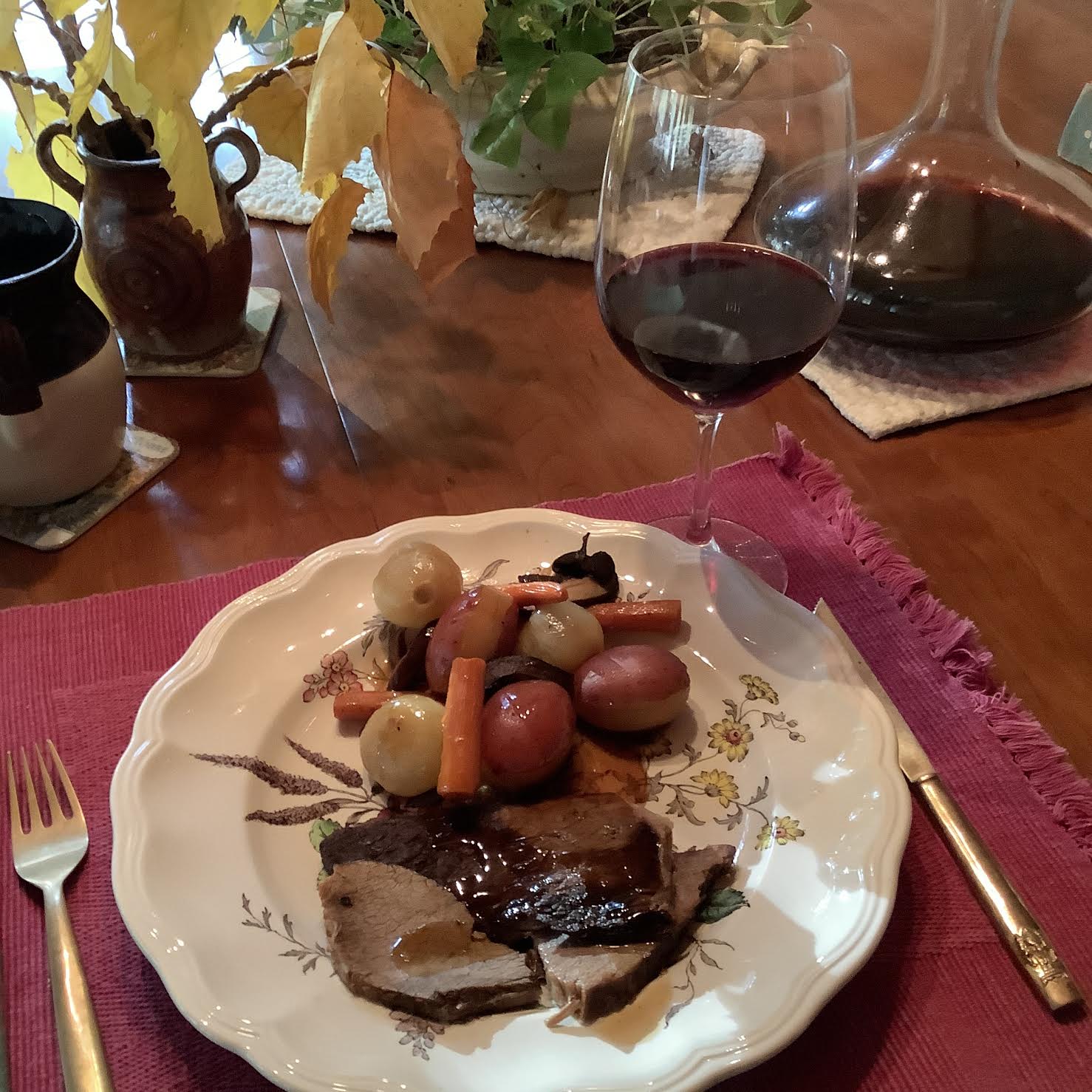
Plated, it looks like this, served with a California Cabernet Sauvignon.

Napped with the thickened stock, this is a wonderful meal.

Since we started with 4.5# of meat, we ended up with lots of meat and vegetables left over. In the next few weeks, you will see how different ways this meal can be used for a Fast Day: repeated as is; as a cold plate supper; as cottage pie. So this might be a great thing to prepare during the holidays, since it provides many subsequent meals.

Slow Days: Pasta DIY

People who are new to Fasting often pose the questions: “Can I really eat ‘anything I want’ on a Slow Day?” and “What should I eat on Slow Days?” To answer those questions, I have decided to add some blog posts to show some of the foods we eat on what the world calls NFDs [non-fast days] but which, in our house, we call ‘Slow Days.’ This feature will appear sporadically. 

Now for the answers. Can you really eat ANYTHING you want on a Slow Day? Not really. If you eat too many calories every Slow Day, you will not lose weight. There are many questions asked on the FastDiet Forum which attest to that. Once in a while you can splurge, as long as it isn’t everyday. For what to eat on Slow Days, Dr. Mosley recommends a Mediterranean Diet. As for how we eat, an example follows.

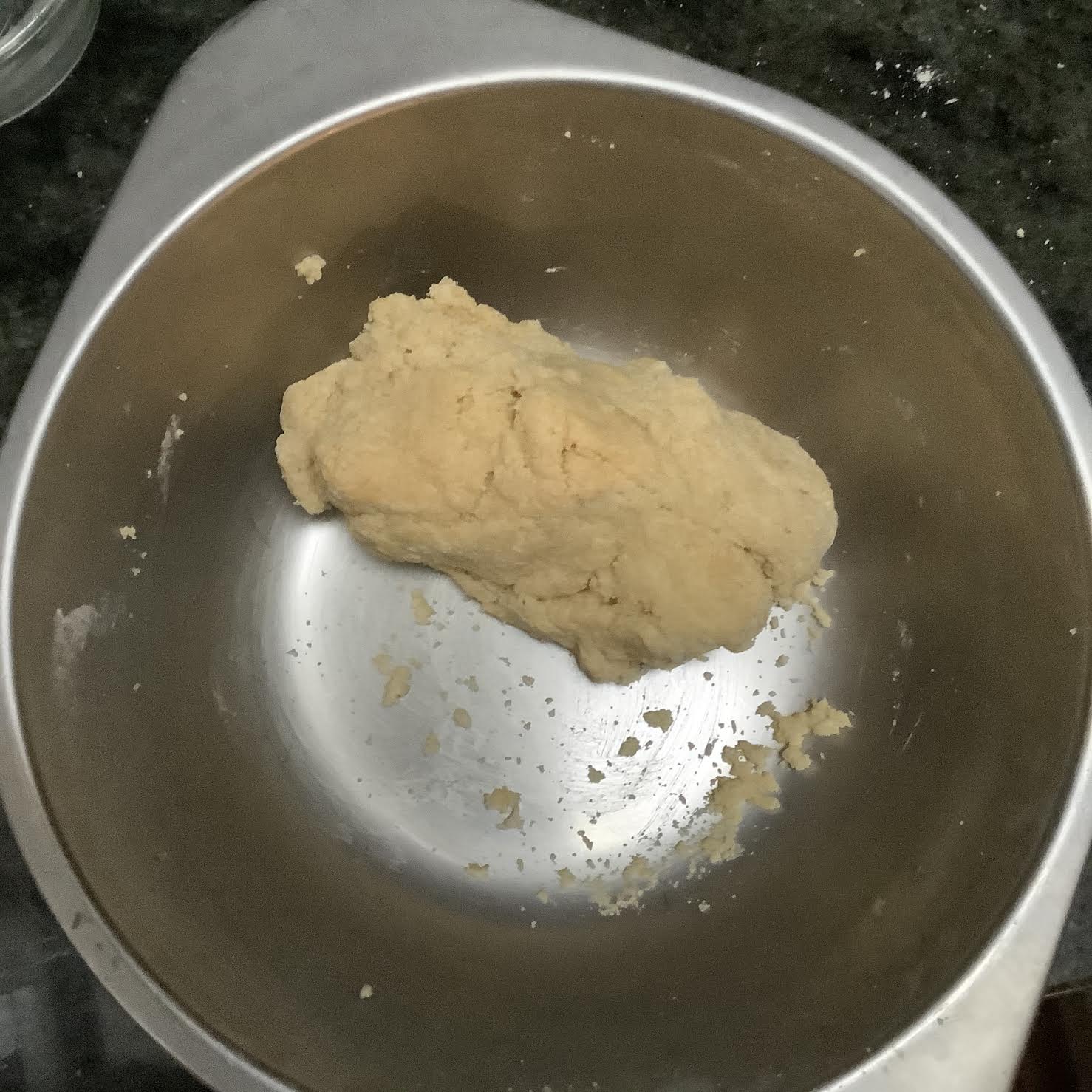
The dough has been mixed

Once a week, we have a meal involving pasta. And, yes, for those of you in the US who are from New England, the day we eat pasta is Wednesday. Many years ago, we bought a pasta machine. We were quite self-sufficient in those days, so making our own noodles seemed just right. It was fun, but then I returned to work and the machine sat in the drawer. Nowadays, it is back to DIY, and with lots of our own eggs, fresh pasta is on the menu again. There are two basic recipes: all-purpose flour + eggs OR semolina flour with water. I decided to combine them: 1 cup semolina flour, 1 cup white whole wheat flour, 1 two-ounce egg [US Large], and some water. These are combined in a food processor or by hand, adding enough water to make a rough ball of slightly moist dough, like Sugar Cookie Dough.

Kneading and rolling it out is the job of the pasta machine. First the dough goes through the rollers at “1,” which is the widest setting. It is folded in half, and rolled again. Every time the dough goes through, it holds together better and becomes smoother. Then you gradually set the rollers at higher and higher numbers: 1 to 2, 2 to 4. Each time, the dough becomes thinner, longer, and more supple. Cut the lo-o-ong dough strips cross-wise so that it is easier to handle. Eventually you reach the setting 6. You could stop there or make it really thin at 7. Six is good for noodles, 7 is better for filled pasta such as ravioli or tortellini.

Now it is time to cut the dough into noodles. You could do it by hand, or by machine. Our machine has two choices: thin like spaghetti, or wider like fettuccini. Working with the smaller dough rectangles, one passes the dough through the cutters. Catch it coming out the other side and hang it up to dry. You can use it fresh, and it is delicious. Cook only 1-2 minutes and bear in mind that 2 oz dry pasta [one serving], is the equivalent of 5 oz fresh pasta. While the water is boiling and the sauce is heating, the pasta is drying slightly, which makes it easier to handle. What I don’t use for today’s meal is dried thoroughly and stored, air-tight, for use another time.

Would I make pasta every week? No, but it is great for special meals. Does pasta make a meal ‘Mediterranean’? Not automatically. How healthy a pasta dish is depends on what is on top of the pasta. Is Pasta a no-no for Fast Day meals? Yes and no. Chicken Tetrazzini, Tortellini with Black Kale, these are some of the Fast meals I’ve posted using pasta as an ingredient. Just remember that a ‘serving’ of dried pasta, of any shape, is 2 ounces. On a Slow Day, knock that down to 1 or 1-1/2 ounces and you can hedge your bet. Our pasta is made even healthier by substituting white whole wheat flour for the all-purpose flour, which adds more protein and more fiber. It is delicious and worth the effort that you put into it.

Slow Days: Election Cake

People who are new to Fasting often pose the questions: “Can I really eat ‘anything I want’ on a Slow Day?” and “What should I eat on Slow Days?” To answer those questions, I have decided to add some blog posts to show some of the foods we eat on what the world calls NFDs [non-fast days] but which, in our house, we call ‘Slow Days.’ This feature will appear sporadically. 

Now for the answers. Can you really eat ANYTHING you want on a Slow Day? Not really. If you eat too many calories every Slow Day, you will not lose weight. There are many questions asked on the FastDiet Forum which attest to that. Once in a while you can splurge, as long as it isn’t everyday. For what to eat on Slow Days, Dr. Mosley recommends a Mediterranean Diet. As for how we eat, an example follows.

At last it is Presidential Election Day in the United States of America. Or, should I say, the last day to vote in this unusual election season. It used to be that all votes were cast during one day, all around the nation. One day for voting. The counting took longer, depending on how difficult the roads were between a given town and the state capital. That was back in the dirt-roads-and-horseback days. Nowadays, vote counts are sent to state capitals by phone. But Election Day has never been the end of the story — the votes must be ‘certified’ in each state, which can take days if there is a recount. Then it is up to the Electoral College to vote, with their selection of the winner on December 14. That’s a long time from today!

Let’s have some cake today — one with a long history and a tradition of being a ‘good keeper’: Election Cake. In Colonial Days and the early days of the Republic, popular cakes were made with dried fruits. If the fruit or the cake was suffused in ‘strong spirits,’ it would keep for a long time, meaning less baking for the housewife. In Connecticut, there was the tradition of a cake for Election Day. It could be baked days in advance, then put in the picnic basket for the day-long trip to the village center to be served there at lunch. My mother said that the alcohol in the cake was because sale of booze was banned on Election Day. Maybe not, but getting voters drunk was an early form of voter coercion, hence the ban on alcohol sales. Last March, I baked 2 loaves of this cake, using sourdough [since we all have plenty of that these days, right?]. We ate some on New Hampshire’s Primary Day and the other loaf went to the freezer. We had some in September for state primary voting and the remainder this morning, just to remind ourselves that it was Election Day. We voted Absentee and turned in our ballots to the Town Clerk weeks ago. Kudos to Deb and John and the election team in Bennington.

Early Day 1 2 c flour  ½ cup + 2 Tbsp buttermilk  ½ cup sourdough, fed and bubbly 1-2 T water, as neededIn a large bowl combine the flour, buttermilk, and sourdough starter until you get a thick dough.  Add water if necessary. Form the dough into a round ball, place it in a bowl and allow it to rest, covered, for 8-12 hours
Evening Day 1 1 stick butter ½ cup + 2 Tbsp sugar 2 Tbsp molasses 1.5 tsp white wine OR Rum 1 Tbsp brandyIn a medium bowl, beat the butter, sugar, molasses, wine, and brandy together until well combined and fluffy.
1 egg 1.5 tsp cinnamon 1.5 tsp ground coriander ¼ tsp allspice ½ tsp ground nutmegStir in the egg and the spices.
Add the yeast dough to this mixture and beat until the mixture resembles that of a thick cake batter.
½ cup prunes, chopped ½ cup raisins/ cranberries/ cherries/ currents/ apricotsStir in dried fruit. Pour the cake into a greased “bundt pan (you could also use a springform or dutch oven)”. I used small loaf pans = two pans, 8x4x3”
Cover the pans with a clean dish cloth and allow to rise until it is almost doubled in bulk (about 1.5 -2 hours) Preheat your oven to 375F. Bake for 45 minutes to 1 hour, or until a toothpick inserted in the cake comes out clean.
This is the recipe I used, slightly adapted from the 
Nourished Kitchen.
Here is Fannie Farmer‘s recipe — lots of whiskey! In my handwriting, amounts for smaller batches.

We like to slice it and toast it lightly to serve at breakfast. A nice treat to mark the passing of the political year.

Election Cake served warm with fruit yogurt, bacon, apple cider, and frothy mocha cafe au lait: this is a breakfast to make one optimistic about an election outcome.

Slow Days: The Tale of a Chicken.

People who are new to Fasting often pose the questions: “Can I really eat ‘anything I want’ on a Slow Day?” and “What should I eat on Slow Days?” To answer those questions, I have decided to add some blog posts to show some of the foods we eat on what the world calls NFDs [non-fast days] but which, in our house, we call ‘Slow Days.’ This feature will appear sporadically. 

Now for the answers. Can you really eat ANYTHING you want on a Slow Day? Not really. If you eat too many calories every Slow Day, you will not lose weight. There are many questions asked on the FastDiet Forum which attest to that. Once in a while you can splurge, as long as it isn’t everyday. For what to eat on Slow Days, Dr. Mosley recommends a Mediterranean Diet. As for how we eat, an example follows.

When I was growing up, my mother served chicken for dinner every Sunday. It was delicious. When Dear Husband and I moved to the country [our dirt road looks much more ‘suburban’ after 40 years], we decided to raise chickens: for eggs and for meat. Since then, we have always had a supply of chicken: whole roasters and parts. We are very lucky to be so well fed. When our sons were in residence, we would eat chicken every other Sunday: roasted and served with mashed potatoes, gravy, and a side of peas. Classic. And then there were left-overs. Now that the boys are off on their own, a chicken goes a lot farther. Here is the tale of one chicken. [no, we don’t give them names nor are they our pets]

We’ll draw the veil of secrecy between chicken in-the-straw and chicken in the freezer. Dear Husband roasts a darned good chicken, with his herb and spice flavorings, and the carrots and onion in the cavity. Once it has been roasted and carved, one is left with a carcass that still has plenty of meat.

The onions and carrots were roasted inside the chicken.

Savory Roll, a recipe from the Fannie Farmer Cookbook, is a favorite use for cooked chicken. One and a half cups of shredded chicken meat, along with the vegetables, plus some gravy or stock for moistening, some dark leafy greens, chutney, egg, and bread crumbs: all goes into the Food Processor to produce 2 cups of ground filling.

clockwise from left: onion, chicken shreds, egg, spinach, crumbs, carrots, and chutney in center.

A pie crust or biscuit dough is then rolled out, and the filling placed down the middle of the dough, log-shaped. The log of filling is then encased in the dough, sealing the edges.

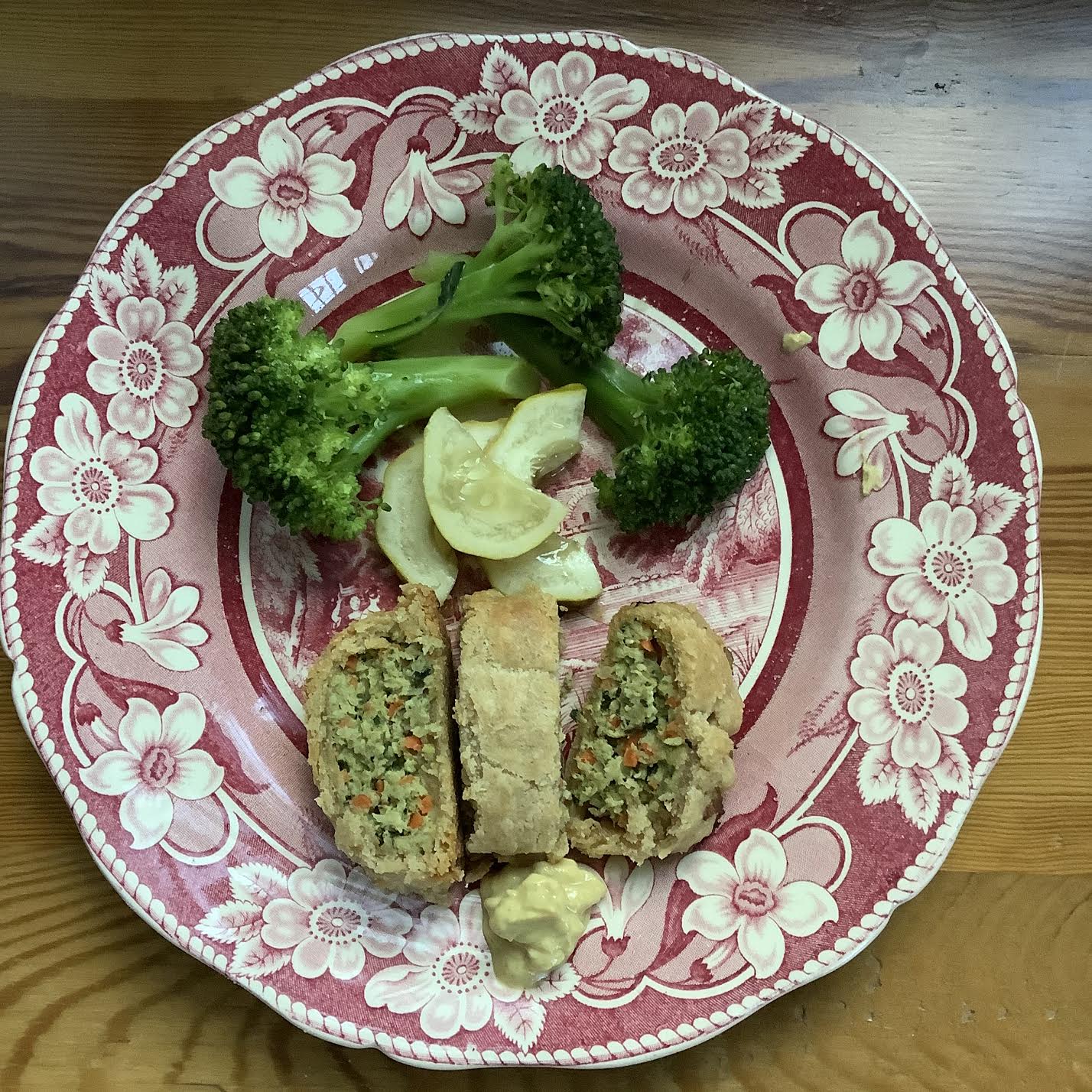
This roll provided 12 slices.

Baked in a hot oven until the dough is brown and cooked, the Savory Roll is now done. This time, I sliced it and served it like a ‘country pate’, with mustard and side vegetables. When encased in biscuit dough, it can be napped with gravy.

What’s next? Chicken stock [some call it ‘bone broth’] from cooking the carcass in seasoned water until, as Julia Child would say, ‘It has given its all.’ I then pressure can it to store in the pantry until it is time to make soups.

How to Stay

How this Fast Diet Lifestyle works: Eat these meals tomorrow, for a calorie total of less than 600. On another day this week, eat the meals from a different post, another day of eating 600 calories or less. Eat sensibly the other days of the week. That’s it. Simple way to lose weight and be healthier.

Starting any new behavior is easy — staying on it is more difficult. Having gone through this myself, I have some tips for you. 1] If you haven’t done so, watch Michael Mosley’s TV presentation Eat, Fast, Live Longer. That’s what motivated us to get on board. 2] We talked about planning and purchasing ahead, so continue to do that. Make it easy for yourself to follow the diet. 3] Make the meal special. On my Home Page is a photo of a demitasse cup. It is the only one I have and I think it is very pretty. I use it on Fast Days only, filling it from a small pitcher of mocha cafe au lait. Make your Fast Meals an occasion — use the good dishes; put the sparkling water in a nice glass with a twist of lemon. 4] Slow down your meals. The little demitasse cup means that I have to stop my breakfast once in a while to refill the cup. Wait until you have swallowed your food before you cut your next mouth-full. 5] Set goals by the clock. From breakfast to noon, put no calories in your mouth. Then set the timer for two hours, and don’t eat during that time. When it rings, set it for another two hours. Its a mind-game, but it works. 6] Distract yourself. Plan projects for Fast Days which will keep you focused on the task for 2-3 hours, so you will think less about food. 7] Think about tomorrow, when you will weigh less and you can eat more freely. Rather than think “I can’t eat that today,” you can think, “I can eat that tomorrow.”

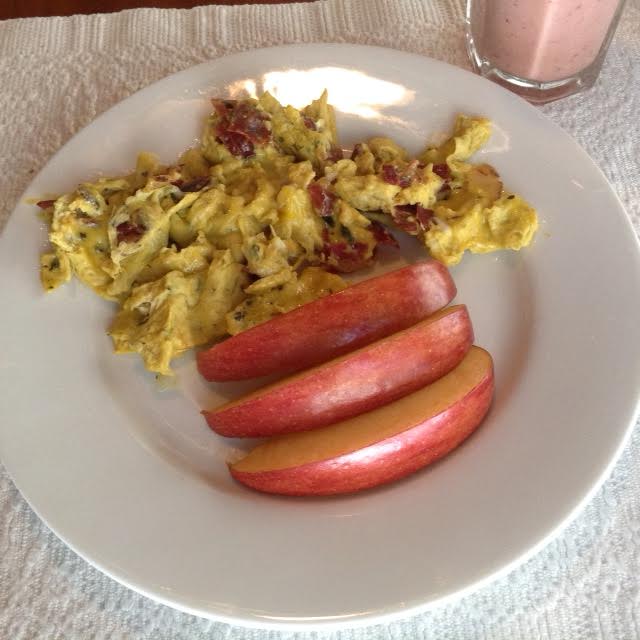
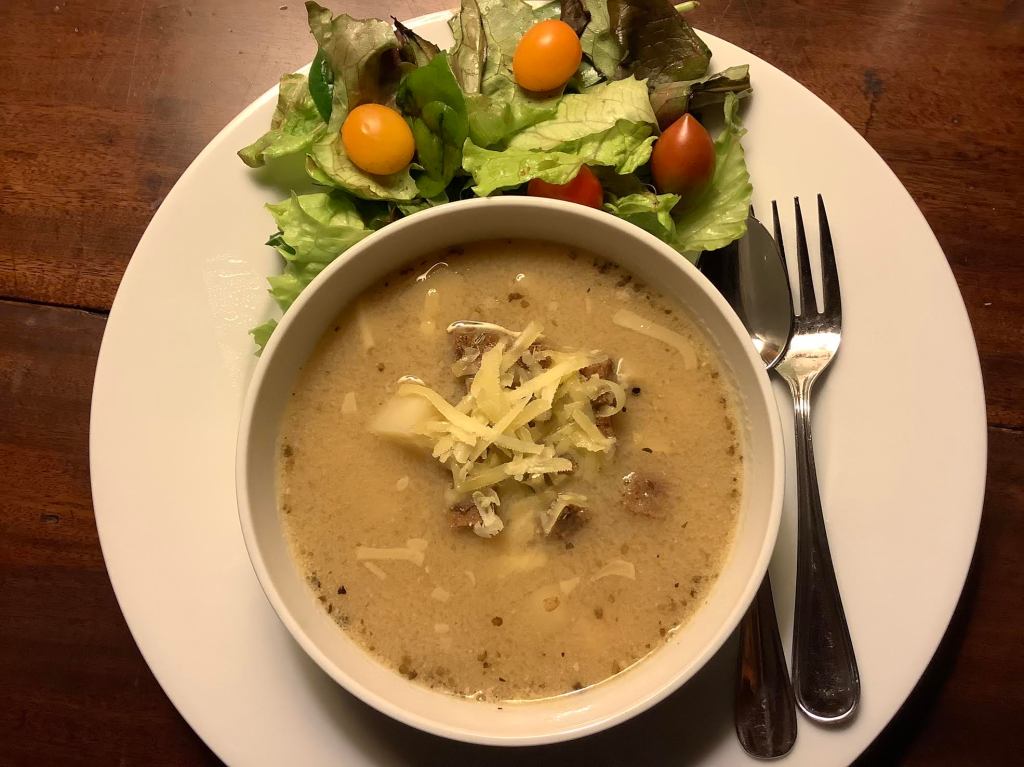
Today’s menus are typical for us on a Thursday: a savory scramble and a hearty soup. The nice thing about soup is that you get to store future meals in the freezer.

Capicola ScrOmelette:  147 calories 8 g fat 1.0 g fiber 13.8 g protein 7.5 g carbs [6.6 g Complex] 72 mg Calcium  NB: Food values shown are for the ScrOmelette and fruit only, and do not include the optional beverages.  GF Capicola is a dried ham which is full of flavor yet low in fat and calories. It goes very well with eggs.  

1½ two-oz eggs  HINT: If you are serving one person, crack three 2-oz eggs into a small bowl or glass measuring cup. Whip up those eggs and pour half of their volume into a jar with a lid and put it in the ‘fridge for next week.   1/3 oz uncured capicola ham, sliced thinly large pinch oregano 1.7 oz apple   Optional: blackish coffee [53 calories] or blackish tea or mocha cafe au lait [65 calories] or lemon in hot water   Optional: 5 oz fruit smoothie or berry-yogurt smoothie  [88 calories]

Chop the capicola and slice the apple. Beat the eggs with the oregano. Heat a non-stick pan and spritz it with non-stick cooking spray. Put the capicola in the pan to heat very briefly, then pour in the eggs. Scramble or cook as you would an omelette. Serve with the beverages of your choice.

Czech Garlic Soup Česneková polévka: 194 calories 4.7 g fat 4 g fiber 9 g protein 27 g carbs [18.4 g Complex] 84 mg Calcium  PB GF – if using GF rye bread What could be better on a cool night than a cozy bowl of soup? This is a classic from czechcookbook, but feel free to make it your own. The calorie count is so low that you could add other vegetables or low-fat meat.  HINT: This recipe makes 8 cups of soup. One serving = 1 cup

1 Tbsp unsalted butter OR bacon fat   
7 cloves garlic
Chop garlic and saute in butter/fat in a stock pot.
7 cups water OR Chicken Broth OR Beef Broth
1½ tsp salt
3 cups cubed potatoes 
3 cups cubed parsnips
Peel potatoes and parsnips and cut in cubes. Add to broth and salt in the stock pot. Simmer for 20 minutes, until vegetables are just under-done. Remove ½ cup soup stock and cool.
1 egg
1 tsp marjoram
Whisk the egg, then whisk it into the reserved ½ cup of soup stock. Return to the stockpot, stirring, and add marjoram. Taste for seasoning. Let sit 8-24 hours.
Per person: ¼ oz rye or whole wheat bread, cubed
Per person: ¼ oz Swiss cheese
Per person: side salad
Toast the cubes of bread. Grate the cheese over them while hot. Use to garnish the reheated soup when serving.

Ingredients for next week: Breakfast, single portion for Monday ……… single portion for Thursday:

1 two-oz egg + corn kernels + basil3 two-oz egg whites 
tomatoes + black beans + olive oil2 egg yolks + sugar
crushed red pepper + melon blueberries + raspberries
red onion + red wine vinegarother berries + Armagnac
Optional smoothieoptional smoothie
optional hot beverageoptional hot beverage

Dinner, single portion for Monday: …………………………. single portion for Thursday:

corn kernels + beef steakchicken breast + polenta + green beans
tomato + canned black beans onion + red bell pepper + garlic
red onion + red wine vinegar green bell pepper + tomatoes + thyme
basil + olive oilred wine + piment d’esplette + olive oil
Sparkling waterSparkling water