Stamford Bridge

How this Fast Diet Lifestyle works: Eat these meals tomorrow, for a calorie total of less than 600. On another day this week, eat the meals from a different post, another day of eating 600 calories or less. Eat sensibly the other days of the week. That’s it: a simple way to lose weight and be healthier. 

King Harold, shown in the Bayeux Tapestry.

In 1066, there was a battle that determined the fate of nations. No, not the Battle of Hastings, but the one right before it — the battle of Two Harolds. In January, the English king had died and the council chose Harold of Wessex to be the next ruler. But William the Bastard, Duke of Normandy, thought he had been promised the throne, and so did King Harald Hardrada, king of Norway. Harald gathered a huge fleet and invaded England near York, the former Viking capital. He was aided by a spy, Tostig Godwinson, brother of King Harold of England. Harald thought he would now waltz through England and take the crown, but he misjudged his adversary. Harold, facing an imminent attack by William, marched his army 45 miles a day for four days to get to York. On the morning of September 25, while Harald’s men lounged in a meadow after breakfast, Harold’s men came over the hill and plowed right into them. The Vikings barely had time to put on their armor. The fight was long and grueling under the warm sunshine. Finally, King Harald was killed, and later the traitor Tostig. The Norsemen fled to their ships and departed, ending the Viking Era. With scarcely a breather, Harold and his men marched back south to Hastings, to engage William. Harold won at Stamford Bridge, but his exhausted army could not win at Hastings, where Harold died. Without the arduous march and battle, it is possible that England could have won the Battle of Hastings, which certainly would have changed the history of Europe forever.

Our menu today would be familiar to both the Vikings and the English: salmon in two forms. Smoked salmon at breakfast, fresh salmon at dinner. Both are winners.

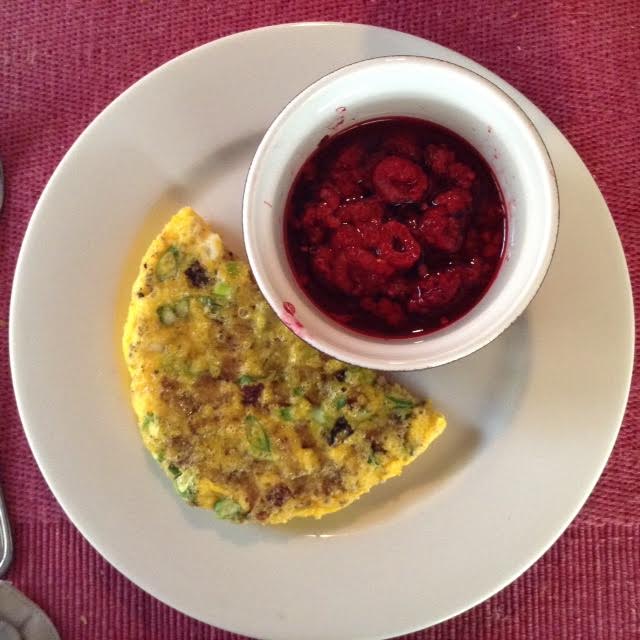
Smoked Salmon Bake: 133 calories 8 g fat 1 g fiber 10.4 g protein 6.6 g carbs 52 mg Calcium  NB: The food values given above are for the egg bake and fruit only, not the optional beverages.  PB GF Gosh this is good. You must try it!

1 two-ounce egg 1 Tbsp soft chevre [goat cheese] ¼ oz smoked salmon, crumbled into pieces 2 Tbsp scallions, green & white parts, diced or sliced 2-3 tsp chopped parsley ¼ cup blueberries  Optional: blackish coffee [53 calories] or blackish tea or mocha cafe au lait [65 calories]  Optional: 5-6 oz fruit smoothie or berry-yogurt smoothie [88 calories]

Put the scallions and parsley into a heat-proof ramekin. Microwave for 30 seconds. Add the salmon.  HINT: I did this the night before. Beat the goat cheese and egg together until the cheese breaks up into tiny lumps. Pour into ramekin and stir all together to mix. Bake at 350 F. 12 minutes, depending on how you like your eggs. Brew your beverage; dish the fruit; shake that smoothie.

Salmon-Dill Casserole:  290 calories 10.4 g fat 6 g fiber 24 g protein 26 g carbs 263 mg Calcium   PB GF  This is a wonderful meal. SO much flavor!!

3 oz salmon, raw 1 cup leeks, sliced 1 clove garlic 2 oz clam juice or fish stock 2 Tbsp milk ½ tsp cornstarch ½ tsp dill pinch nutmeg + pinch cayenne ¼ cup peas 1 oz green beans 

Cut the salmon into one-inch cubes and put in an oven-proof dish, dusting the fish with salt and pepper. Cook the leeks 5 minutes in a pan with a spritz of oil and some water. Slice the garlic and add that to the leeks for an additional 15 seconds. Whisk the cornstarch into the milk and clam juice, then add to the leeks. Cook until it becomes thicker. Take pan off the heat and add dill, cayenne, nutmeg and peas. Pour over salmon and bake around 15 minutes until it is hot through. In the meantime, cook the green beans and drain. Scrape the hot salmon mixture into your serving bowl [I used one 7” bowl per serving], being sure to include all the sauce. Top with the cooked beans. If there is broth left in the bottom of the bowl, don’t be shy – drink it!

Slow Days: Tomato Relishes

People who are new to Fasting often pose the questions: “Can I really eat ‘anything I want’ on a Slow Day?” and “What should I eat on Slow Days?” To answer those questions, I have decided to add some blog posts to show some of the foods we eat on what the world calls NFDs [non-fast days] but which, in our house, we call ‘Slow Days.’ This feature will appear sporadically. 

Now for the answers. Can you really eat ANYTHING you want on a Slow Day? Not really. If you eat too many calories every Slow Day, you will not lose weight. There are many questions asked on the Fast Diet Forum which attest to that. Once in a while you can splurge, as long as it isn’t everyday. For what to eat on Slow Days, Dr. Mosley recommends a Mediterranean Diet. As for how we eat, examples follow.

In mid-September, there are still plenty of tomatoes left in the garden. Even if you don’t have a garden, you can get lots of tomatoes to prepare small quantities of relishes — suitable for use all Winter, or as gifts for friends and relatives. Contact your local farm stand or producer and ask if they will sell you their ‘seconds.’ These are the not-so-good-looking tomatoes that can’t get full price for the grower. Sometimes they are called ‘canners’ or ‘Grade B’ or ‘Number 2s’, and they are sold by the bushel or by the pound. They will all be different shapes and sizes, they might be partially green, they might have blemishes on the surface. But, like people, they are all the same under the skin, no matter their color or appearance or differences.

Grade B tomatoes, after ripening for a few days. The wrinkly one in the lower left ought to be cooked right away, after cutting away the too-soft parts. Use in tomato sauce for pasta.

The greenish tomatoes are perfect for making Chow. Other green ones can be put in a sunny window where they will ripen nicely in a few days. Let the fun begin! You can prepare Tomato Salsa, Bruschetta Relish [the tomatoey stuff for on top of bread], or Corn-Tomato Salsa. These are small-batch recipes, so they are quick to fix and do not need many pounds of materials. If you want to prepare more, double or triple the recipes.

TOMATO SALSA:  makes 3 cups This salsa is useful many ways: as a dipping sauce for chips; as a dressing for cooked fish; as an ingredient in tacos.

2 cups chopped tomatoes 1 cup/5.3 oz chopped green sweet peppers 1 cup chopped onion ½ cup jalapeno/serrano peppers, chopped 1 clove garlic, minced 1 tsp salt ¼ c cider vinegar Stir everything together and let sit 15 minutes to marry the flavors.

BRUSCHETTA SAUCE: In addition to serving on bread as an appetizer, spread on toasted bread and top with an egg for breakfast.

makes 2 cups 
½ pound plum tomatoes + 1 scallion
3 Tbsp extra-virgin olive oil
1 clove garlic + 1 tsp fresh tarragon
½ tsp crushed red pepper flakes
½ tsp salt + 1 tsp fresh oregano 2 Tbsp fresh basil + 1 tsp fresh marjoram
Core and quarter the tomatoes.
Peel and crush the garlic.
Slice the scallion.
Chop the herbs.
Put all of these ingredients into a food processor and pulse off and on to make a chunky sauce.
½ pound plum tomatoesCore and quarter the tomatoes. Add to food processor, and pulse a few more times.
1 Tbsp balsamic vinegar
1½ teaspoons red wine vinegar
Pour the tomato-herb mixture into a bowl and stir in the vinegars.

CORN-TOMATO SALSA  makes 1½ cups  Serve as a side dish or mix with eggs for a bake or scramble.  

1 cup corn kernels 1 cup diced tomato 2 Tbsp minced red bell pepper 2 Tbsp diced red onion 2 Tbsp cider vinegar ¼ tsp dry mustard 1/8 tsp turmeric ¼ tsp sugar 2 dashes ground cumin Stir together all ingredients and let sit to mellow the flavors.

An ordinary stock pot becomes a hot-water-bath canner when you use some kitchen item to raise the canning jars from the bottom of the pot: a small cake pan, left, or a pressure-canner insert, right.

PRESERVING: If you wish to preserve the flavor of Summer, you can “put up” some jars of the Tomato Salsa and Bruschetta using a hot-water bath method. [NB: the Corn Salsa does not have enough vinegar in it to make it safe to can this way.] Canning is rather straight-forward and requires no extra equipment, if you have a nicely-stocked kitchen. You will need: canning jars [1 or 1/2 cup size] and the two-part canning lids that go with them. These are available at hardware and grocery stores. You’ll need a Dutch oven, large saucepan or stockpot deep enough to hold the jars [in one layer] with water covering them by 2 inches. Then you need something to elevate the jars above the bottom of the stockpot: the grill from part of the BBQ; the metal rack from a pressure-canner; a metal pie plate or cake pan that is 1-2″ smaller than the bottom of the stockpot.

Put 4″ water and the empty jars in the stock pot, and bring water to a strong simmer. Using tongs, dip the jar lids into the hot water, then lay them on a dish-towel on the counter. In a saucepan, bring your relish to a low simmer. When relish is hot, remove the sterilized jars to the dish towel and fill them with relish to within 1/2″ of the top. Run a clean chopstick around the inside of each jar, to break any air bubbles and to settle the contents. Wipe the jar tops and rims, and put on the 2-part lids.

Put the ‘bottom-protector’ into the pot, then arrange the jars upright in the simmering water in a single layer. Add enough water to cover the tops of the jars by 2″ and cover the pot. As the water starts a low boil, set the timer for 15 minutes and clean the kitchen. When the timer rings, remove the jars and set them on the dish towel to cool thoroughly.

Autumn, defined

How this Fast Diet Lifestyle works: Eat these meals tomorrow, for a calorie total of less than 600. On another day this week, eat the meals from a different post, another day of eating 600 calories or less. Eat sensibly the other days of the week. That’s it: a simple way to lose weight and be healthier.

We here in the Northern Hemisphere are now in the season of Autumn, or “Fall” as it is called in the USA. If you were to ask different people when Autumn begins, you would get a slew of different answers: Meteorological Autumn, one of the four three-month divisions of the year, begins September 1 and ends November 30. When the meteorologist on TV says “This was the warmest Fall on record,” it is based on temperatures from September, October, and November. This coincides roughly with…….. …..Astronomical Autumn, one of the four natural seasons of the year, begins at the Autumnal Equinox in late September [on the 23rd in 2023], and ends at the Winter Solstice in late December. You can see how this complicates the meteorologists’ calculation of total snow-fall in ‘winter’, since Autumn runs late into December. The start of Astronomical Autumn is the day of the Equinox: marked by equal hours of day/night. Seasons are caused by the tilt of the Earth, which changes the angle of the sun’s rays. Skywatchers know that Autumn is here because it is the best viewing time for the constellations Perseus, Andromeda, and Pegasus which are found high in the dome of the sky at this time of year. For Scholars and Educators, Summer ends and Autumn begins when school resumes after a Summer break. In the US, this was usually after Labor Day, to permit farm children to help bring in the harvest. In recent years, the long, blissful Summer Vacation has been eroded more and more, and schools begin in August. Ask a Fashionista, and she will say that Autumn begins after Labor Day, when the wearing of white clothing stops. [Except that she probably lives in a city where ‘Urban Black’ is in fashion year ’round.] Store owners mark the start of Autumn by putting the Back To School goods on the bargain rack and hauling out the Hallowe’en goods. If they display Christmas items, this is called ‘rushing the season.’ Farm Stand owners in higher latitudes know that the turning colors of leaves, the availability of apple cider, and the display of pumpkins will attract local customers and tourists on a ‘Leaf-Peeping‘ expedition to stop in for Autumn’s start. Often seeing the first turning leaves causes people to think that Fall has begun. Coffee Roasters and Brewers know that Fall has begun when they issue their Pumpkin Spice flavored java and the seasonal Pumpkin Ale.

However you define Autumn, we can’t ignore the delicious ingredients that are available as the seasons change: summer vegetables and autumn’s offerings overlap, as traditional seasonal flavors combine in eggs for breakfast and on pizza for dinner.

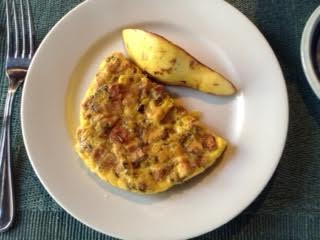
Autumnal Equinox ScrOmelette:  147 calories 7.5 g fat 1.6 g fiber 10.6 g protein 12 g carbs 52 mg Calcium   NB: Food values shown are for the ScrOmelette and fruit only, and do not include the optional beverages.  PB GF  The mushrooms are for Autumn, the tomatoes are for Summer. This meal is for when the seasons overlap.

1½ two-oz eggs  HINT: If you are serving one person, crack three 2-oz eggs into a small bowl or glass measuring cup. Whip up those eggs and pour half of their volume into a jar with a lid and put it in the ‘fridge for next week.  ½ oz mushrooms, chopped 1½ oz tomatoes, cubed/diced, drained 1 Tbsp scallion, chopped 2 oz peach or plum or pear Optional:blackish coffee [53 calories] or blackish tea or mocha cafe au lait [65 calories] or lemon in hot water  Optional: 5 oz fruit smoothie or berry-yogurt smoothie [88 calories]

Drain the tomato cubes in a sieve, overnight if possible. Put the vegetables in an oil-sprayed non-stick pan to warm them and to cook them a bit. Whisk the eggs and pour over the vegetables in the pan. Scramble or cook as an omelette. Prepare the beverages and plate the fruit with the eggs. Contemplate the change of the seasons.

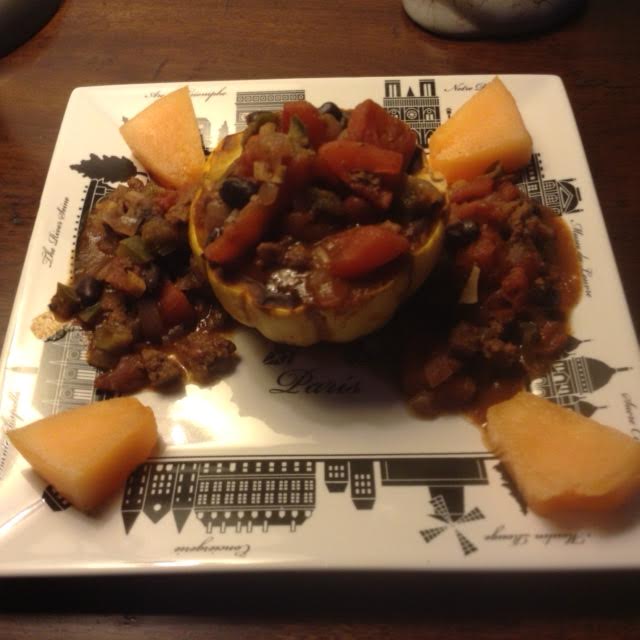
Autumnal Equinox Pizza: 285 calories 8.5 g fat 6.4 g fiber 10 g protein 43.4 g carbs 96 mg Calcium  PB A whole-grain pizza with flavors of the season is just what you need for the Autumnal Equinox in September. Summer’s tomatoes meet Autumn’s cured olives and meat. HINT: This 8” pizza will serve two [2] on a Fast Day.

6 oz whole-wheat pizza dough 3 Tbsp canned crushed tomatoes 4 black olives, chopped 1/3 oz prosciutto, chopped 4 tsp grated Parmesan  per serving: side salad with cukes and beets

Heat the oven to 490F. Have one rack in the middle and one rack at the bottom position in the oven. Brush a baking sheet with enough olive oil to cover an area 8” in diameter. Press and stretch the pizza dough into an 8” round on the oiled baking sheet. If the dough won’t cooperate, let it rest for 2 minutes. Spread crushed tomatoes over the crust, leaving ½” around the edges. Distribute the olives and proscuitto on top, then sprinkle with Parmesan. Place the pizza on the baking sheet in the oven for 3-4 minutes. Use this time to prepare the salad. Now open the oven and see if you can lift the pizza off the pan with a turner. If the pizza is too floppy, return it to the oven for another minute or so. When the pizza is baked enough not to be floppy, take it off the baking sheet and put it on the lower rack, with no pan at all. Continue to bake another 3 minutes, until the top begins to brown. Remove the pizza to a rack to cool and ‘out-gas.’ It must be on a rack, not the cutting board or counter or plate. Remove the pizza to a cutting board and cut into 6 pieces. On each of two plates, place the salad and 3 pieces of pizza. A bit of Pizza Heaven on a Fast Day.

Ingredients for next week: Breakfast, single portion for Monday …………………………… single portion for Thursday:

1 two-oz egg = US large1 two-oz egg 
Scallions + Smoked salmon scallions
chèvre /goat cheese — the soft kindwhite whole wheat flour
parsley + blueberriessoy sauce + melon
optional smoothieoptional smoothie
optional hot beverageoptional hot beverage

Dinner, single portion for Monday:………………………….. single portion for Thursday:

salmon + garlic + milkchicken stock + fresh ginger + cornstarch
clam juice/fish stock + leekbeef + garlic + ground coriander
cornstarch + green beansred pepper flakes + onion
dill + nutmeg + cayenne + peas broccoli + red bell pepper + brown rice
Sparkling waterSparkling water

Tiffany

How this Fast Diet Lifestyle works: Eat these meals tomorrow, for a calorie total of less than 600. On another day this week, eat the meals from a different post, another day of eating 600 calories or less. Eat sensibly the other days of the week. That’s it: a simple way to lose weight and be healthier. 

The ‘Tiffany Blue’ gift box, made famous by Charles Louis Tiffany.

On September 18, 1837, Charles Louis Tiffany and John Young opened a store in New York City. Born in 1812, he left school at age 15 to run his father’s general store in the neighborhood of the family cotton mill. Ten years later, after continuing his education in between selling flour and yard goods, Charles borrowed money from dad to begin his own store. The enterprise had some things working against it: 1837 was a time of financial panic, and the shop was located uptown — not a desirable location. Also, Tiffany and Young insisted on charging fixed prices and being paid in cash. No haggling, no bartering. They sold stationary and ‘fancy goods’ including costume jewelry. In two years, the store added home goods to their inventory and in 1841, Tiffany added wife Harriet, who was Young’s sister. A new partner, J.L. Ellis, was knowledgeable about European jewelry, so those were offered for sale. No more costume jewelry for Tiffany, Young, & Ellis! Branch stores were opened in Paris and London. A silversmith was engaged to design and produce silver flat ware and jewelry. After his partners retired, Tiffany continued to make a name for himself in fine jewelry — in 1887, he purchased the Crown Jewels of the deposed French Royal Family, earning the nickname “King of Diamonds.” Aside from luxury goods, Tiffany made a name for himself in several ways: his was the first ever mail-order catalogue; working with Thomas Edison, Tiffany brought electric foot-lights to the Broadway stage; and he helped to establish 925 parts of silver per thousand as the US standard. Then of course there was Truman Capote’s novella Breakfast at Tiffany’s. From selling stationary, Tiffany’s has come a long way.

The Tiffany name invokes thoughts of luxury and wealth. Thus, for breakfast we will eat “Rolex” — but I don’t mean the watches. For dinner, a meal of lobster in a delicious sauce — ought one to wear diamonds while dining, like society people of New York late in Tiffany’s life?

Rolex: 218 calories 10.5 g fat 2.4 g fiber 12.6 g protein 18.5 g carbs 67.5 mg Calcium   NB: Food values shown are for the Rolex and fruit only, and do not include the optional beverages.  PB Ugandan street vendors have a sense of humor. While some vendors sell “Rolex watches,” others sell rolled eggs and call it Rolex. This is easy to prepare and fun to eat.

1½ two-oz eggs  HINT: If you are serving one person, crack three 2-oz eggs into a small bowl or glass measuring cup. Whip up those eggs and pour half of their volume into a jar with a lid and put it in the ‘fridge for next week.   ¼ c finely sliced cabbage 2 Tbsp onion, chopped 1 tsp oil 2 Tbsp diced tomatoes 2 Tbsp New Mexico Green Chilis two 1-oz pieces of Lavash bread  1 ounce of one of these fruit choices: pineapple, 14 calories; melon, 10 calories; mango, 17 calories; grapes, 20 calories; watermelon, 8 calories    Optional: blackish coffee [53 calories] or blackish tea or mocha cafe au lait [65 calories]   Optional: 5 oz fruit smoothie or berry-yogurt smoothie [88 calories]

Heat oil in a non-stick saute pan and cook cabbage and onion until wilted. Add tomatoes and chilis and heat until warm. Pour whisked eggs over vegetables in pan and cook until vegetables are set. Covering with a lid helps to set the top of the eggs. Warm Lavash briefly in a covered pan, until pliable. Spread out the Lavash and top with eggs. My Lavash was 5” wide by 14-16” long. Cut and adjust eggs so that they are distributed over most of the length of the bread. Roll up into a tight log and plate with fruit of your choice. More delicious and less expensive than a fake watch!

Lobster a l’Armoricaine:  282 calories  3 g fat 2.5 g fiber 21.5 g protein 12 g carbs 142 mg Calcium   PB GF No, it isn’t a typo. This lobster dish is from the Armor coast of Brittany, therefore: Armoricain, “from the Armor.” The recipe is from Brittany Gastronomique by Kate Whiteman. Elegant yet simple.

3 oz lobster, cooked or uncooked 2 Tbsp shallot, minced ½ clove garlic 1 oz cognac or other brandy 2 oz dry white wine [not cooking wine] ½ cup tomato, diced 1 tsp tomato puree [not paste] 1 Tbsp half & half [10% fat, called ‘blend cream’ in Canada] 1 Tbsp Gruyere cheese, grated 1 oz broccoli florets 1 oz carrots, in coins or batons

Remove lobster meat from shell and cut into 1” pieces. Put the shallot and garlic in a pan spritzed with oil. Saute over low heat until soft. Add the lobster meat, and cognac. Tip the pan to distribute the brandy, then flame the contents off the heat until the flames die. Put into a heat-proof dish and keep barely warm. Add the wine, tomatoes, and puree to the pan and cook until syrupy. Add the cream and heat slowly to reduce in volume a bit. Do not let if boil lest the sauce separate. Meanwhile, cook the vegetables. Pour the sauce over the lobster and top with grated cheese. Heat under the broiler or in an oven until bubbly. Plate with vegetables.

Marco Polo

How this Fast Diet Lifestyle works: Eat these meals tomorrow, for a calorie total of less than 600. On another day this week, eat the meals from a different post, another day of eating 600 calories or less. Eat sensibly the other days of the week. That’s it: a simple way to lose weight and be healthier.

“Marco!” calls the child in the swimming pool. “Polo!” answer the other children, hoping they won’t be caught. Do they know that they are shouting the name of a real person who had nothing to do with swimming pools? He was born on 14 September 1254, into the Polo family of Venetian merchants. Prior to his birth, Marco’s father and uncle set off on a trading expedition. While they were gone, Marco’s mother died, he was taken in by an aunt and uncle who taught him the mercantile trade. The boy never met his own father until the man returned when Marco was 15 years old. Two years later, Marco’s father Niccolo and uncle Matteo started off on another trip, and they took young Marco with them. By boat, by camel, by horse, by foot they made their way along the Silk Road to Cathay/China and the court of Kublai Khan. By then, Marco was 21 years old. The Khan was charmed by the family and their news from Europe. He took Marco on as an assistant, sending him on diplomatic missions. After 20-some years in China, the family returned to Venice. Marco, now 41 years old, was captured while defending Venice against the Genoese, and put into prison. As luck would have it, a fellow-prisoner was a novelist. He wrote down the stories that Marco told and when they were released, he published  Livres des Merveilles du Monde, what we know as The Travels of Marco Polo. The book was dismissed by some as fantasy, and inspired many to travel. Marco Polo never left Venice again.

Our day begins in Italy, as did Marco Polo’s life. Our day ends with a meal from Asia, complete with noodles. Contrary to popular belief, Marco Polo did not introduce noodles or any other pasta into Italy. The Arabs had done that centuries before when couscous, made of wheat flour, was brought to Sicily.

Rustica Scromelette: 140 calories 8.6 g fat 0.5 g fiber 11.5 g protein 4.4 g carbs 97 mg Calcium  NB: Food values shown are for the ScrOmelette and fruit only, and do not include the optional beveragesPB GF  One of our favorite dinners for a Slow Day is Pasta Rustica. So why not enjoy those flavors at breakfast? The cheese, the herbs, and the eggs combine with a real WOW in the morning.

1½ two-oz eggs  HINT: If you are serving one person, crack three 2-oz eggs into a small bowl or glass measuring cup. Whip up those eggs and pour half of their volume into a jar with a lid and put it in the ‘fridge for next week.   ½ Tbsp crushed tomatoes ½ Tbsp low-fat ricotta cheese 1/8 oz mozzarella, grated 1/3 oz onion, chopped ¼ clove garlic, minced or pressed basil + oregano + salt + hot pepper flakes, to taste 1 oz melon OR strawberries   Optional: blackish coffee [53 calories] or blackish tea or mocha cafe au lait [65 calories]   Optional: 5 oz fruit smoothie or berry-yogurt smoothie [88 calories]

 HINT: I combined the tomato, cheeses, herbs and spices the night before. You can also prepare the melon beforehand. Heat a well-seasoned cast iron or non-stick pan and spritz it with oil or cooking spray. Add the prepared onion and garlic and stir to cook briefly . Whisk the eggs with the cheeses and seasonings and pour over the onions in the pan. Scramble to your favorite degree of doneness. Plate the fruit, prepare the beverages. You are in for a treat.

Cilantro-Lime Shrimp: 268 calories 4.6 g fat 1.6 g fiber 30.5 g protein 21 g carbs 89.5 g Calcium   PB GF This delicious recipe is from skinnytaste.com.

Serves 2
1.5 oz maifun brown rice noodlesCook in boiling water until done. Drain
10 oz raw shrimp, peeled
¼ tsp ground cumin
salt + pepper
Toss shrimp with seasonngs to coat.
2/3 tsp olive oilPut oil in a hot saute pan and cook shrimp 1-2 mins until no longer pink. 
3-4 cloves garlic, crushedAdd noodles and garlic and cook 1 min.
2 Tbsp lime juice
4 Tbsp fresh, chopped cilantro
Squeeze juice over everything and sprinkle with cilantro. Toss well.
2 large, cupped lettuce leavesPortion into lettuce leaves to serve.

Ingredients for next week: Breakfast, single portion for Monday …………………………… single portion for Thursday:

1 two-oz egg = US large1.5 two-oz eggs 
onion + tomato + cabbagetomato + mushrooms
olive oil + whole-wheat lavashscallion
New Mexico green chilis + fruitapple
optional smoothieoptional smoothie
optional hot beverageoptional hot beverage

Dinner, single portion for Monday:………………………….. single portion for Thursday:

3 oz lobster meat + Gruyere cheese6 oz whole wheat pizza dough
shallot + garlic + broccoli + carrotscanned crushed tomatoes + black olives
1 oz cognac or brandy + 2 oz dry white wineprosciutto + Parmesan cheese
tomatoes, fresh or canned dicedside salad with beets + cucumbers
Sparkling waterSparkling water

Hometown Heroine: Brandywine

How this Fast Diet Lifestyle works: Eat these meals tomorrow, for a calorie total of less than 600. On another day this week, eat the meals from a different post, another day of eating 600 calories or less. Eat sensibly the other days of the week. That’s it: a simple way to lose weight and be healthier. 

Casimir Pulaski was born into a noble family in Warsaw. At that time, Poland and Lithuania had formed an alliance that was threatened by pressure from the Russian Empire. Pulaski was trained in the manly arts of riding, sword-fighting, and in the ideas of the Enlightenment. In an attempt to rid the country of Russian influence, Pulaski joined a group of like-minded patriots. Many raids and skirmishes showed that the young noble had skill and bravado and lots of luck. A failed kidnapping of the pro-Russian king lead to banishment for Casimir. In France, Pulaski met Benjamin Franklin who was signing up recruits for the army of the new United States of America. Upon landing in Boston, Casimir went straight to General George Washington‘s camp in New Jersey to volunteer. Not so fast! The Continental Congress had to approve it first. So Pulaski hung around, and tagged along when the army went to Brandywine Creek where the British troops were gathering. The Americans thought they had blocked all the fords, but the enemy found one and came around on the right. Near the end of the day on September 11, Casimir and Washington realized that their line — and Washington himself — were in danger. Pulaski received permission to lead a cavalry charge. With characteristic brashness, his small force charged the British, allowing an orderly retreat for the Americans. Pulaski had saved the General and perhaps the future nation! At this point you are wondering who was the ‘heroine’ of the battle? Pulaski died at the Siege of Savannah, was buried in Georgia, then was re-interred with honors in 1853. At the time, there were some doubts as to whether the bones were indeed Pulaski’s. In the 1990s, a team of forensic scientists opened the grave — and boy! were they amazed! While a DNA analysis matched that of the family, the wide pelvic bones and the delicate facial features indicated that Pulaski was female. Or maybe intersex. Brown University reports that up to 2% of babies are born intersex: with internal organs that are at odds with their external appearance. Did Casimir’s parents just not know, and raised the child as a boy? Did Casimir recognize that they were not quite the same as other boys? No, Pulaski was not gay, nor were they a cross-dresser. We do not know what Casimir experienced. What we do know is a] that Casimir Pulaski was a dashing hero of the American Revolution, a fighter for freedom on two continents; b] they justly deserved the praise of our nation; c] that gender does not define bravery; d] that sex and anatomy are more fluid than we had thought; e] that Casimir Pulaski is the Parent of the American Cavalry.

The American Polish community is justly proud of their native ‘son’. We will honor Casimir with foods that would have been on the table of their Polish-Lithuanian compatriots.

Czech Breakfast: 233 calories 5 g fat 4 g fiber 11.5 g protein 37 g carbs 65.6 mg Calcium  NB: The food values are for the meal and fruit only and do not include the optional coffee.  PB The Czechs, Germans, and Poles all share a penchant for a breakfast of bread, meat, cheese, and fruit. This is a meal to enjoy often, since it is delicious and simple to prepare.

1-1½ oz sourdough rye bread 1 oz sliced ham, 3% fat ½ oz Hermelin cheese, or substitute Camembert 1 blue or 2 yellow plums   Optional: blackish coffee [53 calories] or blackish tea or mocha cafe au lait [65 calories]

Whether you pile everything on the bread and eat it that way, or sample each item separately, this is a hearty way to start the day. For those of you who start your day with lunch, this is for you.

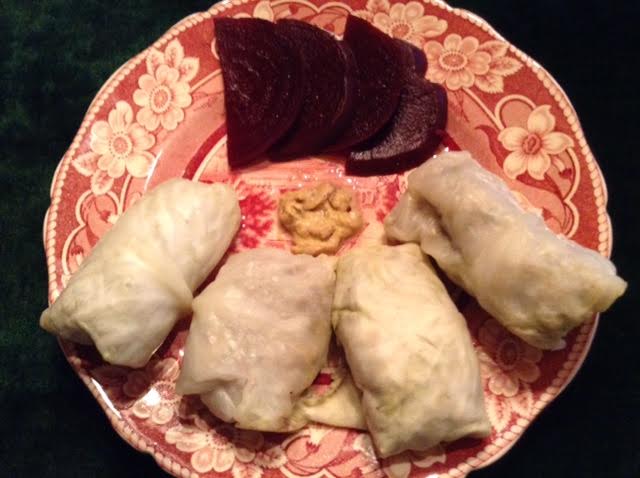
Borscht: 188 calories 3.4 g fat 6 g fiber 10 g protein 30.5 g carbs 117 mg Calcium   PB GF  In Russia, this soup is pureed and served cold in the Summer. This Ukrainian version is eaten in the Winter, hot and chunky and satisfying. Local versions of this soup are found in Poland, Lithuania, Latvia, Estonia, and Belarus.

4 cups = 4 Servings
12 oz roasted beets, skins removed Grate beets to produce ~ 2 cups
1 Tbsp butter
½ carrot
½ stalk celery
½ cup parsnip
½ potato
1/2 stalk celery
¼ small head cabbage
2 Tbsp parsley, chopped
2 tsp thyme, chopped
½ tsp sweet paprika
l large garlic clove
Cut carrot, celery, parsnip, and potato into a ½” dice. 
Slice celery into 1/2″ pieces.
Shred cabbage thinly.
Chop garlic finely.
In a Dutch oven, melt butter. Cook these ingredients ~10 mins until softened but not browned
1 bay leaf
4 allspice berries
8 black peppercorns
Tie spices in a bag or put in tea ball, then add to pot.
2 c. beef/chicken stock
1½ c water
1 c canned tomatoes
Chop tomatoes, if necessary. Add these and simmer ~30 minutes, until vegetables are tender.
Grated beets
2 oz chicken kielbasa
1 c canned, drained small white beans
Cut sausage lengthwise, then slice crosswise ½“ thick. Add to pot with beets and beans.
Simmer ~10 minutes
1 Tbsp red wine vinegar
1½ tsp sugar
Stir in, season to taste with salt+pepper.
optional: Sour cream or plain yogurt
chopped dill
Finn Crisp crackers or Sourdough Rye bread
Ladle into bowls, dollop with sour cream sprinkled with dill. Serve with bread-stuff of choice or omit.

Stealing the Mona Lisa

How this Fast Diet Lifestyle works: Eat these meals tomorrow, for a calorie total of less than 600. On another day this week, eat the meals from a different post, another day of eating 600 calories or less. Eat sensibly the other days of the week. That’s it: a simple way to lose weight and be healthier. 

The original Mona Lisa is on permanent display at the the Musee du Louvre in Paris.

Pity poor Mona Lisa: she has been through a lot. Lisa Gherardini lived in Firenze/Florence, Italy, and she married a silk merchant named Francesco del Giocondo. In the language of the time, one would address a lady as “Ma Donna” [my lady], which contracted to “Mona.” Thus, the lady was Mona Lisa del Giocondo. According to the popular story, Signor del Giocondo commissioned a local artist, Leonardo Da Vinci to paint his wife’s portrait in 1507. Da Vinci either loved the painting so much that he could not bear to hand it over to his patron, or he was not happy with certain details. At any rate, the artist kept the painting, and continuously re-touched it for the next four years. He took it with him to Rome, and he lugged it to Amboise, France where he worked for King Francois I. When Da Vinci died in 1519, the portrait became part of the King’s collection when he bought it from the estate. From there, rulers displayed it at Chateau Fontainebleau, then Versailles, then in the Musee du Louvre after the Revolution. It was considered a minor painting of the collection — so minor that its theft in 1911 wasn’t noticed for more than a day! The thief was Vincenzo Perugia, an Italian national who worked as a carpenter at the Louvre. The search for the missing artwork was intense and theories abounded — was it a jealous artist? an anarchist? On September 7, poet Guillaume Apollinaire was arrested for the crime, and he implicated Pablo Picasso. Perugia kept the painting for two years, but was undone when he tried to sell it to an art dealer in Firenze. He was busted, tried, and sentenced to eight months in prison. The theft made the painting world famous. Since its return, it has been slashed with a knife, splashed with acid, been hit by a tea cup, splattered with paint, and smeared with cake. That is why the lady is now behind bullet-proof glass.

Our breakfast consists of ingredients that Italians would relish — both in Da Vinci’s time and today. The dinner is more in keeping with the budget of the laborer who said that he wanted “to restore La Jocande to her homeland.”

Prosciutto ScrOmelette: 153 calories  8 g fat 1.6 g fiber 11.6 g protein 9 g carbs 47 mg Calcium  NB: Food values shown are for the ScrOmelette and fruit only, and do not include the optional beverages.  PB GF  The earthy flavor of mushrooms [wild ones if you can] combines deliciously with cured meat and eggs at breakfast.

1½ two-oz eggs  HINT: If you are serving one person, crack three 2-oz eggs into a small bowl or glass measuring cup. Whip up those eggs and pour half of their volume into a jar with a lid and put it in the ‘fridge for next week.   ¼ oz prosciutto ½ oz mushrooms ¾ oz pear   Optional: blackish coffee [53 calories] or blackish tea or mocha cafe au lait [65 calories] or lemon in hot water  Optional: 5 oz fruit smoothie or berry-yogurt smoothie [88 calories]

Whisk the chopped meat and mushrooms with the eggs. Pour into a lightly-spritzed non-stick saute pan and scramble to your liking. Plate with the pear and the beverages of your choice.

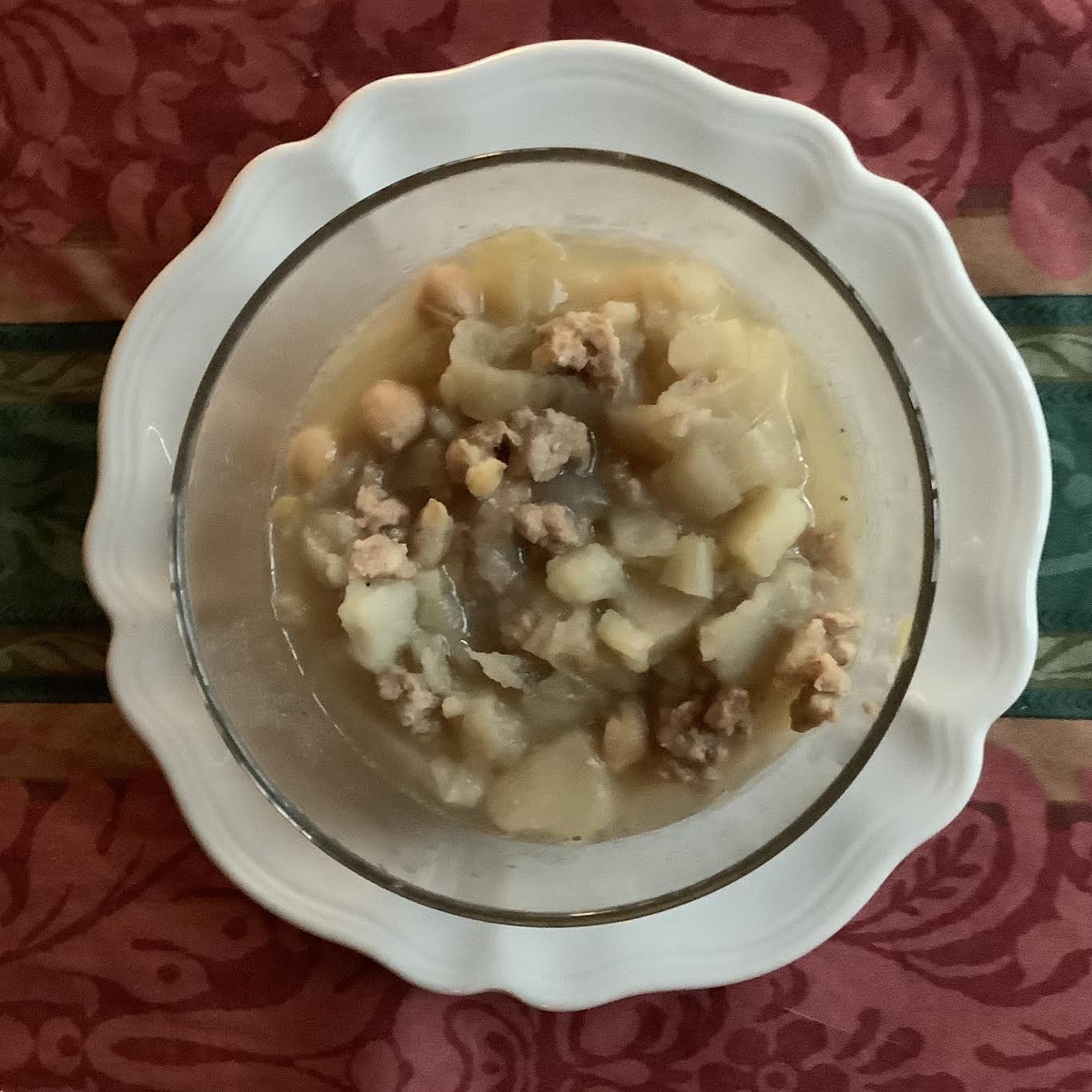
Chickpea Ragout with Meat: nb: entire batch has 484 calories, so divide into portions. The portion size you choose would be dictated by the type and quantity of meat. GF PB divided in 2:  242 calories 5 g fat 10 g fiber 11.5 g protein 40 g carbs 51 mg Calcium divided in 4: 121 calories 3 g fat 5 g fiber 6 g protein 20 g carbs 26 mg Calcium

This is from Jacques Pepin’s Fast Food My Way. Although he doesn’t mean my kind of ‘Fast Food,’ Pepin has long been a proponent of healthy cooking. He presents this as a side dish, but for our purposes it is best prepared as a main course with meat for more protein. 

½ tsp olive oil ½ cup diced onions ½ cup scallions, chopped 1 Tbsp garlic 2 cups diced tomatoes, fresh or canned and drained 1½ cup chickpeas, drained and rinsed if canned ½ cup chicken stock ½ tsp salt ½ tsp pepper a few leaves of baby spinach

Heat the oil in a saute pan. Add the onion, scallion and garlic. Stir briefly over the heat then add the tomatoes, chickpeas, salt, and pepper. Cook over low heat until liquids are mostly evaporated, adding the spinach at the end so it wilts. If using now, separate out your portion and keep warm. Cool the remaining ragout and freeze it in serving portions. Add one of the following meats. >3 oz chicken breast [if cooked, mix in with the ragout to warm the meat] [if meat is raw, add to the pan along with the tomatoes and chickpeas] >>3 oz pork tenderloin [if cooked, mix in with the ragout to warm the meat] [if meat is raw, add to the pan along with the tomatoes and chickpeas] >>>2 oz lean beef pieces, not ground beef [if cooked, mix in with the ragout to warm the meat] [if meat is raw, add to the pan along with the tomatoes and chickpeas]

Ingredients for next week: Breakfast, single portion for Monday …………………………… single portion for Thursday:

Sourdough rye bread1.5 two-oz eggs  + Italian herbs
3%-fat ham slicecrushed tomatoes + ricotta cheese
Camembert or Hermelin cheesegarlic + mozzarella + onion
plum — yellow or dark bluecrushed red pepper + melon
optional smoothieoptional smoothie
optional hot beverageoptional hot beverage

Dinner, single portion for Monday:………………………….. single portion for Thursday:

beets + beef/chicken broth + buttermaifun brown rice noodles
leek + parsnip + potato + cabbage + celeryraw shrimp + ground cumin
paprika + garlic + canned tomatoes + carrotolive oil + garlic + lime juice
canned white beans + chicken/turkey kielbasacilantro + cupped lettuce leaves
Sparkling waterSparkling water

Great Fire of London

How this Fast Diet Lifestyle works: Eat these meals tomorrow, for a calorie total of less than 600. On another day this week, eat the meals from a different post, another day of eating 600 calories or less. Eat sensibly the other days of the week. That’s it: a simple way to lose weight and be healthier. Welcome to ______ who is now Following.

Pulling down buildings was a common technique for fire suppression.

In 1666, residents of London, England must surely have thought that they were the victims of God’s wrath. In 1665, the Black Death came to call. And on 2 September 1666, a fire got out of control at the King’s bakery in Pudding Lane. Fires were common then, but extremely dry conditions, high air temperatures, many wooden houses, and a strong East wind combined to create a conflagration that no one could subdue. Fire brigades, aided by King Charles II himself, poured buckets of water on the flames. Buildings were pulled down in hopes of stopping the fire’s advance. Nothing worked. The public panicked, fleeing to the River Thames for relief from the heat and escape from the city. Dynamite leveled whole neighborhoods — causing fears of a French invasion — but the flames were undeterred. On 6 September, the fire was put out and the damage was surveyed. Huge swaths of the city were destroyed, along with the original Saint Paul’s Cathedral and 89 parish churches. Most of the civic buildings were leveled and 13,000 private dwellings were gone. Tens of thousands were homeless, living in refugee camps outside the city. Astonishingly, only 6 deaths were reported. In a way, the fire ‘cleansed’ the old city [of rats that carried the Plague; of tiny lanes filthy with poor sanitation], an opportunity for a more modern metropolis. Sir Christopher Wren drew up a plan for new city streets, but it was never implemented. He designed a new St Paul’s Cathedral and 57 replacement churches. His St Paul’s still stands, despite Nazi bombings during the Blitz — a symbol of resilience and refusal to give in to pressure. Does it seem that history repeats itself? In 2023, we have had three years of a newer ‘plague,’ hot, dry weather has fanned fires from Maui to Maiorca, and disaster refugees are homeless all over the world. Wrath of God? Or a ‘message’ telling us that the climate has changed drastically and that we must take active steps to prevent further loss. Resilience is a good thing when it spurs us to do what is necessary.

Our breakfast is not of that era, but it is as typically English as Wren’s cathedral. In the same decade of the Great Fire, the East India Company was begun, ‘negotiating’ trade routes and deals [at gunpoint, often], to bring the Spices of the East to the English table. Our dinner is made possible by that trade.

Improper English with Egg: 127 calories 3 g fat 3 g fiber 10 g protein 16.6 g carbs 42.5 mg Calcium  NB: The food values given above are for the plated foods only, not the optional beverages.  PB GF  The ‘proper English breakfast’ is a meal of generous proportions: several meats, eggs, mushrooms, toast, kippers, tomatoes, baked beans, plus whatever else the host cares to add. This is not a meal for a Fast Day. But wait! By taking the healthiest elements and scaling down the amounts, we can achieve all the flavor along with more balanced nutrition.

½ cup baked beans ½ hard-boiled egg 2½ oz tomato, sliced thickly pinch grated Parmesan cheese 1 slice ‘Canadian’ bacon  Optional: blackish coffee [53 calories] or blackish tea or mocha cafe au lait [65 calories]   Optional: 5-6 oz fruit smoothie or berry-yogurt smoothie [88 calories]

Warm the beans. Place the tomato and bacon in a broiler-safe dish. Sprinkle the tomato with salt and Parmesan cheese. Broil until warm and cooked. Peel, slice, and plate the egg half along with the other elements. Proper delicious, that is.

Kedgeree: 250 calories 6 g fat 2 g fiber 22 g protein 26 g carbs 101 mg Calcium   PB GF This Anglo-Indian fusion dish is flavorful and quickly prepared. HINT: This recipe serves two [2] people.

3 oz smoked haddock [aka: finnen haddie]   ½ cup milk  1 bay leaf
 ¼ cup chopped onion 
Put smoked haddock, milk, bay leaf, and onion in a small pan with a lid. Simmer 10 minutes. Remove fish from milk, skin it, and pull apart into large shreds. Strain milk and put it back in the sauce pan. 
2/3 cup cooked brown rice*  1/5 tsp curry powder  ½ tsp turmericAdd rice and spices and shredded fish to milk in the pan, and put on low heat, covered.[* brown rice is preferred as it has more nutrition] 
5 oz asparagus cut into 1½” piecesCook separately until just tender. Add to the rice/fish.
2 hardboiled eggsPeel + cut each into 8 pieces. Strew atop each serving.

Slow Days: Fettuccine with Mussels

People who are new to Fasting often pose the questions: “Can I really eat ‘anything I want’ on a Slow Day?” and “What should I eat on Slow Days?” To answer those questions, I have decided to add some blog posts to show some of the foods we eat on what the world calls NFDs [non-fast days] but which, in our house, we call ‘Slow Days.’ This feature will appear sporadically. 

Now for the answers. Can you really eat ANYTHING you want on a Slow Day? Not really. If you eat too many calories every Slow Day, you will not lose weight. There are many comments on the Fast Diet Forum which attest to that. Once in a while you can splurge, as long as it isn’t everyday. For what to eat on Slow Days, Dr. Mosley recommends a Mediterranean Diet. As for how we eat, an example follows.

In Summertime, we eat mussels. “Rope-grown mussels” are a big industry where we vacation in PEI, Canada, and we take full advantage of them. Years ago, when we first started going to the local mussel processing plant to buy them, they sold for 50 cents/pound. Even though they are $2/pound now, they are worth it. One of our favorite ways to prepare them is a recipe from A Well-Seasoned Appetite by Molly O’Neil. You can prepare these with fresh mussels in their shells, or use cooked mussel meat that has been removed from the shells. We prefer the latter, and find it to be a good way to use left-over mussels from a previous feed. Very quick, very easy, very good.

A mise en place is always a good way to start.
Serves 3
1 T. olive oil
½ c water
½ c white wine
4 cloves garlic, minced
Add to a stock pot, bring to a strong simmer.
32 mussels in shellsAdd mussels to pot and cook until all shells are wide open. Remove from shells or not, according to preference. Strain liquid and save.
1-2 Tbsp whole wheat flour 
3 Tbsp water
Stir these into a paste, and whisk into strained pot liquor. Reduce cooking liquid to 1 cup.
6 Tbsp cream
pepper to taste
Add to reduced stock and warm over low heat until thickened. Add mussels to warm them.
2 oz whole-grain pasta/serving 1 Tbsp chopped parsley/servingPlate pasta, pour mussels-cream sauce over pasta.
Garnish with parsley. Serve with a crisp side salad.

Independence x4

How this Fast Diet Lifestyle works: Eat these meals tomorrow, for a calorie total of less than 600. On another day this week, eat the meals from a different post, another day of eating 600 calories or less. Eat sensibly the other days of the week. That’s it: a simple way to lose weight and be healthier.

Freedom is a wonderful thing. Having a country that is independent, where the people can determine their own destiny, is a wonderful thing. On August 31, in various years, five nations gained their independence from another nation. Let’s celebrate! In 1957, Malaya [now Malaysia] gained independence from the United Kingdom. The day is now marked as Hari Merdeka (“Independence Day”) or Hari Kebangsaan (“National Day”). In 1962, the British Empire cracked apart a bit more, for Trinidad and Tobago became independent. In 1991, Kyrgyzstan declared that it was independent of the Soviet Union, after centuries of being under the rule of larger conquerers — like the Mongols, and the Russians. Speaking of the Russians, in 1993, Russia finally removed all of its troops from Lithuania, and did the same thing on the same day in Estonia in 1994. The soldiers had been in both countries since 1940. Of course, all new nations have some growing pains: stabilizing their economies, creating a working government, breaking bad habits formed under another country’s influence, enforcing laws that are more attuned to the local cultural needs. Here are some results of their independence.  Malaysia rotates the monarchy among the rulers of the nine ethnic Malay states, each being king for a five-year term. Trinidad and Tobago has the 3rd highest GDP per capita in the Americas, based in part on its huge reserve of asphalt. Unfortunately, sparsely-populated Kyrgyzstan is the poorest nation in central Asia. Despite its gold exports, 30% of the country’s income is from remittances. After joining the EU in 2004, Lithuania saw a 50% increase in the GDP per capita, greatly improving the peoples’ health and prosperity. Estonia was named the 8th best country to live in according to the 2015 Index of Economic Freedom. Sounds as if national self-determination is better than subjugation, doesn’t it.

Three recipes to celebrate freedom and independence in five nations. A breakfast from the Malay Peninsula [if not exactly from Malaysia]; flatbreads for Kyrgizstan as well as Trinidad and Tobago, where such breads are enjoyed; a smoked salmon meal from Lithuania which is surely prepared [although with local variation] in Estonia as well.

Thai ScrOmelette: 138 calories 7.5 g fat 1 g fiber 11 g protein 6 g carbs 75.6 mg Calcium  NB: Food values shown are for the ScrOmelette and fruit only, and do not include the optional beverages. PB GF Our younger son prepared a marvelous Thai fried rice dinner for us which bowled us over with its flavors. Here are the same flavors, without the white rice. Still marvelous.

1½ two-oz eggs  HINT: If you are serving one person, crack three 2-oz eggs into a small bowl or glass measuring cup. Whip up those eggs and pour half of their volume into a jar with a lid and put it in the ‘fridge for next week.  1 clove garlic, chopped 3 Tbsp scallions, sliced 2 Tbsp cooked, chopped spinach [about ½ oz] ½ tsp Thai fish sauce ¼ tsp Thai hot chili sauce big pinch dried basil 1.5 oz melon OR applesauce  Optional: blackish coffee [53 calories] or blackish tea or mocha cafe au lait [65 calories] or lemon in hot water  Optional: 5 oz fruit smoothie or berry-yogurt smoothie [88 calories]

Combine the garlic, scallions, spinach, the 2 sauces, and basil. Spritz a fry pan with olive oil or non-stick spray. Heat the pan and stir the vegetables until they are warm and soft. Whisk the eggs and pour them into the pan, stirring to mix with the vegetables. Cook until done to your liking. Plate with the fruit and enjoy with the beverages.

Two Flatbreads to enjoy as part of any meal on a Slow Day. Be sure to take calories into account for a Fast Day.

FLATBREAD Sv. 6 ultimatedanielfast.com Preheat oven to 400F
17×11” baking sheet
LAVASH Vera Abitbol @ 196flavors.com
Makes 16 lavash sheets
Griddle or wide skillet or baking sheets
2½ c whole grain flour: brown rice or spelt or whole wheat
2 Tbsp flaxseed mea
1 tsp dried rosemary
1 tsp salt
1 c warm water
Flaxseed meal is optional. Crush rosemary as you add it. Mix these in a food processor until dough forms a ball.2 c white whole wheat flour 
1 c white flour
Add flour to bowl of a stand mixer with a paddle attachment. Make a well in center of flours.
Turn dough onto a floured surface, and knead  5 mins. Or pulse 15x in food processor.½ tsp salt
1 c. warm water (95 F/36˚C)
Put salt in well. Run at medium speed, adding water slowly. Dough should be soft, homogeneous, and come off walls of bowl.
Cover with a bowl. Let rest at room temp 30-60 mins.Cover bowl of dough. Let rest in a warm place 30 mins. 
Roll out to ¼” thick and move it to an oiled 11×17” baking sheet. With a fork, poke holes all over. Roll dough thinly on a lightly floured surface. Fold sides in to make 4 layers. Let rest 30 mins in a warm place.
1 Tbsp extra-virgin olive oil ½ tsp dried basil ½ tsp garlic powder
½ tsp dried parsley
Mix these in a small bowl, and stir well. Use a basting brush to spread oil mixture across dough. Cut dough in 2. Roll and fold each piece 4x to make dough elastic. Preheat oven 30 mins to 430F/220˚C OR heat griddle
Score (make shallow cuts without cutting through) with a knife into 12 pieces, measuring 3×3½”.Divide dough into 4. Roll out to 1/16”/1.5mm thick. OR pass through pasta machine to setting 6 or 7 
Bake 15-20 mins or until slightly crispy, and remove from oven. In ovenPut dough pieces on a hot baking sheet and bake 4-5 mins.
Let cool on baking sheet 10 mins before cutting and serving.on a griddle or on a skilletPut dough pieces on very hot pan and cook ~1 min per side
Full batch = 1220 calories 24 g fat 30 g fiber 40 g protein 220 g carbs 100 mg Calcium1 of 12 pieces = 101 calories 2 g fat 2.5 g fiber 3.5 g protein 17 g carbs 8 mg CalciumFull batch = 1320 calories 18 g fat 25 g fiber 48 g protein 264 g carbs 80 mg Calcium Makes 20.2 oz =573 g= 16 piece1 oz = 66 calories 1 g fat 1.25 g fiber 2.4 g protein 13 g carbs 4 mg Calcium


Lithuanian Smoked Salmon Salad: 282 calories 11 g fat 3.5 g fiber 19 .5 g protein 25 g carbs 30 mg Calcium  PB GF – if using GF bread or omitting This was a treat to eat at the now-closed Alameda, California restaurant Mama Papa Lithuania, so I tried to emulate it at home. And here it is.  HINT: Serves two.

1 cup cucumber, cubed ½ c tomatoes, cubed ½ c. romaine lettuce, cut as chiffonade 1 c. smoked salmon, shredded ¼ c red onion, thinly sliced 1 two-oz hard-boiled egg, chopped 2 Tbsp honey-dill dressing*   optional: 1 oz flatbread OR 1 oz sourdough rye bread per serving

*Honey-Dill Dressing makes 1/3 cup
 1 Tbsp = 59 calories 5.4 g fat 2.6 g carbs 3 mg Calcium   2 Tbsp extra virgin olive oil 2 Tbsp red wine vinegar 2 Tbsp chopped dill 1 Tbsp honey Whisk together.
Toss together all ingredients, plate with bread.

Ingredients for next week: Breakfast, single portion for Monday …………………………… single portion for Thursday:

1 two-oz egg [US large], hard-boiled1.5 two-oz eggs 
tomato + Parmesan cheeseprosciutto
baked beansmushrooms [preferably wild]
Canadian bacon or back baconpear
optional smoothieoptional smoothie
optional hot beverageoptional hot beverage

Dinner, single portion for Monday:………………………….. single portion for Thursday:

finnen haddie = smoked haddock3 oz pork tenderloin, raw or cooked
hard-boiled egg + asparagusChickpea Ragout
curry powder + turmeric + milk
brown rice + bay leaf + onion
Sparkling waterSparkling water