Hometown Heroine: Mount Tabor

How this Fast Diet Lifestyle works: Eat these meals tomorrow, for a calorie total of less than 600. On another day this week, eat the meals from a different post, another day of eating 600 calories or less. Eat sensibly the other days of the week. That’s it: a simple way to lose weight and be healthier.

Deborah, by Gustave Dore

Deborah and her husband  Lapidoth lived in the Levant in the early 1100s BCE. At that time, there was no Kingdom of Israel, only 12 tribes following their flocks across the Promised Land. They worshipped their god Yahweh in a windowless tent which housed the Ark of the Covenant containing the 10 Commandments. The space was lighted by a golden menorah fueled by olive oil, and Deborah was the tender of the menorah. Because she was a wise woman and a prophet, people came to her with their problems as she sat under a date-palm tree. Their individual problems were small com-pared to those of the tribes of Israel. For 20 years, the Israelites had been under the rule of King Jabin of Hazor. This was said to be a punishment for not having followed Yahweh’s ways. Jabin and his Canaanites resented the incoming Children of Israel, and they subjugated the Israelites by superior force and weaponry. No one dared stand up to them. One day, Deborah called the warrior Barak to her. She revealed that the Lord wanted him to take 10,000 men to Mount Tabor to fight the Canaanites. He said he would go only if Deborah went with him into the fight. She agreed, but teased him with the thought that history would name a woman as the victor of the engagement. Barak was fine with that, so their army made camp on the mountain. When the Canaanites found out, they took their 900 iron chariots, their heavy horses, and their army to the Kishon River valley at the mountain’s base. As Deborah foresaw, it rained heavily that night. When the Israelites stormed down the hillside the next morning, the enemy chariots were mired in mud. The river overflowed, drowning many soldiers and horses. The Canaanites who were left were struck down by the Israelites. Deborah’s army had won! In Judges 5, we find one of the earliest writings in the Bible, The Song of Deborah, said to have been written by the victor herself. Deborah was declared to be a rescuer [that is to say a ‘judge’] of Israel, and peace reigned for 40 years. We could use some peace in our time, and in our children’s time as well.

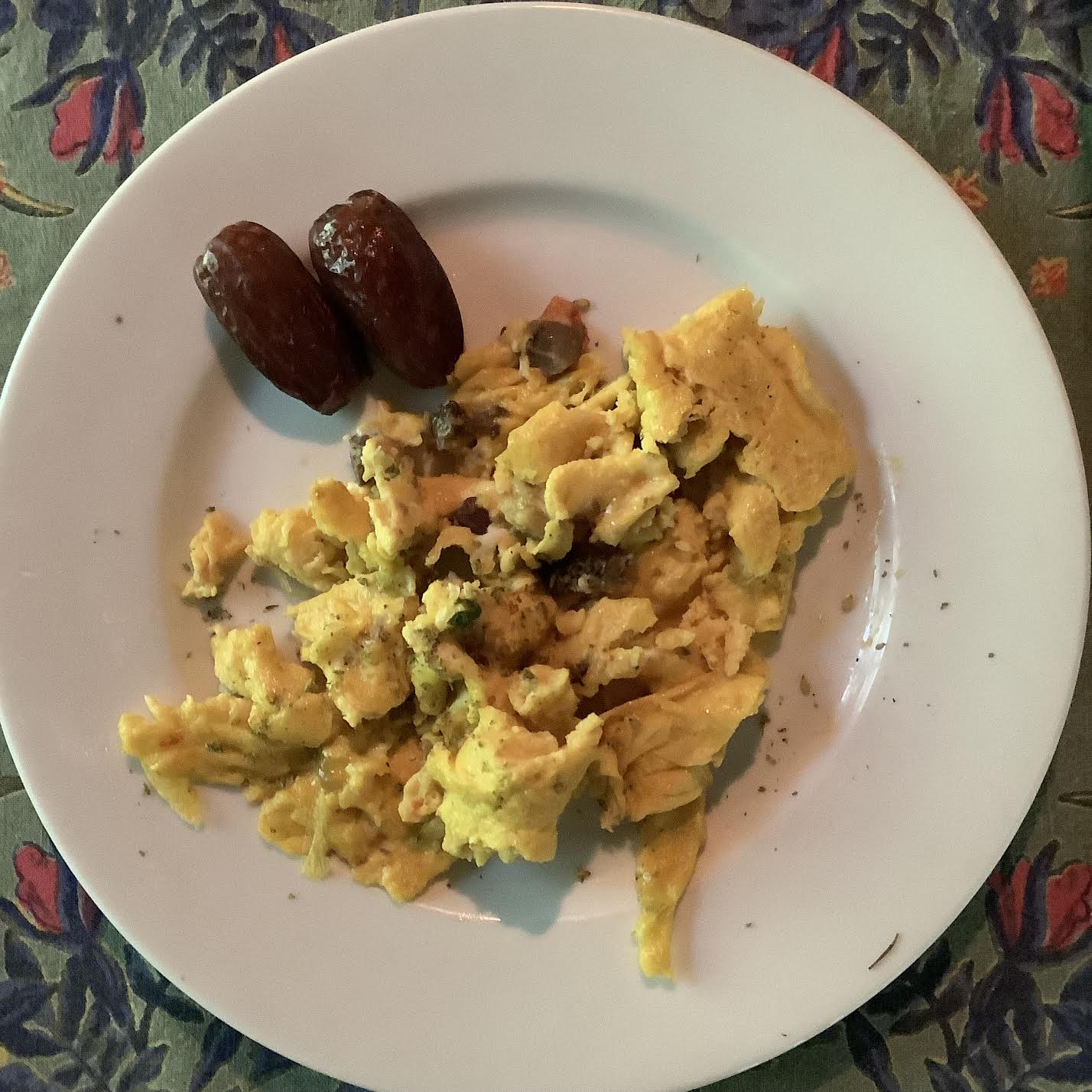
Our breakfast is made from ingredients typical of the Levant [the land where the sun rises]: hummus, olive, dates [for Deborah’s date-palm], local vegetables. The dinner similar to our’s might have appeared on the Kosher table for Deborah and her family.

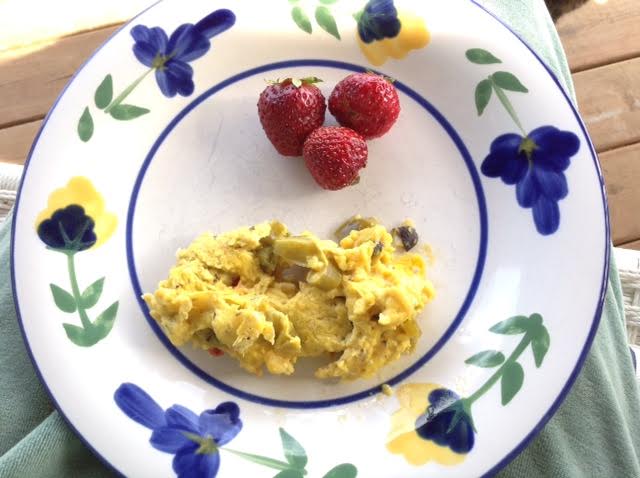
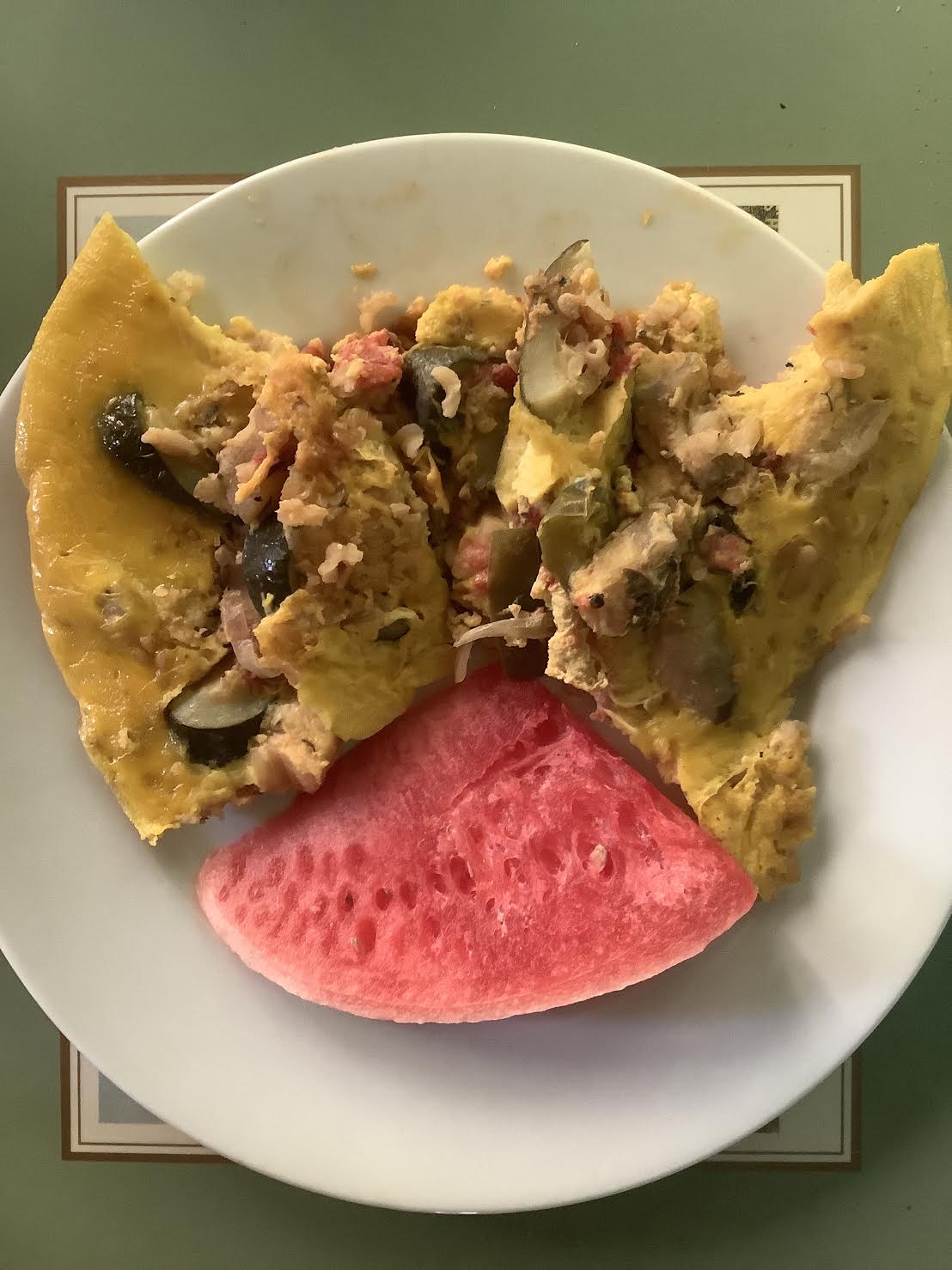
Levantine ScrOmelette: 142 calories 8 g fat 1 g fiber 10 g protein 5 g carbs 50.5 mg Calcium  NB: Food values shown are for the ScrOmelette and fruit only, and do not include the optional beveragesPB GF  These fine ingredients yield a flavorful result. The sun rising in the East will smile on you.

1½ eggs HINT: If you are serving one person, crack three 2-oz eggs into a small bowl or glass measuring cup. Whip up those eggs and pour half of their volume, into a jar with a lid and put it in the ‘fridge for next week.  1 Tbsp Mediterranian vegetables, chopped 1.5 tsp hummus** 1 black olive, minced 2 deglet noor dates  Optional: blackish coffee [53 calories] or blackish tea or mocha cafe au lait [65 calories]   Optional: 5 oz fruit smoothie or berry-yogurt smoothie [88 calories]

Whisk the eggs, then stir in the hummus and vegetables. Pour into a saute pan which has been spritzed with non-stick spray and scramble to your taste or prepare as an omelette. Pour the optional beverages and plate with the fruit.

**HUMMUS: makes 2 cups  Recipe from Mollie Katzen’s Moosewood Cookbook.  1 can [15-oz] chickpeas, drained + rinsed 4 cloves garlic, smashed 1½ tsp salt 4 tsp lemon juice 5 T tahini black pepper + cayenne ¼ c chopped scallions/onions Put everything in the food processor and whizz until smooth. Taste for seasonings. Freezes well. Variation: Add a few slices of cooked beet to obtain an amazing pink color.

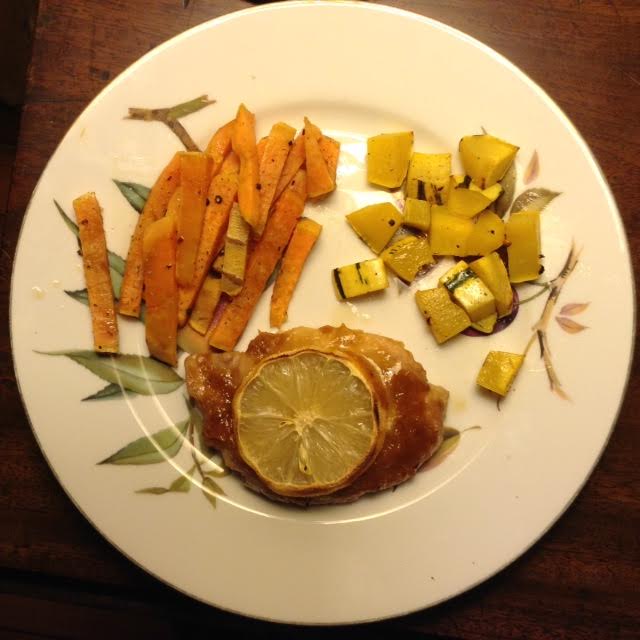
Apricot-Glazed Lemon Chicken:  262 calories 2 g fat 3.4 g fiber 28 g protein 33 g carbs 56.5 mg Calcium  PB GF  Lightly sweet, slightly sour. This chicken is very easy to prepare and it is delicious. You will want to eat this often. The recipe comes from the Great Hadassah Wizo Cookbook, via Omgyummy.com. So you know that then I modified it….

4 oz boneless, skinless chicken breast 1.5 tsp apricot preserves/jam ½ tsp chopped lemon zest 1 tsp fresh lemon juice 1 tsp Dijon mustard 1 or 2 slices of lemon ½ cup delicata squash, cubed 3 oz sweet potatoes garlic powder paprika pepper + salt

Take one boneless chicken breast and place it on a cutting board. Put one hand flat on top of it and cut through the meat parallel to the cutting board. This should give you two equal pieces of breast meat, each 3-4 ounces. [If serving one person, save one of the fillets for another meal.] Whisk the jam, mustard, lemon juice, and zest. If the jam is too solid, warm it gently so it will combine with the other ingredients. Spray a baking pan or pie plate with olive oil and put in the chicken. Pour the sauce over it and place the lemon slices on top. Cut the delicata squash, skin and all, and put into an oven-proof dish, such as a pie plate. Cut the sweet potato into skinny French Fries, toss them with garlic powder, paprika, and pepper, and add them to the pie plate. Spray liberally with non-stick oil or olive oil. Put the chicken and the vegetables into a 400 F oven for 10 minutes. Remove the vegetables and salt them. Return to oven, raise the temperature to 425 F and continue cooking for 10 more minutes. Happy eating awaits.

Ingredients for next week: Breakfast, single portion for Monday ………………………………. single portion for Thursday:

1 two-oz egg = US largepolenta
whole-grain bread + milkblueberries, fresh or frozen, unsweetened
tomato + strawberriesmaple syrup
cooked fish or chicken + cheese
optional smoothieoptional smoothie
optional hot beverageoptional hot beverage

Dinner, single portion for Monday:……………………………….. single portion for Thursday:

Mediterranean Vegetables  + polenta small amount quail or pheasant meat + rabbit liver
herbes de provence + mushroomsDijon mustard + peas + fresh cranberries
Cod-tilapia-perch + Parmesan cheeserich broth + egg + turkey meat + onion + mace
olive oil + pepper flakes  +  garlic powder carrot + wild boar meat + Arnold sandwich-thin 
Sparkling waterSparkling water

Punic Wars

How this Fast Diet Lifestyle works: Eat these meals tomorrow, for a calorie total of less than 600. On another day this week, eat the meals from a different post, another day of eating 600 calories or less. Eat sensibly the other days of the week. That’s it: a simple way to lose weight and be healthier.

Remember studying the Punic Wars in school? Of course you do –War Elephants crossing the Alps and all that? There were three parts to the wars and they provide a lesson for our times. ”Punic” referred to people of Phoenecian origin who lived in the city of Carthage [in what is now Tunisia]. Prior to 264 BCE, Carthage was the premier city of the western Mediterranean, and trade had made the people rich and comfortable. When Carthage got into a dispute with the little city of Rome over control of Sicily, a war ensued. Despite Carthage’s long sea-faring experience, the neophyte Roman sailors won many battles by boarding the enemy ships with a special gangplank to fight hand-to-hand. Thus Rome gained Sicily and Corsica, and there was peace in 256 BCE. That lasted until 218 BCE, when Carthage tried to get revenge by taking over a city in Spain/Iberia. Those citizens appealed to Rome for help, and the war was on again! The skilled general Hannibal decided to take the fight to Rome. He lead an army through southern France/Gaul and over the Alps — elephants and all!! — into Italy/Roman Empire. After initial victories, the Carthaginian invasion was defeated in 202 BCE. The defeat was due to Carthage not paying its soldiers and not having invested in building up its offensive capabilities. By the third Punic War, 149 BCE, Carthage had become very lazy about treaties and keeping up an army. When Carthage attacked another neighboring kingdom, the Romans — who had built up their army and navy and were ready for anything — decided that Carthage had to be destroyed. And so it was — reduced to rubble. [That story of ‘salting the soil’ afterward… just a legend.] So, was 146 BCE the end of the Punic Wars? Not exactly… On February 5, 1985, 2,131 years after the fighting ended, Ugo Vetere and Chedli Klibi, the mayors of Rome and modern Carthage signed a symbolic peace treaty to end the war and to strengthen ties between the two countries. THAT’S how we should be acting today — maintain your defenses, pay people what they are owed, and make treaties.

Our day begins in Tunisia with a traditional meal. The day will end in Sicily, cause of the 1st Punic War, where our dinner was invented.

Tajine Maadnous:  215 calories 10.5 g fat 1 g fiber 20 g protein 9 g carbs 146.5 mg Calcium   NB: The food values given above are plated foods only, not the optional beveragesPB GF  This popular Tunisian dish is a bit like a quiche, a bit like a fritatta — and completely delicious. The recipe is adapted from one by Kristina Todini at 196flavors.com  HINT: this recipe serves 4 [four] people. Since it can be eaten cold, the left-overs would be fine for another breakfast or for lunch on a Slow Day. Or, if serving two people, cut the recipe in half and bake 18-20 minutes.

Sv 4
¼# chicken breast, raw Cut into small cubes                   
½ tsp olive oilHeat oil and brown meat briefly
¼ tsp turmeric   
1 tsp tomato paste
Add these to the pan, along with salt + pepper.
1 cup water OR 1 cup chicken stockAdd, simmer until liquid is reduced to almost nothing.                        
2 tsp oliveoil                           ¼ bunch flat parsley                       ½ c. onionChop vegetables finely.
Saute in oil in another pan a few mins. Cool.                      
4eggs,beaten                          4 T. dry breadcrumbs                      2 oz. grated mozzarellaWhisk in eggs, add crumbs, cheese.
Mix well, pour into an oil-spritzed baking dish.
Bake @ 350 F/180˚C for 30 mins until top is set and golden.

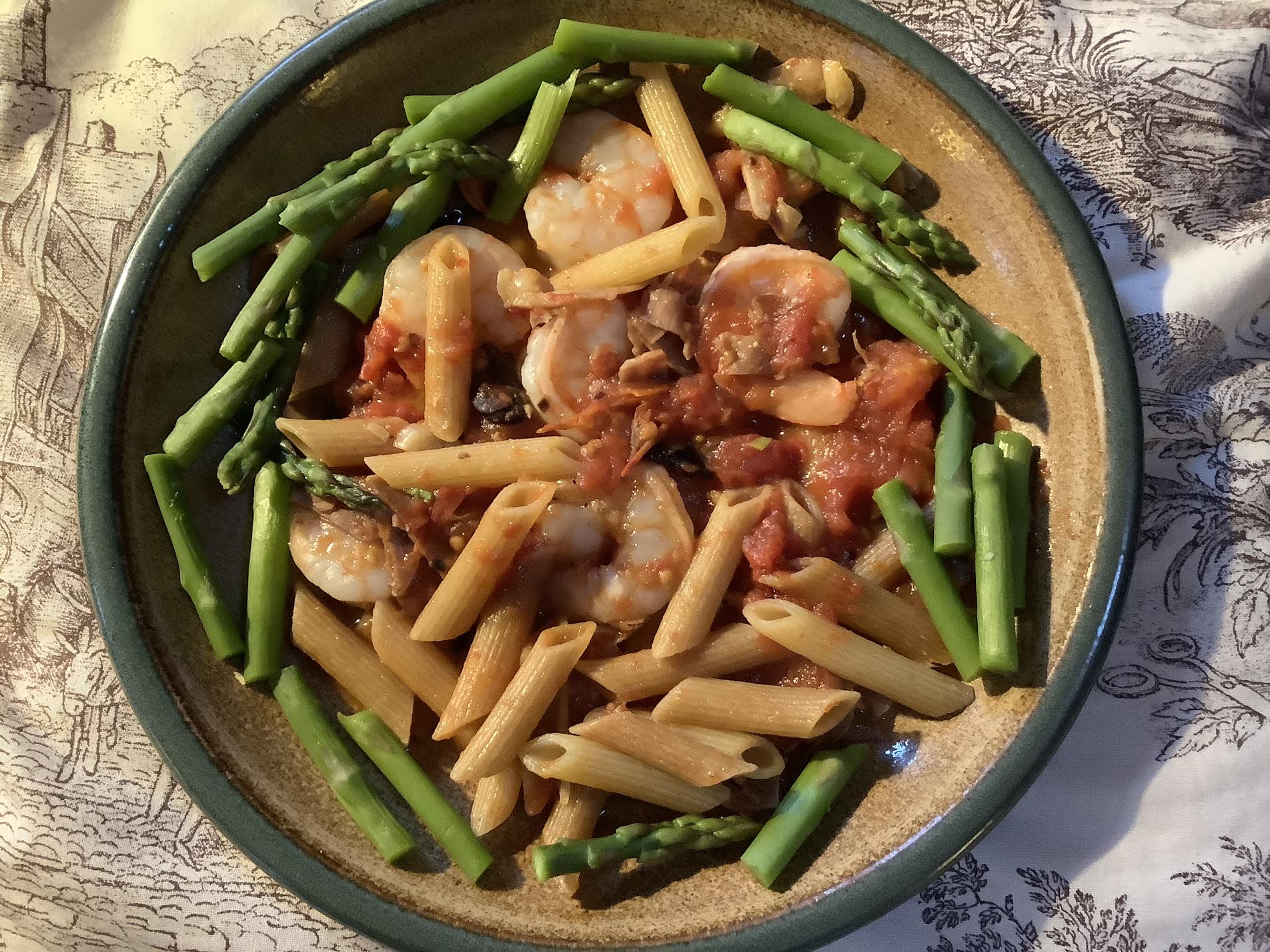
Shrimp Arrabbiata: 287 calories 8.5 g fat 6.4 g fiber 16 g protein 30 g carbs 240 mg Calcium  PB GF – if using GF pasta The box of pasta says that this recipe is from Sarah Leah Chase’s book Cold-Weather Cooking. I added the shrimp and I’m glad I did.  HINT: This recipe serves three [3] people.

1½ oz pancetta or serrano ham, sliced in ribbons  3 cloves garlic, sliced               1 tsp red pepper flakes or more to taste  6 plum tomatoes, diced  3 oz whole-grain ‘penne’ pasta    6 oz shrimp   1 Tbsp grated Parmesan or Romano cheese                     per person: 3 oz asparagus + 1 Tbsp grated Parmesan or Romano cheese

Remove the shells from the shrimp and set aside. Spray a saute pan with non-stick spray. Add the pancetta and garlic and cook until garlic is golden-colored. Add the crushed red peppers and cook for another minute. Add the tomatoes and simmer. Meanwhile, put the pasta in boiling salted water and cook for 3 minutes, then remove pan from heat but do not drain. Scoop out the pasta and add to the tomatoes, along with several tablespoons of the pasta-cooking water. Add the shrimp, some salt, and 1 Tbsp grated cheese to the tomatoes and cook until the shrimp are done. The pasta will continue to cook in the liquid from the tomatoes – if getting too dry, add some more water. Cut the asparagus into 1” pieces and cook in boiling water until soft to your taste. Test the pasta to find out when it is done. Portion and plate with grated cheese on top. Restaurant quality food, at home.


Botany Bay

How this Fast Diet Lifestyle works: Eat these meals tomorrow, for a calorie total of less than 600. On another day this week, eat the meals from a different post, another day of eating 600 calories or less. Eat sensibly the other days of the week. That’s it: a simple way to lose weight and be healthier. Join me in the Fasting Lifestyle!

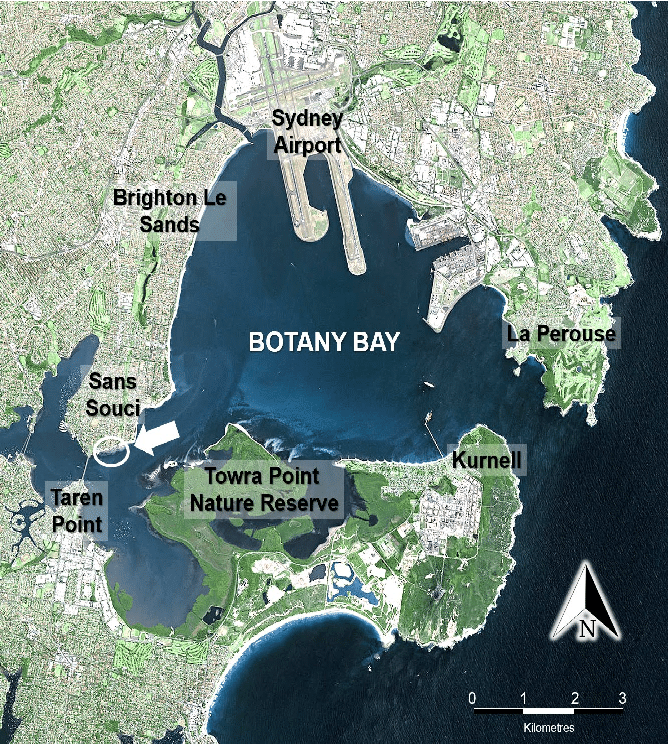
For thousands of years the Tharawal and Eora peoples lived on the shores of Kamay. They fished and foraged and all was well. Until the British came to explore, to settle, to displace. The British named the place Stingrays Bay, then Botanist’s Bay, but soon changed it to Botany. Eighteen years after Captain James Cook first saw the bay, Arthur Phillips arrived on January 18, 1788, with the first shipload of ‘colonists.’ What to do with a vast territory 1000s of miles from Britain? Why, turn it into a penal colony and populate it with felons, of course! There were 19 crimes that could get you sentenced to Botany Bay, including: impersonating an Egyptian; stealing fish from a pond or river; bigamy; and clandestine marriage. The First Fleet consisted of three ships and enough convicts to establish a prison encampment. Phillips was told where to build, but he thought the area too marshy and far from the port, so he moved everyone to Port Jackson. More than 162,000 convicts were transported to Australia from 1788 to 1868, and they built a new nation. Yet ‘Botany Bay’ caught on as a popular term for the sentence of deportation and shorthand for the entire continent of Australia. Many folk songs were written about it and the name even showed up in a popular Star Trek episode. Today the Sydney Airport sits at the north side of the Bay. The Kamay National Park is on the south shore.

There is a plant, Tetragonia tetragonioides, that grows wild in Australia. It is called ‘New Zealand spinach’ although it is not related to spinach. In the garden, it grows well, even in hot climates. In the kitchen, one can use it just like the real spinach. Our meals today utilize spinach, as well as Barramundi, a fish from Australia which can be seen in US markets sometimes.

Chevre & Spinach Bake: 132 calories  7 g fat  2 g fiber  9 g protein 9 g carbs 57 mg Calcium   NB: The food values given above are for the egg bake and fruit only, not the optional beverages. PB GF  This one is really delicious.

1 two-oz egg 2 tsp creamy cheese                              2 Tbsp cooked spinach, drained/squeezed and chopped [if frozen, thaw, drain the night before]     lemon-dill seasoning + salt + pepper          2 oz pear OR 2 oz apple OR applesauce      Optional:  5 oz fruit smoothie or berry-yogurt smoothie [88 calories]    Optional: blackish coffee [53 calories] or blackish tea or mocha cafe au lait [65 calories]

Combine the spinach, cheese, and seasonings. Whisk in the egg and pour into a lightly-oiled or spritzed ramekin. Bake at 350 degrees F. for 12-15 minutes. Meanwhile, prepare the beverages of your choice and plate the fruit. What a nice way to start the day.

Barramundi a la Midi:  249 calories 9.4 g fat  6 g fiber 21.5 g protein 30 g carbs 147 mg Calcium  PB GF  Barramundi is a fish native to Australian waters. For some reason, I decided to prepare it with ingredients from Southern France. And it was great!

3-4 oz barramundi fillet   2 oz/2 cups fresh spinach leaves  ¼ c puttanesca sauce          1 Tbsp black olive sauce**  2 cloves garlic  ¼ c Camargue rice, cooked   2 oz green beans

**Black Olive Sauce  makes ¼ cup   good on fish or eggs   1 Tbsp = 44 calories             1 Tbsp lemon juice  ¼ cup pitted black olives  1½ tsp red wine vinegar  ½ tsp lemon zest      ½ tsp Dijon mustard  1 Tbsp olive oil                             Put olives in a food processor and run the machine until they are ground up, but not a paste. Add remaining ingredients and pulse until they are blended.

Cook the rice [3 parts Water: 1 part Rice] with a clove of garlic, cut in half. Broil or bake the fish. Slice the other garlic and cook it in a saute pan with some cooking spray and a bit of olive oil. After 30 seconds, add the spinach and 2 Tbsp water. Stir until the spinach begins to wilt, then add the sauce and mix them together. Plate the fish, topping it with the olive sauce. Place the spinach and the rice on the plate around the fish. Such a treat.

Ingredients for next week:                                Breakfast, single portion for Monday …………………………… single portion for Thursday:

1 two-oz egg = US large1 two-oz egg 
salt cod + potato flakesmashed potatoes + boiled cabbage
herb savory + strawberriesAmerican streaky bacon, uncured 
Cheddar cheese or ADL cheese, Old or Fortscallion + tomato           
optional smoothieoptional smoothie
optional hot beverageoptional hot beverage

Dinner, single portion for Monday:………………………….. single portion for Thursday:

Tandoori simmer sauce, purchasedmussels  + leeks
low-fat coconut milk + carrotoat bran + whole milk
haddock + red bell pepperCheddar or Welsh aged cheese  
broccoli + 92-calorie naan carrots or green beans
Sparkling waterSparkling water

Slow Days: Fettuccine with Mussels

People who are new to Fasting often pose the questions: “Can I really eat ‘anything I want’ on a Slow Day?” and “What should I eat on Slow Days?” To answer those questions, I have decided to add some blog posts to show some of the foods we eat on what the world calls NFDs [non-fast days] but which, in our house, we call ‘Slow Days.’ This feature will appear sporadically. 

Now for the answers. Can you really eat ANYTHING you want on a Slow Day? Not really. If you eat too many calories every Slow Day, you will not lose weight. There are many comments on the Fast Diet Forum which attest to that. Once in a while you can splurge, as long as it isn’t everyday. For what to eat on Slow Days, Dr. Mosley recommends a Mediterranean Diet. As for how we eat, an example follows.

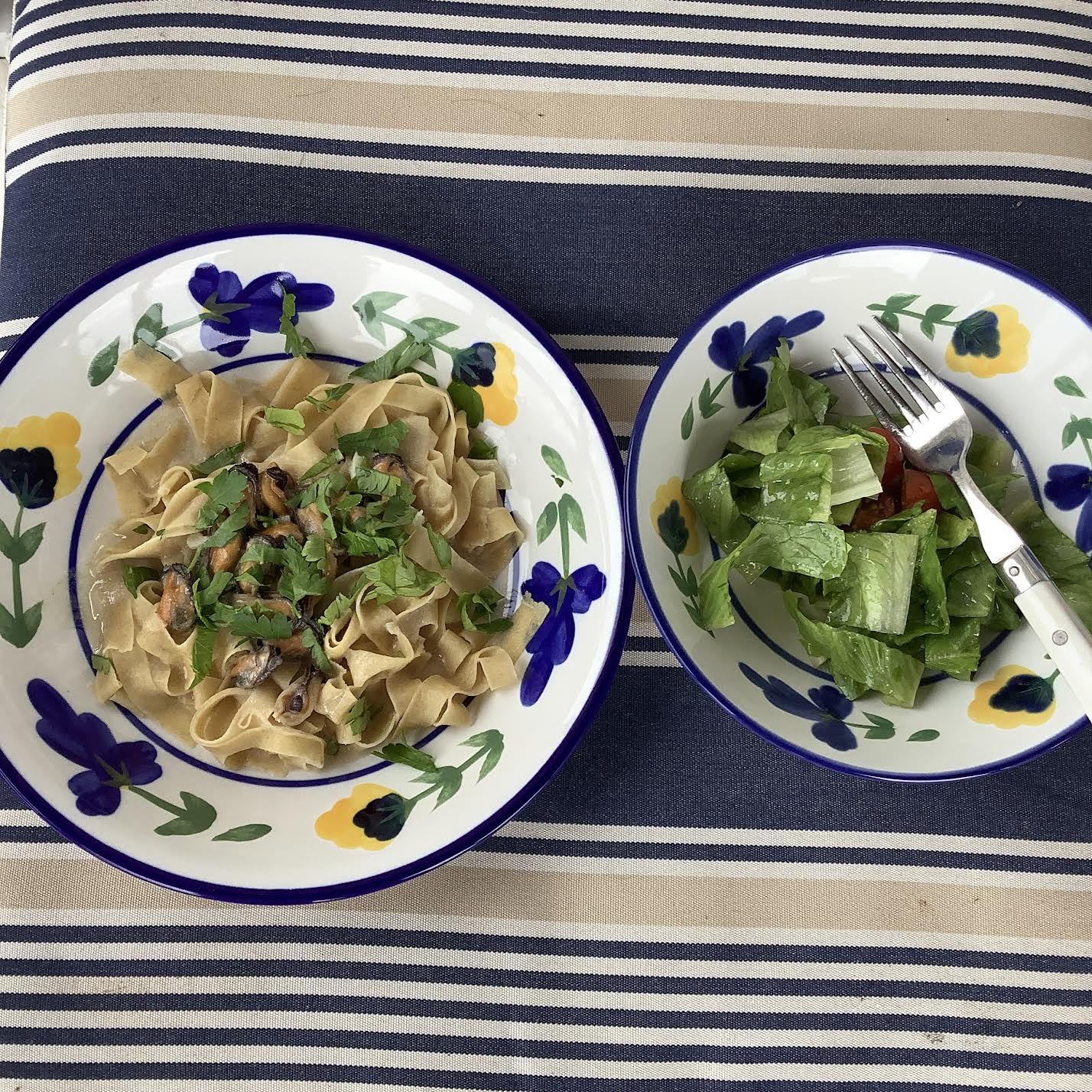
In Summertime, we eat mussels. “Rope-grown mussels” are a big industry where we vacation in PEI, Canada, and we take full advantage of them. Years ago, when we first started going to the local mussel processing plant to buy them, they sold for 50 cents/pound. Even though they are $2/pound now, they are worth it. One of our favorite ways to prepare them is a recipe from A Well-Seasoned Appetite by Molly O’Neil. You can prepare these with fresh mussels in their shells, or use cooked mussel meat that has been removed from the shells. We prefer the latter, and find it to be a good way to use left-over mussels from a previous feed. Very quick, very easy, very good.

A mise en place is always a good way to start.
Serves 3
1 T. olive oil
½ c water
½ c white wine
4 cloves garlic, minced
Add to a stock pot, bring to a strong simmer.
32 mussels in shellsAdd mussels to pot and cook until all shells are wide open. Remove from shells or not, according to preference. Strain liquid and save.
1-2 Tbsp whole wheat flour 
3 Tbsp water
Stir these into a paste, and whisk into strained pot liquor. Reduce cooking liquid to 1 cup.
6 Tbsp cream
pepper to taste
Add to reduced stock and warm over low heat until thickened. Add mussels to warm them.
2 oz whole-grain pasta/serving 1 Tbsp chopped parsley/servingPlate pasta, pour mussels-cream sauce over pasta.
Garnish with parsley. Serve with a crisp side salad.

Slow Days: Farro with Tomatoes and Pesto

People who are new to Fasting often pose the questions: “Can I really eat ‘anything I want’ on a Slow Day?” and “What should I eat on Slow Days?” To answer those questions, I have decided to add some blog posts to show some of the foods we eat on what the world calls NFDs [non-fast days] but which, in our house, we call ‘Slow Days.’ This feature will appear sporadically. 

Now for the answers. Can you really eat ANYTHING you want on a Slow Day? Not really. If you eat too many calories every Slow Day, you will not lose weight. There are many questions asked on the Fast Diet Forum which attest to that. Once in a while you can splurge, as long as it isn’t everyday. For what to eat on Slow Days, Dr. Mosley recommends a Mediterranean Diet. As for how we eat, an example follows.

This recipe is from a New York Times article by Yasmin Fahr. Since we wish to add to our repetoire of whole-grain/Mediterranean Diet recipes, I thought this might be good. I like farro. Dear Husband, who is not wildly enthusiastic about my attempts to add whole grains to our diet, was indeed very enthusiastic about this meal. With almost every fork-full, we exclaimed, “Isn’t this delicious!!” We will decidedly prepare and eat this meal again. And again.

4 servings, original2 servings, my wayHeat oven to 400F. 
1 cup raw farro, rinsed 3 cups salted water½ cup raw farro, rinsed 1½ cups salted waterBring water to a boil. Add farro and adjust heat to keep a medium boil. 
Cook uncovered, stirring a bit so it won’t stick, until tender and a bit chewy, 30 mins.
2 pts cherry tomatoes 7 oz red onion, peeled  2 T. olive oil2 cups cherry tomatoes 3.5 oz/105g red onion
1 tsp olive oil
Cut onion in 1” wedges. On a sheet pan, combine veggies with oil, making sure everything is well coated and glistening. 
Kosher salt + black pepper ½ tsp red-pepper flakes Kosher salt + black pepper ¼ tsp red-pepper flakesAdd seasonings. Roast until tomatoes blister, 25-30 mins.
Cooked farro
¼ c purchased/DIY pesto
Cooked farro 2 T. purchased/DIY pestoMake your own or open a jar you bought. When farro is cooked, drain. Stir in pesto. 
1 T. lemon zest 2 Tbsp lemon juice1.5 tsp lemon zest 1 Tbsp lemon juiceAdd lemon zest and juice. I used only bottled lemon juice, not the zest.
2 packed c. baby spinach½ c. fresh spinach/½ c frzStir spinach into farro. I used frozen.
Roasted vegetables salt & pepperRoasted vegetables salt & pepperScrape farro into vegetables and stir to combine with juices. Season as needed.
4-oz ball fresh mozzarella ¼ c. flat-leaf parsley/basil 1 oz fresh mozzarella 2 T. flat-leaf parsley/basil Tear/cut cheese in chunks. Roughly chop herbs. Stir all into farro, and plate.
Cooked shrimp/chicken/ scallops3.5 oz cooked chicken or scallopsGarnish with protein of choice or not.  I used grilled chicken from Sunday’s meal.

Slow Days: Meze Luncheon

People who are new to Fasting often pose the questions: “Can I really eat ‘anything I want’ on a Slow Day?” and “What should I eat on Slow Days?” To answer those questions, I have decided to add some blog posts to show some of the foods we eat on what the world calls NFDs [non-fast days] but which, in our house, we call ‘Slow Days.’ This feature will appear sporadically. 

Now for the answers. Can you really eat ANYTHING you want on a Slow Day? Not really. If you eat too many calories every Slow Day, you will not lose weight. There are many questions asked on the Fast Diet Forum which attest to that. Once in a while you can splurge, as long as it isn’t everyday. For what to eat on Slow Days, Dr. Mosley recommends a Mediterranean Diet. As for how we eat, an example follows.

Friends were going to drop by for a summer luncheon. We see them only once a year and don’t really know their eating preferences, so we opted for a ‘grazing meal.’ Call it Mezedakia if you are Greek, call it Tapas if you are Spanish, call it Small Bites if you are writing the restaurant appetizer menu. A meal like this offers flexibility and choices for the people around the table, and this assortment is very much in the Mediterranean Diet mode. One can eat as much or as little as one wants. My kind of meal!

Top Row, left to right: Gozleme Bread, Felafel patties Second Row, left to right: Cucumber-Tomato salad, Tzatziki [white, with spreading knife], black olives, cherry tomatoes, watermelon chunks Bottom Row, left to right: Carrots in lemon marinade, za’atar chicken chunks, White Beans with capers

This menu has many make-ahead components, so there is no scrambling at the last minute. And here are the preparation notes:

Gozleme Bread: make ahead

1¼ c white whole wheat flour ½ tsp salt Mix in a 1-Qt-sized bowl. 
¼ c water ¼ c plain yogurt Combine yogurt/water and stir into the flour until well-combined. Add a bit more water if too dry.
On a floured surface, knead ~3 mins, until smooth and elastic. Cover and let sit for a few mins on the counter OR overnight in a cool place.
Roll on a floured surface into flat breads. Divide into sizes for your recipe. Cook on an oil-sprayed skillet 3-4 mins per side until turning brown in spots.

FELAFEL: makes 25 patties  So convenient to have in the freezer for ‘instant’ meals.

2 cups canned chick peas [if you use dried chickpeas, you will get a grainer product. Factor in the time to reconstitute and cook them] 1.5 cloves garlic, crushed [add as much as you enjoy!] ¼ cup celery, minced ¼ c. scallions, sliced 1 two-oz egg 1½ tsp tahini ½ t. cumin ½ t. turmeric ¼ t. cayenne ¼ t. black pepper 1.5 t. salt

Combine in food processer until ingredients form a uniform paste. Scoop into a bowl and chill 1 hour. Form into balls on a silicone mat or parchment paper on a cookie sheet. I used a 1½ Tbsp scoop and then flattened the patties. TIP: You don’t have to bake them now. You could freeze the patties on a cookie sheet, then put them frozen into bags to cook later. Bake at 400F for 10-15 minutes. The patties should be heated through and have an outside ‘crust’ which is firm to the touch. In most recipes, you will cook them further. At this point you want them to be firm enough to store well. There will be about 25 of them. Use now or cool and freeze for later use. 

Cucumber-Tomato Salad: make ahead What a Summer treat!

Sv 4
1 English cucumber, unpeeledTrim off ends of cuke, halve it lengthwise. Cut into ½” dice.
10 oz grape or cherry tomatoes
½ small red onion
Dice tomatoes and red onion. Put all three veg into a bowl.
2 Tbsp olive oil
2 Tbsp red wine vinegar
1 tsp honey
½ tsp Kosher or fine sea salt
¼ tsp black pepper
Whisk these together.Pour dressing over the salad and toss gently to mix.
1 Tbsp chopped fresh parsley/dill /basilGently stir in the fresh herbs, if using. 
Serve immediately or chill in ‘frige 1-2 hrs to let the flavors meld before serving.

Tzatziki:  make ahead This is the traditional Greek condiment. Very refreshing. The recipe comes from themediterraneandish.com and

2½ cups
1 English cucumber or another variety Kosher saltGrate cucumbers whole if using English cucumbers. If using cucumbers with waxy skin, peel and cut in half before grating. Remove and discard seeds. Salt lightly.
Squeeze cucumbers in a clean cloth to remove liquid.
4-5 cloves garlic, minced  1 tsp distilled white vinegar
2 tsp extra virgin olive oil
In a big bowl, combine garlic with these and mix. 
drained cucumber 2 c plain Greek yogurt 
Ground pepper + salt
1 Tbsp chopped fresh dill or mint
Add drained cucumber mixture to the above bowl, then add these ingredients. Stir to combine.
Chill 30 mins -2 hrs before serving with fresh veggies and pita or chips

Carrots in lemon marinade: make ahead Prepare the marinade: In a wide bowl, whisk together 1 tsp olive oil, 1 tsp lemon juice, pinch of granulated garlic, pinch oregano. Cook small carrot sticks until tender and put them into the marinade while they are still hot. Stir at whiles, as the carrots cool on the counter.

Za’atar Chicken: make ahead or grill in front of your guests to show off your skills. Serve the chicken meat in large pieces or cut into 1-inch cubes and serve on picks.

Serves 4Serves 2
5 garlic cloves, pressed zest of 1 lemon 1/3 c yogurt ¼ c chopped fresh cilantro  
3 Tbsp EVOO
1½ Tbsp za’atar
1 Tbsp chopped oregano/marjoram   1¾ tsp salt
¼ tsp ground black pepper
3 cloves garlic
1 Tbsp lemon zest
3 Tbsp yogurt 2 Tbsp cilantro
2 tsp EVOO 2 ½ tsp za’atar 1½ tsp marjoram 1 tsp salt 1/8 tsp pepper
MARINADE – In a large bowl or container, stir together these ingredients.
2¼# boneless, skinless chicken thighs2 thighs with legs, bonedAdd chicken and toss until well coated. Cover and refrigerate for 2+ hrs or overnight.
Heat grill to medium or heat broiler with rack 3” from heat. If broiling instead of grilling, line sheet pan with foil for easier clean up. Take chicken from bowl, shaking off excess marinade, and grill/broil on one side until charred in spots, 5-8 mins. Flip, grill/broil  5-8 mins, until just cooked through.

White Beans with capers: make ahead Drain and rinse canned beans, such as navy or cannellini/white kidney. Stir in 1 Tbsp capers for every cup of beans, along with a pinch or two of salt. Let sit at room temperature to marry the flavors.

Religions: Islam

How this Fast Diet Lifestyle works: Eat these meals tomorrow, for a calorie total of less than 600. On another day this week, eat the meals from a different post, another day of eating 600 calories or less. Eat sensibly the other days of the week. That’s it: a simple way to lose weight and be healthier.

Muhammad ibn Abdullah was born into a prosperous family in Mecca in the year 570 CE. He hardly had a chance to know his family. His father had died before he was born. For his first five years, he lived with a nomadic Bedouin family in the desert. One yer after he returned to his mother, she died. Two years after that, his guardian grandfather died. Then he went to live with an uncle. There he learned to manage camel caravans that plied the trade routes — the ancient Arabian equivalent of owning a long-haul trucking firm. Muhammad became wealthy and gained a loving wife, Khadijah. She herself was rich and influential and 15 years older than her husband. As a respite from his busy life, Muhammad would visit a cave outside of town to meditate and relax for one month each year. In the year 610, when he was in the cave, Muhammad dreamed that an angel came to him, insisting that the man “Read!” Not knowing how to read, Muhammad said that he could not. Finally, the angel dictated a verse which Muhammad said became imprinted on his heart. He hurried home in a state of fear to tell his wife what happened. She comforted him and took the tale to her uncle. Uncle Waraqah was a Christian and a Hebrew scholar. He assured his niece and her husband that the angel was Gabriel and that the message was from The God [known in their language as Allah]. Muhammad began to speak his revelations to his family, and later his friends. All believed him, becoming the first adherents of Islam. His teachings that there is but one God, put him in conflict with local Quraysh tribe, those who guarded the Kaaba. Tradition said that the Kaaba was built by Abraham [patriarch of Judaism and Christianity] and his son Ismael to house a Black Stone that fell from heaven and was given to them by Gabriel. The site was holy to the Bedouin tribes and the building was decorated with statues to many gods. Muhammud and his followers were persecuted and driven from Mecca to Medina. There many more people followed the new religion of Islam, calling themselves Muslims. A treaty with the Quraysh, who had gathered 40 assassins to kill Muhammud, permitted Muslims to make their annual visit to the Kaaba. When the the bargain was broken, the Muslims attacked and gained the city. The gods of the non-believers were thrown out. Expecting death, the Meccans were astonished to be released. From 610-632 CE, Muhammad received words from Allah which he wrote down in the Quran. The final verse was received and recorded within a few weeks of the death of the Prophet on June 22, 633. Islam spread rapidly from the Arabian Peninsula, reaching from China to Spain within 90 years. It is the second largest religion in the world. At the core of their faith are the Five Pillars. Throughout the centuries, Muslims valued knowledge and became great scholars during the time that Europe was in the Dark Ages. It is a pity that the three religions that stem from Abraham cannot see eye to eye, since they preach essentially the same messages.

Islam began in the Levant, so we begin our day with a meal of Levantine ingredients. The Prophet and his initial followers were Arabs, so our dinner contains ingredients that they would have enjoyed.

Levantine ScrOmelette: 142 calories 8 g fat 1 g fiber 10 g protein 5 g carbs 50.5 mg Calcium  NB: Food values shown are for the ScrOmelette and fruit only, and do not include the optional beveragesPB GF  These fine ingredients yield a flavorful result. The sun rising in the East will smile on you.

1 ½ eggs HINT: If you are serving one person, crack three 2-oz eggs into a small bowl or glass measuring cup. Whip up those eggs and pour half of their volume, into a jar with a lid and put it in the ‘fridge for next week.  1 Tbsp mediterranian vegetables, chopped 1.5 tsp hummus** 1 black olive, minced 1 oz strawberries   Optional: blackish coffee [53 calories] or blackish tea or mocha cafe au lait [65 calories] or lemon in hot water  Optional: 5 oz fruit smoothie or berry-yogurt smoothie [88 calories]

Whisk the eggs, then stir in the hummus and vegetables. Pour into a saute pan which has been spritzed with non-stick spray and scramble to your taste or prepare as an omelette. Pour the optional beverages and plate with the berries.

**HUMMUS: makes 2 cups 1 Tbsp = 27 calories 1.5 g fat 0.6 g fiber 0.5 g protein 3 g carbs 1 mg Calcium ¼ c =  108 calories 6 g fat 2.4 g fiber 2 g protein  12 g carbs 4 mg Calcium PB GF  Recipe from Mollie Katzen’s Moosewood Cookbook

1 can chickpeas, drained + rinsed 4 cloves garlic, smashed 1½ tsp salt 4 tsp lemon juice 5 T tahini pepper + cayenne ¼ c chopped scallions/onions

Put everything in the food processor and whizz until smooth. Taste for seasonings. Freezes well. Variation: Add a few slices of cooked beet to obtain an amazing pink color.

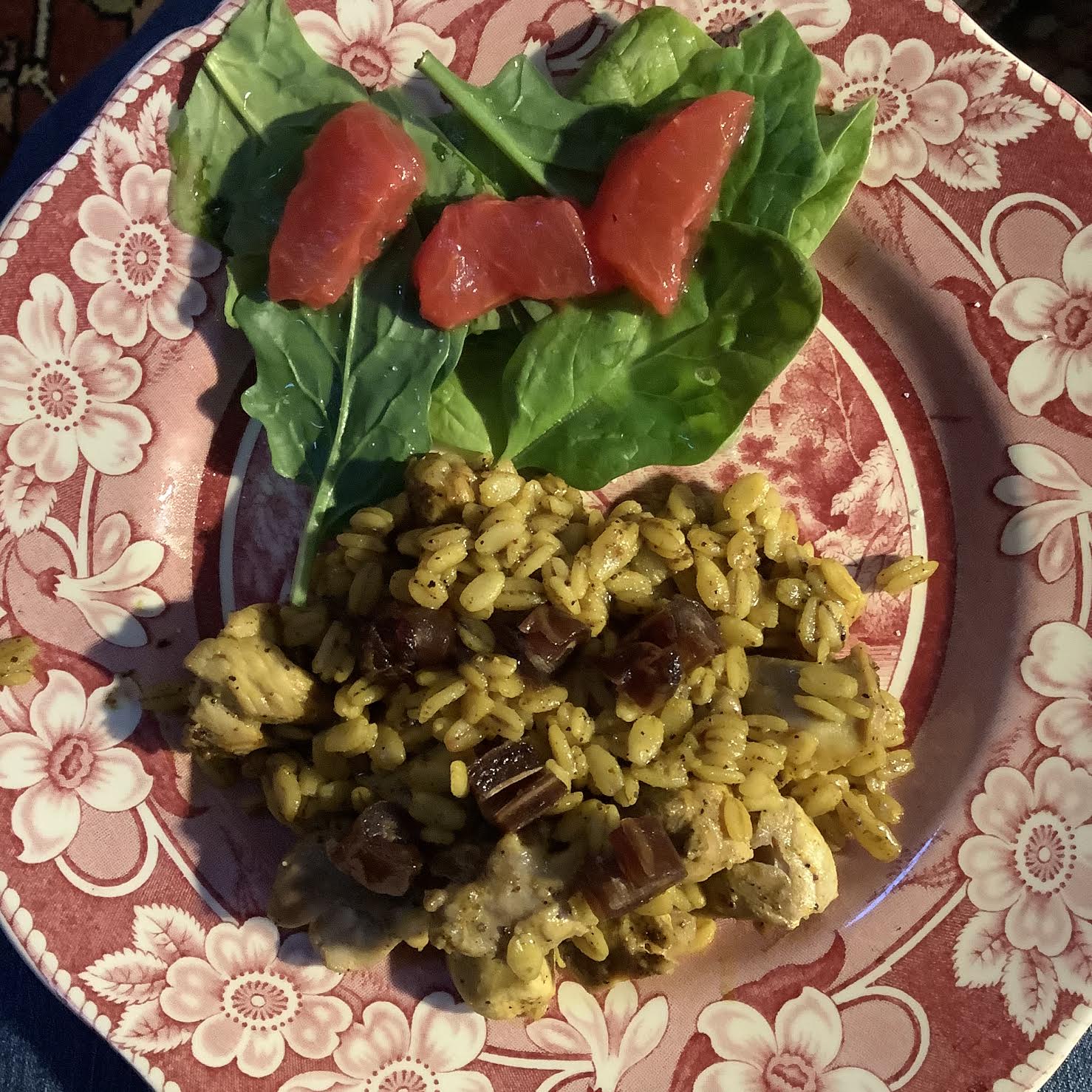
Arabian Spiced Chicken:  297 calories 4 g fat 5.4 g fiber 24.4 g protein 46 g carbs 35 mg Calcium  PB GF  Using ingredients originally from the region, it is possible to craft a very authentic meal that could have been enjoyed by ancient Arabs. They would have eaten by grasping the stew with the flat-bread called fatir — but on a Fast Day, we will choose a fork. TIP: This recipe makes enough for 2 [two] meals.

6 oz chicken thigh meat, boneless, skinless 2/3 cups water 1/3 cup chicken broth 1.5 tsp Hawayij spice  1/3 cup dry quick-cooking barley   Per serving: 5 oz watermelon on baby spinach leaves OR 3 deglet noor dates + 5 oz watermelon cubes

Skin and bone the chicken thigh and cut it into 1” chunks. Heat a non-stick skillet and spritz it with non-stick spray. Sprinkle the chicken with the spice and saute it until partly cooked. To the pan, add the water and heat it, scraping up any brown bits from the bottom. Stir in the dry barley. Put a lid on the pan and simmer for 10-12 minutes. Add the chicken broth and stir gently until everything is heated through. Plate with the dates and watermelon on the side. Sprinkle the stew with more Hawayij if you like. The peppery stew is fabulous with the cool, crisp melon and the sweet, musky dates. What an Arabian Delight.

Ingredients for next week: Breakfast, single portion for Monday …………………………… single portion for Thursday:

1 two-oz egg2 two-oz eggs  + sweet onion
Vache qui Rit/Laughing Cow cheesebeef or chicken stock
herbs — fresh or driedsoy sauce + mirin + scallion
ricotta cheese, lower fat + melon Japanese dried soba noodles [190 calories/2 oz]
optional smoothie
optional hot beverageoptional hot beverage

Dinner, single portion for Monday:………………………….. single portion for Thursday:

white whole wheat flour + egg white + scalliondried buckwheat Japanese noodles with yam + onion
tomato + shrimp + lobster or crab + flounder/fishsesame oil + carrot + celery + cabbage
soy sauce + rice vinegar + chivessoy sauce + spinach + raw shrimp
garlic + red pepper flakes + sugarS&B Japanese curry brick
Sparkling waterSparkling water

Barbary Pirates

How this Fast Diet Lifestyle works: Eat these meals tomorrow, for a calorie total of less than 600. On another day this week, eat the meals from a different post, another day of eating 600 calories or less. Eat sensibly the other days of the week. That’s it: a simple way to lose weight and be healthier.

When I learned in 11th Grade US History that president Thomas Jefferson had suppressed the Barbary Pirates, the image of a Founding Father fighting pirates seemed ludicrous. But it was true, though he did not personally take part. In the early 1800s, the Barbary Coast of Africa was a dangerous shipping lane. The Barbary Coast included the waters off Morocco, Algeria, Tripoli, and Tunis. The pirates were a loose confederation of Berbers and Arabs who had been harrying the coast and kidnapping people for ransom or enslavement for centuries. Thousands of Europeans had been captured, causing an order of monks, the Mercedarians, to form for the purpose of buying back Christians. By the late 1700s, ships of British, French, Spanish, and American flags were trading frequently in the Mediterranean. The pirates would take hostages, ships, and trade goods OR charge large sums of money for safe passage. European governments figured that by paying off the pirates, any damages would happen to ships of rival nations — and that would be just fine. The US Congress budgeted $84,000 in 1785 for paying off the pirates, and in 1798, the payment of $160,000 plus supplies and presents was negotiated. Finally, the US had had enough. From 1801 to 1815, several squadrons of naval vessels with Marines aboard skirmished with the Pirates along the Barbary Coast. First they fought with Tripoli and negotiated an end to their piracy in 1804. After the War of 1812, James Madison was president and he continued the work begun by Adams and Jefferson, this time in Algeria. With US warships in his harbor, the Algerian leader gave up, returned all his prisoners, and paid $10,000 in fines. That ended the war with the Barbary Pirates. The Marines added a line about fighting on ‘the shores of Tripoli’ to their battle song and the nascent USA had a new policy: “that as peace is better than war, war is better than tribute.”

Our breakfast remembers the Berbers who gave the Barbary Coast its name. The dinner has flavors of Morocco, one of the first countries to make peace with the US Government over piracy, after a one-time payment of $20,000.

Berber Spanish Omelette: 141 calories 7.6 g fat 1 g fiber 10.4 g protein 8 g carbs 56.7 mg Calcium   NB: Food values shown are for the egg dish and fruit only, and do not include the optional beverages.  PB GF The Berbers brought rice and eggplant to Spain. The ‘Spanish Omelette’ was developed later, but we can enjoy them together now.

1½ two-oz eggs  HINT: If you are serving one person, crack three 2-oz eggs into a small bowl or glass measuring cup. Whip up those eggs and pour half of their volume into a jar with a lid and put it in the ‘fridge for next week.   ¼ cup Mediterranean Vegetables with chickpeas  2 Tbsp cooked brown rice [save some if you cooked it for a previous meal] 1 oz watermelon   Optional: blackish coffee [53 calories] or blackish tea or mocha cafe au lait [65 calories] or lemon in hot water   Optional: 5 oz fruit smoothie or berry-yogurt smoothie [88 calories]

Spritz a non-stick pan with cooking spray. Put in the rice and cook it until it is warm. Add the vegetables and cook until warm. Whisk the eggs and pour them into the pan without disturbing the vegetables and rice, so they are evenly distributed. Cook the eggs until they are set, and cooked on one side. Turn the egg round over without breaking it and cook the other side. To serve, cut in wedges and plate with the melon.

Moroccan Lamb:  284 calories 6.5 g fat 8 g fiber 28 g protein 28.6 g carb 81 mg Calcium  PB GF  Mint, cumin, and coriander will make your meal taste like a trip to spice shuk. Simple meals are sometimes the best.

3 oz roast lamb ½ cup peas 2-3 pinches dried mint or cilantro 1/3 cup canned white beans, drained and rinsed  Moroccan seasoning or ground cumin mint tea

Gently warm the meat by steaming or heating in a microwave, and dust with Moroccan seasoning. Cook the peas, drain, and stir in a pinch of dried mint/dried cilantro. Heat the beans with the seasoning or cumin to taste. Best served with mint tea.

Ingredients for next week: Breakfast, single portion for Monday …………………………… single portion for Thursday:

sourdough rye breadbanana + plain, fat-free yogurt 
3%-fat hamblueberries + orange juice or crushed rhubarb
Camembert or Hermelin cheese fat-free milk + deglet noor dates
yellow plums or another colorfrozen or fresh spinach
Optional smoothie
optional hot beverageoptional hot beverage

Dinner, single portion for Monday:………………………….. single portion for Thursday:

Jarred spaghetti sauce + chicken stocksalad greens + tomatoes + red bell pepper
garlic + bell peppercooked pork roast + fresh cranberries
chickpeas + cabbage + rosemaryzucchini + good mustard
red pepper flakes + stubby pastabalsamic vinegar + olive oil + edible flowers
Sparkling waterSparkling water

Rule of Benedict

How this Fast Diet Lifestyle works: Eat these meals tomorrow, for a calorie total of less than 600. On another day this week, eat the meals from a different post, another day of eating 600 calories or less. Eat sensibly the other days of the week. That’s it: a simple way to lose weight and be healthier.

Benedict bestows his Rule.

Benedict of Nursia was born in 480 CE. Shocked by the worldly life in Rome, he became a hermit. After becoming a monk, he decided that monastic life had to be reformed. [The monks at his first monastery tried to poison him.] He thought that in 400 years, the Church had slipped a bit in its practices. More than a bit. After founding 12 religious houses, he wrote The Rule of Benedict in 516 CE. That sounds like laying down the law in an unpleasant and self-centered way, but it described a monastic life that could accommodate many different approaches. Thus it became the most prevalent way to live a monastic life all over Europe in the Medieval Era. The Rule described a monk’s day as dedicating 8 hours to prayer [during each of the canonical hours], 8 hours to work, and 8 hours to sleep. “Prayer and Work” were the order of the day. The work was hard: cutting trees, clearing fields, kitchen work, care of the sick, planting and harvesting. Benedict wanted the men to work hard so that they would be too tired to have unreligious or impure thoughts. Meals were part of supporting each man’s ascetic goals. There were two meals each day: late morning and evening. During Lent and on other fast days, there might be only one meal. At each meal, two different foods were served so that if you didn’t like one, you could eat the other. Each man was provided with 1 kilo/2.5 pounds of bread each day and 1/4 liter of wine. There was never any meat served from four-legged animals. Benedict thought that mammals’ meat caused ‘indigestion’ — a code word for carnal thoughts. Benedict believed that humans should suffer in life as Christ suffered, so life in the monastery was austere. Yet men flocked to the monasteries and women became Benedictine nuns. As centuries went by, the monasteries became rich, the work was not so hard, the food was more plentiful, and life was less austere. Therefore new rules arose: the Cistercians at Cluny, France reformed the Rule of Benedict in 910 CE, to get back to the core principles. In 1517, shocked by the worldly life in Rome, Martin Luther proposed reforms to the Church, and ended up tearing it apart in the Protestant Reformation. In 2019, there were 20,000 men and women living under the Rule of Benedict in 400 monasteries around the world, praying and working.

Not sure anyone today wants to eat like a 6th century monk, I have chosen elements from Benedict’s Rule: fish, vegetables, and only a tiny bit of meat — not enough to inflame the body and cause ‘indigestion.’

Maltese ScrOmelette: 152 calories 8 g fat 1.6 g fiber 12.5 g protein 7.6 g carbs 91 mg Calcium   NB: Food values shown are for the ScrOmelette and fruit only, and do not include the optional beverages.  PB GF  With the fish, the vegetables, and the fruit, these flavors have “Malta” written all over them.

1½ two-oz eggs  HINT: If you are serving one person, crack three 2-oz eggs into a small bowl or glass measuring cup. Whip up those eggs and pour half of their volume into a jar with a lid and put it in the ‘fridge for next week  ¼ oz cooked tuna 2 Tbsp frozen spinach 2 Tbsp Mediterranean Vegetables, chopped  ½ clementine  Optional: blackish coffee [53 calories] or blackish tea or mocha cafe au lait [65 calories] or lemon in hot water   Optional: 5 oz fruit smoothie or berry-yogurt smoothie [88 calories]

Thaw and chop the spinach, and drain it through a sieve. Break the tuna into small bits. Combine all vegetables with the tuna. Heat the ingredients briefly in an oil-misted non-stick pan, then pour in the whisked eggs. Cook to your preference. Serve with the fruit and optional beverages of choice. Sunny flavors!

Goat Cheese with Figs: 287 calories 20.6 g fat 2 g fiber 18.5 g protein 25 g carbs 57.5 mg Calcium  PB Joanne Harris, in her French Market cookbook, offers this as a salad. But we saw it as a light dinner and we were very pleased with it. Easy to prepare – as long as you can find fresh figs. One might try plumping dried Turkish figs in warm water in lieu of fresh figs.

++ 3 fresh figs, each ~½ ounce ++++ ½ oz Bayonne or Serrano ham ++++ 1 oz chevre cheese, a creamy type ++++ 4 mint leaves ++++ salt & pepper ++++ ½ plain croissant

Trim the stems from the figs. Sit the fig on its base and cut down into the fig, from top to almost-the-bottom. Make another cut at right angles to the first, so that the fig now is a bud with four petals. Slice the ham into ¼” slices and chop the mint leaves. Cream together the cheese, ham, and mint, along with some flavorful salt and pepper. Divide the mixture into 3 equal portions. Open the petals of the figs and spoon the cheese mixture into the center. Warm the croissant and plate it with the figs.

Ingredients for next week: Breakfast, single portion for Monday …………………………… single portion for Thursday:

1 extra large egg = 2.5 oz + scallion2 chocolate crepes + icing sugar
any color bell pepper2%-fat cottage cheese
white or sweet potato + chivesnon-fat vanilla yogurt + strawberries
plain, low-fat yogurt +Cheddar cheese30-calorie uncured bacon
Optional smoothie
optional hot beverageoptional hot beverage

Dinner, single portion for Monday:………………………….. single portion for Thursday:

chili non carne buckwheat galettes
tostada [fried tortilla]fresh tomato
Monterey Jack or Cheddar cheeseLeek&Bacon Filling
guacamole Mexican Vegetable Pickle basil or thyme
Sparkling waterSparkling water

Slow Days: Greek Pizza

People who are new to Fasting often pose the questions: “Can I really eat ‘anything I want’ on a Slow Day?” and “What should I eat on Slow Days?” To answer those questions, I have decided to add some blog posts to show some of the foods we eat on what the world calls NFDs [non-fast days] but which, in our house, we call ‘Slow Days.’ This feature will appear sporadically. 

Now for the answers. Can you really eat ANYTHING you want on a Slow Day? Not really. If you eat too many calories every Slow Day, you will not lose weight. There are many discussions on the Fast Diet Forum which attest to that. Once in a while you can splurge, as long as it isn’t everyday. For what to eat on Slow Days, Dr. Mosley recommends a Mediterranean Diet. As for how we eat, an example follows.

Every Saturday we enjoy pizza for dinner. Not store-bought, not delivered, but home-made. Mostly, we will prepare the red-sauce-mozzarella type, and we vary the toppings week to week. But once in a while, I suggest a “Greek” pizza. This variety was developed by a Greek immigrant who ran a pizzeria in New London, Connecticut in the 1950s. Since then, Greek Pizza has been popular in New England and eastern New York. Very regional. [I’m not going to get in the middle of which culture really invented pizza — I’d rather just eat it.] My version is based on reading many recipes, taking out the best bits, and putting them together in this recipe.

You will need two whole wheat pizza crusts, each 8″ in diameter. This takes [about 6 ounces of dough for each crust] Pat the crusts out on an oiled baking sheet. Preheat oven to 490F.

Salad Dressing makes 7 Tbsp dressing 1/4 cup virgin olive oil 1.5 Tbsp red wine vinegar 1.5 Tbsp lemon juice large pinch oregano Shake together in a small jar with a lid. Brush each crust with 1 Tbsp of dressing. Save the rest for the salad.

Pizza Topping enough for 2 pizza shells thaw or cook 5 oz spinach. Squeeze it in your hands to expel extra liquid. 3/4 cup shredded mozzarella 1/2 tsp garlic powder pinch ground nutmeg pinch crushed red pepper. Toss lightly to combine, and divide between the pizzas.

Garnish for each pie: 3/4 cup feta cheese, crumbled 3 black olives, pitted and cut in half or quartered 2-3 cherry tomatoes, halved

Bake at 490F for 4 minutes on an oiled baking sheet on the upper of two oven racks. After the first part of baking, remove the pizzas from the baking sheet and move them to the bottom rack with no pan under them. This bakes the bottom of the pizza nicely. Bake 3-4 minutes longer, until the cheeses melt. Serve with a salad of greens which are tossed with the same salad dressing above. Try this pizza some time — I think you will enjoy it.