People who are new to Fasting often pose the questions: “Can I really eat ‘anything I want’ on a Slow Day?” and “What should I eat on Slow Days?” To answer those questions, I have decided to add some blog posts to show some of the foods we eat on what the world calls NFDs [non-fast days] but which, in our house, we call ‘Slow Days.’ This feature will appear sporadically.
Catfish are a fresh-water fish found in many countries around the world, with 30 species in the USA. The states in the center-east of the country are where catfish are most likely to be. Because they are common and can grow quite large, catfish are popular sport and eating fish. Here in New Hampshire, the native species is Ameiurus nebulosus, known to scientists as the Brown Bullhead, and to locals a the ‘horned pout’ [pronounced ‘hornpout‘]. Lakes of easy access sport boats at night, trawling back and forth with lanterns illuminating the water. Everyone knows that means people are hornpoutin’. After seeing catfish at the supermarket a few years ago, and knowing that there was Cajun Seasoning in the pantry, I was seized by inspiration: Cajun Catfish Sandwiches!!
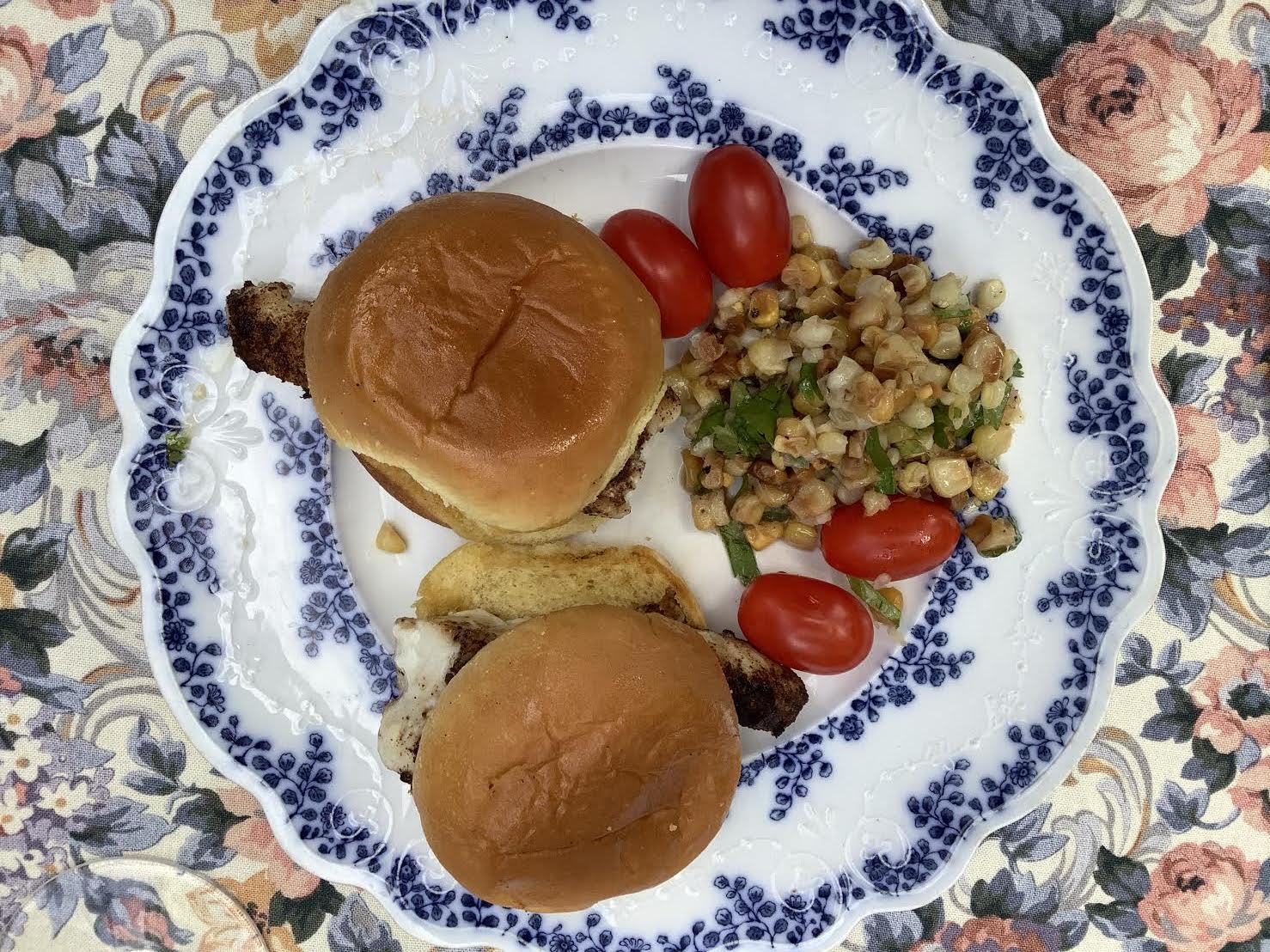
To serve two, we have slider buns, Cajun Seasoning, and 6-8 oz catfish, cut into 4 pieces. The catfish pieces are dredged in the seasoning on all sides, then pan-cooked with a bit of butter/ cooking spray/ or olive oil until done, 3-4 minutes per side. Here’s how to prepare your own seasoning:
Cajun Seasoning:4 Tablespoons A dry powder to add to soups, stews, eggs, or fish. 1 tsp salt 2 tsp garlic powder 2½ tsp paprika 1 tsp ground pepper 1 tsp onion powder 1 tsp cayenne 1¼ tsp dried savory 1¼ tsp dried thyme ½ tsp red pepper flakes
I suggest that the slider buns be toasted. For a real summer treat, serve with some form of corn, such as fresh polenta or corn-tomato salsa. Oh! Yummy! Catfish can be sustainably and environmentally raised on fish-farms, making them a good choice when you are looking for fish to buy. An excellent Summer meal.
How this Fast DietLifestyle works: Eat these meals tomorrow, for a calorie total of less than 600. On another day this week, eat the meals from a different post, another day of eating 600 calories or less. Eat sensibly the other days of the week. That’s it. Simple way to lose weight and be healthier. Welcome to 1981lluciana and Healthy Desire who are now Following.
On August 8, 1516, Hieronymus Bosch died and the legends began. So did the forgeries. Bosch [not his real surname, but he chose it to honor his hometown ‘s-Hertogenbosch] was the most famous painter of his time. While he drew from the compositions of his predecessors, Bosch was the most copied artist for the next century — with many of those works ‘signed’ with his name. His ‘surreal’ style of art struck a real chord with his contemporaries. The late 1400s was a time of pessimism and the church preached that people should fear Divine Retribution. Savonarola with his bonfires was on the same wave-length. Bosch took this to heart since he was a religious conservative who thought that some clergy were part of the problem. His art spotlighted the sins of humankind, constantly repeating that repentance would help us to avoid a horrible punishment in Hell. Few artists were so inventive in their depictions of the netherworld as Hieronymus. One of Bosch’s most famous works is the Garden of Earthly Delights, a triptych begun in 1490. The left-hand panel shows the totally innocent Adam and Eve in Eden, while demons fall from Heaven as Lucifer is thrown out. The middle panel depicts a landscape with rather sex-less, nude, White and Black Barbie-doll figures disporting in all sorts of merriment — activities that will land them in the Hell depicted in the right-hand panel. There, those Barbie-dolls experience the horror of dreadful demons and cruel punishments. The artist was not all about monsters: he produced works on Biblical themes, such as Christ Carrying the Cross [in Vienna]; the Adoration of the Magi; and St Christopher Carrying the Christ Child which show his command of landscape perspective, color use, and depicting the human form. There are only about 20 works which have been attributed to Bosch and many more by his students and copiers.
To me, an hilarious aspect of the Garden of Earthly Delights painting is the giant fruit. In our house, if one picks a particularly large strawberry, it is dubbed ‘an Hieronymus Bosch berry.’ Our breakfast features strawberries and other fruits. To Bosch those represented lust and gluttony — to me, they represent a healthy breakfast. Our dinner involves good ingredients roasted under high heat, but no Fires of Hell are involved.
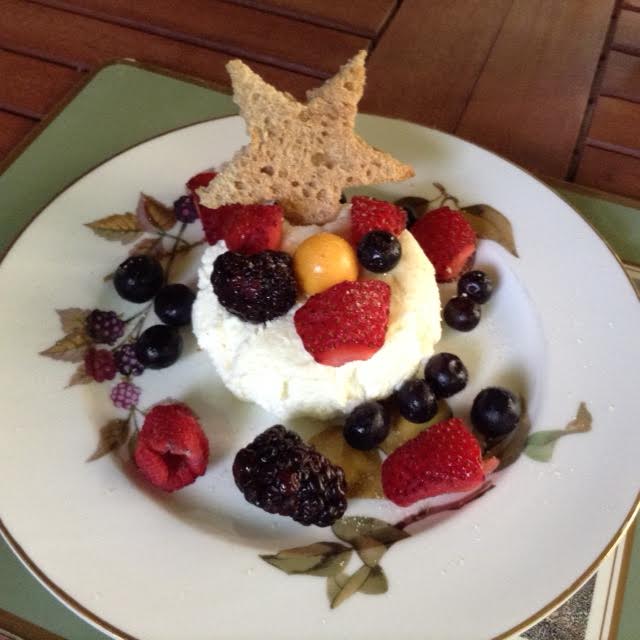
Red White and Blue: 150 calories 1 g fat 2.6 g fiber 14.5 g protein 20 g carbs [10.5 g Complex] 331 mg Calcium NB: Food values given are for the plated foods only, and do not include the optional beverage. PB GF – if using GF bread Ricotta is higher in protein and Calcium than cottage cheese, but you could substitute that if you wish.
½ cup fat-free ricotta ¼ cup blueberries, fresh or frozen [if frozen, keep frozen until ready to use] ½ cup sliced strawberries, fresh or frozen [after slicing, put into a strainer to let the juices drain] 1 slice of 70-calorie multi-grain bread [Nature’s Own/ Dave’s Thin-Sliced] 2 large pinches of cinnamon sugar Optional:blackish coffee [53 calories] or blackish tea or mocha cafe au lait [65 calories] Optional: 5 oz fruit smoothie or berry-yogurt smoothie[88 calories]
Fish Roasted with Vegetables: 290 calories 5 g fat 5 g fiber 29 g protein 16 g carbs 180 mg Calcium PB GF Delicious one-pan meal. AND it is low in calories and fat. Can you believe that a women’s magazine had a similar recipe for 425 calories!!
4 oz pollock, halibut, or other white fish 1½ slice [0.2 oz] American/streaky bacon 2 oz carrots in ½” chunks 2 oz Brussel sprouts cut in half 2 oz cauliflower florets, cut in half or quarters 3 oz cherry tomatoes, cut in half 1 Tbsp Parmesan cheese
Set the oven at 450 degrees F. Cook the bacon in an 8” oven-proof pan, such as cast iron. Remove the bacon, chop it and set aside. Put the prepared vegetables in the pan and toss to coat with the bacon fat. Salt and pepper to taste. Roast for 10 minutes. Remove the pan of vegetables from the oven. If you think they will need more than 10 minutes more of cooking, put them back in for 2-3 minutes. They will not be cooked through at this point. Turn oven down to 400 degrees F. Move the vegetables aside so the fish will sit on the hot pan, with the vegetables nest to it. Salt and pepper the fish. Return the pan to the oven and bake 5-10 minutes more, depending on the thickness of the fish. Sprinkle the entire contents of the pan with Parmesan cheese and bacon. You could eat it right from the pan.
People who are new to Fasting often pose the questions: “Can I really eat ‘anything I want’ on a Slow Day?” and “What should I eat on Slow Days?” To answer those questions, I have decided to add some blog posts to show some of the foods we eat on what the world calls NFDs [non-fast days] but which, in our house, we call ‘Slow Days.’ This feature will appear sporadically.
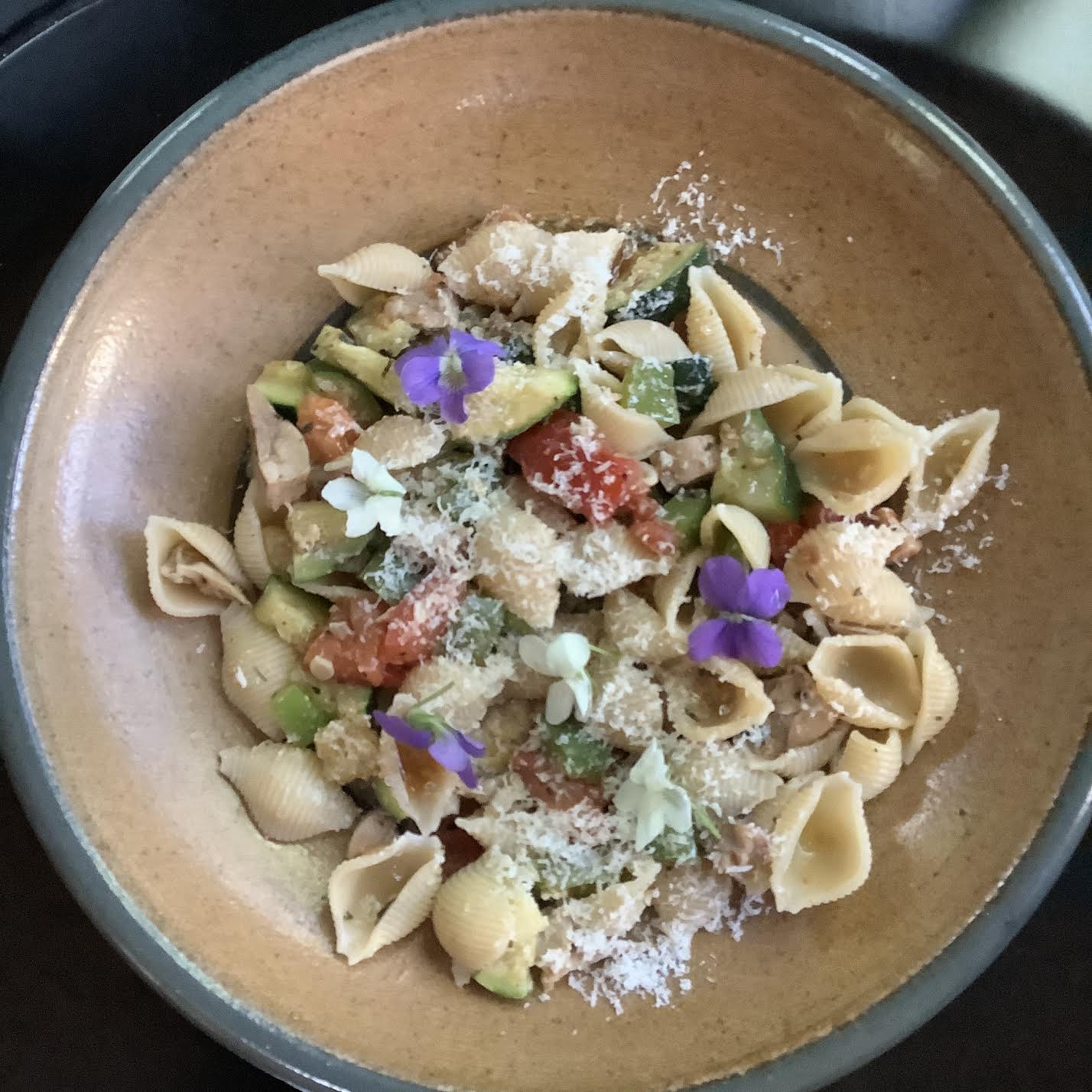
Jacques Pepin is a darned good chef. Perhaps it is the fact that he was formerly the Executive Chef of the Howard Johnson’s chain that caused him to promote simple-to-prepare food that is achievable for the ‘average’ cook. One such recipe, from his book Fast Food My Way, is called Summertime Pasta. [When he talks about Fast Food, he means the kind that is quick to prepare, not the type we eat on a FAST Day***. ] If ever there was a time when one wants to keep prep time to a minimum, Summer is it. It amazes me how easy this meal is on the cook and how fine it is to eat it. We dine on it ourselves and serve it to company. It is that good.
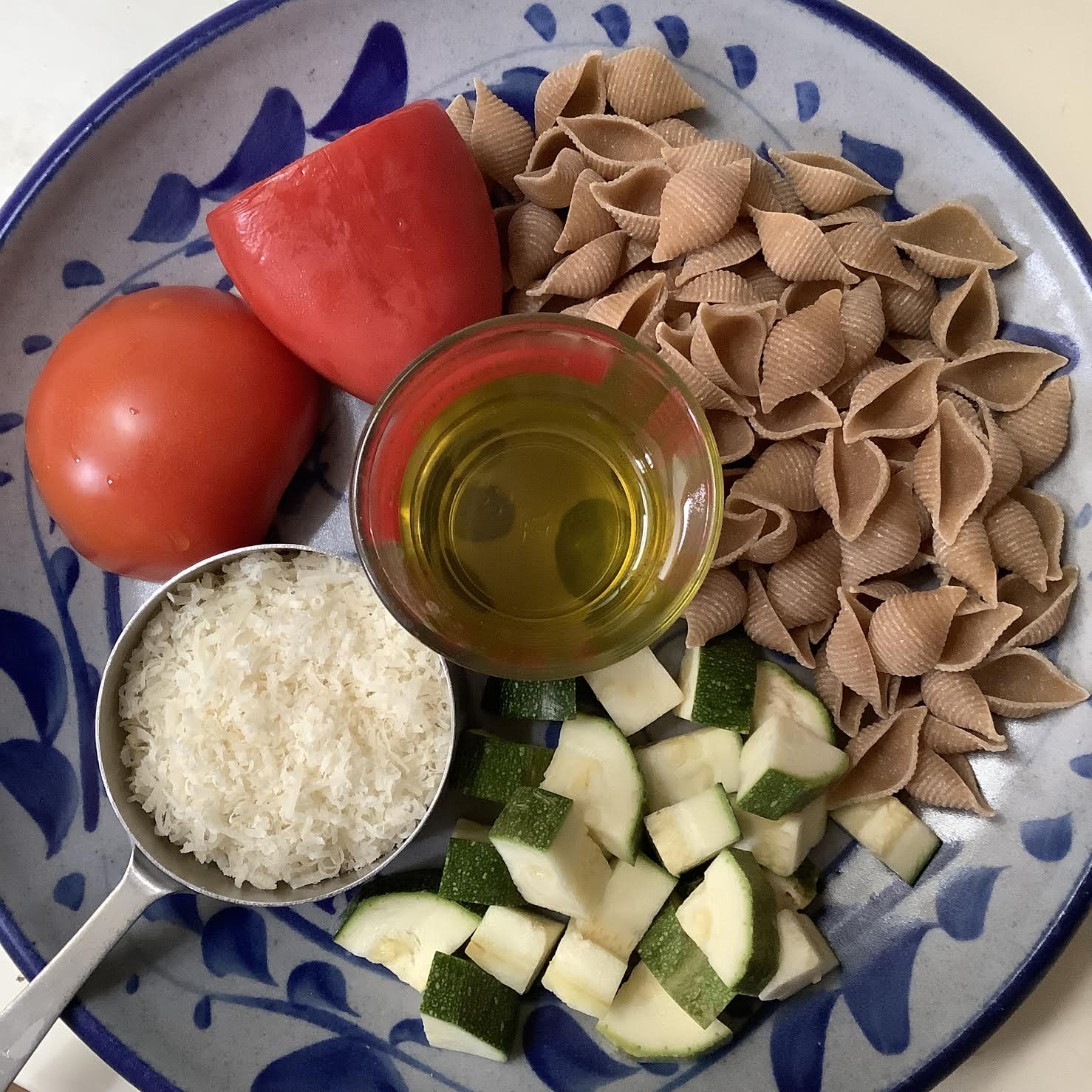
The mise en place for two servings of Summertime Pasta
Sv 4
Sv 2
3 c. tomatoes in ½“ dice 1 ½ c. zucchini in ½“ dice 1 c. white mushrooms, ½” dice 1 tsp salt + black pepper 1/3 c. extra-virgin olive oil
6 oz diced tomatoes ¾ c diced zucchini ½ c diced mushrooms ½ tsp salt + black pepper 3 Tbsp EVOO
Mix everything in a microwavable glass bowl.
6 oz pasta shells, whole wheat 2 qts water salt
3 oz shells, whole wheat 1 qt water salt
20 minutes before serving, bring the water and salt to a boil. Add the pasta and cook about 7 minutes until al dente. Drain.
Microwave the vegetables for 2 minutes or longer until they are lukewarm.
1 c. grated Parmesan cheese
½ c Parmesan
Combine the drained pasta with the warm vegetables, then stir in the cheese.
1½ c. Fresh basil leaves, shredded
¾ c. Fresh basil leaves
Plate, and top with basil.
Every meal looks delicious with edible flowers as a garnish.
If you wish, you can add chunks of chicken or grilled shrimp to the dish to add more protein. Delicious.
Snow peas are also a nice addition.
***Truth be told, I do have a version of this recipe that is fine for a Fast Day. One of these days, I will share it with you.
People who are new to Fasting often pose the questions: “Can I really eat ‘anything I want’ on a Slow Day?” and “What should I eat on Slow Days?” To answer those questions, I have decided to add some blog posts to show some of the foods we eat on what the world calls NFDs [non-fast days] but which, in our house, we call ‘Slow Days.’ This feature will appear sporadically.
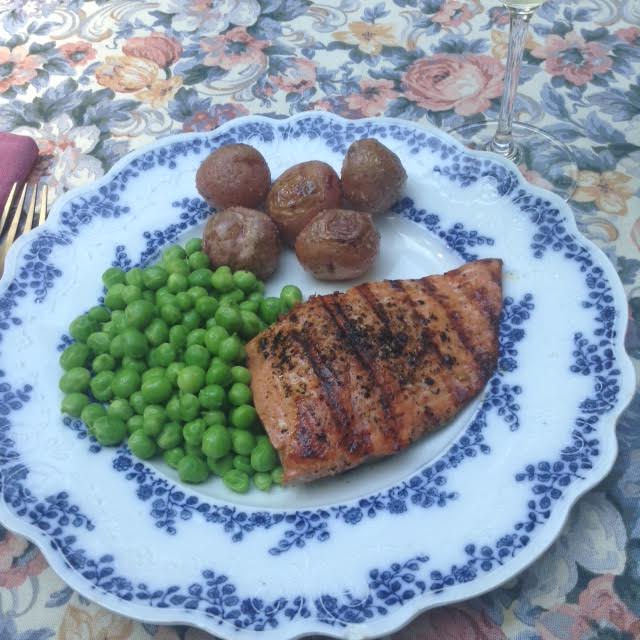
Time was, salmon ran up the rivers of New England by the thousands every year on the way to their breeding streams. They were so common that servants had clauses written into their contracts to prevent their employers from feeding them salmon every day. By early July, there is a wonderful confluence of ingredients: fresh salmon, the new green peas, and the tiny first potatoes. These became the makings of a classic meal for a traditional 4th of July in the 1800s, before anyone had ever heard of hot dogs and hamburgers and barbecue grills. If you don’t believe me, you may consult James Beard’s American Cookery [pg.119] and the Boston Globe.
The salmon may be grilled, poached, or baked. The peas are newly liberated from their shells. The potatoes are roasted with olive oil, salt, and rosemary. A traditional [and attractive, and delicious] way to celebrate our Independence Day.
How this Fast DietLifestyle works: Eat these meals tomorrow, for a calorie total of less than 600. On another day this week, eat the meals from a different post, another day of eating 600 calories or less. Eat sensibly the other days of the week. That’s it. Simple way to lose weight and be healthier.
Canada Day is July 1st. It is not an ‘independence day,’ but it marks the agreement in 1867, that united Nova Scotia, New Brunswick, and “Canada” [as Quebec and Ontario were called] under one government. This was an out-growth of a conference in 1864, at which ‘confederation’ was discussed. So at last, the disparate provinces agreed to join under one name and one government. Provinces and territories from the West joined in turn. Originally, the July 1st was called “Dominion Day” and for a long time it was a celebration of ‘Canada-ness’ within the British Empire. By the turn of the century, it was a showcase for assimilation of non-Europeans. By 1967, the day became more about Canada as a melting-pot under their new flag. Canada finally became a sovereign nation in 1982. This year’s observation will be filled with mixed feelings due to the ongoing revelations of the horror of government-sponsored ‘residential schools’ for First Nations people and all the damage that caused to generations of indigenous citizens. In 1967, Prime Minister Lester Pearson said, “May the land over which this new flag flies remain united in freedom and justice … sensitive, tolerant and compassionate towards all.” Let us hope that Canada — and all nations — can live up to those words.
For any busy holiday, French Toast is a great choice for breakfast since part of the preparation is done the evening before. To cut out the shapes in the bread, we’ll use a maple-leaf cookie cutter in honor of Canada’s flag. Beef is very popular in Canada — whether pasture-raised PEI beef or steers from the high plains of Alberta — so our sliders will be just the thing.
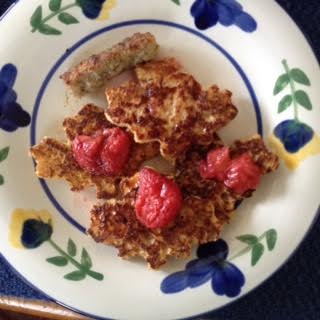
National Holiday French Toast: 187 calories 6 g fat 2.6 g fiber 12.6 g protein 15 g carbs [4.4 g Complex] 95 mg Calcium NB: Food values given are for the plated foods only, and do not include the optional beverage.HINT: This recipe makes French Toast for 2 people or two breakfasts. If serving one, prepare all the toast, but put the remainder in a bag in the freezer for a really fast breakfast later.
4 slices 70-cal whole grain bread one 2-oz egg 2 Tbsp fat-free milk per person: 1 oz strawberries, fresh or unsweetened frozen 1½ tsp maple syrup one 60-cal chicken sausage Optional:blackish coffee [53 calories] or blackish tea or mocha cafe au lait [65 calories]
THE NIGHT BEFORE: Whisk the egg and milk together. Cut the pieces of bread into appropriate shapes using a cookie cutter — for Canada Day, I used little maple leafs. [This step is important for the calorie count to come out right, so don’t skip it even if it seems too much like ‘crafty food.’ The bread that is left over can be fed to the birds or saved to make Stuffed Clams] Put the bread into a pan with a rim which is just big enough for the bread pieces. Pour the egg/milk mixture over the bread, making sure it is all wetted. Let stand OVERNIGHT. Also combine the strawberries and syrup.
The next morning, cook the batter-soaked bread in a hot non-stick pan with a spritz of non-stick spray. Cook until browned on both sides. NOW PUT 1/2 OF THE PIECES ASIDE TO COOL. PUT INTO A BAG AND FREEZE THEM FOR A LATER DATE. Cook the sausage, too. Mash the berries a bit and add the maple syrup. Warm the mixture a little and smear onto the plated toast. Enjoy with the sausage and beverage of choice.
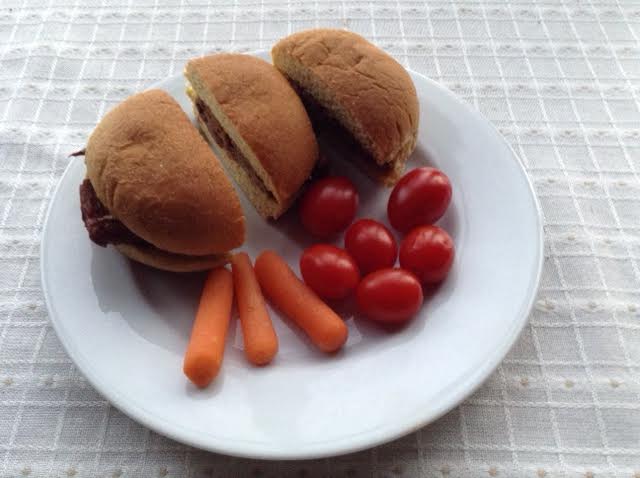
Beef BBQ Sliders: 269 calories 5.6 g fat 5 g fiber 22.6 g protein 31 g carbs 162.6 mg Calcium When a gift box of Corky’s Memphis BarBQue arrived, sliders seemed like a wonderful idea. Such fun to eat and easy to prepare, especially when the sauce and filling have been made for you. HINT: This serves TWO. Share with a friend or save half for lunch tomorrow.
Warm the slider buns while the beef and sauce are heating. Assemble the sliders and cut each in half. NB:Each serving is three halves of slider. Plate with the vegetables. Eat with pleasure.
Ingredients for next week: Breakfast, single portion for Monday …………………………… single portion for Thursday:
2 two-oz eggs + Olive oil
1.5 two-oz eggs
tapioca flour + white whole wheat flour
corned beef + cabbage
Parmesan cheese + uncured bacon
cottage cheese + thyme
applesauce + plain yogurt
caraway seed + apple
Optional smoothie
optional smoothie
optional hot beverage
optional hot beverage
Dinner, single portion for Monday:………………………….. single portion for Thursday:
two 2-oz eggs
cubed chicken breast + dill pickle + seedless grapes
How this Fast DietLifestyle works: Eat these meals tomorrow, for a calorie total of less than 600. On another day this week, eat the meals from a different post, another day of eating 600 calories or less. Eat sensibly the other days of the week. That’s it. Simple way to lose weight and be healthier. Welcome to Treadmills Hub and tthenwhat who are now Following.
Saint Irenaeus was an important man in the early Christian church. He was born in the Greek city of Smyrna, today’s Izmir, Asia Minor [modern-day Turkey] in the 2nd Century CE. At a young age, he heard St Polycarp preach. That is significant because Polycarp had heard the original Apostles preach, thus Irenaeus was the last church leader to be only two degrees of separation from Jesus himself. Irenaeus was sent to Lyons, France as a missionary — there are many links between communities on the Rhone River and the Eastern Mediterranean. This was during the Roman Empire when France was inhabited by Celts. There he learned the local language, set up new churches, and became bishop. He was a fierce defender against schismatic teaching, especially Gnosticism. He studied it well enough to be able to refute it point by point This influenced the wording of the Apostles’ Creed and the Nicene Creed by stating emphatically that God was the author of creation and that Jesus was human and divine. Irenaeus influenced as well the modern Christian Bible which includes both the Jewish texts and the Gospels. His name means ‘peace-maker’ and though he had no patience for heretics, he brought accord among Christians in many theological disputes.
Since Irenaeus began his life in Greece, our breakfast eggs are flavored with a traditional moussaka sauce. For his later life in France — gosh those guys moved around a lot!! — a meal of contemporary French ingredients and flavors.
Moussaka ScrOmelette: 153 calories 10.5 g fat 1 g fiber 12.6 g protein 3.4 g carbs 68 mg Calcium NB: Food values shown are for the ScrOmelette and fruit only, and do not include the optional beverages.PB GF A good sauce makes a fine moussaka casserole. So why not carry that flavor over to breakfast by folding it into eggs? Great idea!
1½ eggs HINT: If you are serving one person, crack three 2-oz eggs into a small bowl or glass measuring cup. Whip up those eggs and pour half of their volume, into a jar with a lid and put it in the ‘fridge for next week. 1/2 fluid ounce/1 Tbsp moussaka sauce 1/8 oz feta cheese, crumbled 1 oz strawberries Optional: blackish coffee [53 calories] or blackish tea or mocha cafe au lait [65 calories] or lemon in hot water Optional: 5 oz fruit smoothie or berry-yogurt smoothie [88 calories]
Warm the moussaka sauce. Whisk the eggs and pour into a heated skillet sprayed with non-stick cooking spray. Cook, tipping the pan and lifting the cooked eggs until the bottom is set but the top is still moist. Top with the sauce and cheese, fold and plate. Serve with the berries.
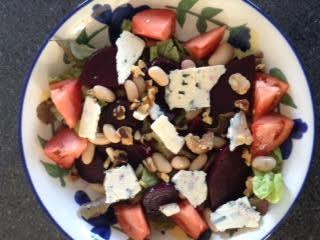
Beet & Bleu Cheese Salad: 288 calories 11 g fat 5 g fiber 14 g protein 19.5 g carb 212 mg Calcium PB GF This recipe takes me back to a delightful restaurant 2 blocks north of Notre Dame in Paris. Dinner at Au Bougnat was a treat and eating this meal evokes fond memories.
2½ oz beets, cooked, skinned, sliced or cubed, cooled 1¼ oz bleu cheese, cubed or crumbled 1½ oz tomato, sliced or cubed 3 walnut halves [or use slivered almonds if you don’t eat walnuts] 1 oz white beans, rinsed and drained if using canned 2½ c. salad greens ¾ tsp olive oil + ¾ tsp balsamic vinegar garnishes: pansy, chive, or nastursum flowers; sliced scallions
Assemble and prep all vegetable ingredients. Whisk oil and vinegar in a wide bowl. Put greens in the bowl and toss. Place in serving bowl and arrange the other ingredients on top. Add a few garnishes. Voila! A beautiful meal.
People who are new to Fasting often pose the questions: “Can I really eat ‘anything I want’ on a Slow Day?” and “What should I eat on Slow Days?” To answer those questions, I have decided to add some blog posts to show some of the foods we eat on what the world calls NFDs [non-fast days] but which, in our house, we call ‘Slow Days.’ This feature will appear sporadically.
You’ve heard of ‘artisan bread,’ but have you ever seen bread that is artistic? I hadn’t, until our older son suggested it while we discussed what to serve at a small dinner party. We start with his recipe for ‘No-Knead Foccacio’ which is simplicity itself.
2 breads to serve 6-10
1 bread to serve 3-5
500 grams bread/strong flour 375 g water 10 g salt 6 g dry yeast
25 grams bread flour 187 g water 5 g salt 3 g dry yeast
Put all ingredients in a bowl with some mixing and rising room. Combine, using a fork, a spoon, or your hands, until it looks like a shaggy ball.
Cover the bowl and let rest 8-12 hours – overnight works well.
After rising over-night, the dough is ready to use.
Lightly brush olive oil onto two 8×15” pans or one large sheet pan. Divide the dough in half. Pat each half into an 8×12” rough oval on the pan. Let stand 1-2 hours
Each half of the dough is patted out on an oiled pan as a rough 8×12-inch canvas.
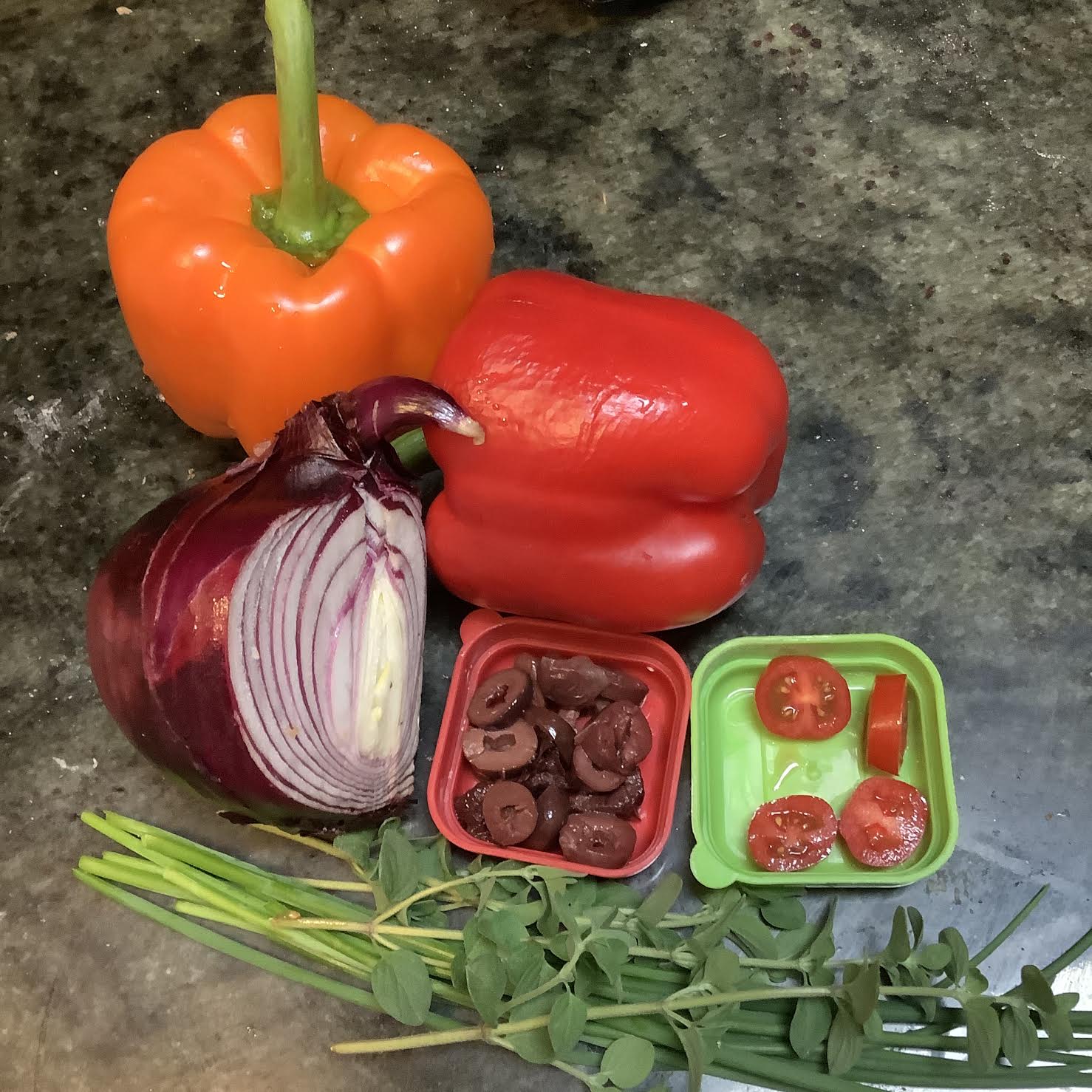
Two colors of bell peppers, red onion, black olives, cherry tomatoes, chives, and marjoram sprigs are the ‘paints’ you use to create your picture.
NB: I had drawn a design in advance to guide me in planning the vegetable placement. Brush the dough with olive oil and sprinkle with finishing salt. Cut the vegetables into the shapes you want for your design, then place them on the dough in a way that pleases your eye.
Ready to go in the oven, after a 15-minute rise.
Bake at 400F for 20 minutes, until crust begins to golden and the bottom of the bread is cooked. Serve warm or at room temperature to rave reviews. Should there be any left-over, it freezes very well.
People who are new to Fasting often pose the questions: “Can I really eat ‘anything I want’ on a Slow Day?” and “What should I eat on Slow Days?” To answer those questions, I have decided to add some blog posts to show some of the foods we eat on what the world calls NFDs [non-fast days] but which, in our house, we call ‘Slow Days.’ This feature will appear sporadically.
Today, I thought it would be fun to make a batch of naan, a bread of India. More than 2500 years ago, ‘chapati’ was the peoples’ bread: unleavened flatbread baked on a griddle. After yeast was introduced to India from Persia or Egypt, experimentation lead to making naan. Originally it was the food of royalty, savored for its light texture. One author says how difficult it is to make, and therefore limited to palace kitchens. When I found out how simple naan is to prepare, I just had to try them. Even thought the dough is made with yeast, it is much less involved than making a loaf of bread. The recipe is by Aarti Sequeira.
1 tsp dry yeast 1 tsp sugar 3/4 c 110 F water
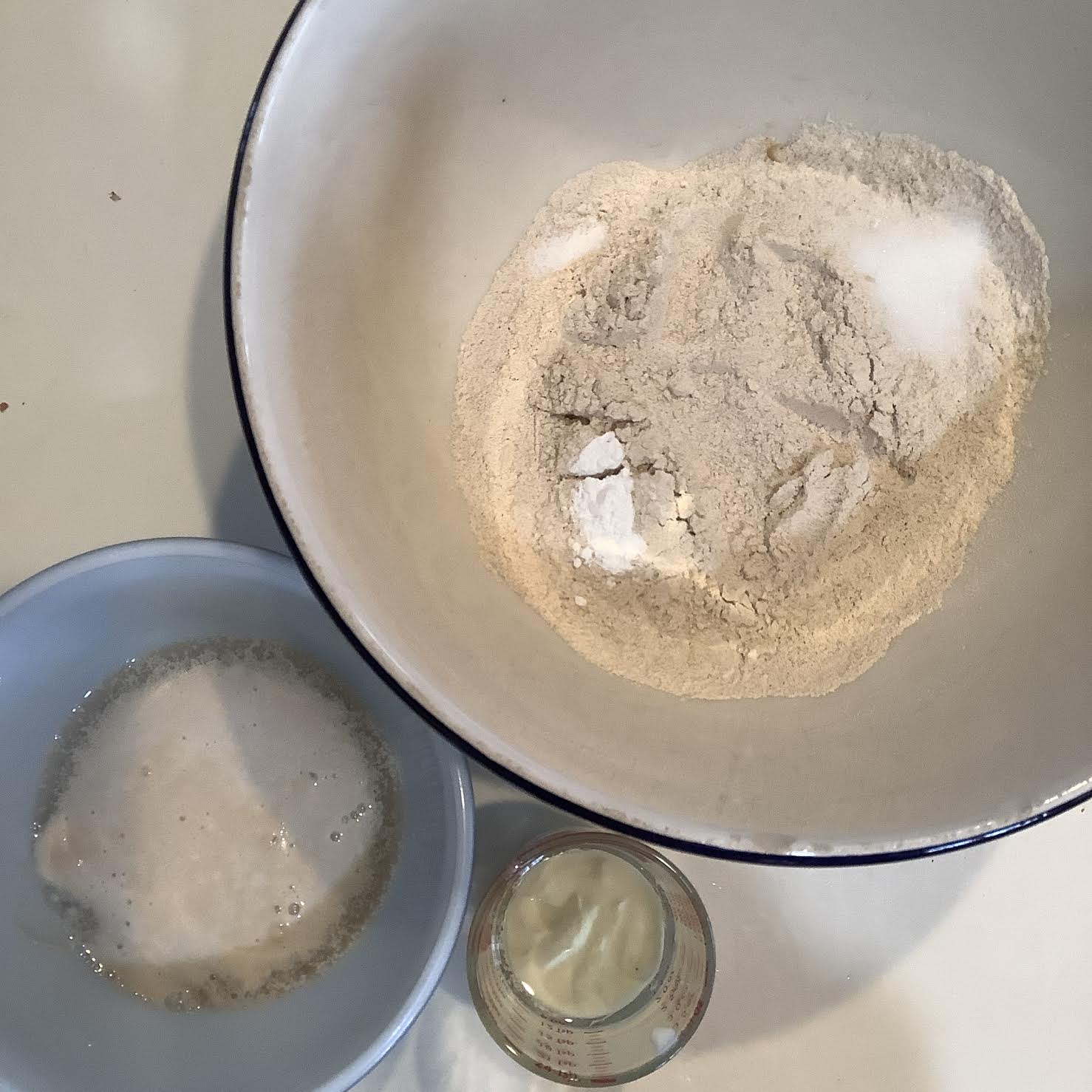
In a large glass or 16-oz measuring cup, combine the yeast, sugar and water. Let stand until foamy, 5 to 10 minutes.
2 c white whole wheat flour** 1 tsp salt 1 tsp sugar 1/8 tsp baking powder
Sift the flour, salt, sugar and baking powder into a large, deep bowl. Whisk to blend.
3 Tbsp plain yogurt 2 Tbsp vegetable oil
Once the yeast is frothy, pour the yogurt and the olive oil into the glass, and stir to combine.
****If you would like to make this gluten-free, you can substitute in 2 1/4 cups of gluten-free all-purpose flour mix for the regular flour, plus 1 1/4 tsp xanthum gum.
Ingredients for the first three steps of the recipe await mixing.
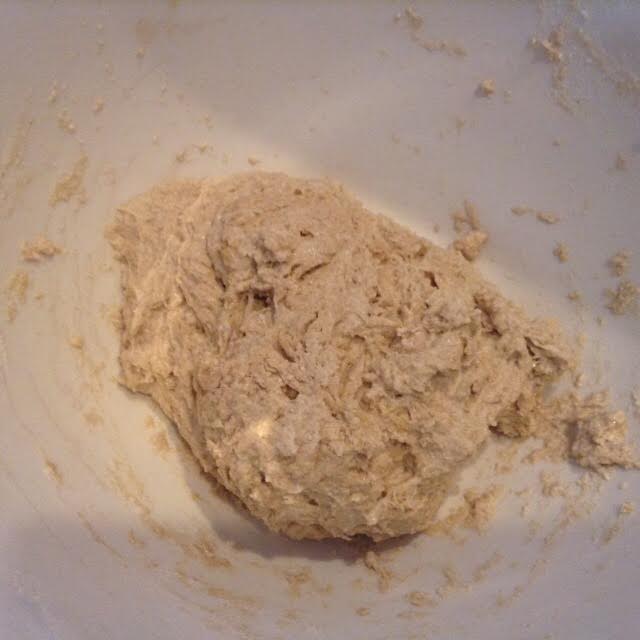
Pour the yogurt mixture into the dry ingredients and gently mix the ingredients together with a fork. When the dough is about to come together, use your hands to mix. It will feel as if there isn’t enough flour at first, but keep going until it transforms into a soft, slightly sticky, pliable dough. As soon as it comes together, stop kneading.
mixed with a forkthen mixed with the handsready to rise
Cover the dough with plastic wrap or a damp tea towel and let it sit in a warm, draft-free place for 2-4 hours.
Have two bowls near-by: one with flour in it, + one with water. The dough will be extremely soft and sticky — the way it should be! Divide dough into 8 or 10 or 12 equal portions and lightly roll each portion in the bowl of flour to prevent sticking to each other.
++if using gluten-free flour, pat the naans into shape with your hands and fingers.
With a rolling pin++, roll out each dough ball on a lightly floured work surface into a tear-drop shape about 4-6“ in diameter and 1/4” thick. Lift up by one end and wiggle it — the dough’s own weight will make it stretch a bit. Repeat with remaining dough.
Have: Cast iron skillet lid to fit the skillet
Warm the skillet over high heat until it’s nearly smoking. Dampen your hands in the bowl of water and pick up one of your naans. Patty-cake it from one hand to the other to dampen it slightly.
Gently lay each naan in the skillet + set timer for 1 minute. The dough should start to bubble. Flip the naan. It should be blistered + a little blackened, don’t worry – that’s typical! Cover the skillet with the lid and cook 30 seconds to 1 minute more. Repeat with remaining dough.
Here they are skillet-baked and ready to eat. You have seen the naan in some of my previous recipes, such as Indian Vegetables with Turkey and Naan. Create your own favorite way to eat this bread and imagine that you are an Indian Noble.
People who are new to Fasting often pose the questions: “Can I really eat ‘anything I want’ on a Slow Day?” and “What should I eat on Slow Days?” To answer those questions, I have decided to add some blog posts to show some of the foods we eat on what the world calls NFDs [non-fast days] but which, in our house, we call ‘Slow Days.’ This feature will appear sporadically.
Mention ‘quiche’ and many thoughts are conjured: Quiche Lorraine; quiche on every restaurant menu for lunch; “Real Men Don’t Eat Quiche;” thick slabs of it; thin tarts of it; hors d’oeuvres; the best of quiche and the worst of quiche. My mother and her friend took a local French Cooking course in the 1960s, and came home to bake Quiche Lorraine. I thought it was rather boring. In the 1980s, Dear Husband and I frequented Peter Christian’s Tavern where we were served a wonderful, cheese-filled quiche. That recipe became one of our family-filling meals for a meatless night.
Although quiche is a French word, the dish comes from the former independent Duchy of Lorraine, a land that became a shuttlecock in a global badminton game between France and Germany, until it became French for good after WW2. The quiche of that country was originally bread dough in a pie plate, covered with a custard of milk/cream, egg, and a bit of bacon. After some evolution, pie crust lined the plate and cheese along with vegetables were added. Quiche was first popular in England after WW2, then in the USA in the 1950s, reaching its peak in the 1970s. Now it is making a comeback, and I invite you to put it on your menu: for the family, for friends — should you ever dine with friends again.
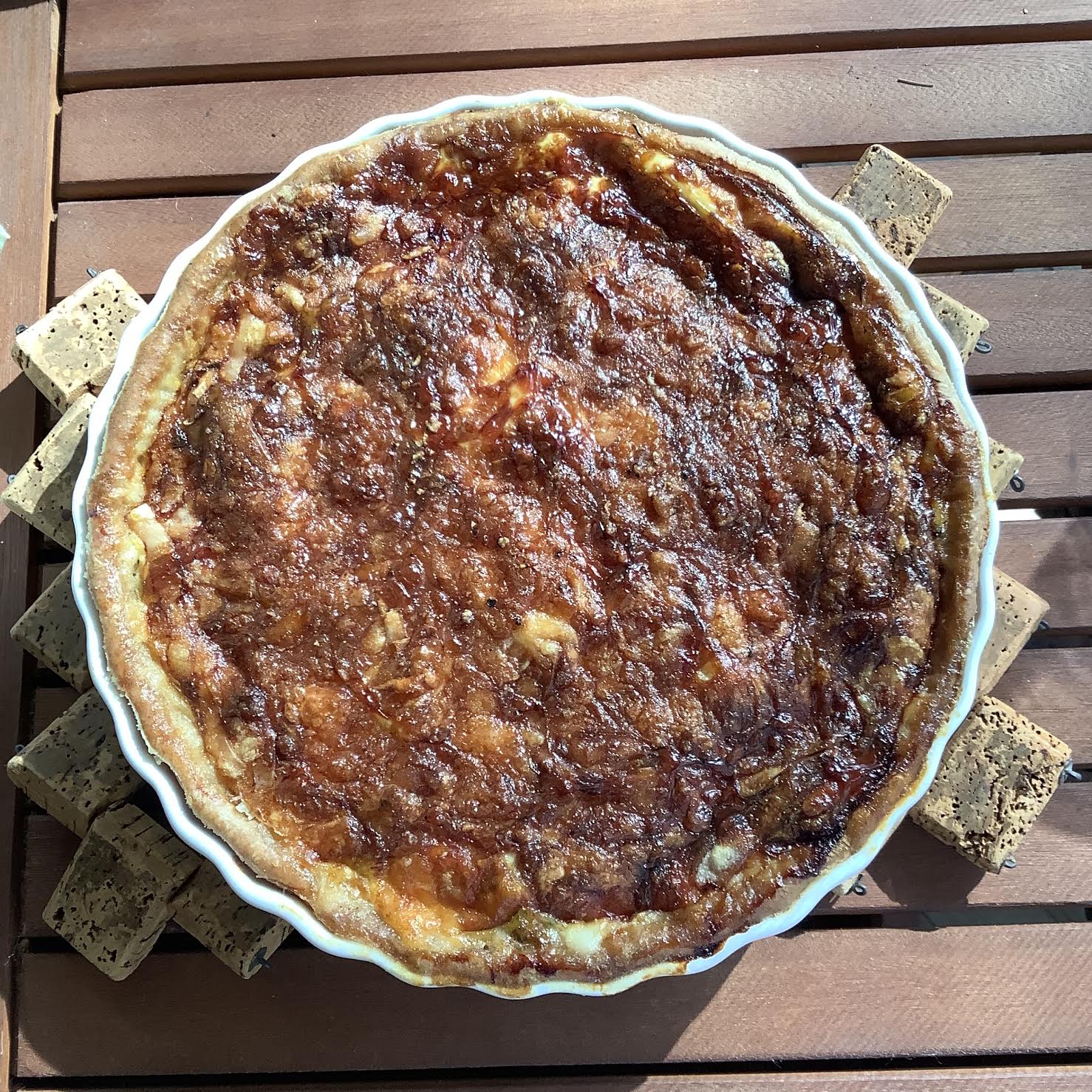
Our Vegetable Quiche is a combo of recipes from Peter Christian’s Recipes and the Town Farm Restaurant Cookbook [Bar Harbor, Maine]. We served it recently and fell in love with it all over again.
A pie crust, some onion, broccoli, and zucchini… Dill Havarti, Cheddar, Swiss Gruyere… eggs, milk. Very elemental ingredients.
That’s a 9-inch quiche/tart/flan pan.
Prepare a pie crust and fit it into a pie plate or tart pan. Sprinkle 2 Tbsp chopped onion over the pie crust. Measure 4 cups of chopped vegetables and steam them until they are just tender. Drain the vegetables and permit them to ‘out-gas’ for a bit while you grate the cheese. Use 2 cups Gruyere, 1 cup Cheddar, and 1 cup dill Havarti. Distribute the vegetables over the onions, then top with cheese. Set the oven at 400 F. Whisk 3 eggs with one cup of milk, salt, pepper, and herbs in abundance. Carefully pour the egg-milk over the contents of the quiche pan — it will be very full. Bake at 400F for 15 minutes, then lower the heat to 350F and bake for 20-30 minutes longer.
Out of the oven and on to the table.
The quiche should sit for 15-20 minutes before serving.
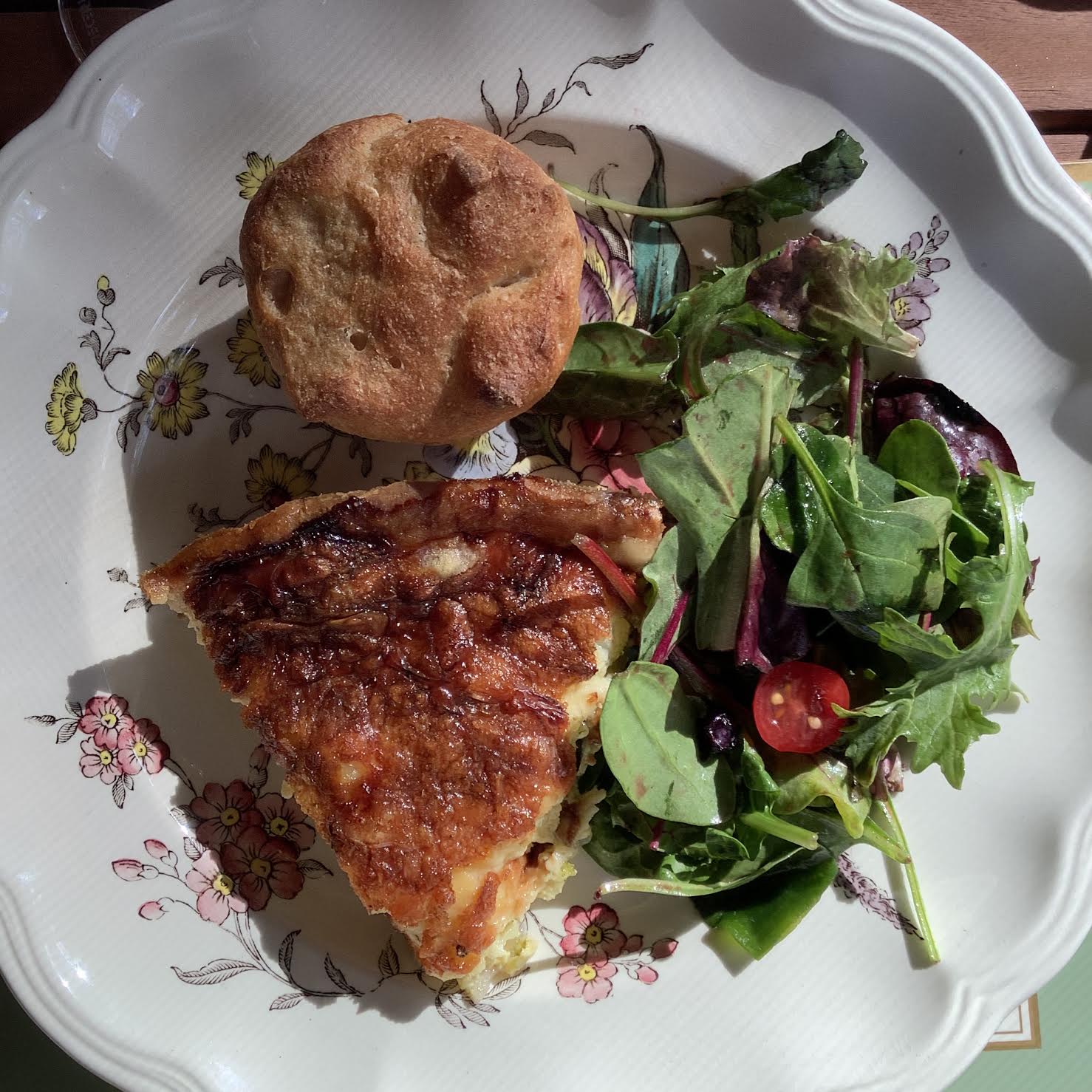
Served with a good green salad and airy home-made rolls — can’t be beat. Serves 6 easily.
People who are new to Fasting often pose the questions: “Can I really eat ‘anything I want’ on a Slow Day?” and “What should I eat on Slow Days?” To answer those questions, I have decided to add some blog posts to show some of the foods we eat on what the world calls NFDs [non-fast days] but which, in our house, we call ‘Slow Days.’ This feature will appear sporadically.
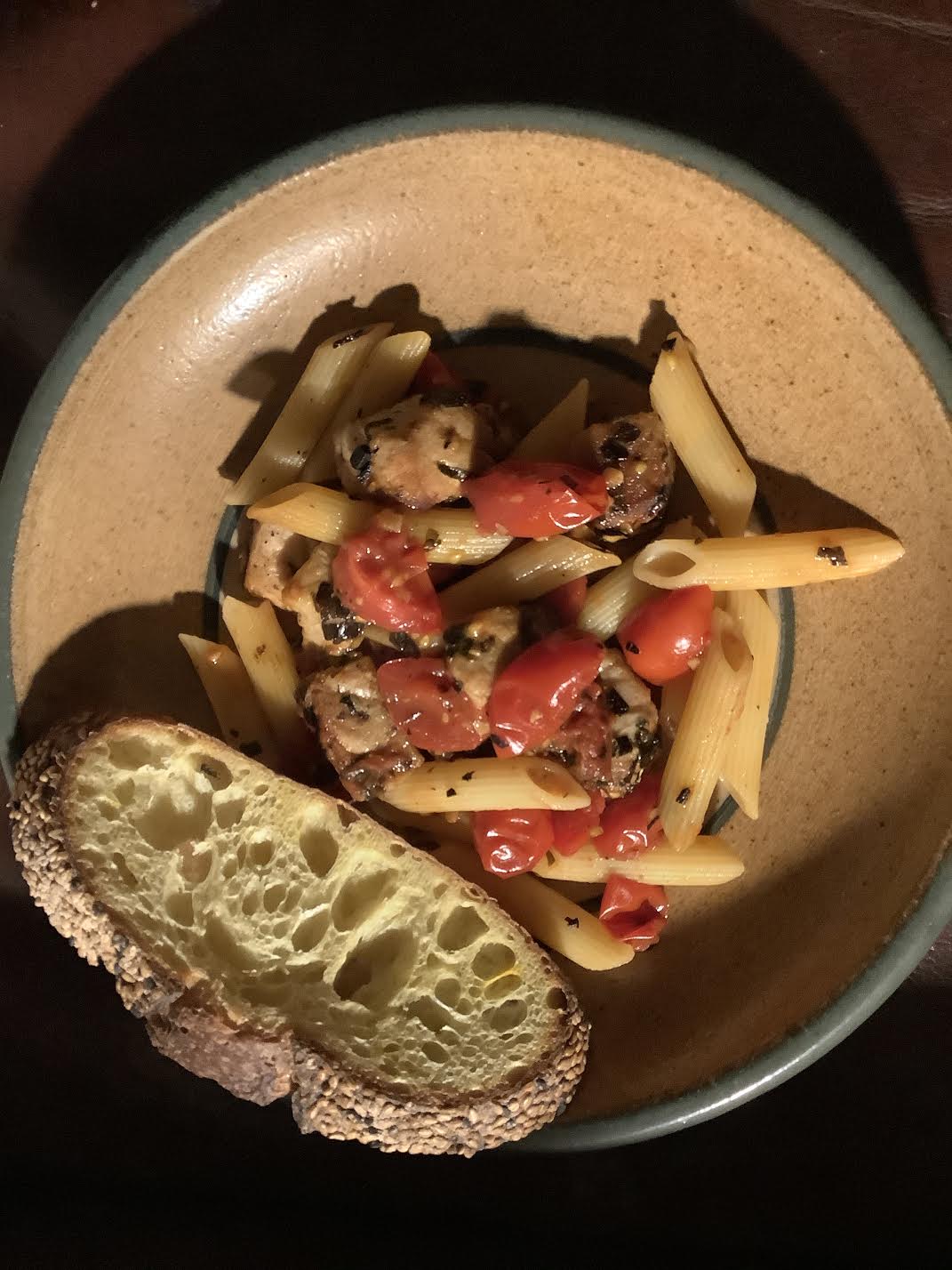
On Wednesday, which is a Slow Day in our house, we invariably dine on a pasta meal. There are so many fine ways to top a plate of pasta that it can be a while until a particular meal is repeated. What follows is a recipe from Diary of a Tuscan Chef by Cesar Casella & Eileen Daspin. The chef calls it “Garganelli con Tonno Fresco,” but we call it Penne with Tuna & Tomatoes. This is so special and so easy to prepare that we schedule it when we want a lot of impact even when there is little time.
My job is to prepare the mise en place and to cook the pasta.
Here we see fresh tuna cut into 1/2 inch cubes, along with garlic chopped with fresh oregano, and 2 cups of halved cherry tomatoes. Cook the pasta of choice in salted water. Meanwhile, saute the garlic and oregano in olive oil until the garlic begins to color. Add the tuna and a pinch of crushed red pepper, and cook, stirring, for 3-4 minutes until the fish is done to your liking. Remove the tuna from the pan to a plate or bowl. Drain the pasta, saving some cooking water. Deglaze the saute pan with about 1/3 cup white wine, and let it cook down while you scrape brown bits off the bottom of the pan. Add the pasta water and the tomatoes to the pan and cook for 2 minutes. Toss in the pasta, some chopped parsley, the cooked tuna, and a sprinkle of salt and pepper. That took less than 15 minutes.
Dear Husband cooks the meal and chooses the wine.
Plate with crusty bread and a crisp salad of many different greens. Easy and delicious — especially when Dear Husband does all the cooking.
Tomorrow marks the 8th anniversary of our Fasting Lifestyle. Our weight is still down where we want it to be, our health is good. And we continue to eat pasta on Wednesdays — what a life!













 Eating well, with creative recipes, to follow the Fasting Lifestyle according to Michael Mosley's "Fast Diet."
#/media/File:Hieronymus_Bosch_054.jpg)