People who are new to Fasting often pose the questions: “Can I really eat ‘anything I want’ on a Slow Day?” and “What should I eat on Slow Days?” To answer those questions, I have decided to add some blog posts to show some of the foods we eat on what the world calls NFDs [non-fast days] but which, in our house, we call ‘Slow Days.’ This feature will appear sporadically.
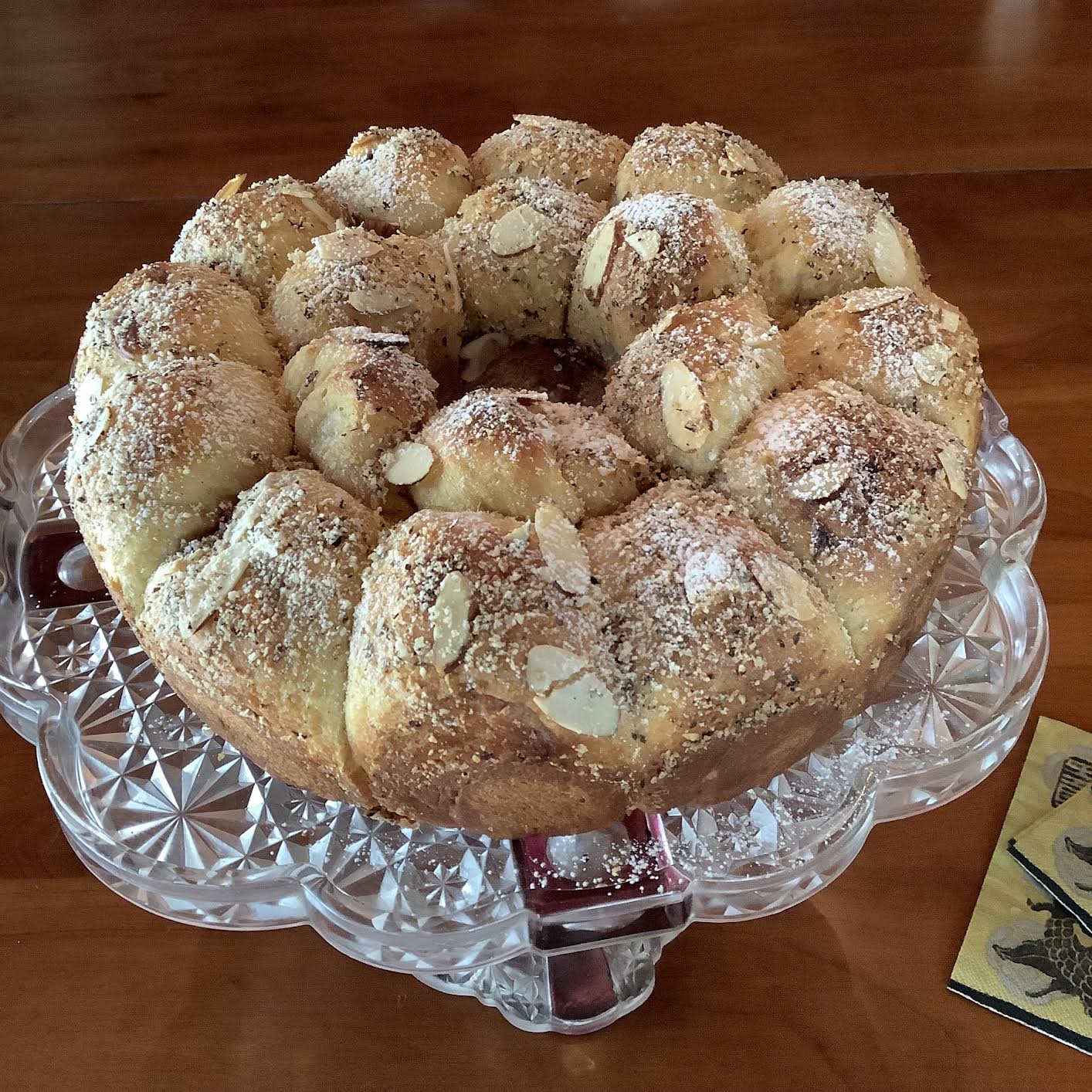
If you want something special for a holiday breakfast, this delightful brioche wreath fills the bill. The recipe is from Bonne Maman, makers of jams, jellies, and spreads, and of course they want you to use one of their products. You may use any quality homemade or purchased jam you wish. I prepared this for a gathering of the knitting group, and it was a success. The step involving the preparation of the jam-filled balls could be a family affair and is a good way to include little hands in the kitchen. I have broken the recipe into steps over two days, which simplifies the process [I think], and breaks it into steps that are not too time-consuming. And the next day, Voila! a splendid breakfast centerpiece that looks spectacular, but was made with little fuss.
1 large wreath of 18 puffs
10” tube pan or 12” pie plate + ramekin
DAY 1, EARLY
7g sachet fast-action dried yeast 25g golden caster sugar 150 g white whole wheat flour 150g strong white = bread flour zest of ½ orange + ½ lemon 1 tsp salt
Caster sugar is a fine-grained sugar from the UK. Blitz granulated white sugar in the food processor to make a substitute. Zest the orange and lemon rinds OR USE 2 Tbsp ORANGE PUREE. [chop an orange into large pieces, run through food processor to make a chunky mush] Mix these in the bowl of an electric mixer with a dough hook. Make a well in the center.
50 ml warm milk 3 large eggs, beaten
Pour these into center well. Mix on a slow speed 2 mins, then on medium 3-4 mins, until dough is soft, glossy and elastic.
225g/16 Tbsp/2 sticks butter, cubed and very soft
Add butter, bit by bit, and mix 4-5 mins. Scrape down bowl to mix thoroughly. Dough will be very soft. Tip into an oiled bowl, cover with film and chill 8-24 hrs until firm.
DAY 1, LATE
18 tsp Bonne Maman Conserve – choose your favorite or make 9 of one flavor and 9 of another
On a lightly oiled surface, divide dough into 18 pieces, ~40 g each. Roll pieces in circles 10 cm in dia. Spoon 1 tsp of jam on centre of each. Bring up sides, pinch together, roll into a ball.
Butter a 10” tube pan. ORPut a greased ramekin in center of buttered 12″ pie plate. Put 6 balls, seam side down, around center tube. Put 12 balls in an outer circle. Cover, let sit 2 hrs until puffy –OR– OVERNight @ 40 degrees
DAY 2, MORNING
Heat oven to 170ºC/340F/ gas mark 5.
Egg wash ½ tsp lemon finishing salt 1 tbsp ground hazelnuts sliced almonds
After rising, brush dough with a little egg wash, sprinkle with salt and nuts. Bake 20 mins, until golden.
Cover with foil and cook 10-15 mins longer.
Icing sugar
Cool slightly, remove from pan. Remove ramekin if using. Dust with icing sugar.
People who are new to Fasting often pose the questions: “Can I really eat ‘anything I want’ on a Slow Day?” and “What should I eat on Slow Days?” To answer those questions, I have decided to add some blog posts to show some of the foods we eat on what the world calls NFDs [non-fast days] but which, in our house, we call ‘Slow Days.’ This feature will appear sporadically.
The late, lamented Gourmet Magazine had a practice of publishing favorite recipes from readers. One of them was for this coffee cake. What makes it “Pennsylvania Dutch” is probably the method of cutting the butter into the flour to form a crumb, then combining most of the crumbs with the moist ingredients. This is similar to the process of preparing a Shoo-Fly Pie, a classic of Pennsylvania Dutch cuisine. Since the recipe makes two 8″ cakes, there is one to eat and one for gifting or for the freezer.
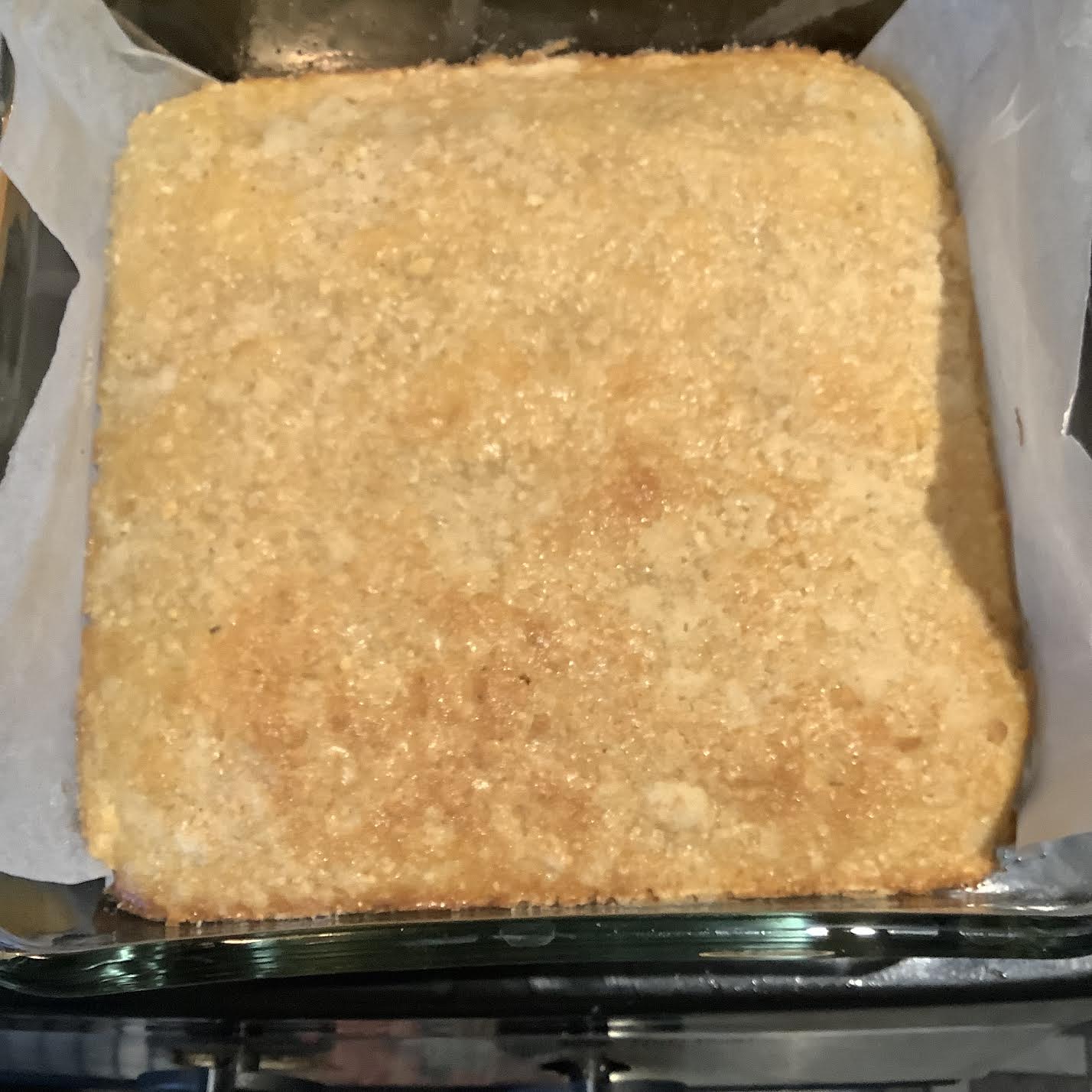
Fresh from the oven, in an 8×8″ pan. Cut into 9 pieces.Served with strawberry yogurt, back bacon, mocha cafe au lait, and orange-rhubarb juice.
The coffeecake is delicious and easy to prepare. Have only one egg to use? You can just as simply make one cake from the recipe. Either way, the cake is moist and flavorful. This is a regular in our breakfast rotation.
Two 8 or 9” cakes
1 cake or 12 muffins
8 or 9” round cake pans
2 eggs 1 c. milk, fat % of your choice
1 eggs ½ c. milk, fat % of your choice
Whisk together and set aside.
2 ½ c. white whole wheat flour 1 ½ c sugar or 1¼ c. ½ tsp salt 1 Tbsp baking powder ¾ c/12 oz butter
1¼ c. white whole wheat flour ¾ c sugar or 2/3 c. ¼ tsp salt 1½ tsp baking powder 1/3 c/ 6 oz butter
With pastry blender or 2 knives, cut together until mixture looks like a coarse meal. SAVE OUT ½ OR ¼ CUP OF CRUMBS, set aside
Stir egg-milk into flour crumbs until combined.
Pour into pans, buttered or lined with parchment paper.
½ cup crumbs
¼ c crumbs
Sprinkle tops with crumbs.
Bake @ 375F 25-30 mins, until top begins to turn golden.
People who are new to Fasting often pose the questions: “Can I really eat ‘anything I want’ on a Slow Day?” and “What should I eat on Slow Days?” To answer those questions, I have decided to add some blog posts to show some of the foods we eat on what the world calls NFDs [non-fast days] but which, in our house, we call ‘Slow Days.’ This feature will appear sporadically.
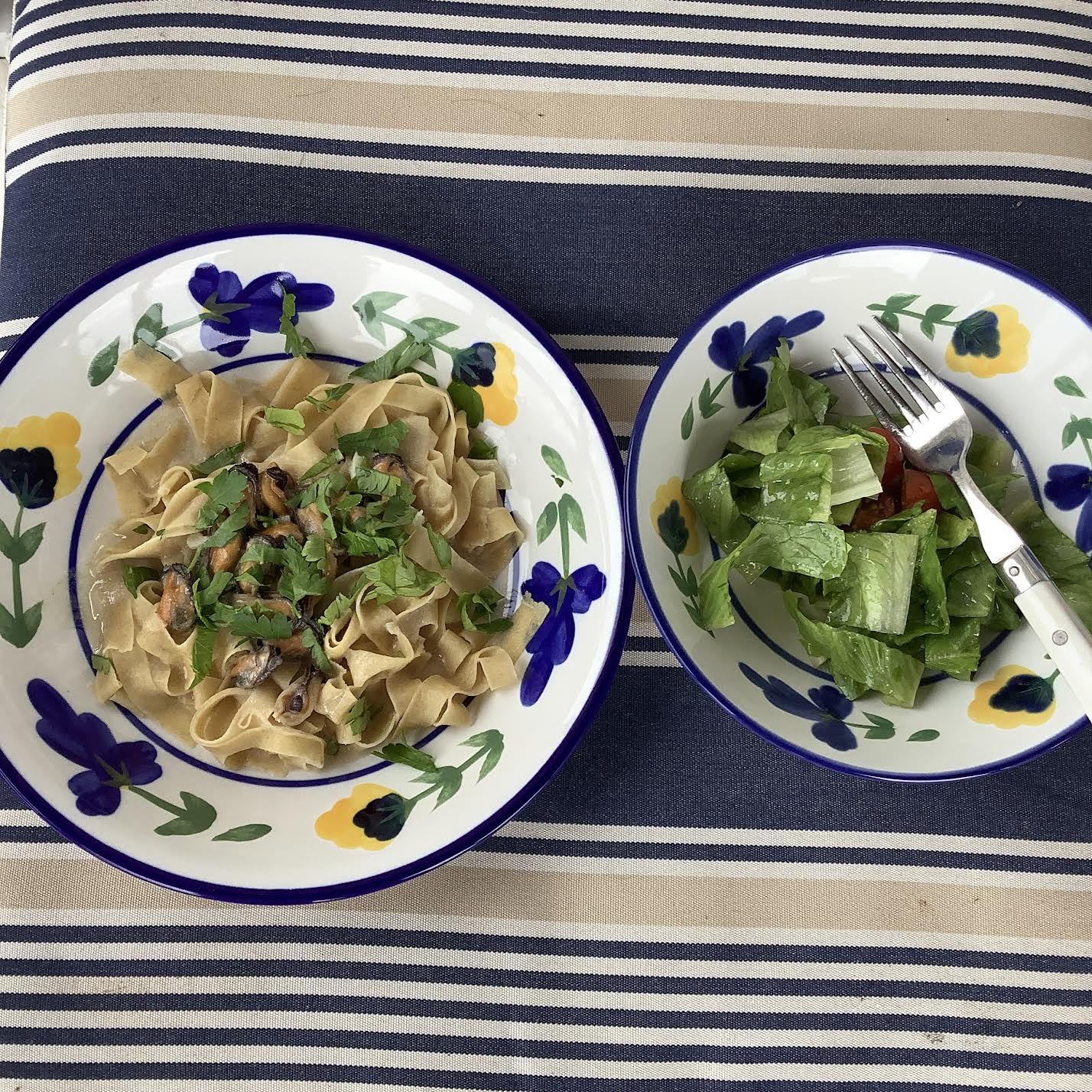
In Summertime, we eat mussels. “Rope-grown mussels” are a big industry where we vacation in PEI, Canada, and we take full advantage of them. Years ago, when we first started going to the local mussel processing plant to buy them, they sold for 50 cents/pound. Even though they are $2/pound now, they are worth it. One of our favorite ways to prepare them is a recipe from A Well-Seasoned Appetite by Molly O’Neil. You can prepare these with fresh mussels in their shells, or use cooked mussel meat that has been removed from the shells. We prefer the latter, and find it to be a good way to use left-over mussels from a previous feed. Very quick, very easy, very good.
How this Fast Diet Lifestyle works: Eat these meals tomorrow, for a calorie total of less than 600. On another day this week, eat the meals from a different post, another day of eating 600 calories or less. Eat sensibly the other days of the week. That’s it: a simple way to lose weight and be healthier.
Bartholomew is listed as one of the 12 disciples of Jesus, and that is the only time he is mentioned in the Bible. [Most Americans hear the name first in the Dr Seuss book The 500 Hats of Bartholomew Cubbins.] He was born in Cana [the place where the water-into-wine wedding was held], and, as a witness to Jesus’ life, Bartholomew traveled widely to spread the Gospel. He preached in Parthia and Mesopotamia. Tradition tells us that Bartholomew voyaged to India, leaving behind a copy of the Gospel of Matthew. At last he went to Armenia, where he met a horrible, gruesome martyrdom, 24 August 70 CE. There is another gory event that is associated with this saint: The Saint Bartholomew’s Day Massacre of 1587. From the early 1500s, the protestant followers of Jehan Calvin, called Huguenots, were growing in numbers and influence. The Roman Catholic leadership and the Royal Family were growing annoyed and fearful. In an attempt to end the Wars of Religion that began in 1562, a marriage was arranged between the daughter of the Catholic Queen Mother [Catherine de Medici] and the Calvinist Queen’s son, the future Henri IV. So many protestants came to Paris for the celebration, that Catholics began to fear an insurrection. Early in the morning of 24 August, Catholic soldiers began to assassinate high-ranking Calvinists. All day long, gangs roamed the streets, slaying Huguenots left and right. The movement spread to the countryside, and more killing followed. A low estimate said that 5000 died in Paris alone, and tens of thousands more around the country in the following two weeks. August 24 was not a good day for Bartholomew or for religious tolerance. Be kind. Be tolerant.
Saint Bartholomew is the Patron Saint of Butchers. Ugh. At Smithfield Market in London, the Butchers’ Guild held a fair on August 24, from 1133 to 1855. Fresh meats of all kinds were featured, especially beef [this is England, after all] and pork. Apples were consumed as well — dipped in honey, or drank as cider or mead. Naturally, our meals today involve pork, and apples, and beef.
Apple-Pork ScrOmelette: 151 calories 8 g fat 1 g fiber 13 g protein 7.4 g carbs 46.4 mg Calcium NB: Food values shown are for the eggs and fruit only, and do not include the optional beverages.PB GF Pork and apples are such a fine combination that they should be part of a yummy breakfast.
1½ two-oz eggs HINT: If you are serving one person, crack three 2-oz eggs into a small bowl or glass measuring cup. Whip up those eggs and pour half of their volume into a jar with a lid to store in the ‘fridge for next week. 1½ oz apple 1 oz raw pork, ground or minced tenderloin 1 leaf fresh sage, sliced thinly crosswise dab of prepared mustard 1½ oz melon Optional:blackish coffee [53 calories] or blackish tea or mocha cafe au lait [65 calories] Optional: 5 oz fruit smoothie or berry-yogurt smoothie [88 calories]
Mince the apple, leaving the skin on it. Put apple and crumbled sage in a saute pan spritzed with cooking spray. Cook over medium for 45 seconds, then add the pork. Cook until pork is cooked and apple is soft. Whisk the eggs and pour over apple-pork-sage. Scramble until done to your liking. Plate with the fruit and plan to do something nice for someone today.
Pot Roast Plate: 269calories 6.6 g fat 3 g fiber 28 g protein 18.5 g carbs 24.6 mg Calcium PB GF You might have enjoyed a pot roast with the family for Sunday dinner, and since that was a Slow Day, you ate a lot and enjoyed it. Would you believe that you could have the left-overs for dinner on a Fast Day? Yes, you can! Low in fat, high in protein, delicious: this meal checks all the boxes. [At Denny’s, this meal clocks in at 400 calories with 20 g fat; at Culver’s, it is 700 calories with 27 g fat] HINT: After preparing the full recipe, I portioned the meal and froze individual servings for quick future meal preparation.
4 oz braised beef bottom round 3 oz carrots, cooked with the beef 2 oz small red potatoes, cooked with the beef 2 oz small [boiling] onions, cooked with the beef 2 Tbsp beef gravy, from the braising liquid
IF USING LEFT-OVER POT ROAST: Slice the meat. Mass out the vegetables to the stated serving size. Either heat everything in the microwave or put into a pan with a tight lid and some water to warm on the stove-top. A steamer basket is another way to re-warm this meal. Serve with heated gravy and have a feast fit for Saint Bartholomew’s Day. IF STARTING FROM SCRATCH: get 4 oz of sliced rare roast beef from the deli section of the supermarket. Put vegetables in a pot with the gravy and 1/2 cup water. Top with a lid and simmer until almost tender. Lay the beef on top of the vegetables, cover, and cook until only a little liquid remains in the pan. Plate it all and pour the pan juices over everything.
Ingredients for next week: Breakfast, single portion for Monday …………………………… single portion for Thursday:
People who are new to Fasting often pose the questions: “Can I really eat ‘anything I want’ on a Slow Day?” and “What should I eat on Slow Days?” To answer those questions, I have decided to add some blog posts to show some of the foods we eat on what the world calls NFDs [non-fast days] but which, in our house, we call ‘Slow Days.’ This feature will appear sporadically.
When our sons were young, our Summer Vacation was two weeks at Prince Edward Island in Canada. I would pack up ingredients for the meals we would eat, we would stuff our duffels with bathing suits and snorkel equipment, and off we would go to the old farm house we would always rent on a little lane that went down to the sea. It was delightful.
Early on, I discovered a new recipe: Pecan Rolls that could rise overnight and be enjoyed for the next day’s breakfast. Even better, the recipe made so many that they could be frozen and re–heated for subsequent breakfasts large enough to satisfy two growing boys. Great!! The recipe is from Great Breads by Martha Rose Shulman.
Now we have our own house on Prince Edward Island, built to resemble our former rental, but with some serious updates — like a large, well-equipped kitchen. Every Summer there, I make a batch of Pecan Rolls: some for the next breakfast, many for the freezer to feed our Summer guests. Depending on how you cut the dough, you could make 24-36 large rolls. Have fun with this one!
Mise en place: in big bowl — 2 flours, mace, salt; in smaller vessels, left to right: milk-juice-honey, yeast, pecans, egg-oil, unplumped raisins
24 huge rolls OR 32 regular
12 huge rolls OR 16 regular
1 cup raisins boiling water to cover
½ cup raisins boiling water to cover
Soak 15 mins, then drain, saving the water and raisins.
½ c cooled raisin water 1 Tbsp yeast
¼ c cooled raisin water 1.5 tsp yeast
Pour into 1-Quart bowl. Let sit a few minutes, then stir to dissolve
¾ c warm milk ½ c warm orange juice 1/3 c warm honey
1/3 c warm milk ¼ c warm orange juice 3 Tbsp warm honey
Stir into yeast solution, let stand 5-10 mins.
¼ c oil, ex: canola two 2-oz eggs
2 Tbsp oil, ex: canola one 2-oz egg
Add to the bowl and mix.
1 2/3 c white flour 2 tsp salt ½ tsp mace or nutmeg 4-5 c white whole wheat flour
½ + 1/3 c white flour 1 tsp salt ¼ tsp mace or nutmeg 2-2½ c white whole wheat flour
Combine in a large bowl.
Plumped Raisins 1 cup liquids
Plumped Raisins ½ cup liquids
Stir into dry ingredients.
1 cup liquids
½ cup liquids
Add more liquids and mix.
Remaining liquids
Remaining liquids
Add and mix. Knead and let rise 1½-2 hours.
Punch down, divide dough in half if making larger amount. Roll ½ to an 8×12” oblong.
4 Tbsp melted butter 2 Tbsp honey 1 tsp cinnamon
2 Tbsp melted butter 1 Tbsp honey ½ tsp cinnamon
Stir to combine. Divide into 2 parts, if making larger amount. Brush rolled dough with 1 part butter-honey.
1/3 cup + 1/3 cup chopped pecans
3 Tbsp chopped pecans
Sprinkle dough with 1 part nuts. With long side toward you, roll up dough, slice into 12-16 pieces. Repeat with other ½ of dough, if making larger amount.
Arrange rolls, cut side up, on buttered baking trays.
Let rise on counter 1 hour, or overnight in ‘fridge.
Bake 15-20 mins at 350F.
½ c. icing sugar or more 1 tsp orange juice or more
¼ c. icing sugar or more 1 tsp orange juice or more
Stir together icing. Slather on rolls to serve today. Cool and freeze un-iced remaining rolls in plastic bags.
Pecan Rolls, back bacon, strawberry yogurt — tastes like Summer to me!
People who are new to Fasting often pose the questions: “Can I really eat ‘anything I want’ on a Slow Day?” and “What should I eat on Slow Days?” To answer those questions, I have decided to add some blog posts to show some of the foods we eat on what the world calls NFDs [non-fast days] but which, in our house, we call ‘Slow Days.’ This feature will appear sporadically.
Friends were going to drop by for a summer luncheon. We see them only once a year and don’t really know their eating preferences, so we opted for a ‘grazing meal.’ Call it Mezedakia if you are Greek, call it Tapas if you are Spanish, call it Small Bites if you are writing the restaurant appetizer menu. A meal like this offers flexibility and choices for the people around the table, and this assortment is very much in the Mediterranean Diet mode. One can eat as much or as little as one wants. My kind of meal!
Top Row, left to right: Gozleme Bread, Felafel patties Second Row, left to right: Cucumber-Tomato salad, Tzatziki [white, with spreading knife], black olives, cherry tomatoes, watermelon chunks Bottom Row, left to right: Carrots in lemon marinade, za’atar chicken chunks, White Beans with capers
This menu has many make-ahead components, so there is no scrambling at the last minute. And here are the preparation notes:
Gozleme Bread: make ahead
1¼ c white whole wheat flour ½ tsp salt
Mix in a 1-Qt-sized bowl.
¼ c water ¼ c plain yogurt
Combine yogurt/water and stir into the flour until well-combined. Add a bit more water if too dry.
On a floured surface, knead ~3 mins, until smooth and elastic. Cover and let sit for a few mins on the counter OR overnight in a cool place.
Roll on a floured surface into flat breads. Divide into sizes for your recipe. Cook on an oil-sprayed skillet 3-4 mins per side until turning brown in spots.
FELAFEL: makes 25 patties So convenient to have in the freezer for ‘instant’ meals.
2 cups canned chick peas [if you use dried chickpeas, you will get a grainer product. Factor in the time to reconstitute and cook them] 1.5 cloves garlic, crushed [add as much as you enjoy!] ¼ cup celery, minced ¼ c. scallions, sliced 1 two-oz egg 1½ tsp tahini ½ t. cumin ½ t. turmeric ¼ t. cayenne ¼ t. black pepper 1.5 t. salt
Combine in food processer until ingredients form a uniform paste. Scoop into a bowl and chill 1 hour. Form into balls on a silicone mat or parchment paper on a cookie sheet. I used a 1½ Tbsp scoop and then flattened the patties. TIP: You don’t have to bake them now. You could freeze the patties on a cookie sheet, then put them frozen into bags to cook later. Bake at 400F for 10-15 minutes. The patties should be heated through and have an outside ‘crust’ which is firm to the touch. In most recipes, you will cook them further. At this point you want them to be firm enough to store well. There will be about 25 of them. Use now or cool and freeze for later use.
Cucumber-Tomato Salad: make ahead What a Summer treat!
Sv 4
1 English cucumber, unpeeled
Trim off ends of cuke, halve it lengthwise. Cut into ½” dice.
10 oz grape or cherry tomatoes ½ small red onion
Dice tomatoes and red onion. Put all three veg into a bowl.
2 Tbsp olive oil 2 Tbsp red wine vinegar 1 tsp honey ½ tsp Kosher or fine sea salt ¼ tsp black pepper
Whisk these together.Pour dressing over the salad and toss gently to mix.
1 Tbsp chopped fresh parsley/dill /basil
Gently stir in the fresh herbs, if using.
Serve immediately or chill in ‘frige 1-2 hrs to let the flavors meld before serving.
Tzatziki: make ahead Thisis thetraditional Greek condiment. Very refreshing. The recipe comes from themediterraneandish.com and
2½ cups
1 English cucumber or another variety Kosher salt
Grate cucumbers whole if using English cucumbers. If using cucumbers with waxy skin, peel and cut in half before grating. Remove and discard seeds. Salt lightly.
Squeeze cucumbers in a clean cloth to remove liquid.
4-5 cloves garlic, minced 1 tsp distilled white vinegar 2 tsp extra virgin olive oil
In a big bowl, combine garlic with these and mix.
drained cucumber 2 c plain Greek yogurt Ground pepper + salt 1 Tbsp chopped fresh dill or mint
Add drained cucumber mixture to the above bowl, then add these ingredients. Stir to combine.
Chill 30 mins -2 hrs before serving with fresh veggies and pita or chips
Carrots in lemon marinade:make ahead Prepare the marinade: In a wide bowl, whisk together 1 tsp olive oil, 1 tsp lemon juice, pinch of granulated garlic, pinch oregano. Cook small carrot sticks until tender and put them into the marinade while they are still hot. Stir at whiles, as the carrots cool on the counter.
Za’atar Chicken:make ahead or grill in front of your guests to show off your skills. Serve the chicken meat in large pieces or cut into 1-inch cubes and serve on picks.
Serves 4
Serves 2
5 garlic cloves, pressed zest of 1 lemon 1/3 c yogurt ¼ c chopped fresh cilantro 3 Tbsp EVOO 1½ Tbsp za’atar 1 Tbsp chopped oregano/marjoram 1¾ tsp salt ¼ tsp ground black pepper
MARINADE – In a large bowl or container, stir together these ingredients.
2¼# boneless, skinless chicken thighs
2 thighs with legs, boned
Add chicken and toss until well coated. Cover and refrigerate for 2+ hrs or overnight.
Heat grill to medium or heat broiler with rack 3” from heat. If broiling instead of grilling, line sheet pan with foil for easier clean up. Take chicken from bowl, shaking off excess marinade, and grill/broil on one side until charred in spots, 5-8 mins. Flip, grill/broil 5-8 mins, until just cooked through.
White Beans with capers:make ahead Drain and rinse canned beans, such as navy or cannellini/white kidney. Stir in 1 Tbsp capers for every cup of beans, along with a pinch or two of salt. Let sit at room temperature to marry the flavors.
How this Fast Diet Lifestyle works: Eat these meals tomorrow, for a calorie total of less than 600. On another day this week, eat the meals from a different post, another day of eating 600 calories or less. Eat sensibly the other days of the week. That’s it: a simple way to lose weight and be healthier.
Coney Island is situated at the southern edge of Brooklyn, a borough of New York. It was an island when the Dutch arrived in the 1600s, and was left in isolation by the subsequent English and Americans. Fishermen, farmers, and shell-fishers who lived there in the early 1800s served cooked meals to visitors from the interior of Brooklyn who found that the sea breezes were refreshing in the Summer. In the 1820s, a bridge was built to the island and a road was constructed — ‘paved’ in crushed sea shells. By the 1830s, two hotels were in business, and the wealthy sojourned there, far from the crowds of the city. In the 1850s, the middle class began to visit, aided by the new ferry service. The aftermath of the Civil War saw railroad lines going to the peninsula. Shifting currents and developers filled in the water, making the former island part of the mainland. New hotels were built as everyone from immigrant families to the very rich flocked to Coney’s beaches. Then the Boom Times came: amusement parks, racetracks, and other attractions sprung up in profusion. Steeplechase Park, 1897; Luna Park, 1903; and Dreamland, 1904 vied to see which could sport the most electric lights. Outside the parks were the B&B Carousell [sic] with its hand-carved wooden horses and roller-coasters. The famous wooden Cyclone was open for business on June 26, 1927. Dear Husband recalls the clackety-clacking sound of the cars climbing up before a heart-stopping descent. Of course visitors needed food. Charles Feltman began selling hot dogs from a push-cart and ended up with an entire restaurant. His employee, Nathan Handwerker thought he could do better and Nathan’s Famous still exists. Fires, the automobile, and the 1964 World’s Fair caused the fortunes of Coney Island to wane. In the 1960s, Fred Trump wanted to tear down many of the old buildings to develop new residential and entertainment sites. The plan fell through. Luna Park has been re-built, the Cyclone still runs, and tourists still flock to Brighton Beach and Manhattan Beach, just as they have for 160 years.
By the early 1900s, Coney Island was the playground of the young and single residents of New York — factory and shop workers who wanted to play on the weekend. Our breakfast might have been eaten by one of them before hopping on the trolley to Coney. For dinner, what else but a hot dog!
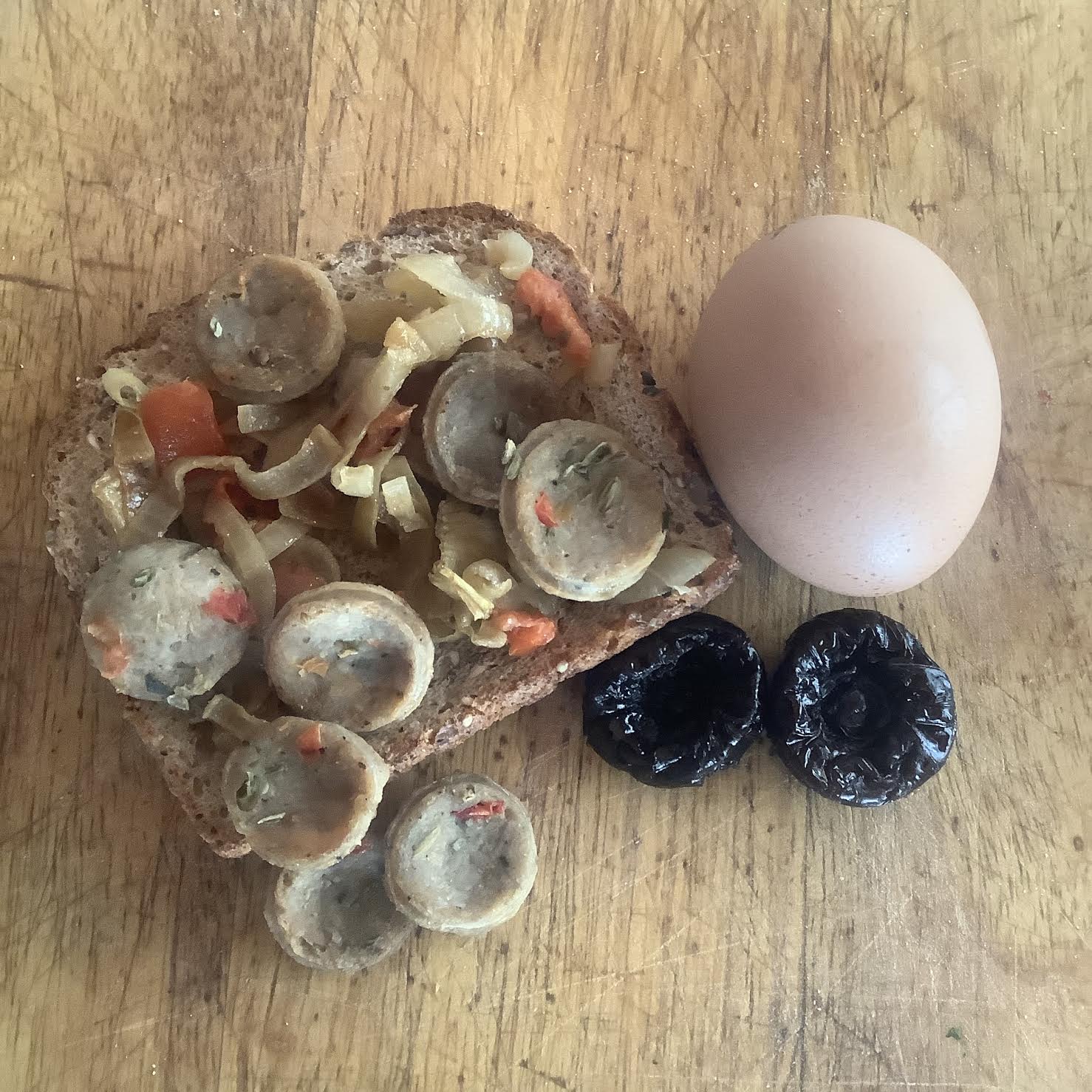
Shop Girl’s Breakfast: 231 calories 9 g fat 4.6 g fiber 14.5 g protein 27.5 g carbs 7 mg Calcium PB The Industrial Revolution brought young women by the thousands from the farm to the city, to work in the factories and as shop girls. Breakfast would have been served cold, made from dinner leftovers and other foods that required little preparation or refrigeration.
1 slice 70-calorie whole-grain bread [not white bread on her budget] 1 two-oz hard boiled egg 1 oz chicken dinner sausage 1 oz onion, sliced 2 prunes [0.6 oz] Optional: blackish coffee [53 calories] or blackish tea
The night or day before, slice the sausage and the onion. Place in a small pan with some water and a spritz of non-stick spray. Cook until the water has evaporated, sausage slices have browned a bit and the onions are limp. In the morning, toast the bread lightly and top with the sausage-onion mixture [rewarmed if you like]. Plate with the egg and the prunes. Only blackish coffee or tea for our shop girl – no stop at Starbucks on the way to work for a fancy brew.
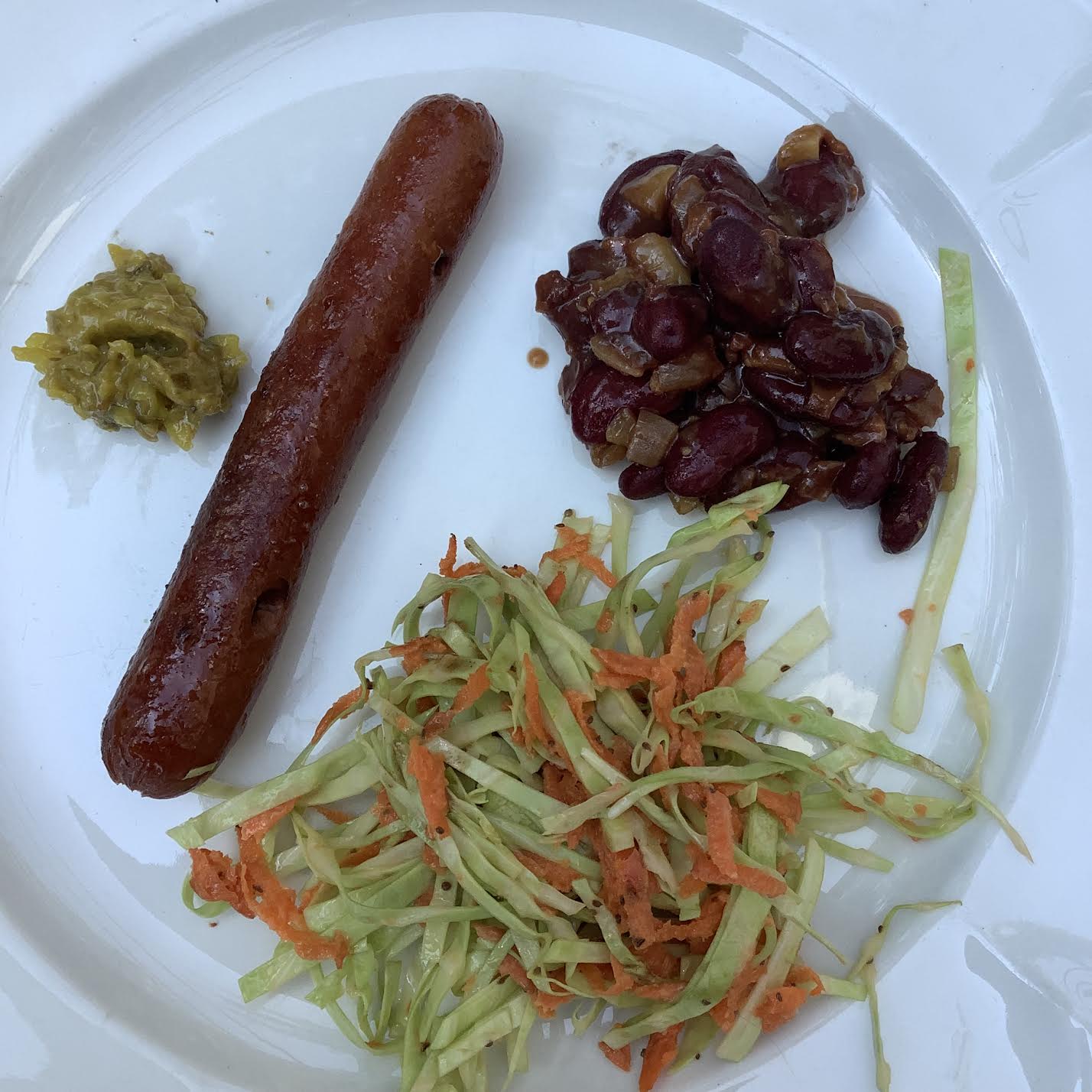
Hot Dog & Beans for Summer: 263 calories 18 g fat 6 g fiber 13 g protein 21.6 g carbs 68 mg Calcium PB GF This is what you want for a summer meal on the deck – all the flavors without the bun. HINT: This is enough for two.
Two <110-calorie hot dogs ½ c canned baked beans 1 deviled egg* ¾ c. coleslaw**
Grill or steam the hot dogs while you warm the baked beans. Prepare the deviled egg and coleslaw. This is a good old summer-time meal.
*Deviled Egg: 80 calories 5 g fat 0 g fiber 8 g protein 1 g carbs 36.6 mg Calcium PB GF Old favorite, updated.
One 2-oz egg, hardboiled, peeled 1 Tbsp 2%-fat cottage cheese Yellow Sriracha or New Mexico green chilis in a jar paprika or sumac
Slice egg in half lengthwise. Scoop out the yolk and mash on a plate with a fork. Add cheese and savory liquid, and mash until well blended. Spoon back into the divot of the egg white and sprinkle with paprika or sumac.
**COLESLAW: Makes ¾ cup From Jacques Pepin 1 cup = 81 calories 5 g fat 6.5 g fiber 2 g protein 11.4 g carbs 76 mg Calcium ½ cup = 41 calories 2.4 g fat 3 g fiber 1 g protein 5.5 g carbs 38 mg Calcium PB GF 1 cup chopped cabbage ½ oz carrot grated [makes ¼ cup] 1½ tsp ‘Mayo Dressing’ made with olive oil -OR- use plain yogurt 1½ tsp cider vinegar pinch celery seed
Whisk everything but the vegetables together in a wide bowl. Stir in the vegetables, add salt, pepper, or more vinegar to taste.
People who are new to Fasting often pose the questions: “Can I really eat ‘anything I want’ on a Slow Day?” and “What should I eat on Slow Days?” To answer those questions, I have decided to add some blog posts to show some of the foods we eat on what the world calls NFDs [non-fast days] but which, in our house, we call ‘Slow Days.’ This feature will appear sporadically.
Saint Patrick’s Day is an occasion that demands to be celebrated with special foods. No, not green beer. No, it doesn’t have to be Corned Beef & Cabbage. Look in most common cook books [James Beard, Fannie Farmer, Joy of Cooking, et alia] for ‘Irish Stew’ and you will find that it is made of lamb. Thus lamb, even better, lamb stew is appropriate for March 17th. When young Patrick was enslaved in Ireland, he worked as a shepherd — so there’s another reason to celebrate good Patrick with lamb. Most recipes are really plain and basic: cubed raw lamb, cubed potatoes, sliced onions, water, salt. We tried many of those recipes, and although they are surely authentic, they are just plain DULL.
How happy we were to find this recipe in the book Salute to Healthy Cooking by the French Culinary Institute! We prepare a large batch periodically, and serve it twice a year: on St Patrick’s Day in March and also in December during the run-up to Christmas. Lamb has much symbolic significance to Christians, so serving it during Lent and Advent makes sense to us.
Lamb Stew for twocan double or triple!
Need: saute pan + Dutch oven with lid + non-stick pan
½ pound boneless lamb shoulder, cubed cooking spray salt + pepper
Sear lamb cubes on all sides in a heavy pan spritzed with non-stick spray or oil. Cook meat in batches so pan doesn’t cool. Put cooked meat in a Dutch oven, sprinkle with salt and pepper.
½ cup onions, chopped
Put onions in saute pan and cook until tranluscent with enough water to make them sizzle .
1 oz dry red wine
Deglaze pan with wine, stirring up brown bits.
Heat the oven to 350 F.
¾ tsp white whole wheat flour water ½ Tbsp tomato paste
Sprinkle deglazed pan with flour and stir. Add to lamb in Dutch oven. Add enough cold water to go to top of the lamb but not cover it. Stir in tomato paste.
1 tsp thyme 1 bay leaf
Add herbs. Heat to a simmer over medium heat. Cover casserole and put in oven. Bake 1 hour, making sure stew is not boiling.
¾ c. carrots, cut in 2” batons
Add carrots, cover pan, bake 15 minutes.
½ cup cubed potatoes
Add potatoes, cover pan, bake 45 minutes. Remove bay leaf.
Salt + pepper
Add salt and pepper. Take off heat and cover until vegetables are cooked.
6 pearl onions, trimmed and peeled 1 cup/5 oz turnips, in 2” batons water ½ tsp sugar 1 tsp butter
Put vegetables in a small non-stick pan with sugar and butter. Add enough water to cover the vegetables half-way up. Simmer 10 minutes, uncovered, shaking pan occasionally.
Plate stew with the glazed vegetables.
Here is the stew in all its glory, served with an individual Soda Bread from Friend Ann.
And while you are doing your Irish thing, the best item to go with Irish Stew is Irish Soda Bread. I usually prepare a batch in the morning, so we can enjoy them for breakfast. Then the remaining ones are served at dinner with the stew. The recipe that I use is based on the Fannie Farmer Cookbook, with a few tweaks.
Makes 12 individual biscuits or 1 large loaf
Preheat oven to 400F. Buttered cookie sheet.
1 cup white flour 1 cup white whole wheat flour 1 tsp baking powder ½ tsp baking soda ½ tsp salt 1 Tbsp sugar 3 Tbsp butter
Cut the ingredients together, using two knives or a pastry blender. Purists would do it with their fingers. Non-purists might blitz this in a food processor.
½ – 1 cup raisins [black or golden] or currants 1 Tbsp caraway seed
Stir these into the dry mixture.
¾ cup buttermilk or soured milk – all of the milk may not be needed, or you might need more
Add milk bit by bit, stiring with a fork, until the dough is moistened and forms a ball.
For 12 individual biscuits
Roll/pat out dough on a lightly floured surface. Cut with a 2” or 3” round cutter. Use a knife to mark an ‘X’ on top of each.
For one large loaf
Gather the dough into a single ball, and flatten slightly. Use a knife to incise an ‘X’ on the top.
Bake at 400F 10-15 mins or 20 mins for large loaf
A portion of Irish Stew with a fruited slice of Soda Bread loaf.
How this Fast Diet Lifestyle works: Eat these meals tomorrow, for a calorie total of less than 600. On another day this week, eat the meals from a different post, another day of eating 600 calories or less. Eat sensibly the other days of the week. That’s it: a simple way to lose weight and be healthier.
Dear Husband has decided, since his birthday is tomorrow, that he will shift his eating plan into a higher gear: in addition to Fasting two days each week, he would like the Slow Day meals to be more Mediterranean in nature. What a good idea! This ancient Way of Eating has been studied since the 1950s and causing double-takes for decades — how can they eat all that olive oil and wine and cheese and still be healthy??!?! It is not about what they do eat but what they do not eat: butter, cream, red meat, refined carbohydrates, processed foods, sweets. Is there any benefit to eating like a Mediterranean? Oh yes!! A large, long-term study in the US showed that a Mediterranean Diet lowers cholesterol, helps the body to regulate blood sugar, and reduces damaging inflammation linked to metabolic disease, all while keeping arteries flexible and free from plaque. AND it can promote weight loss. In sum, a Mediterranean Diet, along with other healthy lifestyle choices, seems to reduce early death due to heart issues by 80%. W.O.W. Dr, Michael Mosley, originator of the Fast Diet, highly recommends a Mediterranean Diet for everyone on Slow Days. How similar are the Fast Diet and the Mediterranean Diet? Let’s look at a comparison:
Is this food allowed on this diet…
MEDITERRANEAN
On Fast Days
Fatty Animal protein: beef, lamb, pork
< 3 oz sv.
Small servings
Lean Animal protein: chicken, turkey
3 oz sv
Yes, preferred
Eggs
Up to 7 per week
Yes
Beer, wine, cocktails
Yes to wine
On Slow Days
Oats, barley, quinoa, brown rice, whole-wheat bread/pasta
Based on information from the Cleveland Clinic website.
There are many ways to add vegetables to your diet deliciously, such as Zucchini-Feta Fritters for breakfast [or dinner] and Felafel at dinner [or breakfast]. Try making changes to one meal a week, to conform to the new guidelines, then expand your repertoire to other meals.
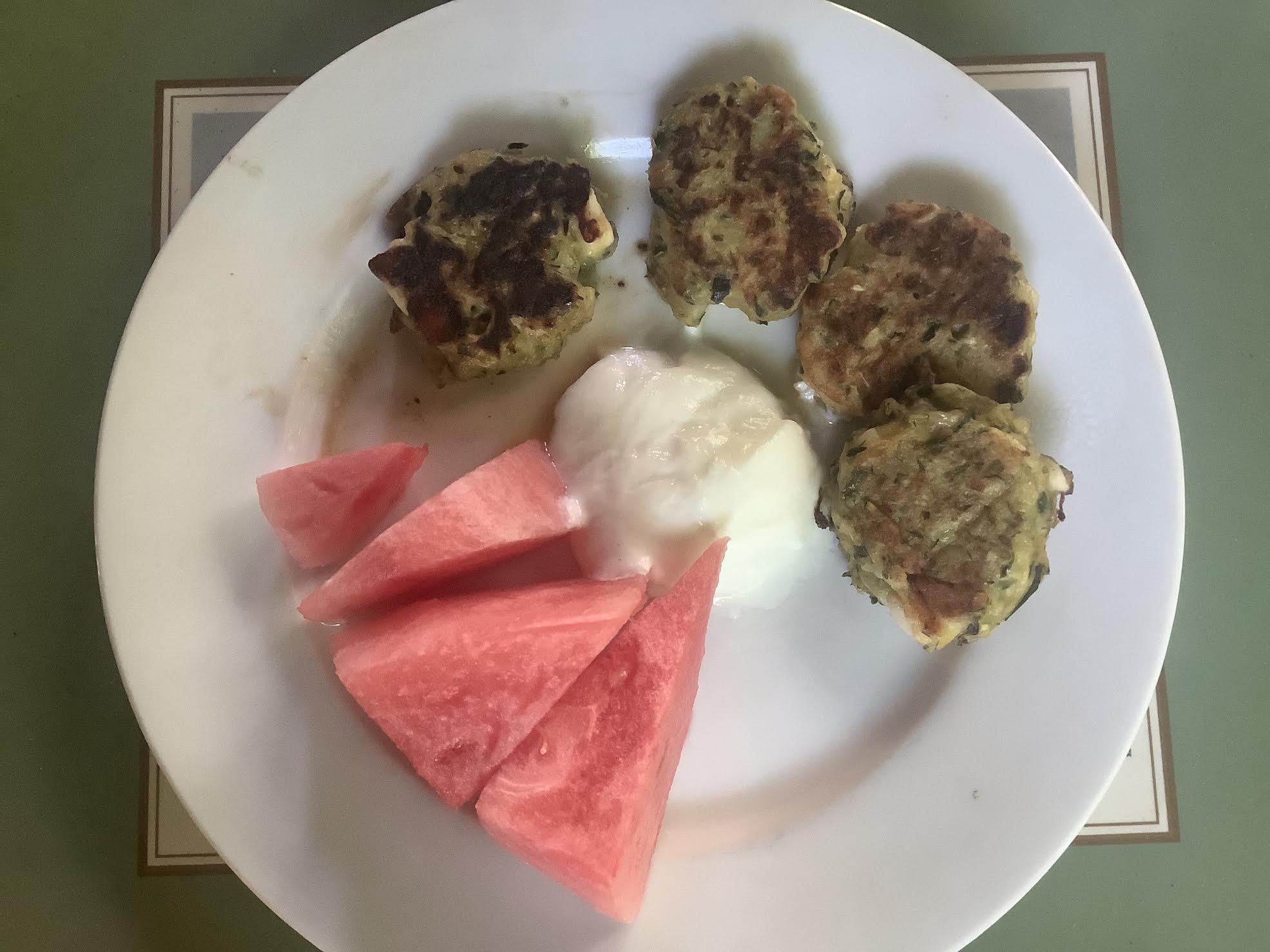
Zucchini-Feta Fritters & Fruit: 178 calories….. 5 g fat… 3 g fiber… 8.4 g protein… 31.6 g carbs… 208 mg Calcium… NB: Food values given are for the plated foods only, and do not include the optional beverage.PBGF – if using GF flour Savory with the feta, sweet with the melon – a flavor adventure for breakfast.
++ 4 zucchini-feta fritters ** ++++ 3 oz watermelon ++++ 2 Tbsp plain, fat-free yogurt ++++ Optional: 5 oz fruit smoothie or berry-yogurt smoothie[88 calories] ++++ Optional:blackish coffee [53 calories] or blackish tea or mocha cafe au lait [65 calories] ++
Start the fritters the night before to allow the zucchini to drain thoroughly. Using 1.5 Tablespoons per fritter, place the batter on a hot griddle which has been spritzed with non-stick spray. Flatten the fritters, and cook on both sides until well browned. Plate with the melon and yogurt. Serve with beverage of choice, noting their calorie count. [Refrigerate the remaining batter until you have time to cook and freeze the remainder.]
**Zucchini-Feta Frittersmakes 23-24 each: 34 calories 1.5 g fat 0.3 g fiber 1.5 g protein 3 g carbs 34 mg Calcium PB These are a yummy treat, at breakfast or as a pre-dinner nibble. 1-1/8 pound [18 oz] zucchini salt 1 two-oz egg 4 oz feta cheese, crumbled or diced ¼ cup fresh dill weed OR 2 Tbsp dried 2 Tbsp fresh parsley ¼ c white whole wheat flour ¼ cup self-rising flour Grate the zucchini and put it in a collendar over a bowl. Sprinkle with salt and use your fingers to toss the zucchini to distribute the salt. Let sit several hours or overnight. Place the zucchini in a clean bowl and add the remaining ingredients. Combine well. Heat a griddle/large skillet and spray with non-stick spray. TIP: I used a 1.5 Tbsp scoop, but a heaping tablespoon would do as well. Make piles of the batter on the cooking surface, then flatten them, and cook until well-browned on both sides.
Felafel with Vegetable Salsa: 205 calories 5 g fat 7.5 g fiber 9 g protein 26.5 g carbs 139 mg Calcium PB GF The felafel recipe is from Molly Katzen’s Moosewood Cookbook. Perfect for any time of year. Felafel is so convenient to have in the freezer for ‘instant’ meals.
6 falefel patties ½ cup diced fresh tomatoes ½ cup diced orange or yellow bell peppers 2 Tbsp red onion, chopped 1 Tbsp lemon juice
Combine the chopped vegetables with the lemon juice. Let sit while the felafel warms. If frozen, warm the felafel. Plate the felafel and the salad. It’s that easy?!? Yes it is!
FELAFEL: makes 26 patties each patty = 25 calories
2 cups canned chick peas [if you use dried chickpeas, you will get a grainer product. Factor in the time to reconstitute and cook them] 1.5 cloves garlic, crushed [add as much as you enjoy!] ¼ cup celery, minced ¼ c. scallions, sliced 1 egg 1½ tsp tahini ½ t. cumin ½ t. tumeric ¼ t. cayenne ¼ t. black pepper 1.5 t. salt
Combine in food processer until ingredients form a uniform paste. Scoop into a bowl and chill 1 hour. Form into balls on a silicone mat or parchment paper on a cookie sheet. I used a 1½ Tbsp scoop and then flattened the patties. TIP: You don’t have to bake them now. You could freeze the patties on a cookie sheet, then put them frozen into bags to cook later. Bake at 400F for 10-15 minutes. The patties should be heated through and have an outside ‘crust’ which is firm to the touch. In most recipes, you will cook them further. At this point you want them to be firm enough to store well. There will be about 25 of them. Use now or cool and freeze for later use.
Ingredients for next week: Breakfast, single portion for Monday …………………………… single portion for Thursday:
1 two-oz egg + apple or pear
barley flour + white whole wheat flour
Tattie Scone: mashed potatoes
1 egg + plain fat-free yogurt + fat-free milk
egg white + milk
baking soda + baking powder + honey
white whole wheat flour + baking powder
dried fig + grapes or melon
Optional smoothie
deglet noor dates + salt
optional hot beverage
optional hot beverage
Dinner, single portion for Monday:………………………….. single portion for Thursday:
People who are new to Fasting often pose the questions: “Can I really eat ‘anything I want’ on a Slow Day?” and “What should I eat on Slow Days?” To answer those questions, I have decided to add some blog posts to show some of the foods we eat on what the world calls NFDs [non-fast days] but which, in our house, we call ‘Slow Days.’ This feature will appear sporadically.
Every Saturday we enjoy pizza for dinner. Not store-bought, not delivered, but home-made. Mostly, we will prepare the red-sauce-mozzarella type, and we vary the toppings week to week. But once in a while, I suggest a “Greek” pizza. This variety was developed by a Greek immigrant who ran a pizzeria in New London, Connecticut in the 1950s. Since then, Greek Pizza has been popular in New England and eastern New York. Very regional. [I’m not going to get in the middle of which culture really invented pizza — I’d rather just eat it.] My version is based on reading many recipes, taking out the best bits, and putting them together in this recipe.
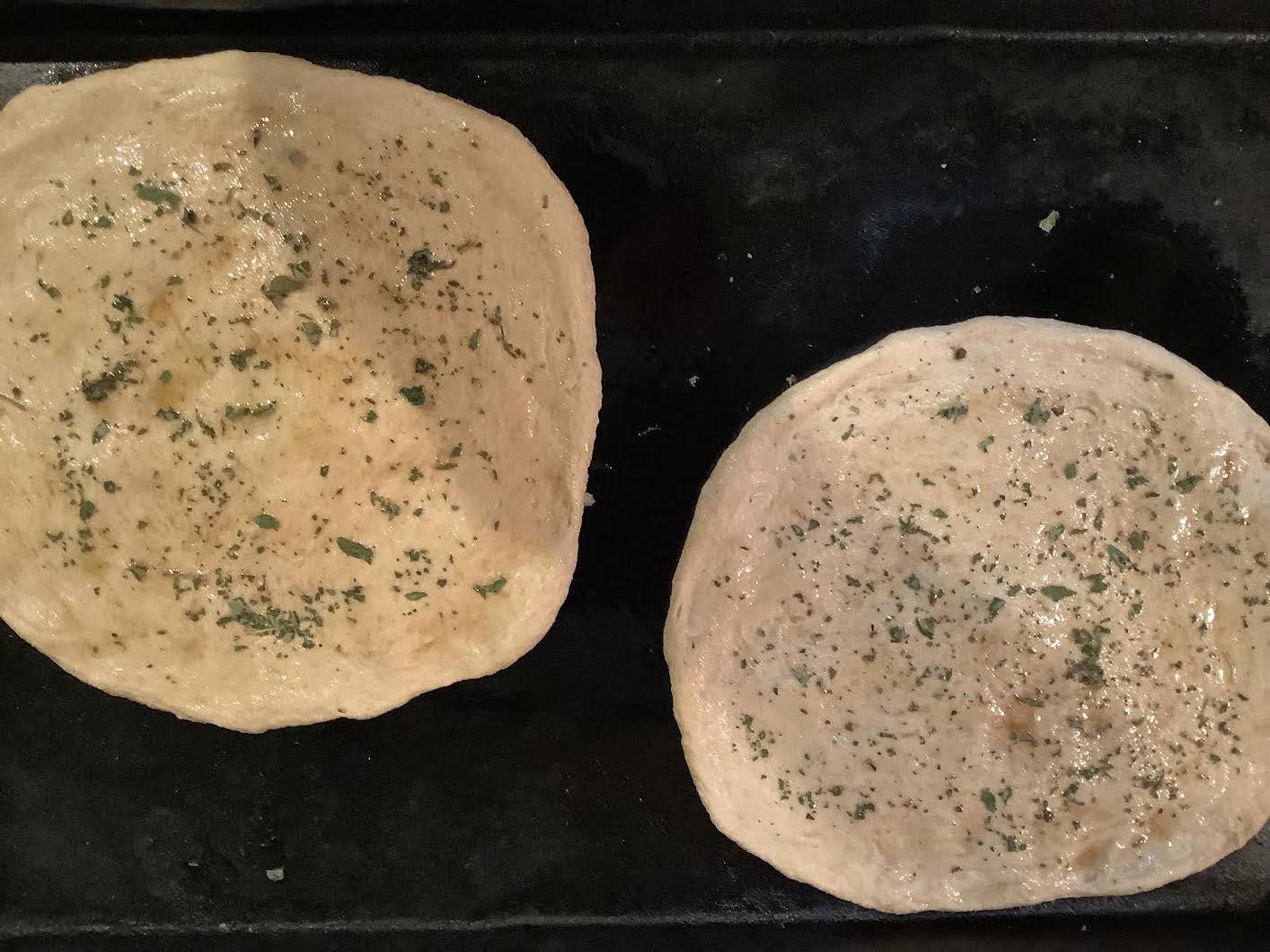
You will need two whole wheat pizza crusts, each 8″ in diameter. This takes [about 6 ounces of dough for each crust] Pat the crusts out on an oiled baking sheet. Preheat oven to 490F.
Salad Dressing makes 7 Tbsp dressing 1/4 cup virgin olive oil 1.5 Tbsp red wine vinegar 1.5 Tbsp lemon juice large pinch oregano Shake together in a small jar with a lid. Brush each crust with 1 Tbsp of dressing. Save the rest for the salad.
Pizza Topping enough for 2 pizza shells thaw or cook 5 oz spinach. Squeeze it in your hands to expel extra liquid. 3/4 cup shredded mozzarella 1/2 tsp garlic powder pinch ground nutmeg pinch crushed red pepper. Toss lightly to combine, and divide between the pizzas.
8″ dough rounds, brushed with salad dressingPizzas topped and ready for the oven.Baked and plated with a salad.
Garnish for each pie: 3/4 cup feta cheese, crumbled 3 black olives, pitted and cut in half or quartered 2-3 cherry tomatoes, halved
Bake at 490F for 4 minutes on an oiled baking sheet on the upper of two oven racks. After the first part of baking, remove the pizzas from the baking sheet and move them to the bottom rack with no pan under them. This bakes the bottom of the pizza nicely. Bake 3-4 minutes longer, until the cheeses melt. Serve with a salad of greens which are tossed with the same salad dressing above. Try this pizza some time — I think you will enjoy it.










 Eating well, with creative recipes, to follow the Fasting Lifestyle according to Michael Mosley's "Fast Diet."