Slow Days: Chinese Pork Steamed Buns

People who are new to Fasting often pose the questions: “Can I really eat ‘anything I want’ on a Slow Day?” and “What should I eat on Slow Days?” To answer those questions, I have decided to add some blog posts to show some of the foods we eat on what the world calls NFDs [non-fast days] but which, in our house, we call ‘Slow Days.’ This feature will appear sporadically. 

Now for the answers. Can you really eat ANYTHING you want on a Slow Day? Not really. If you eat too many calories every Slow Day, you will not lose weight. There are many questions asked on the Fast Diet Forum which attest to that. Once in a while you can splurge, as long as it isn’t everyday. For what to eat on Slow Days, Dr. Mosley recommends a Mediterranean Diet. As for how we eat, an example follows.

Large cosmopolitan cities around the world have many choices of cuisine, and opportunities to get food that one didn’t cook oneself. Chinese food is very popular for take-away. But out here in the woods of New Hampshire, carry-out might involve a drive so long that the food is cold by the time one gets home to eat it. The solution? Make your own. OK, perhaps there is a bit of Yankee self-sufficiency in that course, but it is need-driven.
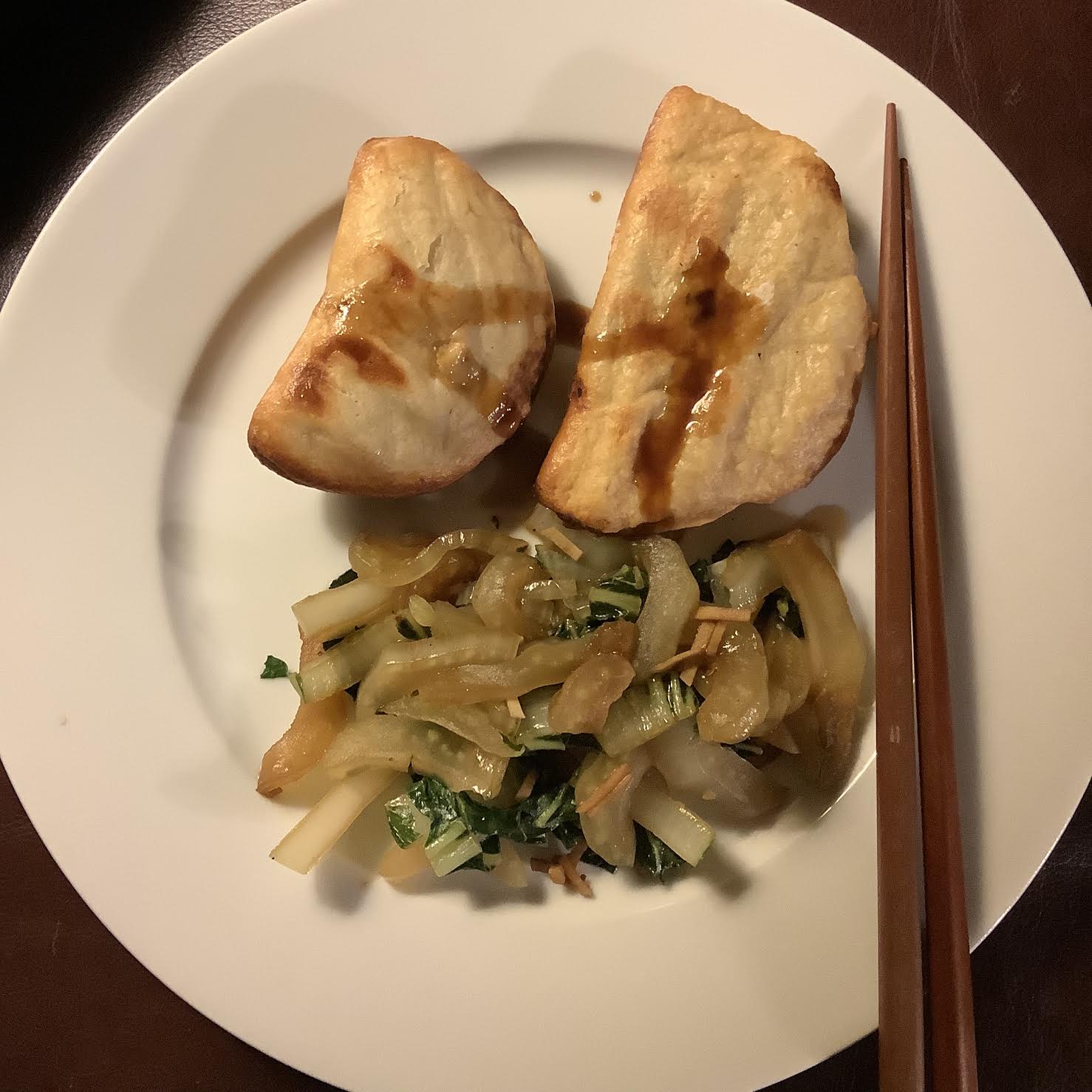
Chinese steamed buns, Char Siu Bao, are yummy and really not that difficult to prepare. With Chinese New Year coming up, treat yourself and your friends to steamed buns from home. You can make the filling days in advance. If you wish, the filling, or at least the Chinese Roast Pork, could be purchased at an Asian market or from a co-operative Chinese restaurant — I think I might have seen it at a supermarket in the deli case. Not an option? Then make your own filling.

FOR THE FILLING: 

1 T. oil OR 1 tsp oil + spray of PAM
 ⅓ cup finely chopped shallots or red onion
Heat the oil in a wok over medium high heat. Add the onion and stir-fry 1 min.
1 Tbsp sugar         
1 Tbsp light soy sauce ++++1½ Tbsp oyster sauce +++2 tsp sesame oil ++++2 tsp dark soy      
                  
Turn heat down to medium-low, and add these ingredients. Stir and cook until mixture starts to bubble up.
½ cup chicken stock             2 Tbsp white whole wheat flour Add the stock and flour, cooking for a couple minutes until thickened
1½ cups diced Chinese roast pork = 6.75 oz = 193 gTake from heat and stir in pork. Set aside to cool. If you make filling ahead of time, refrigerate covered to prevent drying.

FOR THE BUN DOUGH:

1 teaspoon active dry yeast         ¾ cup warm waterIn the bowl of an electric mixer fitted with a dough hook (you can also just use a regular mixing bowl and knead by hand), dissolve the yeast in the warm water. 
1 c all-purposeflour  1 c white whole wheat flour        1 c cornstarch
4 tablespoons sugar  ¼ c canola or vegetable oil
Sift together flours and cornstarch, and add to the yeast-water along with sugar and oil. Set mixer to lowest setting and let it mix until a smooth dough ball is formed. Cover with a damp cloth and let it rest for 2 hours.
2½ tsp baking powder
2-3 tsp water
Add baking powder and turn mixer to lowest setting. If dough looks dry and baking powder won’t mix in, add water. Gently knead with dough hook until it is smooth again. Cover with damp cloth, let rest 15 minutes. Set up your steamer in the wok.
Roll dough into a long tube and divide into 20 equal pieces. Press each piece of dough into a disc about 4½ inches in diameter (it should be thicker in center and thinner at edges).
Add some filling and pleat buns closed. Place each bun on a parchment paper square or cabbage leaf. Put steamer over wok, being sure boiling water does not touch the buns during steaming process. Once the water boils, put buns in the steamer for 12 minutes over high heat.

TO ASSEMBLE AND COOK

1.5 T scoopScoop filling onto a piece of dough. Pleat to close buns. I haven’t mastered that part yet…maybe this year. Here’s another link for pleating steamed buns.
Place each bun on a parchment paper square, and steam. I steamed the buns in two batches using a bamboo steamer Be sure boiling water does not touch buns during steaming process. Once water boils, put buns in the steamer, and steam each batch 12 mins over high heat.

Serve the Cha Siu Bao fresh, with stir-fried vegetables. Freeze any that are left over for a future dinner or even breakfast.

Shek Yeung, Pirate Queen

How this Fast Diet Lifestyle works: Eat these meals tomorrow, for a calorie total of less than 600. On another day this week, eat the meals from a different post, another day of eating 600 calories or less. Eat sensibly the other days of the week. That’s it: a simple way to lose weight and be healthier. Welcome to melissaketodiet who is now Following.

She was born in the poorest province of China and served as a child prostitute, yet she rose to be the richest, most powerful woman of her time. She was Shek Yeung [aka: Ching Shih, Zheng Yi Sao, Shi Yang, Shi Xianggu], the Pirate Queen of the South China Sea. Wow. As a prostitute, she worked in a floating brothel in Canton harbor. Her beauty and elegance attracted many customers. Her ability to find out and to trade secrets made her important to influential people. When she was 26, a pirate leader named Zheng Yi either won her heart or forced her into marriage. Her status enabled her to negotiate a hefty bride price: control over half of her husband’s piracy enterprise. They married in 1801, and established a coalition of six pirate chiefs along the coast in 1804. Each group was known by the color of their flags –Shek Yeung and Zheng Yi commanded the Red Flag Fleet. But in 1808, Shek Yeung was a widow. Her tactical move was to join forces with the second in command, her late husband’s adopted son, Cheung Po Tsai. They married and continued marauding along the coast. Within a few years, Shek Yeung had 1800 large and small junks under her control, carrying 80,000 pirates! She was not merely “Cheung’s Widow” [one of her many names], she was respected and obeyed by all her men. Shek Yeung was also a thorn in the side of the colonial factions. The Portuguese and English banded together to subdue the pirates, with varying degrees of success. At last, in 1810, the Qing Dynasty had had enough. They negotiated with Shek Yeung: she could retire with impunity, earn a government appointment for her husband, and keep all her wealth if she would step down as Pirate Queen. She took the deal, leaving the South China Sea in relative peace. The Fragrant Lady retired to Macao, where she set up a gambling parlor [forerunner of today’s casinos in Macau?] and, unfortunately, a brothel, before she died in 1844. Remarkable life. Remarkable woman.

The famed pirate queen has been depicted in print, on TV [with Dr Who] and on film [Madame Ching in Pirates of the Caribbean]. The latest work about her, the highly-anticipated novel Deep as the Sky, Red as the Sea, by Rita Chang-Eppig will come out on May 30, 2023.

Shek Yeung was from Guangzhou [formerly Canton] and so are today’s foods. Quickly-cooked fresh vegetables are a hallmark of the cuisine of Guangdong Province 广东省. Seafood also figures prominently in the region’s cooking, so we will have shrimp and crabmeat on the menu.

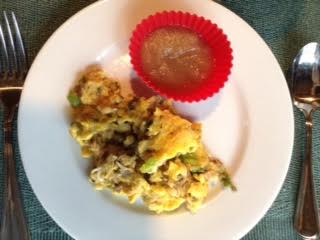
Foo Yung ScrOmelette: 150 calories 7.6 g fat 1.5 g fiber 13 g protein 8 g carbs 68 mg Calcium  NB: Food values shown are for the ScrOmelette and fruit only, and do not include the optional beverages.  PB GF  Here we take the Cantonese classic and prepare it for breakfast. Filling and nutritious.

1 ½ two-oz eggs  HINT: If you are serving one person, crack three 2-oz eggs into a small bowl or glass measuring cup. Whip up those eggs and pour half of their volume into a jar with a lid and put it in the ‘fridge for next week.  2 Tbsp crab meat    ¾ tsp soy sauce ¼ c mung bean sprouts ¼ oz mushrooms green parts of one scallion, sliced ¼ tsp ground ginger splash of hot sauce 1 oz applesauce   OR 1 oz pear Optional: blackish coffee [53 calories] or blackish tea or mocha cafe au lait [65 calories] or lemon in hot water  Optional: 5 oz fruit smoothie or berry-yogurt smoothie [88 calories]

The night before, combine the crab, soy, sprouts, mushrooms, scallion, ginger and hot sauce in a small bowl. Next morning, spritz a non-stick saute pan with oil or non-stick spray and briefly cook the crab mixture to heat it thoroughly. Whisk the eggs with salt and pepper and pour into the pan, scrambling to incorporate the crab mixture. Cook to your favorite degree of doneness. [Alternately, cook like pancakes: put half of the crab mixture in the pan, then pour half of the egg on top. When done on the bottom, turn to cook the top. Repeat with other half of ingredents.] Dish up the fruit, brew your hot beverage, and prep the smoothie. And your fortune cookie says: “You will lose weight.”

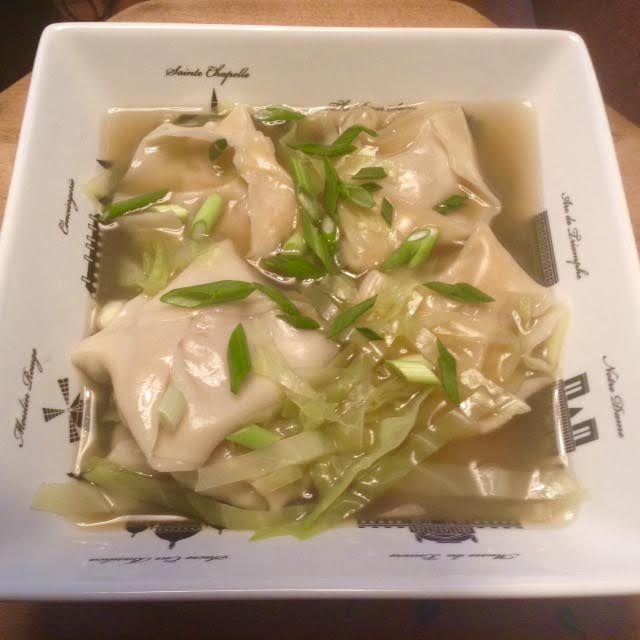
Wonton Soup: 257 calories 34 g fat 1 g fiber 23.5 g protein 29 g carbs 25 mg Calcium   PB Cantonese wonton soup can be your’s, easily and without the extra salt or MSG. I prepared the entire batch of filling, then stuffed and poached all 26 wontons. Frozen, they will be the ‘instant’ source of future meals or an addition to a Dim Sum assortment.

Filling: 4 oz ground pork 4 oz chicken meat ½ tsp cornstarch ¾ tsp sugar 1 tsp sesame oil ¼ tsp white pepper ¾ tsp salt 1 Tbsp water 1 Tbsp sherry 4 oz shrimp, chopped to the size of green peas

Combine all ingredients except the shrimp in the bowl of a food processor and mince to a paste. Stir in the shrimp. Refrigerate until ready to fill the wontons. TIP: Can be made the day before.

Wontons: wonton skins are small squares of egg-roll wrappers 5 wonton skins per bowl of soup = 26 skins for the entire batch

Put 4-6 wonton skins on a cutting board. Moisten two edges of one of the squares. Place 1 Tbsp of filling on the square, fold over to make a triangle, and pinch the sides together. Set aside until ready to poach them.

Poaching filled wontons: Bring a pan of water to boil. Depending on the diameter of the pan, add wontons 4-5 at a time. They will sink to the bottom of the pan. When they float to the surface [in 4-5 minutes], fish them out and put on a tea towel to drain.

To finish the soup: 1.5 cups delicious chicken stock 1.5 oz cabbage in strips 5 wontons 1 Tbsp sliced scallion Heat the stock to a simmer and add the cabbage. Cover and simmer until the cabbage is cooked. Put 5 poached wontons in the bowl, add the stock and cabbage, sprinkle with scallion. Pass the soy sauce.